

Spring arrived at the University of Notre Dame quietly.
Universities rarely notice spring at first.
They notice deadlines.
The first warm afternoon passed almost unremarked — students moving quickly between buildings, professors speaking urgently about final papers, administrators discussing seating charts for commencement.
But the trees noticed.
The bare branches along the quad softened first, sprouting the faintest suggestion of green. The long Indiana winter began to loosen its grip, and the air carried that strange mixture of cold and warmth that belongs only to April.
Which is to say, it carried departure.
The tower of O’Shaughnessy Hall stood exactly as it always had — square, unromantic, and patient.
Inside, the small studio of WSND-FM hummed softly.
Paul sat alone at the board.
The equipment glowed with the quiet confidence of machines doing precisely what they were designed to do. Meters flickered. A reel turned slowly.
Three tall windows rose directly in front of the console — narrow vertical panes that framed the campus like a set of stained-glass panels without color.
Through them Paul could see the lawn stretching toward the Golden Dome.
Students crossed the paths below in loose patterns that resembled thought more than motion.
Paul had watched this view for years.
During snowstorms when the campus vanished in white silence.
During thunderstorms when lightning flashed across the lake.
During Saturday mornings when Father Griffin sat in the small studio to the left, reading stories into a microphone while the campus still slept.
The console lights reflected faintly in the glass.
Paul rested his hand lightly on the board.
There was nothing left to repair.
Everything was steady.
Which was exactly how he had always wanted it.
Across campus, Michael sat on the wide stone steps of the art building with his sketchbook open on his knee.
Students passed him without noticing.
Artists become invisible in public spaces. It is a professional advantage.
He studied the final panel of Molarity.
The drawing was simple.
The Dome stood in the center of the frame.
Students walked away from it in different directions — some laughing, some thoughtful, some uncertain.
No conveyor belt.
No satire.
Just departure.
In the corner of the drawing, beneath the ground line, he had added a small hidden panel.
A basement room.
A dog at the door.
A priest pouring coffee.
A few students talking.
Caption:
Education is not a machine. It is a departure.
Michael closed the sketchbook slowly.
He had drawn hundreds of strips during his time at Notre Dame.
This one felt less like satire and more like gratitude.
Which frightened him slightly.
Joe stood alone on the stage of Washington Hall.
The auditorium lights were dim. Rows of empty seats stretched toward the back wall like patient witnesses.
Joe paced the stage once.
Twice.
He wore no hat.
No cane.
No accent.
Just a plain jacket and a script folded in his hand.
He delivered the final line of the play quietly into the empty room.
No flourish.
No theatrical pause.
Just the words.
When he finished, he remained standing there for a moment.
Something unexpected happened.
He did not imagine applause.
For the first time since he had discovered the stage, the silence afterward did not feel like failure.
It felt like honesty.
Joe folded the script and smiled faintly.
That, he suspected, was what Father Griffin had meant all along.
Christina walked slowly along the path toward the law building.
The acceptance letter was no longer folded anxiously in her coat pocket.
It had already been mailed back.
Acceptance confirmed.
The decision made.
But the strange thing about decisions is that they rarely remove doubt.
They merely give doubt a direction.
She stopped near the lake and watched the water move under the breeze.
Father Brown’s words returned to her with uncomfortable clarity.
You can draw lines without forgetting faces.
Law, she realized, was not argument.
It was responsibility.
To remember the person inside the case.
To protect the weak from the powerful.
To hold justice steady without losing mercy.
The doubt did not vanish.
But it became purpose.
Christina turned and continued toward the building.
Darby’s Place was quieter than usual that evening.
Graduation week scattered people in all directions — rehearsals, packing boxes, farewell dinners, last-minute exams.
Father Griffin stood behind the counter, pouring coffee into cups that might or might not be needed.
Darby lay near the door, watching the hallway with the calm authority of a creature who believed all visitors eventually arrived.
Father Brown sat at the table.
“You will leave tonight,” Griffin said without turning.
“Yes,” Brown replied.
“You solved nothing.”
“I rarely do,” Brown said mildly.
Griffin smiled.
“You observed a great deal.”
“That is the easier profession.”
They sat quietly for a moment.
“I sometimes wonder,” Griffin said, “whether anything done here lasts.”
Father Brown glanced toward the door where Darby lay.
“My dear Father,” he said gently, “people remember rooms where they were allowed to be unfinished.”
Griffin poured another cup of coffee.
“Yes,” he said softly.
“Perhaps they do.”
The following morning the tower filled early.
Joe arrived first.
Then Michael.
Then Christina.
Darby followed Father Griffin up the narrow stairs as if inspecting the structure for structural weakness.
Paul remained seated at the board.
“You’re all early,” he said.
“We heard there was a reading,” Joe replied.
Father Griffin adjusted the microphone.
“There always is.”
He opened a worn book.
It was the same one he had read from every year.
The House at Pooh Corner.
The studio grew quiet.
Outside the windows, the campus filled with parents and cameras and expectation.
Griffin read slowly.
Not like a performer.
Like a man remembering something important.
When he reached the final chapter — the quiet walk through the Hundred Acre Wood, the promise that certain places remain even when people leave them — his voice softened.
He closed the book gently.
The red ON AIR light faded.
The broadcast ended.
No one spoke.
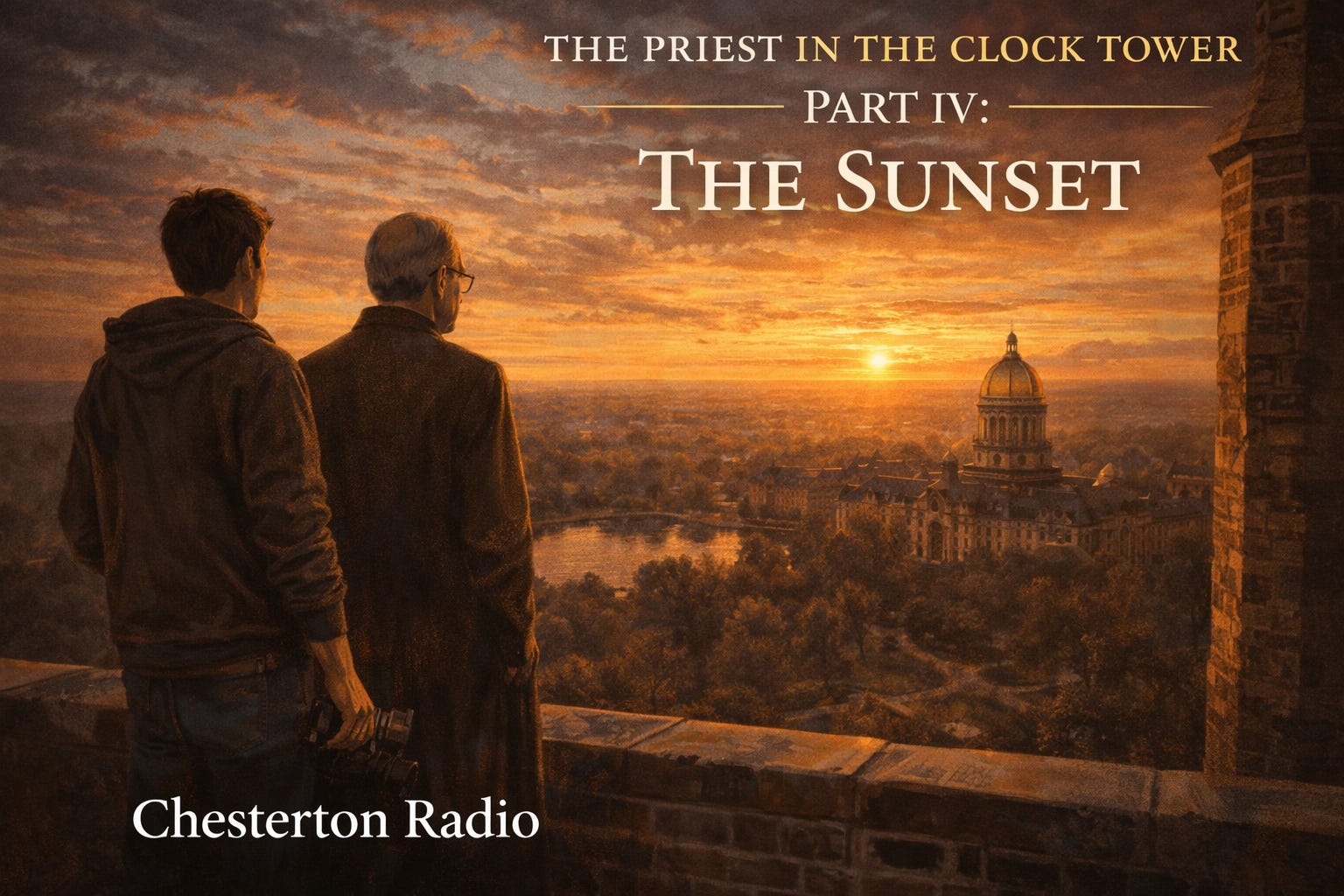
That evening Paul climbed the narrow stairs above the studio.
Few people ever went up there.
At the top was a small access door.
He pushed it open.
The roof of the tower stretched around him.
The entire campus lay below.
The Dome glowed in the last light.
The lakes shimmered.
The trees along the quad moved in the evening breeze.
Paul lifted his camera.
He had brought it without explaining why.
He framed the horizon carefully.
Not the buildings.
Not the tower.
Just the campus bathed in the golden light of evening.
The moment before the sun disappeared.
He pressed the shutter.
Behind him, footsteps approached.
Father Brown stood near the doorway.
“I suspected you might come here,” he said.
Paul lowered the camera.
“It seemed appropriate.”
They watched the sky together.
“You believe nothing changes when you leave,” Brown said.
Paul shrugged slightly.
“I’m an engineer.”
“Yes,” Brown replied.
“Which means you understand foundations.”
The sun dipped lower.
The campus quieted.
“And foundations,” Brown continued gently, “are rarely visible once they are finished.”
Paul said nothing.
But he understood.
The sun touched the horizon.
For a moment the sky held its color.
Then it slowly dimmed.
Evening began.
Final Observation
Father Brown remained a moment longer on the roof of the tower before descending the narrow stair.
He had solved no crime.
No villain had been unmasked.
Yet he suspected that something rarer had occurred.
A handful of young people had discovered that the world does not require them to be finished — only faithful.
And if the world was held together by anything at all, it was not towers, or diplomas, or arguments.
It was the small rooms beneath them where someone had once said, very quietly:
You may remain unfinished here.
And then poured another cup of coffee.
If you enjoyed The Priest in the Clock Tower, you are already part of what we are building at Chesterton Radio.
Stories like this — and the classic radio dramas, mysteries, and reflections that inspired them — continue each day through our listener-supported stream and our Chesterton Radio Storycraft series.
If you believe there is still room in the modern world for good stories, thoughtful conversation, and the quiet wisdom of writers like Chesterton, Tolkien, and Lewis, consider supporting the work.
Your support helps keep the microphones on, the stories coming, and the small rooms open where unfinished people are still welcome.
An good story! Thanks!