

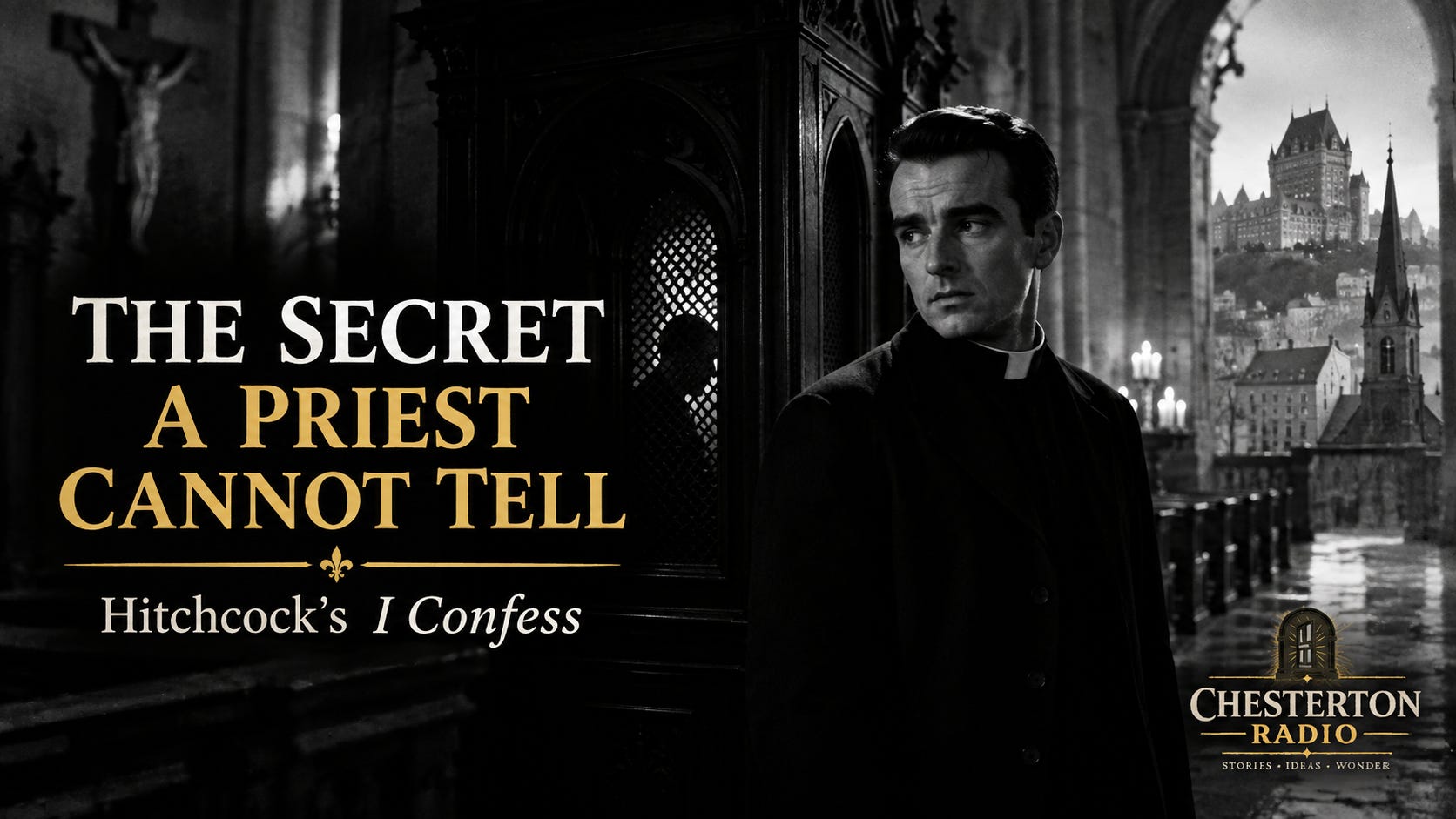
There is a murder.
There is a witness.
There is a confession.
And within the opening minutes of Alfred Hitchcock’s I Confess, we know who did it.
That seems like a strange way to begin a murder mystery. But Hitchcock isn’t really asking us who killed the man.
He is asking a much more troubling question:
What happens when an innocent man knows the truth—but has no moral right to tell it?
That is the extraordinary premise of I Confess, Hitchcock’s dark, solemn and strangely beautiful 1953 film starring Montgomery Clift, Anne Baxter and Karl Malden.
More than seventy years later, it deserves another look—not merely as a lesser-known Hitchcock picture, but as perhaps the most explicitly Catholic film Alfred Hitchcock ever made.
Listen to I Confess
The Lux Radio Theater drama is available here. This article contains Spoilers. We invite you to listen to the story first then return for our deep dive:
A Murder in Quebec
The setting is Quebec City, and Hitchcock makes extraordinary use of it.
This isn’t simply Hollywood’s idea of a Catholic city. Hitchcock took his company to Quebec and filmed among its streets, churches and landmarks. The Château Frontenac, Parliament Building, Lévis ferry and other recognizable locations become part of the visual world of the film.
Church towers rise above the streets. Priests move naturally through the city. Crosses and religious images seem almost to watch the characters pass beneath them.
Catholicism isn’t something Hitchcock has added to the scenery.
It is the scenery.
And into this world comes Otto Keller.
Keller is a German refugee employed at the rectory with his wife, Alma. Desperate for money, he attempts to rob a lawyer named Villette while disguised in a priest’s cassock.
Something goes wrong.
Keller kills him.
Then the murderer runs.
And where does a murderer run after committing murder?
In this story, he runs to church.
Keller finds Father Michael Logan and asks him to hear his confession.
Father Logan enters the confessional.
Keller kneels.
And the murderer tells him everything.
Hitchcock has sprung his trap.
Not on Keller.
On Father Logan.
The Secret
Most thrillers give their protagonist a difficult problem.
Hitchcock gives Logan an impossible one.
Keller has not simply told Father Logan that he committed murder.
He has told him in sacramental confession.
That changes everything.
The Catholic Church’s law on this point is uncompromising. Canon 983 of the Code of Canon Law states that the sacramental seal is inviolable: a confessor may not betray a penitent by words or in any other manner, for any reason.
Canon 984 goes further. A priest may not use knowledge acquired in confession to the detriment of the penitent.
Father Logan therefore isn’t merely keeping a confidence.
He isn’t deciding that professional confidentiality outweighs helping the police.
There is no balancing test.
He cannot tell.
And this is crucial to understanding the movie.
For a viewer who doesn’t accept Logan’s obligation, I Confess can be maddening.
Just tell the police.
Problem solved.
But Hitchcock asks us to enter a moral universe in which an obligation does not cease being an obligation simply because keeping it has become dangerous.
There is no emergency exception.
No greater-good exception.
No “surely God would understand” exception.
The seal is the seal.
The question therefore isn’t whether Logan can find a clever way around it.
The question is:
How much will keeping it cost him?
When Goodness Becomes a Weapon
Keller quickly understands the advantage he has gained.
The one man who knows that Keller is guilty is the one man who cannot expose him.
And this creates one of Hitchcock’s most diabolical situations.
Keller has taken something holy and attempted to use it as a hiding place.
Worse, he is using Father Logan’s goodness against him.
If Logan were a bad priest, Keller would be in danger.
If Logan regarded confession as merely professional confidentiality, Keller would be in danger.
If Logan believed sufficiently extreme circumstances justified an exception, Keller would be in danger.
But Keller knows Logan will keep the seal.
The murderer’s safety depends upon the innocence of the man he is allowing to suffer.
That is the first great inversion in I Confess.
Hitchcock has another waiting.
The Evidence Turns Toward Logan
Someone saw a man wearing priestly clothing leaving Villette’s house.
Father Logan appears at the murder scene the following morning.
Inspector Larrue, played by Karl Malden, begins investigating.
And then he discovers something worse.
Logan knew Villette.
So did a woman named Ruth Grandfort, played by Anne Baxter.
Years before Michael Logan became Father Logan, Michael and Ruth had been in love.
Then came the war.
Logan went away. Ruth eventually married. Michael returned and entered the seminary.
But their story did not end quite so neatly.
After the war, Logan and Ruth met again. A storm forced them to spend the night at a summer house.
Nothing adulterous occurred.
But Villette discovered them.
And Villette began blackmailing Ruth.
Suddenly the police have what Keller’s confession could never give them:
a motive for Father Logan.
The murdered man was threatening to expose a scandal involving Logan and a married woman.
Logan had arranged to meet him.
Villette is murdered.
Someone dressed as a priest is seen leaving.
And Father Logan cannot reveal the one fact that would destroy the case against him.
Keller’s guilt has effectively been transferred onto an innocent man.
Montgomery Clift’s Silence
This is where Montgomery Clift becomes essential to the film.
Father Logan cannot explain himself.
So Clift cannot perform the role through speeches.
He has to perform it through silence.
A glance.
A hesitation.
A tightening of the face.
A moment when Logan knows exactly what happened while everyone around him desperately tries to discover it.
Watch Clift whenever Keller is nearby.
The murderer can speak.
The priest cannot.
That imbalance becomes almost unbearable.
Hitchcock himself later expressed reservations about working with Clift and about aspects of the film. Yet Clift’s unusual inwardness may actually make him ideal for Logan.
Most Hitchcock protagonists desperately try to prove their innocence.
Father Logan cannot.
His restraint isn’t passivity.
It is the action around which the entire film turns.
Everybody Is Confessing
Once you notice it, something curious begins happening.
Everybody in I Confess is confessing.
Keller confesses his murder to Logan.
Ruth confesses her relationship with Logan to Inspector Larrue.
Logan’s private past is dragged into public view.
Witnesses make statements.
Police interrogate suspects.
Lawyers question witnesses.
A courtroom demands testimony.
The entire movie becomes an elaborate machine for extracting truth from human beings.
And yet the one confession that could solve everything is the one confession that cannot be repeated.
That makes the title wonderfully ambiguous.
I Confess.
Who is the “I”?
Keller?
Ruth?
Logan?
Perhaps everybody.
Because this isn’t simply a movie about keeping a secret.
It is a movie about different kinds of truth.
Truth freely offered.
Truth reluctantly admitted.
Truth extracted.
Truth distorted.
Truth suspected.
Truth publicly testified to.
And truth entrusted to another person under circumstances in which it no longer belongs to him to reveal.
Confession Without Repentance
There is an even deeper problem with Keller’s confession.
He has confessed.
Yet something is terribly wrong.
Keller has told the truth about what he did.
But has he really turned away from what he did?
There is a profound difference between:
I did it.
and
I have sinned.
Keller increasingly treats the sacrament not as the beginning of repentance but as protection from consequences.
That is a grotesque inversion of confession.
The confessional exists so that the guilty man can accuse himself before God and seek reconciliation.
Keller instead allows an innocent man to be accused before the world.
He speaks his guilt.
But he refuses to carry it.
Father Logan has committed no murder.
Yet Logan accepts suffering rather than betray what was entrusted to him.
One man confesses but refuses suffering.
The other is innocent but accepts suffering rather than violate the confession.
And suddenly I Confess is no longer primarily a murder story.
It is becoming something resembling a Passion story.
The Man Carrying the Cross
Hitchcock doesn’t exactly hide the comparison.
As Logan moves through Quebec, Hitchcock repeatedly surrounds him with Christian imagery.
The associations accumulate.
An innocent man is accused.
Witnesses testify.
His past is exposed publicly.
Authorities interrogate him.
A crowd turns against him.
He possesses knowledge that could help save him.
He remains silent.
And he walks toward judgment.
The point isn’t that Father Logan is Christ.
He isn’t.
Something more interesting is happening.
In these circumstances, Logan’s priesthood requires him to imitate Christ.
Not by defeating his enemies.
Not by discovering a loophole.
Not by producing a clever Hitchcockian solution.
By remaining faithful.
Even if faithfulness costs him everything.
The Woman He Might Have Married
This also explains why Ruth matters.
Without her, Father Logan could become an abstraction—the Perfect Priest obeying a difficult rule.
Instead, we discover Michael Logan before Father Logan.
He loved a woman.
He went to war.
He returned.
He made a choice.
He became a priest.
Ruth represents another life he might have lived.
That gives his vocation weight.
Logan has not withdrawn from human love because he knows nothing about it.
He has known it.
And chosen something else.
Now the murder investigation forces those two lives into collision:
Michael Logan, the man Ruth remembers.
Father Michael Logan, the priest standing before the world.
And Ruth’s attempt to save him produces another Hitchcockian irony.
She tells the truth because she believes the truth will clear Logan.
Instead, her confession gives the police a motive for murder.
Once again, Hitchcock turns confession inside out.
The truth is good.
But telling the truth does not guarantee that other people will understand it correctly.
Hitchcock and Catholic Guilt
This territory was hardly foreign to Alfred Hitchcock.
He had been raised Catholic and educated by Jesuits, and guilt, confession, punishment and transferred guilt appear repeatedly throughout his films.
Usually Hitchcock disguises those ideas inside thrillers.
In Strangers on a Train, one man commits murder and attempts to transfer responsibility to another.
In The Wrong Man, an innocent man is swallowed by the machinery of accusation.
Vertigo buries guilt beneath obsession and deception.
Psycho is saturated with concealed guilt and judgment.
But I Confess strips away the metaphor.
Here there is an actual priest.
An actual confession.
An actual murderer.
An actual innocent man.
And an actual sacramental seal.
Perhaps I Confess isn’t an unusual detour in Hitchcock’s career.
Perhaps it briefly exposes something that had been underneath his movies all along.
The Movie Hitchcock Almost Made
And here the history of I Confess becomes even more fascinating.
The film originated in Paul Anthelme’s 1902 French play Nos deux consciences—Our Two Consciences.
Its ending was considerably harsher.
The priest is accused.
He refuses to violate the seal.
He is convicted.
And he goes to the gallows.
Hitchcock’s adaptation encountered extraordinary Production Code scrutiny. Film historian John Billheimer reports 59 Production Code suggestions concerning I Confess—more than for any other Hitchcock film.
Eventually the ending changed.
Father Logan would not die.
The murderer would be exposed.
And that leaves us with perhaps the most intriguing question surrounding the film:
Would the original ending have made I Confess a greater movie?
Imagine it.
No last-minute vindication.
No worldly justice arriving before the final reel.
An innocent priest goes to his death because he refuses to betray a confession.
Would Logan’s fidelity still be worthwhile if it saved neither his reputation nor his life?
That is a much harder question.
Because we like stories in which doing the right thing ultimately produces the right outcome.
Virtue is rewarded.
Truth emerges.
The innocent are vindicated.
Christianity has never promised that.
Sometimes the innocent man is crucified.
Sometimes the martyr dies.
Sometimes fidelity looks remarkably like defeat.
Who Is Really the Prisoner?
The released film gives us another ending.
Eventually Keller is exposed.
Father Logan survives.
But look carefully at what has happened to the two men.
For most of the story Keller can walk wherever he pleases.
He isn’t under arrest.
He isn’t on trial.
He possesses the secret that protects him.
Yet with every scene his world becomes smaller.
Fear closes around him.
Suspicion closes around him.
His wife’s conscience closes around him.
His own crime closes around him.
Father Logan experiences the opposite journey.
His physical danger increases.
His reputation collapses.
His past becomes public.
He may lose everything.
Yet internally Logan remains free.
He knows what he must do.
And he does it.
Keller is free to speak but becomes imprisoned by guilt.
Logan is forbidden to speak but remains free in conscience.
That may be Hitchcock’s final inversion.
Two Men Leave the Confessional
Think again about the beginning.
Two men leave that confession.
One is guilty.
One is innocent.
The guilty man has confessed his crime.
The innocent man carries the secret.
From that moment onward, the world slowly begins treating the innocent man as though the guilt belonged to him.
But it never does.
Keller can transfer suspicion.
He can transfer suffering.
He can transfer consequences.
He cannot transfer guilt.
That remains his.
And perhaps that is why I Confess feels surprisingly Chestertonian beneath its grim surface.
Chesterton understood paradox.
The man who appears trapped may actually be free.
The man who appears free may actually be imprisoned.
Silence may speak.
Public disgrace may conceal innocence.
And confession itself is useless if a man wants forgiveness without conversion.
Keller’s great mistake is believing that the confessional is a hiding place.
It isn’t.
The seal protects the penitent’s confession from the world.
It does not protect the penitent from his own conscience.
Why I Confess Is Worth Rediscovering
Perhaps we should stop asking whether I Confess is one of Hitchcock’s greatest thrillers.
It may not be.
Hitchcock himself had reservations about it. Contemporary critics found it slow. Its tone is unusually solemn. Compared with the dazzling machinery of Rear Window, Vertigo, North by Northwest or Psycho, it can seem almost austere.
But those apparent weaknesses may be precisely what make it worth rediscovering.
Hitchcock made something unusual here.
A thriller in which suspense depends upon fidelity.
A murder mystery in which we already know the murderer.
A story about confession in which the most important words can never be repeated.
And a drama in which an innocent man’s greatest weapon—the truth—is precisely the weapon he refuses to use.
Not because truth doesn’t matter.
But because the truth does not belong to him to tell.
At the beginning of I Confess, Otto Keller believes he has found the perfect hiding place for murder.
He places his guilt inside the confessional.
And walks away.
But the sacrament can forgive a sinner.
It cannot make evil good.
It cannot transform cowardice into innocence.
And it cannot free a man who refuses to turn away from what he has done.
By the end, Father Logan has nearly lost everything.
Keller has desperately tried to keep everything.
And yet we discover which man was free all along.
One man confessed—and remained a prisoner of his crime.
The other kept silent—and remained innocent.
That is the strange, unsettling paradox at the heart of Alfred Hitchcock’s I Confess.
And more than seventy years later, it may be the reason this quiet Hitchcock film deserves another look.
— Chesterton Radio