

There are crimes of passion.
There are crimes of greed.
And then there are crimes committed in the name of order.
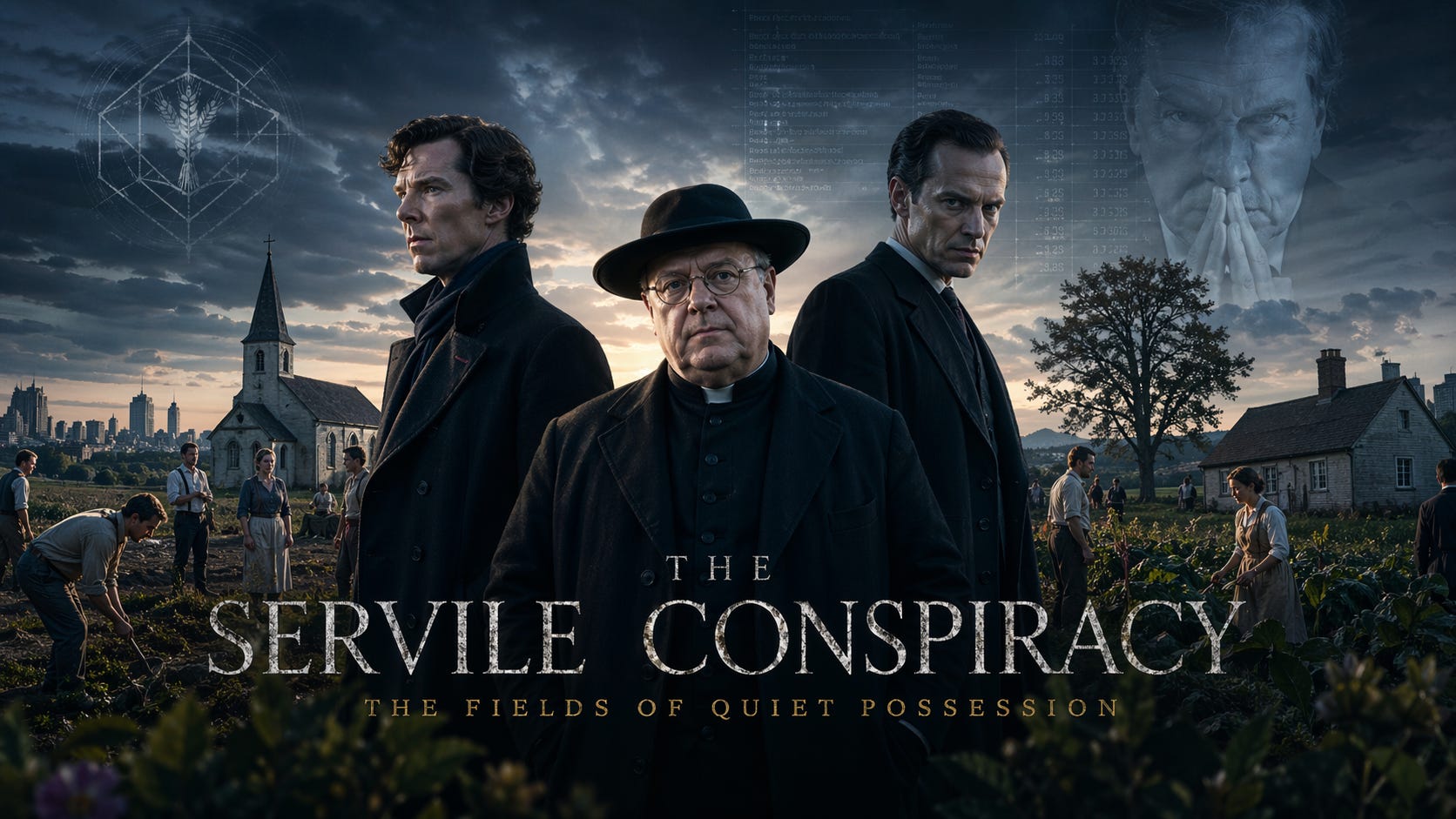
In a quiet countryside where families own their land and no man calls another master, something has gone terribly wrong. A founder is dead. No weapon is found. No struggle is seen. And yet—something far more unsettling lingers beneath the surface.
Because this was not merely a murder.
It was a correction.
In this first episode of The Servile Conspiracy, Sherlock Holmes follows the evidence. Father Brown follows the soul. And somewhere beyond both, an unseen intelligence begins to emerge—one that does not simply commit crimes, but designs systems in which they become inevitable.
This is a story about freedom… and the quiet ways it can be lost.
Welcome to St. Jude’s Field.
Listen carefully.
I. The Station That Waited
The train did not so much arrive as reconsider its purpose.
It slowed long before the platform appeared, as though uncertain whether the place ahead belonged to the same world it had left behind. The engine exhaled a low, reluctant sigh, and the wheels—so confident a moment before—began to turn with hesitation.
When at last it stopped, it did so gently, almost apologetically.
The platform was wooden. Not the clean, standardized timber of modern construction, but boards that had weathered into their own opinions. A sign leaned slightly, as if the name it bore were not entirely convinced of itself:
ST. JUDE’S FIELD
Beyond it stretched a countryside that resisted classification.
It was not wild. Nor was it orderly in any industrial sense. It was… composed. Fields lay in irregular divisions bordered by hedges that had grown into permanence through patience rather than planning. A small orchard rose on a gentle slope. Smoke lifted in thin, deliberate columns from chimneys that seemed to belong to houses rather than systems.
A rooster crowed—not loudly, but with authority.
“Curious,” said a tall man descending from the carriage, his long coat settling around him like a verdict. “No telegraph wires. No mechanized infrastructure. And yet—observable order.”
His eyes moved quickly, absorbing detail with unsettling precision.
“Order without visible enforcement,” he continued. “That is rarely accidental.”
Behind him came a shorter figure, rounder, quieter, carrying an umbrella that appeared both unnecessary and indispensable.
“Not all order needs enforcing,” he said mildly.
The taller man did not look at him.
“No,” he replied. “But all order must be explained.”
The smaller man smiled.
“Or confessed.”
The tall man turned slightly.
“Sherlock Holmes,” he said.
“I know,” said Father Brown.
A third man approached across the platform, walking with the steady assurance of someone accustomed to both responsibility and solitude. His coat was patched but clean. His boots were worn but well-kept.
“Gentlemen,” he said. “You must be the investigators.”
Holmes inclined his head a fraction.
“And you are?”
“Thomas Weaver. Steward of the land.”
Father Brown’s eyes brightened faintly.
“A good name,” he said. “Especially for a steward.”
Weaver gestured toward the fields.
“We are trying something here,” he said. “Families on their own land. Work tied to ownership. No masters. No distant employers. A man’s labor belongs to himself.”
Holmes studied him—not skeptically, but analytically.
“And yet,” Holmes said, “you have sent for men like us.”
Weaver’s expression shifted—very slightly, but enough.
“Yes,” he said.
He paused.
“One of our founders is dead.”
II. The Walk Into Silence
They did not go immediately to the body.
Weaver led them first through the village.
“This way,” he said. “You should see it before you see… that.”
Holmes did not object. Observation, he knew, was always best before contamination.
They walked a narrow path between fields. The earth was firm underfoot—not packed by machinery, but by use. A woman knelt in a garden, her hands deep in the soil. She glanced up as they passed, not with suspicion, but with a calm curiosity.
Children played nearby, building something from sticks that appeared to have no purpose beyond delight.
A man repaired a fence—not hurriedly, but with the patience of someone who expected the fence to outlast him.
Holmes noticed everything.
“No visible wage exchange,” he murmured. “No overseers. No centralized distribution in sight.”
Father Brown nodded.
“It looks like a place where people belong to things instead of being owned by them.”
Holmes’s mouth tightened slightly.
“Belonging,” he said, “is often a prelude to ownership.”
They passed a blacksmith’s forge. The sound of hammer on iron rang out—not rhythmically, but emphatically.
Holmes paused.
“That man is angry,” he said.
Father Brown glanced at the blacksmith.
“No,” he said gently. “He is afraid.”
Holmes said nothing—but he did not forget it.
They reached the orchard.
And there, beneath a tree whose branches twisted like old arguments, lay the body.
III. The Man Who Changed His Mind
Elias Mercer lay as though placed there—not fallen.
His face was calm. Too calm.
Holmes knelt immediately.
“No disturbance of ground,” he said. “No defensive wounds. No sign of struggle.”
He examined the man’s hands.
“One clenched. Interesting.”
Father Brown did not approach immediately.
Instead, he stood beneath the tree and looked upward.
The branches bent inward slightly, as if enclosing the space.
“A thoughtful place to die,” he murmured.
Weaver shifted uncomfortably.
“We found him at dawn.”
Holmes examined the body with clinical precision.
“Time of death: approximately four to five hours before discovery. No visible trauma. No blood. No lividity suggesting relocation.”
He paused.
“This is not an obvious killing.”
Father Brown stepped closer at last.
“Was he happy?” he asked.
Weaver blinked.
“I beg your pardon?”
“Here,” Father Brown said. “In this place. Was he happy?”
Weaver hesitated.
“He believed in it.”
Holmes looked up sharply.
“That is not the same thing.”
Weaver swallowed.
“He… changed.”
“When?” Holmes asked.
“Recently.”
Holmes nodded.
“Of course he did.”
He stood.
“Men do not die for ideas they still believe in,” Holmes said. “They die for ideas they have begun to doubt.”
Father Brown gently opened Mercer’s clenched hand.
Inside lay a small wooden token.
A sheaf of wheat, tightly bound.
Father Brown looked at it for a long moment.
“Yes,” he said quietly.
“That would do it.”
IV. The Argument No One Heard
They learned of the argument before they learned of the system.
It had taken place the night before.
Mercer and Margaret Hale—co-founder of the community—had met in the schoolhouse.
Voices had been raised.
Holmes reconstructed it from fragments—timing, witness positions, inferred emotion.
“He did not simply disagree,” Holmes said. “He confronted.”
Weaver nodded reluctantly.
“He said we were losing something.”
“What?” Father Brown asked.
Weaver hesitated.
“Freedom.”
Holmes’s eyes sharpened.
“And what did she say?”
“That freedom without structure collapses.”
Father Brown sighed softly.
“Yes,” he said. “That is always the argument.”
Holmes looked at him.
“You’ve heard it before?”
Father Brown smiled faintly.
“Only every time someone tries to improve humanity.”
V. The Blacksmith’s Fear
Jacob Hales was still at the forge.
The hammer struck harder now.
Holmes approached without ceremony.
“You argued with Mercer.”
Hales did not turn.
“We all did.”
“You disagreed about the direction of the community.”
Hales stopped.
“Yes.”
“Explain.”
Hales turned slowly, his face flushed from heat and something deeper.
“He wanted contracts,” he said. “Schedules. Guarantees.”
“And you objected?”
“He wanted to make us efficient,” Hales snapped. “Like machines.”
Holmes tilted his head.
“And you preferred inefficiency?”
“I preferred freedom.”
Father Brown stepped forward.
“Did he speak of security?” he asked.
Hales’s anger faltered.
“Yes.”
Holmes nodded.
“Of course he did.”
“What do you mean?” Hales demanded.
Holmes’s voice was quiet.
“He offered you a world where nothing could go wrong.”
Hales looked away.
“And you were tempted.”
Hales did not answer.
Father Brown spoke gently.
“Did you kill him?”
Hales looked up sharply.
“No.”
Father Brown nodded.
“I believe you.”
Holmes did not disagree.
But he watched Hales carefully.
Fear, not guilt.
Father Brown had been right.
VI. The Token That Did Not Belong
Holmes turned the wooden token over in his hand as they walked back toward the center of the village.
“It is not handmade,” he said.
Weaver frowned.
“That is impossible.”
Holmes stopped.
“No,” he said. “It is precise. Uniform. Produced with consistent tooling.”
He held it up.
“Look at the edges. Identical. The carving depth—mechanically controlled.”
Weaver stared at it.
“But we don’t—”
“No,” Holmes said. “You do not.”
He looked at Father Brown.
“This was made elsewhere.”
Father Brown nodded slowly.
“Yes,” he said. “And brought here.”
Holmes’s expression hardened.
“Then this place is not as isolated as it appears.”
VII. Beneath the Chapel
Holmes found the entrance without effort.
Not because it was well hidden—but because it was imperfectly hidden.
A seam in the floor.
A discrepancy in wear.
A subtle misalignment that betrayed intent.
Below lay the truth.
Ledgers lined the walls. Documents were stacked with meticulous care. Seals—identical seals—marked pages with a symbol Holmes recognized instantly as foreign to the organic chaos above.
Holmes opened a ledger.
His eyes moved rapidly.
“Labor allocation,” he said. “Output quotas. Exchange ratios. Penalties.”
Weaver descended behind them, pale.
“These are just records—”
“These,” Holmes interrupted, “are controls.”
He flipped pages.
“You have created a system in which behavior is guided—not by force—but by consequence.”
“It’s voluntary,” Weaver insisted.
“For now,” Holmes said.
Father Brown ran his fingers lightly over the pages.
“A law that whispers,” he said.
Holmes nodded.
“And whispers are often more persuasive than shouts.”
Weaver’s voice rose.
“We had to prevent collapse!”
Father Brown looked at him with quiet sadness.
“And in preventing collapse,” he said, “you have begun to prevent freedom.”
VIII. Margaret Hale
She was waiting for them.
As though she had always known they would come.
“You’ve seen it,” she said.
Holmes inclined his head.
“Yes.”
“You built this.”
“Yes.”
“You structured the community.”
“Yes.”
“Why?”
Her answer came without hesitation.
“Because people are inconsistent.”
Holmes watched her closely.
“And your solution?”
“Remove inconsistency.”
Father Brown stepped forward.
“And in doing so,” he said, “you remove something else.”
She met his gaze.
“Yes,” she said. “But something necessary.”
Holmes’s voice was sharp.
“You replaced trust with system.”
“I replaced chaos with order.”
“And Mercer?” Holmes asked.
She hesitated.
“He began to doubt.”
Father Brown’s voice was very soft.
“He began to believe again.”
She did not answer.
IX. The Night Reconstructed
Holmes assembled the night like a machine.
Mercer leaves the schoolhouse.
Walks to the orchard.
Someone follows.
No struggle.
No outcry.
Holmes paused.
“This is not an attack,” he said.
“It is an intervention.”
Father Brown nodded.
“Yes.”
Holmes looked at him.
“You already know.”
Father Brown sighed.
“Yes,” he said.
“He trusted the man who followed him.”
X. The Steward’s Burden
They found Weaver at the edge of the fields, looking out across the land as though trying to hold it together by will alone.
“You believed in this,” Holmes said.
“Yes.”
“You still do.”
“Yes.”
“Mercer threatened it.”
Weaver’s voice broke.
“He would have destroyed everything.”
Holmes stepped closer.
“And so you stopped him.”
Weaver collapsed inward.
“I didn’t mean to kill him.”
Father Brown approached gently.
“You didn’t mean to kill him,” he said.
“You meant to save the system.”
Weaver wept.
“He was going to ruin it.”
Father Brown shook his head.
“No,” he said.
“He was going to save it.”
XI. The Shape of the Crime
The method was simple.
Too simple.
A restraint. A pressure applied too long.
A man silenced—not in anger—but in necessity.
Holmes explained it clinically.
Father Brown did not.
“You see,” Father Brown said, “you didn’t kill him because you hated him.”
Weaver looked up.
“You killed him because you believed he was wrong.”
XII. The Mark of Something Larger
Holmes returned to the ledger.
The symbol.
Precise.
Repeated.
Not local.
He traced it slowly.
“This is not an accident,” he said.
Father Brown nodded.
“No.”
Holmes looked up.
“This is a system.”
“Yes.”
“And this system extends beyond this village.”
Father Brown said nothing.
Holmes closed the ledger.
“We are not investigating a murder.”
He paused.
“We are observing an experiment.”
XIII. Departure
The train came again.
Reluctantly.
Holmes stood at the platform.
“They tried to escape dependence,” he said.
“And nearly rebuilt it,” Father Brown replied.
Holmes was silent.
Then:
“There is someone behind this.”
Father Brown nodded.
“Yes.”
Holmes turned.
“A designer.”
“Yes.”
Holmes’s voice hardened.
“I have met such a mind before.”
Father Brown looked at him.
“Yes,” he said.
“I believe you have.”
XIV. The Man Behind the Pattern
Far away, in a room stripped of all unnecessary detail, a man closed a ledger.
He did not look surprised.
He did not look disappointed.
He looked… interested.
“The first instability,” he said.
An assistant stood nearby.
“Shall we discontinue?”
The man shook his head.
“No.”
He turned a page.
“Refine.”
His finger traced the symbol.
“Remove variance. Increase compliance. Preserve perceived autonomy.”
“And the investigators?”
A faint smile.
“Let them observe.”
He closed the book.
“They are… instructive.”
The assistant hesitated.
“And the man who died?”
The man did not look up.
“A necessary variable.”
He paused.
Then added:
“Next iteration.”
END OF EPISODE I
The crime is solved.
But the problem remains.
What happened in St. Jude’s Field was not an isolated tragedy—it was a glimpse of something forming. A pattern. A method. A way of organizing human life that promises stability… and delivers something far more dangerous.
As Sherlock Holmes begins to trace the structure, and Father Brown uncovers the deeper moral fault, one question begins to take shape:
What if the system is not failing?
What if it is working exactly as intended?
In Episode II — The Contract of Bread — a family refuses to sign a “voluntary” agreement… and disappears. What Holmes discovers will suggest that St. Jude’s Field is not alone.
And what Father Brown begins to suspect is worse:
That many would choose this world willingly.
—
If this story gripped you, consider subscribing to Chesterton Radio on Substack. This series is part of a larger exploration into freedom, order, and the ideas behind works like The Outline of Sanity and The Servile State—not as theory, but as lived reality.
Because the most dangerous systems are not the ones imposed on us—
but the ones we accept.
Stay tuned.