

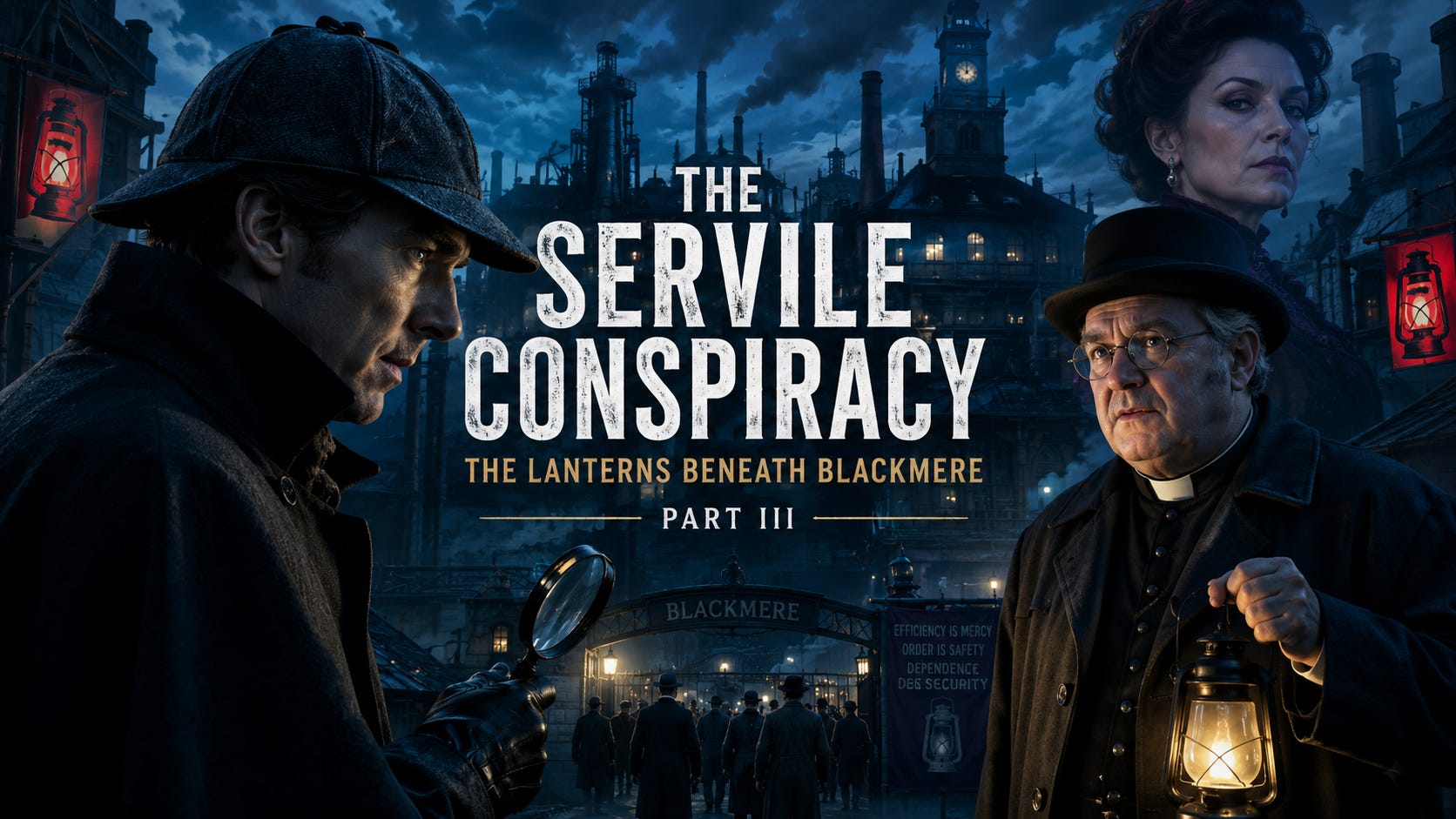
Before the Third Knock
Every conspiracy eventually acquires a geography.
At first it exists merely as fear.
Then as rumor.
Then as policy.
And finally—as roads.
Sherlock Holmes understood this long before he understood most governments.
A lie could travel invisibly for years, but once men began constructing systems around the lie—routes, ledgers, permissions, committees, delivery schedules—the deception became physical. It occupied space. It developed architecture. And architecture, unlike rhetoric, always left evidence behind.
Three weeks after the affair at Marchmere, Holmes found himself once again seated opposite Father Brown in the northbound carriage of a late autumn train.
Outside the windows England passed beneath a sky of dim silver and charcoal cloud. Wet fields stretched toward distant hedgerows blackened by rain. Villages appeared briefly through drifting mist and vanished again before the eye could fully settle upon them.
The country looked peaceful.
That, Holmes reflected, was becoming increasingly suspicious.
Father Brown slept.
Or rather, he appeared to sleep in the peculiar priestly fashion that suggested he remained spiritually attentive even while physically unconscious. His shabby umbrella leaned against the seat beside him like a veteran of forgotten campaigns.
Holmes meanwhile reread the letter lying open across his knee.
It had arrived that morning at Baker Street by special courier.
No signature.
No return address.
Only six lines written in a disciplined hand:
You were correct about Marchmere.
It was not isolated.
Another district has begun implementation under different terminology.
Men have disappeared here as well.
If you intend to stop what is spreading through the counties, come at once to Blackmere.
Trust no allocation board.
Holmes folded the letter carefully.
Then he looked again through the rain-streaked glass.
Blackmere.
The name itself sounded less like a village than a warning.
Father Brown opened one eye suddenly.
“You’re thinking too loudly.”
Holmes sighed.
“I was unaware thought possessed volume.”
“Oh yes. Yours generally sounds like somebody sharpening instruments in the next room.”
The priest sat upright slowly and adjusted his spectacles.
“We’re nearly there?”
“Another twenty minutes.”
Father Brown yawned.
“Good.”
“You seem remarkably calm considering the contents of the letter.”
Father Brown accepted the folded paper from Holmes and reread it without visible alarm.
“Yes,” he said finally. “It’s exactly what one would expect.”
Holmes raised an eyebrow.
“You expected another conspiracy?”
“No. I expected the same conspiracy wearing a different hat.”
The train rounded a slow curve.
Ahead, through thinning mist, Holmes could see the industrial outlines of Blackmere district beginning to emerge.
Not a village.
A manufacturing town.
Tall chimneys.
Rail sidings.
Warehouses.
Long rows of worker cottages pressed tightly together beneath smoke-dark roofs.
And beyond all of it, rising above the valley like some enormous mechanical fortress, stood the Blackmere Textile Works.
Father Brown followed Holmes’s gaze.
“Well,” he murmured. “That looks considerably more dangerous than bread.”
Holmes nodded.
“Yes. Because machinery scales.”
The train entered Blackmere Station beneath clouds of steam and coal smoke.
The platform bustled with laborers, clerks, freight handlers, and women carrying market baskets through the damp afternoon. Unlike Marchmere, Blackmere did not suffer from silence.
It suffered from exhaustion.
The entire town moved with the rhythm of industrial dependence.
Shift whistles.
Freight schedules.
Factory bells.
Steam pressure.
Everything timed.
Everything regulated.
Everything connected.
Holmes stepped onto the platform and immediately noticed the notices.
Not one.
Dozens.
PLACEMENT ASSISTANCE REGISTRATION.
COMMUNITY WELFARE ALLOCATION.
TEMPORARY WORKER STABILIZATION INITIATIVE.
AUTHORIZED FOOD DISTRIBUTION DISTRICTS.
The language had evolved.
It no longer resembled village paternalism.
It resembled industrial administration.
Father Brown read one silently.
Then another.
Then a third.
“They’ve improved the vocabulary,” he observed.
“Yes,” Holmes replied quietly. “That is never encouraging.”
A man approached them cautiously from near the freight office.
He wore a dark overcoat despite the smoke and damp heat of the station. His face was narrow and prematurely aged, with the strained expression common to men who spend too many years balancing fear against responsibility.
“Mr. Holmes?”
“Yes.”
The man glanced around before continuing.
“My name is Edwin Vale.”
Holmes became very still.
“Relation?”
The man nodded.
“Younger brother.”
Father Brown blinked.
“Well,” he said mildly. “That complicates things immediately.”
Edwin Vale gave a humorless smile.
“You think I don’t know that?”
Holmes studied him carefully.
Unlike Sir Julian, Edwin possessed none of the elder Vale’s effortless authority. He looked instead like a man who had spent years watching confidence from the outside.
“Why contact us?” Holmes asked.
“Because my brother was only one branch of it.”
Steam hissed nearby.
Freight wagons clanged somewhere beyond the station wall.
Holmes said nothing.
Edwin lowered his voice.
“After Greyford collapsed, I thought the network would retreat. Instead it accelerated. New districts. New committees. New emergency measures. Men who previously hesitated now insist coordination must continue before instability spreads.”
Father Brown looked toward the factory skyline.
“Yes,” he murmured. “Fear reorganizes itself very quickly after embarrassment.”
Edwin continued.
“You must understand something before we go further. This isn’t one organization.”
“No?”
“It’s an idea. Different counties. Different leaders. Different methods. But the same principle underneath all of it.”
Holmes folded his gloves slowly.
“Dependency through managed insecurity.”
Edwin stared.
“Yes.”
Father Brown sighed softly.
“The trouble with evil systems is that once discovered, they often become easier to imitate.”
Edwin motioned toward the station exit.
“We shouldn’t remain here long.”
“Why?” Holmes asked.
“Because Blackmere allocates railway employment now. Station men report unusual visitors.”
Father Brown smiled faintly.
“Good heavens. They’ve bureaucratized gossip.”
They left the station through a narrow side passage leading toward the lower town.
Blackmere smelled of coal smoke, wet brick, machine oil, and overcrowded humanity.
Children moved through the alleys carrying bundles of cloth scraps. Factory whistles echoed continuously across the valley. Long rows of workers’ houses stretched uphill toward the mills beneath a haze of drifting soot.
Holmes walked in silence for several minutes.
Then he spoke.
“How many disappearances?”
Edwin answered without looking at him.
“Officially? None.”
“Unofficially?”
“Seven in six weeks.”
Father Brown’s expression darkened.
“Families?”
“Mostly labor organizers. A priest. One schoolteacher.”
Holmes stopped walking.
“A priest?”
“Yes.”
“Name?”
“Father Marcus Hale.”
Father Brown looked sharply at Edwin.
“What happened to him?”
“No one knows.”
The priest adjusted his hat slowly.
“That is becoming a tiresome sentence.”
Edwin led them into a narrow public house hidden beneath the railway arches.
Inside, the room glowed dimly beneath gaslight and smelled strongly of beer, wet wool, and exhausted men.
Several factory workers glanced toward the newcomers, then quickly looked away.
Fear again.
But urban fear differed from village fear.
Marchmere had feared social isolation.
Blackmere feared replacement.
Edwin guided them toward a rear booth.
“The system here operates differently,” he explained quietly once seated.
“How?” Holmes asked.
“In Marchmere they controlled bread. Here they control employment assignments, housing vouchers, medical access, and factory placement.”
Father Brown frowned.
“Housing vouchers?”
“The textile works purchased most worker housing after the winter closures.”
Holmes leaned slightly forward.
“So dependency is vertically integrated.”
Edwin blinked.
“You make it sound mechanical.”
“It is mechanical.”
A serving woman brought tea reluctantly.
Holmes noticed bruising along her wrist.
Father Brown noticed Holmes noticing it.
The priest spoke gently to the woman.
“Long week?”
She managed a faint smile.
“Long year.”
After she departed Edwin continued.
“The public face is called the Blackmere Welfare Coordination Board. They claim it prevents labor unrest and guarantees stable employment during shortages.”
“And privately?” Holmes asked.
Edwin hesitated.
“Privately they maintain compliance registries.”
Holmes smiled coldly.
“Of course they do.”
Edwin reached inside his coat.
From an envelope he withdrew several folded sheets.
Holmes spread them across the table.
Lists.
Categories.
Reliability scores.
Placement status.
Housing eligibility.
Medical priority classifications.
Father Brown read silently.
Then he closed his eyes briefly.
“Oh dear.”
Holmes examined one page closely.
“Interesting.”
“What?” Edwin asked.
“The terminology.”
He pointed.
“Notice how punishment has disappeared linguistically. No one is denied housing. They are simply marked low-priority for placement efficiency.”
Father Brown nodded sadly.
“Yes. Once cruelty learns accounting language, civilization becomes very tired indeed.”
Edwin lowered his voice further.
“There’s something else.”
Holmes looked up.
“The disappearances aren’t random.”
“No?”
“They’re targeting people capable of building independent networks.”
Father Brown looked toward Holmes immediately.
“The same pattern.”
“Yes,” Holmes replied softly.
Edwin continued.
“Father Hale organized unauthorized meal distribution from the parish hall. The schoolteacher ran literacy circles for laborers dismissed from the mills. One missing organizer had contacts among railway workers outside the district.”
Holmes leaned back slowly.
“They are not suppressing dissent,” he said.
“They are suppressing alternatives.”
The factory whistle sounded again outside.
Long.
Mechanical.
Absolute.
For several moments none of them spoke.
Then Father Brown asked quietly:
“Who runs Blackmere?”
Edwin answered immediately.
“Lady Catherine Vale.”
Holmes stared.
“Sir Julian’s widow?”
“No. Cousin.”
Father Brown sighed deeply.
“The family appears regrettably committed to organization.”
Edwin’s expression tightened.
“She’s more dangerous than Julian.”
Holmes’s eyes sharpened.
“Why?”
“Because she doesn’t care whether people admire her.”
Outside, somewhere beyond the smoke-dark windows of Blackmere, another whistle began sounding through the industrial dusk.
And Holmes realized with growing certainty that Marchmere had indeed been only the beginning.
Not because a hidden cabal directed events from shadows.
But because modern civilization itself had begun discovering how efficiently fear could be administered once connected to systems large enough to make refusal economically impossible.
The conspiracy was spreading.
And Blackmere, with its factories, railways, housing districts, allocation boards, and endless human dependency, represented something far more dangerous than a frightened village.
It represented scale.
Act II — The Missing Priest
Night settled over Blackmere like soot.
Not darkness exactly.
The factories prevented true darkness.
Furnace glow stained the low clouds red above the valley while steam drifted continuously between rooftops and chimneys. Even after sunset the town continued moving with exhausted mechanical persistence. Shift whistles sounded. Freight wagons rattled over wet streets. Windows glimmered behind curtains in endless rows of workers’ houses climbing the hillsides beneath the mills.
Holmes stood at the upstairs window of the narrow lodging house Edwin Vale had secured for them and watched the industrial district breathing beneath the rain.
Blackmere did not sleep.
That, he thought, was one of the central differences between rural dependency and industrial dependency.
Marchmere had feared scarcity.
Blackmere feared interruption.
A village might survive disorder briefly through neighbors and memory.
An industrial town depended upon uninterrupted systems the way a patient depended upon uninterrupted blood flow.
Food deliveries.
Housing assignments.
Factory placement.
Medical vouchers.
Transport schedules.
Coal allotments.
Everything connected.
Everything conditional.
Father Brown sat near the small iron stove reading one of the placement documents Edwin had provided earlier.
The priest’s expression grew more troubled with every page.
“They’ve mathematized mercy,” he murmured.
Holmes did not turn from the window.
“Yes.”
“It’s very efficient.”
“Yes.”
Father Brown folded the paper carefully.
“That may be the most frightening sentence in the English language.”
A knock sounded below.
Three short taps.
Then two.
Edwin Vale entered moments later carrying a damp overcoat beneath one arm.
“There’s been another disappearance.”
Holmes turned immediately.
“When?”
“Tonight.”
“Who?”
Edwin hesitated.
“A railway clerk named Samuel Finch. He handled freight allocation records.”
Father Brown looked up slowly.
“And he vanished?”
Edwin nodded.
“His wife says two Board officers came to question him after supper. By midnight he was gone.”
Holmes’s eyes sharpened.
“Question him about what?”
Edwin removed a folded slip from his coat.
“Apparently he discovered discrepancies in emergency coal deliveries.”
Holmes took the paper.
Freight routing numbers.
Transfer codes.
Warehouse designations.
At first glance ordinary.
Then Holmes saw it.
“Interesting.”
Father Brown sighed softly.
“That word again.”
“These delivery routes bypass worker districts entirely.”
Edwin nodded grimly.
“Yes.”
“Where do they terminate?”
“We don’t know.”
Holmes studied the codes again.
Then abruptly crossed toward the desk.
He spread a railway map beneath the lamp.
Blackmere Station.
Factory sidings.
Coal depots.
Textile warehouses.
Worker housing districts.
He marked the transfer numbers quickly in pencil.
Then stopped.
Father Brown watched him closely.
“Well?”
Holmes tapped the map lightly.
“These shipments disappear beneath the old lower canal district.”
Edwin frowned.
“There’s nothing there except abandoned storage tunnels.”
“Precisely.”
Father Brown leaned back slowly.
“Oh dear.”
Holmes looked toward him.
“You anticipated this?”
“No. But hidden systems always become subterranean eventually. Human beings feel safer burying their consciences underground.”
The wind rattled faintly against the windows.
Below them Blackmere continued pulsing with factory life.
Edwin lowered his voice.
“There’s something else you should know before we continue.”
Holmes waited.
“Lady Catherine knows you’re here.”
Father Brown blinked.
“That was quick.”
“She controls half the district payroll indirectly. Visitors become visible.”
Holmes smiled thinly.
“Excellent.”
Edwin stared.
“Excellent?”
“Yes. It means she prefers observation to immediate obstruction.”
“And that’s good?”
“It means she still believes herself in control.”
Father Brown stood slowly and reached for his umbrella.
“Where are we going?” Edwin asked.
“To visit the missing clerk’s family,” said the priest.
“At this hour?”
Father Brown looked mildly surprised.
“My dear Mr. Vale, terror keeps very inconvenient hours.”
Samuel Finch’s house stood in the lower railway quarter near the freight yards.
The district differed sharply from Marchmere’s damp cottages.
Here the streets were narrow brick corridors crowded with identical worker houses pressed shoulder to shoulder beneath soot-darkened roofs. Steam drifted continuously between alleys while gas lamps burned weakly through smoke and fog.
Children still moved through the streets despite the hour.
Thin children.
Tired children.
Children who had learned industrial rhythms before childhood properly ended.
Holmes noticed one boy carrying ledger books nearly larger than himself.
Another slept sitting upright beside a stairwell while his mother waited in line outside a communal bakery.
Blackmere possessed no silence.
Only fatigue.
Mrs. Finch opened the door after Edwin identified himself quietly.
She was a pale woman perhaps thirty years old though fear and factory smoke had added a decade to her face. Two children sat near the hearth wrapped in blankets while untouched tea cooled upon the table.
“You’ve found him?” she asked immediately.
Holmes removed his hat.
“No.”
Hope vanished from her expression with painful speed.
Father Brown entered gently behind Holmes.
“May we sit with you for a little while?”
She nodded numbly.
The room smelled faintly of coal dust and damp wool. Every surface appeared carefully maintained despite poverty, as though order itself constituted resistance.
Holmes examined the room quietly while Father Brown spoke softly with the children.
No signs of struggle.
One chair displaced.
A ledger missing from the shelf beside the stove.
Mud near the rear threshold.
Boot prints.
Three men.
One official.
Two labor escorts.
“Mrs. Finch,” Holmes said quietly, “please describe exactly what happened.”
She clasped her hands tightly together.
“Two Board officers came after supper. They asked Samuel questions about freight manifests.”
“Were they uniformed?”
“No. But everyone knows Board men.”
“What sort of questions?”
“They kept asking about transfer schedules under the lower canal routes. Samuel said there were accounting irregularities.”
Holmes’s eyes narrowed slightly.
“What kind of irregularities?”
“He said supplies marked for emergency worker relief never reached the registered districts.”
“Did he suspect theft?”
Mrs. Finch hesitated.
“No.”
“What then?”
“He thought the goods were being redirected somewhere unofficial.”
Father Brown looked up from beside the children.
“Unofficial charity?”
Mrs. Finch shook her head.
“Samuel said charity leaves records eventually. This was something else.”
Holmes crossed slowly toward the rear window.
Outside, freight steam drifted through the alley beyond.
“What happened after the questioning?”
“They told Samuel he needed to clarify records at the district office.”
“And he agreed to go?”
“He said if he refused, they might suspend our housing eligibility.”
Father Brown closed his eyes briefly.
There it was again.
The same mechanism.
Not direct force.
Conditional existence.
Holmes turned.
“Did he leave willingly?”
Mrs. Finch looked toward her sleeping children.
Then answered very quietly:
“In Blackmere no one leaves willingly anymore. They leave compliantly.”
For several moments no one spoke.
The factory whistle sounded again somewhere beyond the district.
Long.
Mechanical.
Absolute.
Father Brown finally rose and moved beside the hearth.
“Mrs. Finch,” he said gently, “did your husband trust anyone outside the Board?”
She looked uncertain.
“There was Father Hale.”
Holmes turned sharply.
“The missing priest?”
“Yes.”
“What connection?”
“He helped workers dismissed from placement rolls. Food. Shelter. Sometimes papers.”
“Papers?”
“Travel permits. Temporary housing certifications. Things people needed if the Board suspended them.”
Holmes and Father Brown exchanged a glance.
An alternative network.
Again.
Always the same pattern.
The conspiracy did not merely punish dissent.
It destroyed parallel structures capable of sustaining independence.
“Did Father Hale visit here?” Holmes asked.
“Yes. Two weeks ago.”
“What did he want?”
Mrs. Finch looked frightened suddenly.
“He asked Samuel whether freight could move unnoticed beneath the canal district.”
Holmes became perfectly still.
“And Samuel answered?”
“He said yes.”
The room seemed to contract slightly around the revelation.
Holmes spoke carefully now.
“What happened afterward?”
“Father Hale never returned.”
Outside, rain began again lightly against the windows.
Father Brown walked slowly toward the shelf beside the stove.
There he found a child’s drawing pinned carefully above the mantle.
A church.
A factory.
And beneath both, a line of small lanterns leading underground.
The priest studied it silently.
Then he looked toward Mrs. Finch.
“Who drew this?”
“My son.”
“Why lanterns?”
The woman seemed confused by the question.
“Because everyone knows about the lantern men.”
Holmes turned immediately.
“The lantern men?”
Mrs. Finch blinked.
“You truly are strangers here.”
Father Brown’s voice remained calm.
“Please explain.”
She lowered her voice instinctively.
“Sometimes at night workers disappear from placement housing before suspension officers arrive. Sick families receive coal unexpectedly. Food appears where allocation cards have failed. People say men with lanterns move beneath the old canal tunnels carrying supplies.”
Holmes stared at the drawing again.
Not a conspiracy.
A resistance.
Father Brown smiled faintly.
“Well,” he murmured softly, “thank God for lanterns.”
Holmes’s expression remained thoughtful.
“No,” he said quietly.
“Why not?”
“Because if the Board knows about them too, the tunnels may already be a trap.”
