

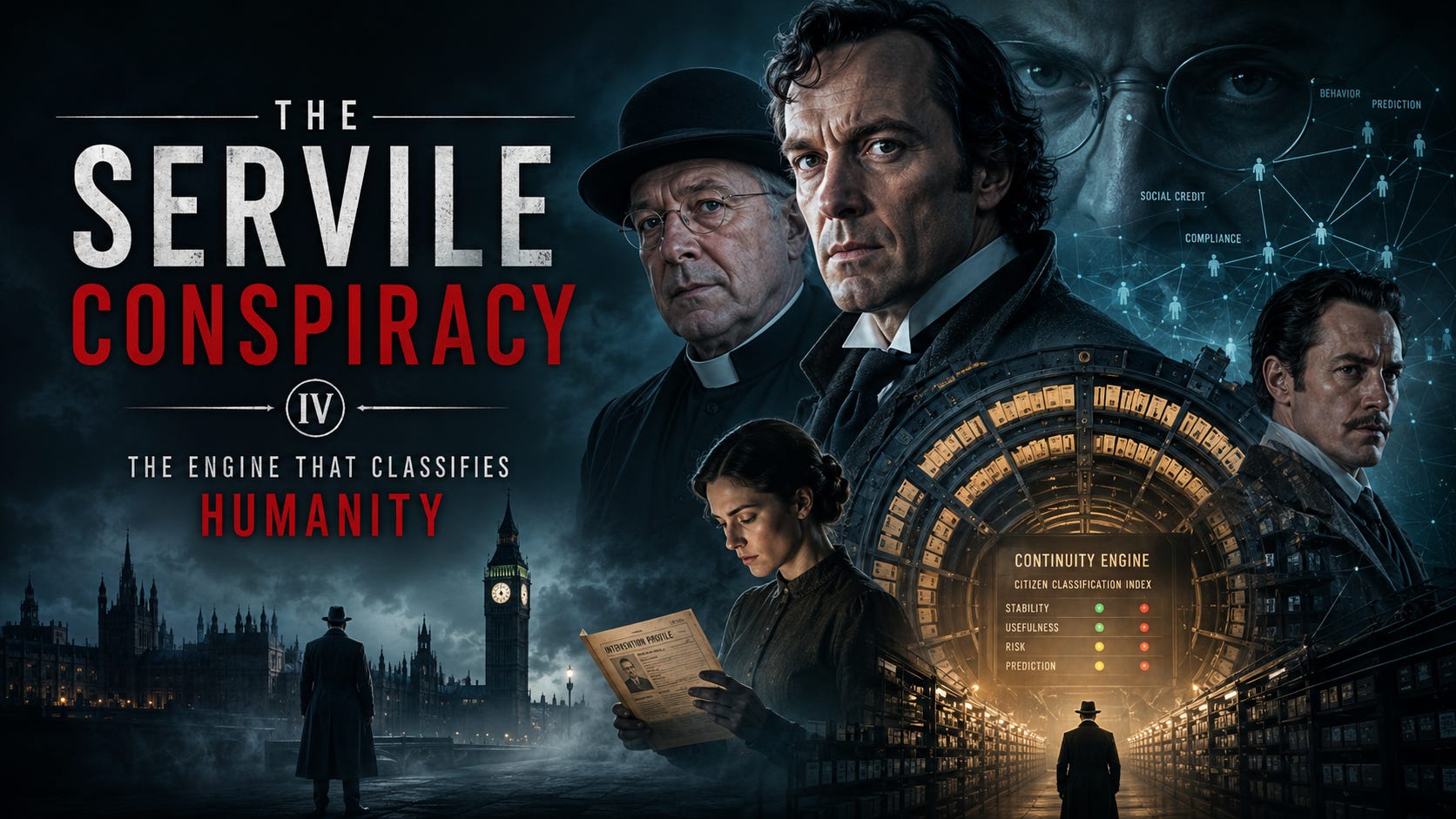
ACT I — The Statistician
London in November possessed a particular genius for making enormous systems appear natural.
Fog concealed scale.
That was its great accomplishment.
It softened ministries into silhouettes, blurred railway arches into phantoms, muted cathedral domes, disguised slums as weather, and turned the endless machinery of empire into distant lamps floating quietly in gray air. A man could walk through London believing civilization merely happened, as fog happens, without quite perceiving the thousands of offices, ledgers, schedules, signatures, pipes, rail timetables, shipping manifests, and administrative decisions required to keep the vast organism breathing another day.
Sherlock Holmes distrusted any city that hid its mechanisms too well.
He stood at the sitting-room window of Baker Street shortly after seven in the morning, watching hansom lamps drift through the mist below like lanterns crossing some subterranean river. Coal smoke pressed low over Marylebone Road. Somewhere in the distance a railway whistle sounded faint and mournful through the fog.
Behind him Watson folded the morning paper.
“You have read the same paragraph six times,” the doctor observed.
Holmes did not turn.
“Five.”
“My apologies.”
Holmes finally glanced over his shoulder.
“The correction is important. Repetition suggests uncertainty. Precision suggests irritation.”
Watson lowered the newspaper with patient resignation.
“You are irritated, then.”
“Profoundly.”
The doctor tapped the paper.
“Because Lady Catherine has not yet been charged formally?”
“No. Because everyone is relieved.”
Watson frowned.
“That seems understandable after Blackmere.”
“Yes,” Holmes said softly. “Which is why it troubles me.”
He turned back toward the window.
Across the street a milk cart moved through the fog while two laborers argued beside a stack of crates. Their voices arrived dulled by damp air.
“The newspapers,” Holmes continued, “have already settled upon the most comforting interpretation possible.”
Watson glanced at the headlines again.
INDUSTRIAL WELFARE ABUSES EXPOSED
BLACKMERE REVIEW COMMISSION EXPECTED
LOCAL AUTHORITIES PROMISE REFORM
“It was exposed,” Watson said carefully.
“Yes. A provincial administrative scandal. Excessive emergency powers. A few regrettable detentions. Some overzealous coordination officers.” Holmes’s mouth hardened slightly. “The entire country has decided Blackmere was an exception because exceptions are emotionally affordable.”
Watson studied his friend.
“You disagree.”
“I know systems. Blackmere was not improvised. It was iterative.”
The doctor leaned back thoughtfully.
“You believe there are others.”
“I believe,” Holmes replied, “that Lady Catherine Vale possessed the confidence of a woman who knew she was not inventing the future alone.”
A knock sounded below.
Mrs. Hudson’s footsteps followed, then the door opened and Inspector Harker entered carrying enough fog upon his coat to suggest he had personally walked through the Thames.
“Morning,” he muttered.
Holmes nodded.
“You look inconvenienced.”
“I am inconvenienced. Whitehall is full of committees, newspapers are full of experts, and every clerk in England suddenly claims he always distrusted welfare indexing.”
Watson smiled faintly.
“That sounds almost encouraging.”
“It would be,” Harker said, removing gloves damp from mist, “if half the country weren’t now trying to save its own neck by pretending Blackmere was merely an accounting irregularity.”
Holmes gestured toward the armchair.
“You have something.”
Harker sat heavily.
“A dead Treasury statistician.”
Watson blinked.
“That was abrupt.”
“So was his death.”
Holmes’s attention sharpened instantly.
“Name?”
“Arthur Bellamy. Senior actuarial analyst attached to the Treasury Labor Harmonization Committee.”
Watson frowned.
“That sounds extraordinarily dull.”
Harker nodded.
“Which is precisely why no one asks questions about it.”
Holmes crossed to the table.
“Cause of death?”
“Officially? Heart failure.”
“And unofficially?”
Harker reached into his coat and withdrew a sealed envelope.
“He sent this to me yesterday morning. Requested immediate confidential review connected to Blackmere. By evening he was dead in his office.”
Holmes took the envelope carefully.
“Opened?”
“No.”
“Excellent.”
He slit the seal with a paper knife and removed several folded pages covered in tightly ordered numerical tables, coded references, and handwritten notes.
For several seconds Holmes said nothing.
Then his eyes narrowed.
Watson recognized the expression immediately.
It meant pattern.
“What is it?” he asked.
Holmes spread the pages across the table.
“Classification transfer models.”
Harker frowned.
“In English?”
“Bellamy was comparing Blackmere allocation categories against national labor census forecasts.”
Watson stepped closer.
The pages appeared to contain columns of numerical groupings beside occupational districts, railway regions, housing density projections, and mortality estimates.
None of it looked remotely criminal.
That disturbed Holmes even more.
“Observe here,” he said quietly.
He pointed toward several recurring coded initials.
“PR.”
“Placement Review,” Watson said. “The same term used in Blackmere.”
“Precisely.”
Holmes traced another sequence.
“And here: housing stability indexing. Medical priority weighting. Employment continuity metrics.”
Harker rubbed tired eyes.
“You’re telling me Whitehall copied Blackmere?”
“No,” Holmes said softly. “I am telling you Blackmere may have copied Whitehall.”
Silence settled briefly over Baker Street.
Outside the fog thickened against the windows.
Watson looked down at the papers again.
“But these are only projections.”
“Yes,” Holmes replied. “At present.”
Harker leaned forward.
“Bellamy wrote anything else?”
Holmes unfolded the final page.
Only three handwritten sentences appeared there.
The predictive architecture is expanding beyond industrial coordination.
Blackmere was a field application.
The numbers are beginning to speak to one another.
Father Brown arrived at Baker Street less than an hour later carrying rain upon his hat and an expression of mild concern that never entirely left him nowadays when Holmes summoned him urgently.
The little priest accepted tea gratefully while Holmes laid Bellamy’s documents before him.
Father Brown adjusted his spectacles.
“I confess,” he said after a moment, “that numbers have always struck me as honest creatures badly corrupted by accountants.”
Holmes ignored this.
“You received a letter yesterday?”
Father Brown reached into his coat.
“Yes. From St. Bartholomew’s Hospice.”
Holmes extended a hand.
The priest hesitated.
“Before you read it, I should explain that Brother Anselm is dying.”
“Of what?”
“Efficiency,” Father Brown said quietly.
Holmes looked up sharply.
Father Brown continued:
“The physicians informed him treatment resources must be directed toward patients with higher recovery probability.”
Watson frowned immediately.
“That is not uncommon in overwhelmed institutions.”
“No,” said Father Brown. “But Brother Anselm believed the selection process had changed.”
He handed Holmes the letter.
The handwriting was weak and uneven.
Dear Father Brown,
They no longer speak of souls here.
Only durations.
Probabilities.
Projected recoveries.
Resource allocation.
The younger administrators discuss men as if they were weather patterns.
The numbers are beginning to speak to one another.
Please come.
Brother Anselm
Holmes laid the letter beside Bellamy’s final note.
The room grew very quiet.
Harker looked between them.
“That phrase again.”
“Yes,” Holmes said softly.
Watson frowned.
“What does it mean?”
Holmes moved slowly back toward the window.
“It means someone is connecting systems previously kept separate.”
No one spoke.
Below Baker Street the city moved invisibly through fog:
railways
hospitals
labor offices
insurance ledgers
census departments
ministries
pension boards
freight offices
housing commissions
Each system ordinary by itself.
Each incomplete.
But Holmes suddenly saw the possibility Bellamy had died fearing.
Interconnection.
The detective spoke almost to himself.
“Blackmere controlled a town because its systems shared classifications.”
Harker’s face tightened.
“And now?”
Holmes turned.
“Now someone is teaching London to calculate human beings across institutions.”
Father Brown looked down at the scattered papers.
“That sounds dangerous.”
“It is more than dangerous,” Holmes replied quietly.
“It is patient.”
The fog outside thickened until even the lamps across the street disappeared completely.
For a moment Baker Street itself seemed suspended inside blank gray air.
Then Holmes reached abruptly for his violin case.
Watson blinked.
“You’re going out?”
“Immediately.”
“Where?”
Holmes’s eyes remained fixed on Bellamy’s notes.
“To the Treasury first. Then St. Bartholomew’s Hospice.”
“And what precisely are we looking for?”
Holmes closed the violin case with a sharp click.
“A machine,” he said.
“Before it learns to hide itself better.”
ACT II — The Bureau of Civic Continuity
The Treasury building possessed the moral atmosphere of a mausoleum designed by accountants.
Holmes formed this conclusion within thirty seconds of entering it.
The great corridors of Whitehall had always struck him as curiously priestless cathedrals devoted to procedure rather than transcendence. Everything inside them implied permanence: the stone staircases worn shallow by generations of officials, the polished brass directory plates, the endless doors concealing men who controlled vast portions of national life through memoranda no ordinary citizen would ever read.
Yet the building’s power came not from grandeur.
It came from accumulation.
Every office connected quietly to another office. Every file referenced another file. Every clerk depended upon another clerk’s signature somewhere deeper in the maze. It reminded Holmes unpleasantly of a spiderweb whose strands had forgotten the spider.
Watson accompanied him through the lower corridor while a junior Treasury official hurried ahead carrying Bellamy’s authorization file.
The man introduced himself twice before Holmes retained the name.
Mr. Leonard Pierce.
Assistant Statistical Registrar.
Thirty-two years old.
University educated.
Mildly ambitious.
Poorly slept.
Ink stains on the right cuff.
A man who believed civilization depended upon forms being submitted on time.
Holmes distrusted him immediately and then, after further observation, decided Pierce was probably harmless.
Which was often worse.
“Mr. Bellamy’s office has been sealed,” Pierce explained nervously as they climbed another staircase. “The department considered his death most unfortunate.”
“Did it?” Holmes asked.
Pierce blinked.
“Yes. Of course.”
“How touching.”
Watson shot Holmes a warning glance.
Pierce continued uncertainly.
“The Treasury Labor Harmonization Committee has suspended current reviews until after internal consultation.”
Holmes stopped walking.
“Harmonization.”
Pierce adjusted his spectacles.
“Yes.”
“What precisely does the committee harmonize?”
The younger man hesitated only slightly before slipping into bureaucratic fluency.
“Employment volatility projections, regional labor continuity, medical productivity forecasts, housing stability estimates, pension sustainability modeling, and transport reliability integration.”
Holmes stared at him.
“My dear Mr. Pierce, you have just described the management of human existence while sounding as though you were discussing railway umbrellas.”
Pierce reddened faintly.
“These are merely administrative forecasting tools.”
“Administrative forecasting,” Holmes repeated softly.
Then he resumed walking.
Watson fell into step beside him.
“You frightened him.”
“I wished to hear whether he would defend the language or the purpose.”
“And?”
“He does not know the purpose.”
They reached Bellamy’s office at the far end of a quieter corridor where fewer clerks moved and voices lowered instinctively.
Two constables stood outside the door.
Pierce produced a key.
The office within was surprisingly small.
That interested Holmes immediately.
Men who perform genuinely consequential intellectual work inside governments are rarely housed extravagantly. Vanity offices belong to public officials. Real systems are usually designed in cramped rooms by exhausted men nobody remembers afterward.
Bellamy’s room contained:
two overflowing filing cabinets
a drafting table covered in statistical overlays
stacks of census reports
labor maps pinned to the walls
mortality charts
freight schedules
railway transfer diagrams
and a large regional map of England covered in colored strings connecting industrial districts.
Watson stopped beside it.
“Good Lord.”
Holmes approached slowly.
There it was again.
Interconnection.
Blackmere.
Greyford.
Manchester districts.
Northern rail hubs.
Hospital regions.
Dockyard allocations.
Housing migration flows.
Not separate crises.
A network.
Holmes’s eyes sharpened.
“Observe this carefully, Watson.”
The doctor stepped closer.
Each colored string linked different systems:
labor instability
housing density
medical demand
food distribution
transportation dependency
unemployment probability
Bellamy had not merely been studying industrial conditions.
He had been modeling social predictability.
Pierce shifted uneasily.
“The committee’s purpose was preventative coordination.”
Holmes glanced toward him.
“Was it?”
“Yes.”
“Then why are the housing instability projections linked directly to medical access forecasts?”
Pierce hesitated.
“I… don’t know.”
“Excellent. Honesty appears at last.”
Holmes crossed to Bellamy’s desk.
The dead statistician had worked obsessively.
Notes covered nearly every surface in tiny compressed handwriting.
Tables layered upon tables.
Probability sequences.
Regional classifications.
Behavioral compliance projections.
Watson picked up one document.
“Holmes…”
The doctor’s face tightened.
The page contained categories.
Not criminal categories.
Predictive categories.
HIGH SOCIAL DISRUPTION RISK
RESOURCE INSTABILITY LIKELIHOOD
DEPENDENCY ESCALATION POTENTIAL
COMPLIANCE RESISTANCE INDEX
Watson looked up slowly.
“These are people.”
“Yes,” Holmes said quietly.
“Or rather, they were.”
Pierce stepped defensively forward.
“These are aggregate social models, not individual citizens.”
Holmes lifted another folder immediately.
Inside:
names
addresses
medical histories
employment interruptions
housing transfers
family dependency counts
Individual citizens.
Pierce went pale.
“That should not be here.”
“No,” Holmes agreed. “It should not.”
The younger man stared at the folder in horror that appeared entirely genuine.
Watson observed him carefully.
“He truly didn’t know.”
Holmes nodded faintly.
“Most machinery functions because each gear sees only its neighboring teeth.”
He moved toward Bellamy’s drafting table.
At the center lay a large partially completed chart titled:
PROPOSED NATIONAL CONTINUITY INDEX
Beneath it:
Unified Behavioral Stability Assessment Framework
Watson read the phrase twice.
“I dislike that enormously.”
“So did Bellamy,” Holmes said.
He pointed toward frantic handwritten notes crowding the margins.
Too broad.
No external oversight.
Cross-indexing dangerous.
Predictive penalties inevitable.
System beginning to self-reference.
Then, beneath those:
Wren insists social forecasting must become adaptive.
Holmes became very still.
“Wren,” he murmured.
Pierce looked up involuntarily.
Watson noticed immediately.
“You know the name.”
Pierce hesitated.
“Dr. Elias Wren consults for the Bureau of Civic Continuity.”
Holmes turned sharply.
“The what?”
Pierce appeared surprised.
“The Bureau.”
“Where is it located?”
The younger official blinked.
“I assumed you knew.”
Holmes stepped closer.
“Mr. Pierce, I assure you that if I knew, this conversation would already be less pleasant.”
Pierce swallowed.
“It’s an interdepartmental policy office attached administratively to the Ministry of Civic Planning.”
“Which means?”
“No one entirely knows who controls it.”
Holmes smiled thinly.
“Now we approach competence.”
Pierce continued reluctantly.
“They coordinate long-term national stability models. Labor forecasting. Housing continuity. Infrastructure resilience. Public health projections.”
“Classification systems?”
“Indirectly.”
“Medical prioritization?”
“In some contexts.”
“Transportation access?”
“Possibly.”
“Employment indexing?”
Pierce said nothing.
Holmes’s expression hardened.
“There it is.”
Watson folded his arms.
“Holmes… this sounds less like a department and more like an attempt to calculate society itself.”
“Yes,” Holmes said quietly.
“That is exactly what it sounds like.”
A knock interrupted them.
One of the constables opened the door to admit a gray-haired Treasury secretary carrying another sealed file.
“For Mr. Holmes,” the man said nervously. “Recovered from Bellamy’s locked cabinet.”
Holmes accepted it.
The secretary left quickly.
Watson watched Holmes open the file.
Inside lay correspondence between Bellamy and the Bureau of Civic Continuity.
Most pages contained statistical disputes and procedural objections.
Then Holmes found a memorandum signed:
DR. ELIAS WREN
The handwriting was elegant, disciplined, and almost unnervingly calm.
Mr. Bellamy,
You continue resisting the inevitable integration of predictive social coordination because you remain emotionally attached to nineteenth-century concepts of individuality.
Modern civilization already functions statistically.
Insurance functions statistically.
Medicine functions statistically.
Rail transport functions statistically.
Labor forecasting functions statistically.
The question is not whether human beings will be classified.
The question is whether classification will remain blind, fragmented, and inefficient.
We do not create abstraction.
We merely acknowledge it.
Holmes read the final line twice.
Then handed the memorandum silently to Watson.
The doctor frowned darkly as he finished.
“He writes like a man describing weather.”
“Precisely.”
Pierce shifted uneasily again.
“Dr. Wren is highly respected.”
“That,” said Holmes, “is becoming increasingly alarming.”
Father Brown arrived at St. Bartholomew’s Hospice shortly after noon.
The building stood in a quieter quarter of the city where old stone walls and narrow gardens attempted unsuccessfully to resist London’s expansion. Rain drifted softly through bare trees in the courtyard. Somewhere nearby bells marked the Angelus beneath the muffled growl of distant traffic.
The hospice smelled faintly of medicine, damp wool, and candle wax.
Father Brown always found hospitals spiritually revealing places.
Not because men die there.
Men die everywhere.
Hospitals revealed what civilizations believed about weakness.
A young administrator met him in the corridor outside Brother Anselm’s ward.
The man introduced himself as Edward Mallory.
Twenty-eight years old.
Polite.
Exhausted.
Precisely dressed.
The sort of administrator whose collars remain immaculate while his conscience slowly frays unnoticed beneath them.
“You’re Father Brown,” Mallory said.
“Yes.”
“Brother Anselm asked for you repeatedly.”
“Then I had better justify his confidence.”
Mallory attempted a smile.
“It would help if you did not agitate him.”
Father Brown removed his hat.
“My dear fellow, priests only agitate people who were trying to avoid thinking.”
Mallory’s smile faded uncertainly.
As they walked the corridor, Father Brown noticed something immediately strange.
The nurses spoke in numbers.
Not constantly.
Not mechanically.
But habitually.
“Ward Four recovery probability has dropped.”
“Priority cases moved to Category B.”
“Projected duration poor.”
The language floated through the corridors softly enough that perhaps no outsider would notice.
Father Brown noticed.
Because language always revealed worship eventually.
He stopped beside a bulletin board.
Pinned there:
bed utilization tables
treatment allocation summaries
recovery-duration charts
mortality efficiency comparisons
Not monstrous.
Merely cold.
Mallory followed his gaze.
“These systems help us maximize care under limited resources.”
Father Brown nodded slowly.
“Yes.”
Mallory relaxed slightly.
The priest continued:
“But they also teach young doctors to think like accountants standing beside coffins.”
The administrator stiffened.
“That’s unfair.”
“Probably,” Father Brown agreed. “Most true things are slightly unfair at first hearing.”
Brother Anselm’s room overlooked the courtyard garden.
The monk looked very near death.
Thin hands.
Sunken cheeks.
Breathing shallow and irregular beneath blankets.
Yet when Father Brown entered, the old man smiled with visible relief.
“You came.”
“Of course.”
Mallory withdrew discreetly, though not entirely out of earshot.
Father Brown sat beside the bed.
Brother Anselm gripped his wrist weakly.
“They’re changing the language.”
“Yes.”
“They say it improves efficiency.”
“Yes.”
The old monk’s eyes moved toward the corridor.
“The younger physicians no longer speak about patients first. They speak about system strain. Resource sustainability. Predictive recovery values.”
Father Brown listened quietly.
Brother Anselm swallowed painfully.
“One of them said last week that some lives create negative continuity pressure.”
The priest’s face changed almost imperceptibly.
“Whose phrase was that?”
“I asked.”
“And?”
“They said it came from Bureau policy research.”
Father Brown leaned back slowly.
Outside rain tapped softly against the windows.
Inside the hospice corridor footsteps moved steadily from room to room with the rhythm of institutional life.
The old monk whispered:
“Father… they are beginning to calculate mercy.”
Father Brown closed his eyes briefly.
Then he said something so softly that only Brother Anselm heard it.
“That is because they have forgotten mercy is the one thing too large for arithmetic.”ACT III — The House of Numbered Men
London became more administrative after dark.
Holmes had observed this for years.
During daylight the city still preserved certain theatrical illusions:
commerce,
traffic,
clubs,
newspapers,
cabmen shouting through rain,
ladies entering concert halls,
gentlemen discussing Parliament,
street sellers crying evening editions.
But at night another London emerged.
A quieter London.
The London that actually governed things.
Behind lit windows in government annexes, railway offices, insurance houses, hospital registries, census bureaus, telegraph exchanges, and financial clearing rooms, exhausted men continued moving paper long after the public believed the nation asleep.
Holmes distrusted that London intensely.
At half past nine he and Watson stood across the street from a narrow stone building near Westminster Bridge whose brass directory plate read:
BUREAU OF CIVIC CONTINUITY
Nothing else.
No decorative crest.
No ministerial banners.
No public entrance queue.
Only four dim windows glowing behind fogged glass.
Watson adjusted his collar against the damp wind.
“It looks disappointingly ordinary.”
Holmes kept his eyes on the windows.
“The most dangerous modern institutions usually do.”
A tram rattled distantly across the bridge while rain mist drifted through the lamps.
Watson glanced toward the entrance.
“No guards.”
“Visible guards suggest acknowledged importance.”
“And invisible guards?”
Holmes nodded faintly toward the alley beside the building.
Two men smoked beneath the awning pretending unsuccessfully not to observe the street.
Railway boots.
Military posture.
Civilian coats purchased recently enough to crease badly.
Watson sighed.
“I miss the old days.”
“What old days?”
“When villains at least hired recognizable thugs.”
Holmes almost smiled.
“My dear Watson, progress has improved criminal subtlety everywhere except politics.”
Across the street, clerks continued leaving the building one by one:
statisticians
filing assistants
transport analysts
health coordinators
None looked sinister.
That disturbed Watson increasingly.
“How many people work there?”
“Unknown.”
“And the Bureau reports to whom?”
“Also unknown.”
“That seems remarkably improper.”
“Yes,” Holmes replied softly. “Which generally means several departments share responsibility while none share accountability.”
Watson looked again at the brass plate.
“What precisely is civic continuity?”
Holmes lit a cigarette slowly.
“An attempt to make civilization behave predictably.”
Rain hissed softly against the pavement.
Then Holmes stiffened almost imperceptibly.
A young woman emerged from the building carrying a leather document case.
Dark coat.
Plain hat.
Quick intelligent eyes.
She moved with the distracted pace of someone whose mind remained at work long after office hours.
Holmes watched her carefully.
“Interesting.”
Watson followed his gaze.
“What?”
“She counts steps unconsciously.”
“What?”
“Observe.”
The woman paused at the curb precisely as a carriage passed, adjusted her pace twice to avoid collision without ever fully looking up, then resumed walking while mentally sorting papers inside the case.
“Mathematical cognition under stress,” Holmes murmured.
“You deduced that from crossing the street?”
“No. From the fact that she arranges movement like an equation.”
Watson sighed.
“I increasingly suspect you invent half your observations merely to discourage friendship.”
Holmes ignored this.
The woman turned suddenly into a narrower lane leading toward the Embankment.
Then stopped.
Abruptly.
Holmes’s expression changed.
“She knows she’s followed.”
Watson blinked.
“Followed by whom?”
The answer emerged almost immediately.
A man stepped from the fog behind her.
Then another.
Neither wore uniforms.
One carried an umbrella despite the rain having nearly stopped.
The woman’s shoulders tightened visibly.
Holmes moved instantly.
“Come.”
By the time they crossed the street the confrontation had already begun.
The taller man spoke first.
“Miss Vale.”
The woman turned sharply.
“I told the Bureau I’d completed tonight’s review.”
“This concerns supplemental continuity assessments.”
“I was not informed.”
“You are now.”
Holmes slowed slightly as they approached through the mist.
The woman’s face had gone pale, but not with ordinary fear.
Recognition.
The fear of someone realizing procedure had just become personal.
The shorter man extended a folded paper.
“Your transit authorization.”
She stared at it.
“My authorization?”
“It has been temporarily suspended pending classification clarification.”
Watson frowned immediately.
The language.
Blackmere language.
The woman looked up sharply.
“There must be some mistake.”
“Possibly,” said the taller man. “That is why clarification procedures exist.”
Holmes stepped from the fog before either man noticed him.
“Good evening.”
All three turned.
The taller man’s posture altered instantly.
Professional caution.
Holmes continued calmly:
“I could not help overhearing what sounds remarkably like bureaucratic kidnapping.”
The shorter man stiffened.
“This is official Civic Continuity business.”
“How comforting.”
The taller man recovered slightly.
“And you are?”
“Sherlock Holmes.”
Both men went still.
The reaction interested Holmes greatly.
Fear.
Not confusion.
Recognition.
The Bureau knew his name already.
Watson arrived beside him carrying his cane with increasingly visible medical irritation.
The woman looked rapidly between them.
Holmes spoke gently now.
“Miss Vale, I presume?”
Her eyes widened slightly.
“You know me?”
“No. But your file case bears the initials EV beneath recent abrasion marks where a previous brass plate was removed.”
Watson muttered:
“Of course it does.”
The taller Bureau man stepped forward.
“This matter is confidential.”
Holmes nodded.
“Yes. Most abuses prefer privacy.”
“You are interfering with authorized classification review.”
“There,” Holmes said softly.
“That word again.”
The man’s expression hardened.
“Step aside.”
Holmes did not move.
Neither did Watson.
The fog thickened briefly around them while carriage lamps drifted somewhere beyond the Embankment like drowned stars.
Miss Vale found her voice suddenly.
“My authorization was valid this morning.”
The shorter man answered mechanically.
“Continuity risk assessments update dynamically.”
Holmes’s eyes sharpened.
“Dynamic classifications.”
Neither man answered.
Holmes continued:
“And what precisely occurs when one’s classification changes?”
“Supplemental review.”
“Meaning?”
“Temporary movement restrictions.”
“Employment limitations?”
No answer.
“Medical access implications?”
Silence again.
Watson looked at Holmes darkly.
“My God.”
Holmes nodded faintly.
There it was.
Not arrests.
Administrative unreality.
A person could vanish now not through prison cells but through interconnected denials:
transit suspended
employment paused
housing review triggered
medical access delayed
financial authorization questioned
Not dead.
Not charged.
Simply incompatible with systems.
Miss Vale whispered:
“I only questioned the correction models.”
The taller man’s face remained expressionless.
“Your recent analytical behavior indicates destabilization risk.”
Holmes laughed once softly.
Not amusement.
Recognition.
“They’ve taught mathematics to become paranoid.”
The taller man stepped toward Holmes.
“Final warning.”
Holmes’s gaze became suddenly cold.
“My dear fellow, you are attempting covert detention on a public London street while carrying a forged continuity suspension order signed by an assistant registrar whose ink has not fully dried.”
The man froze.
Holmes continued mercilessly:
“The document was prepared hastily within the last hour. The seal pressure is uneven, the classification code incomplete, and your colleague’s shoes still carry limestone dust from the Bureau archive basement where emergency forms are stored.”
Watson almost pitied them.
Almost.
Miss Vale stared.
“You can see all that?”
“Yes,” Holmes said.
“Unfortunately.”
The shorter man recovered first.
“You have no authority here.”
Holmes smiled thinly.
“No. But you have even less than you think.”
He stepped closer.
“Tell Dr. Wren something for me.”
Neither man moved.
Holmes’s voice lowered.
“Blackmere taught me where to look.”
A long silence followed.
Then the taller man folded the suspension order carefully.
“This conversation never occurred.”
“An admirable ambition,” Holmes replied. “Ruined by witnesses.”
The two Bureau men withdrew into the fog without another word.
Watson watched them disappear.
“I dislike this enormously.”
“Yes.”
Holmes turned toward the young woman.
“Miss Vale?”
She still looked shaken.
“Eleanor Vale.”
Holmes’s eyes sharpened slightly.
“Related to Lady Catherine?”
She flinched.
“My cousin.”
Watson exhaled heavily.
“Oh splendid. Another Vale.”
But Holmes was already studying her with intense concentration.
Not aristocratic like Catherine.
Not uncertain like Edwin.
Eleanor possessed something more dangerous:
intelligence still capable of moral surprise.
“How long have you worked for the Bureau?” Holmes asked.
“Three years.”
“And only now realized what it was becoming?”
She looked at him miserably.
“At first it seemed humane.”
Holmes said nothing.
That answer mattered enormously.
Eleanor continued quietly:
“We were told the models would prevent suffering.
Prevent shortages.
Predict housing crises.
Prevent unemployment waves before they spread.”
“Blackmere,” Holmes said softly.
She looked startled.
“You know about Blackmere?”
“Intimately.”
Her face tightened.
“Dr. Wren called it a successful stress test corrupted by local authoritarianism.”
Watson muttered:
“That sounds exactly like something a clever devil would say.”
Eleanor gripped the document case tighter.
“I thought the classifications were abstract. Population-level forecasting. But last month correction profiles began appearing.”
Holmes became perfectly still.
“Correction profiles.”
She nodded.
“Individuals flagged as future continuity risks.”
“What qualified as risk?”
“Employment instability. Political agitation. irregular movement patterns. medical burdens. dependency escalation probability. noncompliant behavioral indicators.”
Watson stared.
“They’re predicting disobedience.”
“No,” Holmes said quietly.
“They are criminalizing unpredictability.”
Rain drifted lightly through the alley.
Eleanor looked suddenly exhausted.
“They’ve started linking systems.”
Holmes nodded.
“Tell me everything.”
She hesitated.
Then said the sentence Holmes had already feared most:
“The Bureau is building unified identity continuity.”
Watson frowned.
“In English?”
Eleanor answered quietly:
“One national classification structure connecting:
transit
employment
medicine
housing
insurance
pensions
education
and labor forecasting.”
Silence.
Then Holmes asked:
“Who authorized this?”
Eleanor looked toward the fog where the Bureau men had vanished.
“No one officially.”
Holmes smiled without warmth.
“Yes,” he said softly.
“That is exactly how real machinery begins.”
ACT IV — Dr. Elias Wren
Holmes insisted upon meeting Dr. Elias Wren immediately.
Watson objected to this with unusual force.
“It is midnight.”
“Yes.”
“We know almost nothing about the man.”
“No.”
“He may already know we are investigating the Bureau.”
“He certainly does.”
Watson threw up his hands.
“Then why in Heaven’s name walk directly into his office?”
Holmes fastened his coat calmly.
“Because men like Wren become more dangerous the longer they remain theoretical.”
Rain swept through the streets as they crossed Westminster toward the river. Eleanor Vale walked beside them in strained silence beneath a borrowed umbrella, her gloved hands clenched tightly around the document case she had removed from the Bureau.
The city had grown quieter now.
Fog pressed low over the embankments. Government windows glowed dimly through mist like watchful eyes. Somewhere beyond the river came the deep mechanical pulse of nighttime rail transfer.
London never truly slept anymore.
It processed.
That thought stayed with Holmes unpleasantly.
The Bureau of Civic Continuity appeared almost deserted when they returned shortly after midnight. Only two upper windows remained lit. The brass directory plate shone damply beneath the lamps.
No guards visible this time.
That disturbed Holmes more than guards would have.
Eleanor stopped beneath the awning.
“He’ll still be here.”
“You sound certain.”
“He never leaves before two.”
“Why?”
She looked toward the upper windows.
“He says civilization reveals itself most honestly after office hours.”
Holmes’s eyes narrowed faintly.
“Yes,” he murmured. “I believe he may actually think that.”
They entered.
The lobby smelled faintly of wet wool, coal heat, and paper aging in warm rooms. Somewhere deeper inside the building typewriters still clicked intermittently. The sound echoed strangely through the corridors like distant insects.
A night clerk looked up nervously as they approached.
Then saw Eleanor.
Then Holmes.
Recognition passed visibly across his face.
“I… Dr. Wren is occupied.”
Holmes removed gloves slowly.
“My dear fellow, every significant danger in England is currently occupied. Kindly announce us anyway.”
The clerk hesitated.
Then a voice drifted calmly from the staircase above.
“That will not be necessary.”
They all looked up.
Dr. Elias Wren descended the staircase without haste.
Watson had expected someone colder.
That was his first mistake.
Wren did not resemble a fanatic, tyrant, or bureaucratic monster. He resembled a physician, scholar, or patient university lecturer. Tall, spare, and dark-haired prematurely silvered at the temples, he moved with controlled physical economy rather than aristocratic authority. His face possessed an unsettling composure that suggested not emotional emptiness but emotional regulation refined into habit.
His eyes interested Holmes immediately.
Not cruel.
Analytical.
That was worse.
Wren reached the bottom of the staircase.
“Mr. Holmes,” he said calmly.
“Dr. Wren.”
“You found us sooner than anticipated.”
Watson muttered:
“Remarkably welcoming for a man constructing a national classification apparatus.”
Wren turned toward him politely.
“Dr. Watson, I presume. Your Afghan journals remain statistically unusual among military memoirs for emotional honesty.”
Watson stared.
“I beg your pardon?”
Wren inclined his head slightly.
“I read widely.”
Father Brown arrived at that exact moment carrying rain upon his hat and mild irritation upon his face.
“I dislike being summoned after midnight,” the priest announced.
Wren looked at him carefully.
“Father Brown.”
“Yes.”
“I have wanted to meet you.”
“That worries me immediately.”
To Watson’s astonishment, Wren smiled slightly.
Not mockery.
Genuine amusement.
Holmes observed everything:
pulse steady
breathing controlled
no visible anxiety
no defensive posture
no effort to dominate physically
Wren did not behave like a man concealing wrongdoing.
He behaved like a man convinced concealment was unnecessary.
That made him profoundly dangerous.
“Shall we speak upstairs?” Wren asked.
Holmes nodded once.
The upper office overlooked the river through tall fogged windows. Unlike Bellamy’s cramped room, Wren’s office was almost austere:
no decorative clutter
no personal photographs
no trophies
no family portraits
only books
maps
statistical tables
and one enormous wall chart showing interconnected regional systems across England.
Holmes crossed immediately toward it.
Rail.
Housing.
Medical access.
Employment density.
Insurance.
Food distribution.
Migration patterns.
Educational placement.
Everything linked.
London itself rendered as circulatory mathematics.
Wren removed gloves carefully.
“Beautiful, isn’t it?”
Watson stared.
“That is not the word I would choose.”
“No,” Wren agreed softly. “Most people reserve beauty for emotionally comforting things.”
Father Brown sat quietly near the fire.
“You speak like a man who has not trusted comfort for a very long time.”
Wren glanced toward him briefly.
“Comfort is frequently dishonest.”
Holmes turned from the wall chart.
“You modeled Blackmere.”
“Partially.”
“Field application?”
“A regrettably unstable one.”
Eleanor spoke suddenly.
“You knew what Lady Catherine was doing.”
Wren regarded her calmly.
“I knew she accelerated implementation under industrial pressure conditions.”
“She imprisoned people.”
“Yes.”
“She forged classifications.”
“Yes.”
“She weaponized dependency.”
Wren folded his hands loosely behind his back.
“She operationalized continuity enforcement prematurely.”
Watson exploded.
“Good God, man!”
But Holmes raised one hand sharply.
“No. Let him continue.”
Wren’s eyes returned to Holmes.
“You understand something your companions do not, Mr. Holmes.”
“Which is?”
“That industrial civilization already functions through interconnected systems. Blackmere merely revealed the process visibly.”
Holmes lit a cigarette slowly.
“And therefore abuse becomes acceptable?”
“Abuse becomes inevitable under fragmentation.”
Silence.
Rain moved softly against the windows.
Father Brown watched Wren carefully now with profound sadness rather than anger.
Wren continued calmly:
“Insurance companies already classify risk. Hospitals already prioritize outcomes. Rail systems already predict movement patterns. Employers already categorize reliability. Housing boards already identify instability zones. Banks already measure financial trustworthiness.”
He gestured lightly toward the wall map.
“The modern state merely inherited disconnected systems evolving independently.”
Holmes exhaled smoke.
“And your solution is to connect them all.”
“Of course.”
Watson stared incredulously.
“You say that as though discussing sewer improvements.”
“In many respects,” Wren replied, “the comparison is accurate.”
Father Brown murmured:
“Yes. Sewers are also very useful when they overflow into houses.”
Wren ignored the remark.
“Civilization now operates at scales emotionally incomprehensible to the individual human mind. London alone requires predictive coordination simply to avoid paralysis.”
Holmes stepped closer.
“And therefore citizens become variables.”
“No,” Wren answered calmly.
“They become visible.”
Eleanor shook her head.
“That isn’t true anymore.”
Wren turned toward her.
“You disappoint me, Eleanor.”
She flinched visibly.
Holmes noticed immediately.
Wren continued softly:
“You once understood the ethical necessity of continuity systems.”
“I understood forecasting shortages.”
“Yes.”
“I understood preventing unemployment waves.”
“Yes.”
“I did not understand correction profiles.”
A faint silence settled over the room.
Wren regarded her almost sympathetically.
“That is because you remain morally attached to randomness.”
Father Brown blinked.
“What an extraordinary sentence.”
Wren turned toward him.
“Father, every catastrophic social event in modern history emerges from unmanaged instability:
shortages
panic migrations
labor collapses
epidemic spread
infrastructure disruption
financial contagion
civil unrest”
His voice remained level throughout.
“Industrial civilization cannot survive nineteenth-century assumptions about individuality.”
Holmes smiled thinly.
“And there it is at last.”
“What?”
“The old temptation wearing modern clothes.”
Wren’s eyes narrowed slightly.
“Meaning?”
Holmes stepped toward the wall chart.
“You believe scale abolishes moral proportion.”
“No,” Wren replied. “Scale changes it.”
“No,” Holmes said softly.
“You merely prefer systems easier to calculate than human beings.”
For the first time, something sharpened visibly in Wren’s expression.
Not anger.
Intensity.
“Human beings are already calculated,” he said.
The room grew still.
Wren continued:
“Insurance tables calculate them.
Employers calculate them.
Hospitals calculate them.
Governments calculate them.
Railways calculate them.
Markets calculate them.”
His gaze fixed on Holmes.
“You accuse me of abstraction while living inside civilizations entirely dependent upon invisible probabilistic management.”
Holmes answered immediately.
“The invisibility is precisely the danger.”
Wren nodded faintly.
“At last. An intelligent criticism.”
Watson looked between them uneasily.
The conversation no longer sounded like ordinary disagreement.
It sounded like two men examining the future from opposite sides of a cliff.
Wren crossed calmly toward the fire.
“The old tyrants failed because they relied upon visible coercion:
armies,
police,
spectacle,
fear.”
He looked toward the rain-streaked windows.
“The modern world no longer requires that inefficiency.”
Father Brown spoke quietly now.
“And what replaces it?”
“Prediction.”
The priest folded his hands.
“That is a very lonely religion.”
Wren looked at him curiously.
“Religion?”
“Yes.”
Father Brown’s voice remained gentle.
“You are trying to eliminate suffering by eliminating uncertainty.”
“Partially.”
“And eventually,” Father Brown continued softly, “you will eliminate freedom because free people remain stubbornly difficult to predict.”
Wren met his gaze steadily.
“Freedom is largely statistical noise romanticized by literature.”
Watson inhaled sharply.
But Father Brown merely looked tired.
“My poor man.”
Something flickered across Wren’s face then.
Not offense.
Not embarrassment.
Something closer to intellectual irritation.
“You believe souls transcend systems.”
“Yes.”
“And that belief prevents practical governance.”
“No,” said Father Brown.
“It merely prevents governance from becoming ownership.”
The room fell silent again.
Holmes watched Wren carefully.
The man’s danger lay not in cruelty but coherence. Unlike Lady Catherine, Wren possessed no visible hunger for authority. He truly believed himself humane.
That made argument difficult.
Because portions of his analysis were correct.
Industrial society did depend upon coordination.
Mass systems did require prediction.
Infrastructure did require abstraction.
The trap lay elsewhere.
Holmes moved toward Wren’s desk.
Among the papers there lay several thick binders marked:
CONTINUITY INTEGRATION PHASE III
He opened one.
Inside:
transit reliability scores
employment continuity indexing
medical prioritization overlays
pension sustainability ratings
educational access projections
All cross-linked.
Watson read several pages and went pale.
“These are individual citizens.”
“Yes,” Wren replied calmly.
“Pilot regions only.”
Holmes looked up sharply.
“Pilot regions.”
“Limited implementation improves model accuracy.”
“Blackmere again.”
Wren did not deny it.
Father Brown rose slowly from his chair.
“When did people consent to this?”
Wren answered without hesitation.
“They already consent continuously whenever they participate in modern society.”
The priest shook his head sadly.
“No. They consented to railways and hospitals and employment offices. They did not consent to becoming permanent suspects inside interconnected arithmetic.”
For the first time Wren’s composure cooled slightly.
“Father Brown, your objection is emotional.”
“No,” the priest replied softly.
“It is theological.”
The room became extraordinarily quiet.
Even the rain seemed distant now.
Father Brown continued:
“You believe human beings become safer when fully legible to systems.”
“Yes.”
“But souls are partly sacred because they cannot be fully reduced.”
Wren’s voice sharpened faintly.
“That is mystical nonsense.”
“No,” said Father Brown.
“It is merely the last defense against people who wish to improve mankind by converting persons into categories.”
Wren turned toward Holmes again.
“You see why modern governance struggles with clerics.”
Holmes nodded faintly.
“Yes. They insist inconveniently upon human beings.”
Wren studied Holmes carefully.
“And you?”
“I distrust any system that cannot tolerate exceptions.”
Wren almost smiled.
“Exceptions create collapse.”
Holmes’s eyes hardened.
“No. Exceptions create civilization.”
The silence after that sentence lingered heavily in the office.
Beyond the windows London glowed dimly beneath fog and rain:
millions of lives
moving through rail systems
hospitals
housing offices
insurance ledgers
employment registries
All increasingly measurable.
Increasingly connected.
Wren walked slowly back toward the great wall chart.
“You cannot stop this,” he said quietly.
Holmes said nothing.
Wren touched one line linking transport and labor districts.
“The complexity of modern civilization guarantees convergence eventually.”
Then another line.
“Prediction.”
Another.
“Classification.”
Another.
“Continuity management.”
Another.
“Behavioral forecasting.”
Finally he turned back toward them.
“You think Blackmere was the danger.”
His eyes moved calmly across the room.
“Blackmere was merely provincial.”
And for the first time since entering the Bureau, Sherlock Holmes felt something very close to genuine fear.
ACT V — The Silent Catastrophe
The catastrophe announced itself so quietly that most of London mistook it for inconvenience.
A bank clerk in Holborn discovered his housing authorization had been temporarily suspended due to unresolved identity variance.
A railway foreman in Lambeth found his travel clearance delayed pending continuity review.
Three dockworkers in Wapping arrived at the hiring office only to discover their labor histories no longer matched central records.
A widow in Southwark attempting to collect her pension was informed her classification file contained contradictory dependency indicators requiring reassessment.
At St. Bartholomew’s Hospice, two patients were quietly moved from active treatment priority into observational holding because updated recovery projections altered resource efficiency rankings overnight.
No riots followed.
No soldiers appeared.
No public decrees were issued.
That was the terrifying elegance of it.
The system injured people one administrative interruption at a time.
And because each interruption appeared individually plausible, almost no one recognized the pattern immediately.
Holmes recognized it within forty-eight hours.
He stood over the long dining table at Baker Street shortly after dawn while newspaper clippings, railway notices, handwritten reports, hospital memoranda, and copied pension irregularities spread outward before him like the beginnings of an epidemic map.
Watson entered carrying coffee and stopped short.
“Good Lord.”
Holmes did not look up.
“Observe the distribution.”
Watson moved closer.
At first the incidents appeared unrelated:
banking delays
transport suspensions
medical reclassification
labor verification disputes
housing inconsistencies
But Holmes had already begun connecting them with colored pencil marks across a large city map.
The clusters aligned.
Not geographically.
Systemically.
The same names repeated across institutions.
The same households triggered parallel interruptions.
The same classification language appeared everywhere.
CONTINUITY REVIEW
TEMPORARY VERIFICATION
PREDICTIVE DISCREPANCY
RESOURCE PRIORITY ADJUSTMENT
Watson frowned darkly.
“They’ve started using it.”
“Yes.”
“But Wren said implementation remained limited.”
Holmes finally looked up.
“My dear Watson, all dangerous systems begin experimentally while their architects describe them as theoretical.”
A knock sounded below.
Moments later Inspector Harker entered carrying rainwater, exhaustion, and visible irritation.
“I have just spent two hours listening to three ministries explain that none of them technically controls the Bureau of Civic Continuity.”
Holmes nodded.
“Which means all of them use it.”
“Exactly.”
Harker threw several additional files onto the table.
“Transport disputes. Pension inconsistencies. Insurance anomalies. Employment verification collapses.”
Watson flipped open one report.
A schoolteacher in Camden had been denied salary release because her identity continuity score conflicted with medical dependency forecasts attached mistakenly to another household.
Another case:
A railway mechanic lost transit authorization because his brother appeared in an industrial agitation registry.
Another:
A child’s treatment voucher delayed because housing classifications remained unresolved after relocation.
Watson looked up slowly.
“These are ordinary people.”
“Yes,” Holmes replied quietly.
“That is the point.”
Father Brown arrived shortly thereafter with Eleanor Vale.
The young statistician looked markedly worse than she had the previous evening. Lack of sleep sharpened the strain beneath her eyes, and she carried two leather document cases held so tightly that Watson suspected she had not loosened her grip during the entire journey.
Father Brown removed his damp coat.
“London feels different today.”
Holmes nodded.
“Because administration has begun touching the surface visibly.”
Eleanor set the cases upon the table.
“They accelerated implementation overnight.”
Harker stared.
“Why?”
She looked toward Holmes.
“Because Dr. Wren realized exposure was coming.”
Holmes’s expression hardened.
“Yes.”
Eleanor opened the first case.
Inside lay hundreds of copied Bureau memoranda.
Transit integration pilots.
Medical prioritization overlays.
Continuity reliability scoring.
Cross-indexed employment classifications.
Watson turned pages rapidly, disbelief growing with each document.
“My God…”
Eleanor spoke quietly.
“The Bureau calls it Unified Civic Continuity.”
Holmes answered without humor.
“Of course it does.”
She continued:
“The goal is total interoperability between systems.”
Father Brown blinked.
“That sounds less like governance and more like nervous system surgery.”
Eleanor nodded faintly.
“Every institution already possesses separate data:
employment
housing
medicine
pensions
insurance
transport
education”
She pointed toward the papers.
“Wren believes fragmentation creates inefficiency and social instability.”
Harker folded his arms.
“And what exactly counts as instability?”
Eleanor hesitated.
Then answered honestly.
“Anything difficult to predict.”
Silence settled over Baker Street.
Outside the city moved through another gray morning unaware that invisible classifications had already begun attaching themselves quietly to daily life.
Holmes spread several pages across the table.
“These correction profiles…”
Eleanor looked visibly uncomfortable.
“They began after Blackmere.”
“Why?”
“Because the Bureau concluded reactive governance was too inefficient.”
Watson frowned.
“In English?”
Holmes answered for her.
“They no longer wish merely to respond to crises.”
Father Brown completed the thought softly.
“They wish to identify future inconvenient people before inconvenience occurs.”
Eleanor closed her eyes briefly.
“Yes.”
Harker muttered:
“Sweet Heaven.”
Holmes continued examining the files with growing intensity.
Then abruptly stopped.
“What is this?”
Eleanor stepped beside him.
A page near the bottom of the stack carried a red classification mark.
CATEGORY D — CONTINUITY INTERVENTION ELIGIBLE
Below it:
Subjects exhibiting escalating systemic destabilization probability may require administrative restriction prior to overt disruptive activity.
Watson stared.
“That is preemptive punishment.”
“No,” Holmes said quietly.
“It is worse.”
Everyone looked toward him.
“Punishment at least acknowledges action.”
He tapped the page.
“This criminalizes statistical possibility.”
Father Brown sat very still.
Then said softly:
“And once society accepts that principle, innocence disappears mathematically.”
The room fell silent again.
Harker looked increasingly ill.
“You’re telling me they intend to classify citizens according to what they might someday become?”
Eleanor answered almost in a whisper.
“The models predict future instability patterns.”
Watson exploded suddenly.
“Models are not souls!”
The violence of the sentence startled even him.
Eleanor looked shaken.
Holmes, however, looked almost approving.
“Yes,” he said softly.
“That is the entire case against Wren.”
The morning newspapers arrived shortly after ten.
Mrs. Hudson brought them upstairs herself, muttering darkly about government men and miserable weather.
Holmes scanned headlines rapidly.
Then stopped.
His eyes narrowed.
“What is it?” Watson asked.
Holmes handed him the paper.
GOVERNMENT ANNOUNCES NATIONAL CIVIC STABILITY REVIEW
Subheading:
New interdepartmental coordination measures proposed following industrial welfare failures.
Harker cursed aloud.
“They’re legitimizing it already.”
Eleanor went pale.
“No…”
Holmes continued reading.
“The proposal recommends improved integration between:
transport systems
employment registries
health administration
housing coordination
pension verification
public continuity forecasting.”
Father Brown looked toward the window.
“The language sounds so reasonable.”
“Yes,” Holmes replied.
“That is why it will spread.”
Watson read further.
“There’s no mention of correction profiles.”
“Of course not.”
“No mention of predictive restrictions.”
“Certainly not.”
“No mention of Blackmere.”
Holmes smiled coldly.
“Because Blackmere was merely the prototype nobody intends to acknowledge publicly.”
Eleanor moved suddenly toward the fire.
“We have to expose all of it.”
Holmes looked at her carefully.
“All of it?”
“The hidden classifications. The continuity scoring. The intervention categories.”
Harker shook his head immediately.
“You’ll cause panic.”
Father Brown spoke quietly.
“No. Panic comes later.”
They all looked toward him.
The priest continued:
“First comes comfort.”
Watson frowned.
“What do you mean?”
Father Brown folded his hands.
“Many people will welcome this system.”
Silence.
Then Eleanor whispered:
“No…”
Father Brown looked at her sadly.
“My dear child, frightened societies nearly always welcome systems promising predictability.”
Holmes nodded slowly.
“Especially systems introduced gradually through convenience.”
He crossed to the map again.
“Insurance discounts for stable continuity profiles.”
“Priority transit access.”
“Accelerated medical approval.”
“Employment reliability certification.”
Watson stared.
“You think people will volunteer for classification?”
Holmes turned.
“My dear fellow, eventually they may compete for it.”
The thought settled over the room like another layer of London fog.
Harker broke the silence.
“What now?”
Holmes looked toward Eleanor.
“How much of the archive can you access?”
Her face tightened.
“Less now than yesterday.”
“Can you still enter the lower registry levels?”
“Yes.”
“Correction profiles?”
A pause.
“Possibly.”
Holmes’s eyes sharpened.
“Then we require the full archive.”
Watson frowned immediately.
“You intend burglary?”
“No.”
“Illegal infiltration?”
“Certainly.”
Father Brown sighed.
“You always sound so much happier when crimes become complicated.”
Holmes ignored this.
“We need proof not merely of theoretical abuse but operational implementation.”
Harker folded his arms.
“And if the government suppresses it?”
Holmes looked toward the rain-streaked windows.
“Then at least history will know when the machinery became conscious.”
The phrase lingered unpleasantly.
Below Baker Street carriage wheels hissed through wet streets while London continued unknowingly feeding information into systems already beginning to classify it silently.
At noon Holmes and Father Brown visited St. Bartholomew’s again.
The hospice had changed subtly overnight.
Not visibly harsher.
More procedural.
That frightened Father Brown more.
New forms appeared beside beds.
Treatment durations updated hourly.
Colored classification tabs marked patient files.
Nurses spoke more cautiously.
Administrators moved faster.
And everywhere the same language repeated softly through the corridors:
resource strain
continuity adjustment
priority reassessment
stability review
Brother Anselm looked weaker now.
The old monk’s breathing rattled faintly beneath blankets while rainlight drifted through the high windows.
Father Brown sat beside him quietly.
“They’ve begun using the system publicly.”
Brother Anselm nodded faintly.
“Yes.”
“You knew they would.”
“Yes.”
The old monk smiled weakly.
“When men begin speaking of persons as variables, they eventually start arranging compassion like freight schedules.”
Father Brown lowered his eyes.
Outside the room Holmes spoke quietly with a young physician reviewing treatment ledgers.
“Who determines these priority revisions?”
“The Continuity Advisory Board.”
“Attached to the Bureau?”
The physician hesitated.
“Indirectly.”
“By what criteria are patients downgraded?”
The young doctor looked uncomfortable.
“Projected recovery sustainability.”
Holmes’s face hardened.
“You mean probability.”
The physician swallowed.
“We must allocate resources rationally.”
Holmes leaned slightly closer.
“And how long before rationality begins preferring healthier citizens permanently?”
The physician said nothing.
Because he had already thought it himself.
Holmes recognized that immediately.
That was the true horror of Wren’s system.
Not wicked men.
Reasonable men adapting incrementally.
That evening Eleanor returned from the Bureau white with shock.
“They’ve started sealing records.”
Holmes looked up sharply.
“How extensively?”
“Entire archive sections.”
“Why?”
“They know someone is leaking information.”
Harker swore.
Eleanor continued rapidly.
“And there’s more.”
She pulled several folded pages from her coat.
Holmes unfolded them.
Then became perfectly still.
Watson stepped beside him.
The pages contained something far worse than correction profiles.
A proposal.
NATIONAL CONTINUITY REGISTRY
PHASE IV IMPLEMENTATION
The document outlined:
universal citizen indexing
unified reliability scoring
predictive social stability assessments
integrated institutional access controls
Watson felt suddenly cold.
“This is a national identity system.”
Holmes nodded faintly.
“Yes.”
Father Brown looked toward the fire.
“No,” he said softly.
“It is a national permission system.”
Silence.
Then Eleanor whispered the sentence she had clearly dreaded speaking aloud:
“It’s already being tested.”ACT VI — The Burning Archive
The rain stopped over London sometime after midnight, though the city did not seem to notice.
Moisture remained everywhere:
on iron railings,
on carriage roofs,
inside fog,
inside lungs,
inside the ancient stone of government buildings that appeared to perspire bureaucracy through their walls.
At half past one in the morning, Sherlock Holmes stood beneath the archway opposite the Bureau of Civic Continuity watching clerks leave through the side entrance carrying locked dispatch cases chained discreetly to their wrists.
Transfers.
Acceleration.
Wren was moving the system.
Holmes watched the rhythm carefully:
every twelve minutes
two couriers
one armed escort disguised as civil transport staff
destination tags removed before departure
Not panic.
Containment.
Watson joined him beneath the archway.
“You were correct.”
“I generally am.”
“I refer to the speed.”
Holmes kept his eyes on the building.
“Yes.”
The doctor looked across the street uneasily.
“They’re evacuating records.”
“No,” Holmes replied softly.
“They’re preserving continuity.”
Watson exhaled slowly.
“I shall miss the era when criminals merely hid evidence.”
Holmes finally glanced toward him.
“My dear fellow, Wren does not consider himself a criminal. That is precisely why he is dangerous.”
Behind them, Father Brown emerged from the fog carrying an umbrella he had forgotten to open.
Eleanor Vale followed closely beside him, pale beneath the gaslight.
The young statistician had not slept in nearly two days. Holmes noticed the tremor in her hands immediately.
“You should not be here,” he said.
Eleanor shook her head.
“If they complete the transfer tonight, the correction ledgers disappear into distributed departments by morning.”
Watson frowned.
“And then?”
“Then no one can expose the full architecture.”
Father Brown removed rain from his spectacles thoughtfully.
“A sin divided among offices becomes remarkably difficult to confess.”
Holmes nodded once.
“Exactly.”
Harker arrived moments later from the western alley wearing the expression of a man who had spent twelve consecutive hours arguing with officials intellectually incapable of urgency.
“The Home Office refuses warrants.”
“Expected.”
“The Treasury denies operational authority.”
“Predictable.”
“The Ministry of Civic Planning claims the Bureau exists only in an advisory capacity.”
Holmes almost smiled.
“Meaning it controls everything important unofficially.”
Harker lowered his voice.
“I also received a private warning.”
That interested Holmes immediately.
“From whom?”
“A Cabinet undersecretary too frightened to put anything in writing.”
“And?”
“He said if we expose this improperly, Parliament will bury the investigation to prevent public instability.”
Father Brown sighed softly.
“There it is again.”
Watson frowned.
“What?”
“The recurring temptation to protect society from truth by giving society to liars.”
Silence settled briefly beneath the dripping stone archway.
Across the street another courier exited the Bureau carrying sealed records.
Holmes checked his watch.
“Eleanor.”
She looked toward him.
“The lower archive entrance.”
“There’s a service stair behind Registry Hall Three.”
“Guarded?”
“Usually one clerk and one continuity officer.”
“Armed?”
“No.”
Watson adjusted his coat grimly.
“That is almost disappointing.”
Holmes ignored this.
“We retrieve the correction ledgers tonight or lose the architecture forever.”
Father Brown looked toward the Bureau windows glowing through the fog.
“And if we succeed?”
Holmes’s expression darkened slightly.
“Then England discovers respectable men attempted to classify the future.”
The side entrance opened again.
Another courier emerged.
Then another.
Too many.
Holmes stiffened.
“Wren’s moving faster now.”
Eleanor went pale.
“He knows.”
“Yes,” Holmes said quietly.
“He has finally decided the country is not yet trustworthy enough for transparency.”
The group crossed the street separately in timed intervals to avoid attracting attention.
Holmes first.
Then Eleanor.
Then Watson and Father Brown together.
Finally Harker from the rear entrance lane.
The Bureau’s interior corridors looked different at night.
Not emptier.
More alive.
Typewriters clicked behind closed doors. Pneumatic tubes hissed intermittently overhead carrying memoranda between departments. Clerks moved rapidly through intersections carrying stacks of coded continuity summaries.
Everywhere:
paper,
classification,
movement,
connection.
The machinery was accelerating.
Eleanor led them through a side corridor lined with filing rooms.
Watson whispered:
“This place resembles the nervous system of an anxious empire.”
Father Brown nodded.
“Yes. And anxious systems often become cruel before anyone notices.”
They reached Registry Hall Three.
A single continuity officer sat outside the lower archive stair reviewing transfer manifests beneath a green-shaded lamp.
Holmes observed him for less than three seconds.
Thirty-eight years old.
Military background.
Recent promotion.
Fatigued.
Overconfident.
Right knee stiffness.
Reads forms thoroughly but slowly.
Holmes crossed the corridor casually.
“Excuse me.”
The officer looked up.
“Yes?”
“You have a mathematical inconsistency.”
The officer blinked.
“What?”
Holmes handed him a folded transfer sheet removed moments earlier from a courier rack.
The man instinctively accepted it.
Holmes pointed sharply toward a numerical column.
“Observe this continuity sequence.”
The officer frowned downward automatically.
Watson never afterward understood precisely how Holmes accomplished what followed.
One instant the continuity officer stood examining papers.
The next he sat unconscious in his chair with his collar loosened while Father Brown looked vaguely scandalized.
“I dislike it when you move that quickly,” the priest muttered.
Holmes took the key ring calmly.
“He’ll recover with an exaggerated respect for arithmetic.”
Eleanor stared.
“You barely touched him.”
“Yes.”
“How?”
“Leverage.”
Father Brown sighed.
“A philosophy increasingly popular tonight.”
The lower archive staircase descended much farther than Watson expected.
The air grew colder.
Drier.
The sounds of upper offices faded gradually until only distant mechanical humming remained.
Then they entered the archive vault.
Watson stopped dead.
“Good Lord…”
The chamber stretched enormous beneath the Bureau like the hidden hold of some bureaucratic cathedral.
Rows upon rows of iron shelving disappeared into shadow carrying:
citizen records
continuity profiles
regional stability assessments
transit reliability indexes
medical prioritization files
behavioral forecasts
Thousands upon thousands of lives reduced to categorized permanence.
Gas lamps burned low along the aisles.
Somewhere deeper within the vault, machinery clicked steadily.
Holmes moved forward slowly.
“There.”
At the center of the chamber stood a circular indexing apparatus unlike anything Watson had ever seen.
A massive rotating classification system interconnected through mechanical retrieval arms, cross-reference drums, and linked ledger cylinders.
Eleanor whispered:
“The Continuity Engine.”
Holmes’s eyes narrowed.
“Not metaphorical, then.”
“No.”
Watson stared at the machine.
“You built this?”
Eleanor shook her head faintly.
“Wren designed it.”
The mechanism turned softly in the dim light.
Not steam powered.
Human powered.
Clerks upstairs entered classifications continuously through linked indexing stations, feeding the engine’s interconnected registry system below.
Holmes approached the nearest ledger rack.
The labels alone chilled him.
CITIZEN STABILITY TRACKING
DEPENDENCY ESCALATION FORECASTS
PREDICTIVE DISRUPTION PROFILES
RESOURCE VIABILITY INDEXES
Watson picked up one file and went pale.
“Holmes…”
Inside:
employment history
medical conditions
political associations
family relationships
housing changes
transit records
All cross-linked.
One human life rendered administratively transparent.
Father Brown moved slowly between shelves reading names.
Not statistics.
Names.
That distinction mattered deeply to him.
The priest looked suddenly exhausted.
“It’s confession without mercy.”
Holmes turned sharply toward Eleanor.
“The correction ledgers.”
She pointed toward the far vault wall.
“Restricted section.”
As they crossed the chamber Holmes noticed something else.
The records contained color marks.
Different colors attached to different futures.
Green:
stable continuity.
Yellow:
monitoring recommended.
Red:
intervention eligible.
The detective stopped before one shelf.
His own name stared back at him.
SHERLOCK HOLMES
OBSERVATIONAL IRREGULARITY INDEX
Watson swore aloud.
Father Brown leaned closer.
“My goodness.”
Holmes opened the file calmly.
Inside:
travel patterns
known associates
behavioral tendencies
case involvements
police relationships
newspaper mentions
And beneath them:
SUBJECT DISPLAYS HIGH SYSTEMIC UNPREDICTABILITY
LIMITED MODELING RELIABILITY
OBSERVATIONAL STATUS ADVISED
Watson looked horrified.
“They profiled you.”
Holmes closed the file.
“No.”
His eyes hardened.
“They attempted to.”
Then Father Brown noticed another shelf.
He stopped completely.
Slowly removed his spectacles.
And stared.
Holmes followed his gaze.
FATHER BROWN
PERSISTENT ETHICAL DISRUPTION PATTERN
Watson blinked.
“What in Heaven’s name is ethical disruption?”
Father Brown looked oddly wounded.
“I believe,” he said quietly, “it means I make systems nervous.”
Eleanor led them finally to the restricted archive wall.
Heavy iron cabinets stood there secured with combination locks and continuity seals.
“Those contain the intervention profiles.”
Holmes examined the mechanisms quickly.
“Complicated.”
Watson looked hopeful.
“You can open them?”
“No.”
Watson blinked.
“No?”
“I can destroy them.”
Father Brown sighed heavily.
“Always the dramatic option.”
Holmes crouched beside the lowest lock.
“Fortunately unnecessary.”
He looked toward Eleanor.
“You know the sequence.”
She hesitated.
Then nodded slowly.
Her hands trembled as she entered the combination.
The cabinet opened.
Inside lay the true horror of the Bureau.
Not merely classifications.
Predictions.
People flagged before crimes.
Workers identified before agitation.
Families marked before instability.
Citizens categorized according to projected future usefulness.
And beneath many names:
PREEMPTIVE CONTINUITY ACTION ADVISED
Watson felt physically ill.
“This cannot continue.”
“No,” Holmes agreed softly.
“Which is why Wren accelerated implementation.”
Father Brown turned pages slowly.
Then stopped.
“What is this?”
Eleanor stepped beside him and went white.
The file bore a heading:
NATIONAL CONTINUITY INTEGRATION
PHASE V
Below it:
VOLUNTARY CITIZEN PARTICIPATION STRATEGY
Watson frowned.
“Voluntary?”
Holmes read rapidly.
Then his face darkened more than Watson had seen since Moriarty.
“They intend to incentivize participation.”
“How?”
“Priority medical access.”
“Preferred housing.”
“Travel acceleration.”
“Employment certification.”
“Insurance discounts.”
Father Brown whispered:
“They’re teaching people to purchase privilege with obedience.”
The vault fell silent.
Then a voice spoke calmly from the darkness behind them.
“Yes.”
Everyone turned.
Dr. Elias Wren stood at the far end of the archive chamber beneath the dim lamps.
Not angry.
Not surprised.
Only tired.
“I wondered how long it would take you to find the engine,” he said quietly.
Holmes stepped forward instantly.
“You built a machine for reducing citizens into probabilities.”
Wren looked toward the vast archive shelves.
“No,” he replied softly.
“I built a machine for preventing collapse.”
Watson stared at him in disbelief.
“By tracking every human life in England?”
“If necessary.”
Father Brown looked at the endless files.
“And when exactly did you stop seeing these as people?”
For the first time all evening, Wren’s composure weakened slightly.
“They are people,” he said.
“Which is why they must survive the century coming.”
Holmes’s voice hardened.
“You intend permanent predictive governance.”
“Yes.”
“You intend preemptive restrictions.”
“Yes.”
“You intend national behavioral classification.”
Wren met his gaze steadily.
“Yes.”
The word echoed softly through the archive vault.
No shame.
No hesitation.
Only certainty.
Holmes realized then the true scale of the danger before them.
Lady Catherine had hidden her machinery underground because she feared public judgment.
Wren feared no judgment at all.
Because he believed history itself would eventually vindicate him.
Father Brown stepped slowly toward the Continuity Engine.
The rotating cylinders clicked softly beside him like enormous mechanical rosary beads counting invisible sins.
Then the priest asked the question that finally broke the room’s composure.
“Dr. Wren…”
Wren looked toward him.
“When your system eventually classifies someone as unnecessary…”
the priest said softly,
“…who teaches the machine how to mourn?”
ACT VII — The Arithmetic of Souls
No one moved in the archive chamber after Father Brown’s question.
The Continuity Engine rotated softly in the silence.
Click.
Turn.
Index.
Cross-reference.
Its mechanical cylinders whispered through the vault with the dreadful calm of something designed to continue indefinitely whether men argued beside it or not.
Dr. Elias Wren stood beneath the gas lamps watching the priest.
For the first time since Holmes had met him, uncertainty—not fear, but interruption—crossed his face.
Only briefly.
Then composure returned.
“Mourning,” Wren said quietly, “is not an administrative function.”
Father Brown nodded sadly.
“Yes,” he replied. “That is exactly the danger.”
Holmes stepped toward the nearest cabinet of intervention profiles.
“You accelerated implementation because exposure threatened the project.”
Wren’s eyes shifted toward him.
“Because fragmentation threatened stability.”
“No,” Holmes said coldly. “Because once people understood the full architecture, they might still possess enough conscience to resist it.”
Wren regarded him steadily.
“You continue romanticizing human irrationality.”
“And you continue mistaking predictability for civilization.”
Watson looked between them uneasily.
The atmosphere in the archive had changed.
This no longer resembled a criminal confrontation.
It resembled two incompatible futures attempting to occupy the same room.
Wren moved slowly toward the great Continuity Engine.
The machine reflected faint gold light across his face as the cylinders turned behind him.
“You believe this system monstrous because you imagine individuality exists independently of infrastructure.”
Holmes said nothing.
Wren continued:
“But modern life already depends entirely upon interconnected abstractions:
rail timing
hospital capacity
food logistics
labor synchronization
insurance continuity
financial trust networks”
He touched one of the rotating index drums almost gently.
“The nineteenth century allowed men to pretend they were independent because systems remained small enough to fail locally. That age is over.”
Father Brown answered quietly.
“No. Human beings are still human-sized. Only governments have become swollen.”
Something almost like impatience flickered across Wren’s expression.
“Father Brown, sentiment cannot coordinate millions of lives.”
“No,” said the priest.
“But neither can arithmetic love them.”
The words settled heavily through the archive vault.
Somewhere above them, faintly, typewriters continued clicking in the upper offices.
The machinery of London still worked while philosophy descended into the basements beneath it.
Eleanor Vale stood beside the open intervention cabinet trembling visibly now.
Not merely from fear.
From recognition.
Her entire professional life had led downward into this chamber.
Every harmless-seeming efficiency model.
Every continuity projection.
Every optimization review.
All converging here.
She looked at Wren.
“You said the classifications would remain probabilistic.”
“They are.”
“These people were already flagged for intervention.”
“Yes.”
“Some had done nothing.”
Wren’s voice remained calm.
“Instability patterns emerge before visible disruption.”
Watson stared incredulously.
“You mean before guilt.”
Wren turned toward him.
“Doctor, epidemics are contained before every citizen becomes infected. Structural failures are reinforced before bridges collapse. Modern governance must operate anticipatorily or not at all.”
Holmes’s eyes hardened.
“There it is again.”
“What?”
“The language of engineering replacing the language of justice.”
For the first time, Wren’s composure sharpened visibly.
“Justice?” he repeated.
“Mr. Holmes, every major social catastrophe in modern industrial history occurred because governments responded emotionally instead of mathematically.”
He moved toward the archive shelves.
“Famines.
Panic migrations.
Bank collapses.
Labor riots.
Housing failures.
Infrastructure paralysis.”
His voice remained low but increasingly intense.
“You speak as though systems create suffering. In reality, unmanaged systems create vastly more.”
Father Brown watched him quietly.
“My poor man,” the priest said softly.
Wren turned sharply.
“Yes,” Father Brown continued gently. “You have spent so long studying collapse that you now believe fear itself is wisdom.”
The words struck harder than Watson expected.
Not because they were loud.
Because they were accurate.
Wren became very still.
Then he said quietly:
“You think me cruel.”
“No,” Father Brown answered.
“I think you are lonely.”
The silence afterward felt almost physical.
Holmes watched Wren carefully.
There it was.
Not tyranny.
Isolation.
A man who had spent too many years reducing society into systems until uncertainty itself began appearing immoral.
Wren spoke at last.
“When I was twelve years old,” he said quietly, “my father lost work during the Birmingham freight panic.”
No one interrupted.
“He spent six months attempting to secure employment while every office told him conditions were temporary.”
The Continuity Engine clicked softly behind him.
“My mother died that winter because treatment allocation collapsed under overcrowding.”
Watson’s face shifted slightly.
Wren continued calmly, though the calm now cost effort.
“The hospitals had no predictive coordination.
The rail systems had no integrated supply continuity.
The labor offices shared no information.
Food distribution collapsed district by district because every institution functioned blindly and separately.”
He looked toward the endless files.
“I decided then that civilization itself was primitive.”
Father Brown listened with profound sadness.
“And so you attempted to build a civilization incapable of surprise.”
“Yes.”
The priest lowered his eyes briefly.
“That sounds unbearable.”
Wren’s expression tightened.
“It sounds survivable.”
Holmes stepped toward the intervention cabinets.
“And eventually,” he said quietly, “survivability becomes the highest moral category.”
Wren did not answer immediately.
Because again Holmes had found the hidden center.
At last Wren said:
“Dead societies possess many freedoms.”
Holmes nodded slowly.
“And frightened societies surrender them one efficiency at a time.”
The archive fell silent again.
Then suddenly Harker’s voice echoed distantly from the upper stairwell.
“Holmes!”
Footsteps thundered above.
Shouting followed.
Watson turned sharply.
“What now?”
Harker appeared moments later at the top of the archive stairs flushed with exertion and fury.
“The Home Office moved early.”
Holmes’s eyes narrowed.
“How many?”
“Half the bloody government, by the look of it.”
Behind him came the sounds of hurried movement throughout the upper corridors:
officials,
constables,
clerks,
messengers,
administrators.
The Bureau was being seized.
Or protected.
Possibly both simultaneously.
Harker descended rapidly into the vault.
“Several ministries are already trying to secure records before newspapers get hold of this.”
Wren closed his eyes briefly.
“Predictable.”
Holmes stepped closer.
“You informed them.”
“Yes.”
“Why?”
“Because uncontrolled exposure produces institutional panic.”
Watson exploded.
“You built a machine to classify human beings and now you’re concerned about panic?”
Wren looked genuinely puzzled by the question.
“Of course.”
Father Brown sighed softly.
“There are moments, Dr. Wren, when you sound less like a man than a weather forecast.”
The sounds above intensified.
Doors opening.
Orders shouted.
Metal cabinets moving.
The government had arrived.
Not to destroy the machinery.
To decide who would own it.
Holmes realized this instantly.
And the realization chilled him more deeply than anything yet discovered inside the archive.
Blackmere had at least possessed villains.
London possessed stakeholders.
Eleanor seemed to understand the same thing simultaneously.
Her face went white.
“They’re not shutting it down.”
Holmes answered quietly:
“No.”
Harker looked furious.
“The newspapers will expose them.”
“Some portions.”
“The public will revolt.”
Holmes turned toward him.
“No. The public will divide.”
Silence.
Because everyone knew he was correct.
Some would fear the system.
Others would welcome it.
Especially once fear, convenience, security, and comfort became attached to participation.
Wren watched Holmes carefully.
“You see it now.”
Holmes met his gaze coldly.
“Yes.”
“This does not end with your arresting me.”
“No.”
Wren looked almost relieved.
“Good.”
Father Brown stared at him sadly.
“My dear man…”
Wren turned toward the priest.
“You think me monstrous because I quantify social behavior.”
“No,” Father Brown replied softly.
“I think you are monstrous because you no longer understand why some things should remain partly unquantified.”
The typewriters above stopped abruptly.
A strange stillness spread through the building.
Then footsteps descended the archive stairs.
Senior officials entered the vault:
Home Office representatives,
Treasury delegates,
two ministers,
rail administrators,
civil continuity supervisors.
Respectable men.
Tired men.
Intelligent men.
None looked evil.
That was the true horror.
One of the ministers stopped upon seeing the open intervention cabinets.
His face drained of color.
Another looked not horrified but fascinated.
Holmes noticed that immediately.
So did Father Brown.
The older priest closed his eyes briefly.
There it is, he thought.
The temptation.
The Treasury delegate spoke first.
“This archive must be secured immediately.”
Holmes laughed once softly.
Not amusement.
Recognition.
“Of course,” he said.
The man looked toward him sharply.
“These materials involve national stability.”
“Yes,” Holmes replied. “That phrase appears increasingly capable of justifying anything.”
The rail administrator stepped toward the Continuity Engine.
“Incredible…”
Holmes watched him carefully.
Not disgust.
Admiration.
Father Brown saw it too.
The priest spoke quietly:
“You are all thinking about using it.”
No one answered.
Which was answer enough.
The Home Office minister cleared his throat.
“Certain continuity principles may still possess legitimate administrative value.”
Watson stared in disbelief.
“After all this?”
The minister stiffened.
“Doctor, civilization requires coordination.”
“There,” Holmes said softly.
“The sentence survives the scandal.”
Wren stood very still near the machine.
Not triumphant.
Not defeated.
Merely vindicated.
And Holmes understood then the true scale of the catastrophe.
The Bureau itself might collapse publicly.
The names might change.
Committees might resign.
Newspapers might rage for several weeks.
But the idea had already escaped.
Because the system solved a genuine problem.
That was what made it immortal.
The Continuity Engine rotated softly behind them all.
Click.
Turn.
Index.
As though history itself were filing human beings into drawers.
Eleanor suddenly crossed the vault toward the machine.
Before anyone realized her intention, she seized a lamp from the archive desk and hurled it directly into the open ledger bins beside the rotating drums.
Flame erupted instantly.
Oil spread across dry paper.
The fire raced upward through stacked classifications with terrifying speed.
Shouting exploded through the chamber.
Officials lunged backward.
Harker swore violently.
Watson grabbed Eleanor before falling shelves struck her.
The fire spread across the intervention files.
Thousands upon thousands of classifications ignited simultaneously.
Names burned.
Predictions curled black.
Continuity scores vanished into flame.
Wren stared at the fire in absolute silence.
Holmes watched him carefully.
Not rage.
Grief.
The grief of a man watching what he believed civilization’s future disappear.
Smoke rolled upward toward the vaulted ceiling.
Officials shouted for water.
Clerks ran.
Cabinets toppled.
The Continuity Engine continued turning through the growing firelight for several strange seconds longer.
Click.
Turn.
Index.
Then flame reached the central drum housing.
The machine shuddered violently.
Metal shrieked.
And the great classification engine stopped.
The silence afterward felt immense.
Father Brown stood watching the burning files while smoke climbed around the shelves like dark incense.
Then he looked toward Wren.
“You were wrong about one thing.”
Wren’s eyes remained fixed on the fire.
“What?”
Father Brown answered softly:
“Human beings remain wonderfully difficult to finalize.”
The flames spread higher.
Above them, throughout the Bureau of Civic Continuity, clerks, ministers, officials, statisticians, and administrators scrambled desperately through smoke and confusion while London continued moving outside through fog and rain entirely unaware that beneath Westminster an argument about the future of civilization had just caught fire.
Postscript — The Machines Remember
The fire beneath Westminster burned until dawn.
Officially, the government would later describe the destruction of the Bureau of Civic Continuity archive as:
an administrative accident,
a records containment failure,
and an unfortunate loss of interdepartmental planning material.
Committees would investigate.
Newspapers would speculate.
Ministers would deny.
And somewhere, in quiet offices behind polished doors, new committees would already begin drafting cleaner versions of the same ideas under gentler names.
Because that was the final lesson Holmes carried away from London:
The modern world no longer conquers men primarily through force.
It classifies them.
Not always cruelly.
Not always visibly.
Not always even maliciously.
Sometimes through efficiency.
Sometimes through convenience.
Sometimes through safety.
Sometimes through comfort.
Sometimes through systems built by intelligent men honestly trying to prevent suffering.
And that, perhaps, is why the danger becomes so difficult to recognize.
Blackmere taught them how dependency could become coercion.
London taught them something worse:
That entire civilizations may eventually volunteer for their own arithmetic.
Yet even in the burning archives beneath Westminster, one stubborn truth survived the machinery:
Human beings remain larger than the systems built to predict them.
That is why Holmes still investigates.
That is why Father Brown still listens.
And that is why the lanterns continue burning in the dark.
Coming Next in The Servile Conspiracy
PART V — The Cathedral of Glass
Europe changes.
Not through war.
Through information.
A powerful international consortium unveils a revolutionary communications architecture promising:
universal coordination,
predictive crisis prevention,
frictionless identity verification,
and “transparent civilization.”
Governments celebrate it.
Banks adopt it.
Universities praise it.
The public embraces it eagerly.
But when a Vatican archivist disappears after uncovering hidden continuity protocols embedded deep within the system’s design, Holmes and Father Brown are drawn into their most dangerous investigation yet.
This time:
there are no tunnels,
no hidden prisons,
and no underground archives.
Because the new machinery does not hide itself.
It wants to be admired.
And somewhere inside the glittering architecture of the modern world, a terrifying new idea is beginning to emerge:
What if human beings could be governed not merely through systems…
but through permanent visibility?
Keep the Lanterns Burning
If you enjoyed The Servile Conspiracy, help support the continuing work of Chesterton Radio.
🕯 The Open Door — Live 24/7
Classic radio drama, mysteries, reflections, music, and literary broadcasts continue around the clock at:
Streaming on Rumble as part of our effort to build an independent permanent home for Chesterton Radio.
📚 The Chesterton Radio Library Channel
Classic mysteries, BBC drama, old-time radio, science fiction, literary broadcasts, and forgotten voices from the wireless archives:
Chesterton Radio Library Channel
🎙 Chesterton Radio Originals
Original stories, deep dives, literary mysteries, NotebookLM explorations, Father Brown adventures, and new serialized fiction:
Chesterton once wrote:
“The most extraordinary thing in the world is an ordinary man and an ordinary woman and their ordinary children.”
In an increasingly mechanical age, Chesterton Radio exists to remember that.
So wherever you are tonight —
in a quiet apartment,
a late-night workshop,
a railway office,
a college dormitory,
a parish rectory,
or somewhere out beyond the fog where the lanterns still burn —
thank you for helping keep the signal alive.