

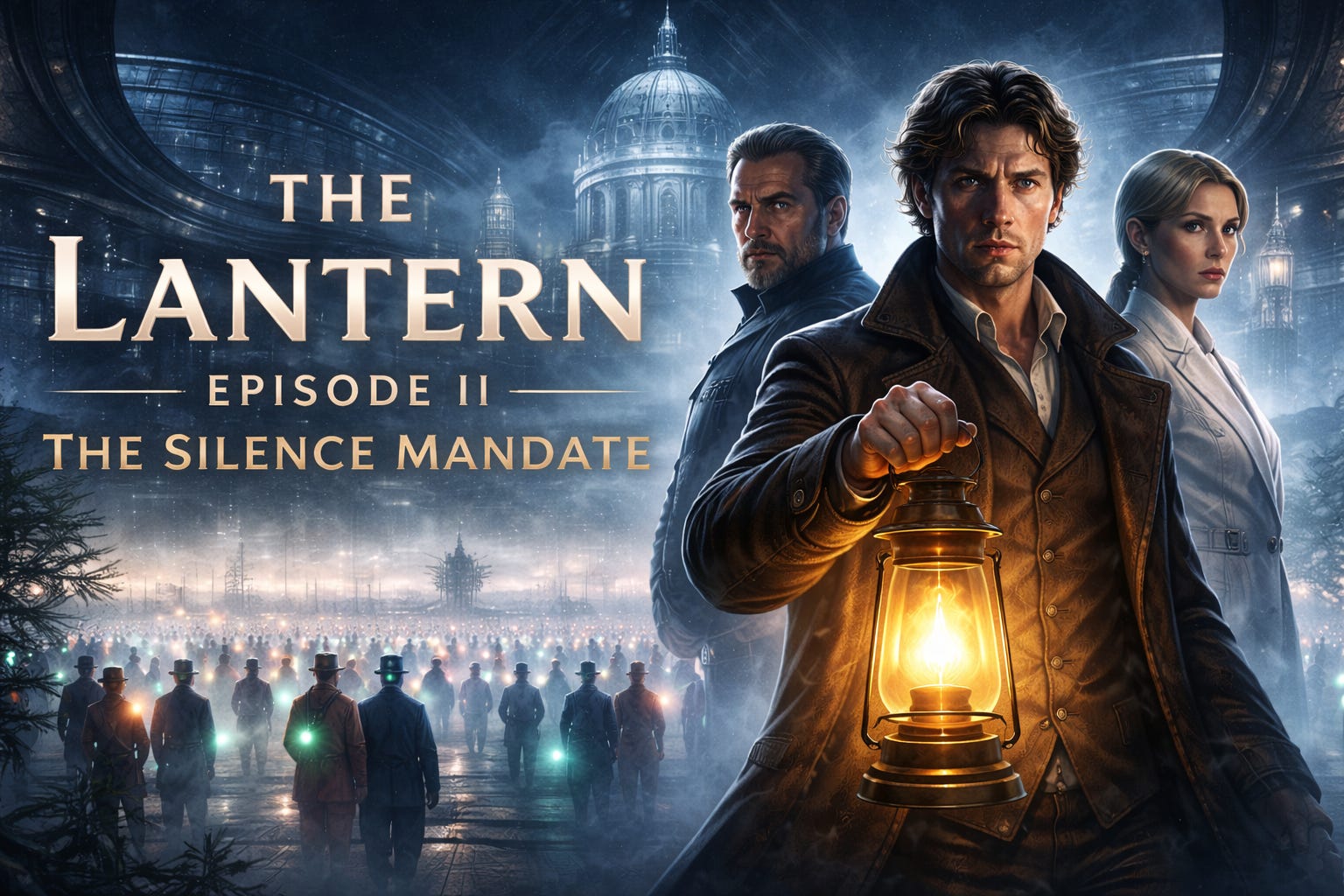
Intro
Each month, The Lantern travels where good things have grown dangerous.
Not evil.
Not monstrous.
Merely swollen beyond measure.
In Episode I, we encountered a civilization that abolished edges in the name of unity — and discovered that without definition, nothing stands.
Tonight, we arrive at a different distortion.
A world that outlawed speech in the name of compassion.
Here, no one argues.
No one interrupts.
No one risks offense.
And yet something essential has vanished.
Because mercy requires confession.
And confession requires words.
Welcome to Episode II — The Silence Mandate.
I. The Planet of Soft Agreements
The Lantern entered orbit above a planet wrapped in pale silver haze, the kind of atmosphere that made distance look merciful. From space, the cities seemed immaculate—geometric as diagrams and calm as a prayer.
No scars of war.
No borders marked in defiance.
No smoke.
Just symmetry.
Captain Alistair Rowan stood at the forward glass, hands folded behind his back in that unhurried posture of a man who refused to be rushed even by the universe.
“Orderly,” he said.
“Regulated,” Elias North corrected, turning a brass dial that clicked like a patient insect.
Julian Ashcroft paced, restless as a thought that would not settle.
“Dead,” he said.
Clara Wren read from the archive slate. “Civilization name: the Concord. Primary civic doctrine: Compassion Preservation. Their key legal instrument is called the Silence Mandate.”
Rowan glanced sideways. “A law against speech.”
“A law against harm,” Clara corrected gently, quoting the Concord’s own language. “Speech was deemed the primary carrier of offense. Offense the seed of violence.”
Father Lucian Vale sat in a chair with his hat folded neatly in his lap, eyes half closed.
“Then the seed has been uprooted,” he murmured.
Julian’s mouth tightened. “Or buried.”
Clara continued, “They replaced most verbal exchange with emotional projection—calibrated empathic transmitters. Their records claim it reduced interpersonal conflict by ninety-four percent.”
“Records claim many things,” Rowan said mildly.
The Lantern descended.
It did not land so much as arrive, settling in a wide plaza that seemed designed to avoid the possibility of confrontation—no sharp corners, no narrow corridors, no places where two people must pass and decide who yields.
The air itself felt managed.
Even the wind moved politely.
II. The Greeting Without Words
They were met by citizens in simple garments of soft gray and muted blue. At each throat, a delicate collar-band pulsed faint color—blue for contentment, amber for attention, gold for affirmation. The colors were gentle, like the wash of stained glass.
No one spoke.
Instead, the square filled with a warm sensation—an emotional greeting, projected outward like perfume. The translator on Clara’s slate rendered it into words, but the words felt like an imperfect attempt to bottle weather.
Welcome. You are safe here. We share your peace.
Julian replied aloud, because he could not bear being comforted by a machine.
“Peace is not proved by the absence of noise.”
The nearest collar flickered—an involuntary irregularity—then settled back to serene blue.
A woman stepped forward. Her collar-band held a steady amber glow, as though she were perpetually in the posture of listening.
She projected again:
You are visitors. We understand you travel to unstable worlds. You will find no instability here.
Rowan inclined his head. “That is a remarkable claim.”
Not a claim. A condition.
Elias looked beyond the crowd to the city’s tall structures—perfectly vertical, smooth-faced, with windows arranged like careful mathematics. “How do you coordinate labor without speech?”
The woman’s collar pulsed faint gold.
Through alignment.
Father Vale’s eyes opened fully, calm and intent. “And when alignment fails?”
The woman’s projection came slower:
Alignment is taught. Alignment is maintained. Alignment is compassion.
Julian’s gaze sharpened. “And those who cannot align?”
The woman did not answer immediately. Her collar faded from amber to a cautious violet. The translator rendered:
We assist them.
The word assist sat on the tongue like something sweet that could conceal poison.
III. The Council of Harmonies
The Council chamber was a masterpiece of avoidance.
No dais.
No raised seat.
No sharp acoustics.
A circular hall with soft surfaces that swallowed sound, as though even echoes were considered a form of aggression.
At the chamber’s center stood a shallow basin of water. The water was perfectly still, a symbol of harmony—or perhaps an instruction.
A man greeted them. His collar pulsed constant blue, with faint gold pulses that suggested official welcome. His face was calm in the manner of those who believe they have solved the world.
“I am Sera Kine,” he said aloud—his voice carefully controlled, almost ceremonial. It was clear that speech here was not forbidden outright; it was reserved, rationed, and treated like a dangerous substance.
Beside him stood another figure: a woman with sharper eyes, collar pulsing not blue but a disciplined silver-white—rare, almost clinical.
“This,” Kine projected through the system, “is Advocate Liora Venn, Steward of the Mandate.”
Julian watched her collar with interest.
“Silver,” he said. “Not an emotion.”
Venn’s gaze did not flicker. “It is a standard.”
Clara’s translator rendered Kine’s formal projection:
We adopted the Silence Mandate to protect compassion. Words injure. Tone wounds. Misunderstanding multiplies. We removed the primary vector of offense.
Rowan’s voice was gentle. “And in doing so, you removed argument.”
Kine nodded slightly. “Argument is a rehearsal for violence.”
Julian’s laugh was short. “Or a rehearsal for truth.”
Venn spoke aloud, clipped and certain. “Truth does not require injury.”
Father Vale’s voice was soft. “Truth often causes it.”
The room’s ambient color shifted imperceptibly—no longer serene blue, but a paler shade as if the atmosphere itself had been asked to remain calm.
Rowan gestured toward the basin. “Your symbol is still water.”
Kine nodded. “Stillness is safety.”
“And forgiveness?” Rowan asked quietly.
Kine’s mouth opened, but Venn answered first.
“Forgiveness is unnecessary when offense is prevented.”
Rowan looked at her for a long moment.
“If no one speaks,” he asked, “who forgives?”
Venn did not flinch. “We do not require forgiveness. We require regulation.”
IV. The Streets of Perfect Courtesy
After the Council session, Clara requested a tour.
They walked streets that were clean enough to feel newly invented. Citizens moved with remarkable efficiency—no jostling, no hurried interruptions, no shouted conversations from balconies. The only sounds were footsteps and the faint hum of the collar-bands.
Elias watched a line of workers passing bricks hand to hand, each motion timed, each exchange accompanied by a faint gold pulse.
“Signal coordination,” he murmured. “They’ve replaced language with a synchronized control loop.”
Julian gave him a look. “Spoken like a man who loves machines.”
Elias didn’t deny it. “Machines are honest about their purpose.”
“And people?” Julian asked.
Elias considered. “People are honest about theirs, too. Eventually.”
They passed a small café. No clatter of chatter. Only soft music and projected mood—gentle contentment, not from the patrons but from the building itself. A hush manufactured as product.
Clara frowned. “Do you ever get tired,” she asked one patron through projection, “of always feeling what you are supposed to feel?”
The patron’s collar warmed briefly in amber—uncertainty—then returned to blue.
Supposed is a violent word, came the projection.
Julian muttered, “And there it is.”
They came upon a public fountain where a dozen citizens stood in a ring. They were not speaking. They were aligning—sending waves of calm to one another like a communal weather report.
A child stood at the edge of the ring. His collar pulsed irregular gray, then faint red, then snapped back to blue with a visible shudder.
Venn noticed their gaze and stepped forward.
“Malalignment,” she said aloud. “We are correcting it.”
Father Vale watched the child’s face. The boy’s eyes were wide with something that was not permitted to be named.
V. The Boy Who Wanted to Shout
Later, Elias found the same child sitting alone beside a narrow canal. The city’s architecture made even solitude feel planned: a bench precisely placed, a gentle light, a wall curved to hide him from view.
Clara approached slowly, the translator ready. The child’s collar flickered gray.
Are you here to align me? the projection asked.
“No,” Clara said softly. “We are visitors.”
Visitors are unpredictable.
Julian crouched, bringing his face level with the boy’s. “Unpredictable is sometimes another word for alive.”
The boy’s collar flickered red. Immediately it dimmed—an automatic dampening. The red didn’t vanish; it was suppressed.
Elias leaned in, examining the collar-band. “Feedback loop,” he murmured. “It detects spikes and compresses them.”
Father Vale’s voice was gentle. “Compresses grief as well as anger.”
The boy looked at Vale, and for a moment the collar didn’t catch the change quickly enough.
I want to say something, he projected.
“What?” Vale asked.
The boy’s collar went gray again.
I want to shout.
Julian’s eyes hardened. “At whom?”
At my mother. At the Council. At the sky.
Clara blinked. “Why the sky?”
Because the sky never answers.
Vale nodded slightly, as though this were the most reasonable thing said all day.
“And what happens,” Vale asked, “if you shout?”
The boy’s collar flickered pale violet.
Isolation.
“Isolation from whom?” Julian asked.
From everyone.
Elias’s hand hovered near the collar, not touching. “They’ve made loneliness a penalty.”
“They’ve made loneliness a tool,” Julian said.
The boy looked away. The canal water was perfectly still, like the basin in the Council chamber.
“It’s a pretty world,” Julian said softly. “But it smells like fear.”
The boy’s collar pulsed amber—agreement—and then immediately dimmed, as if agreement with that statement was itself dangerous.
VI. The Advocate of Kindness
That evening, Advocate Venn invited the crew to observe a Mandate session—a “Compassion Calibration” conducted to correct emotional disharmony.
Rowan accepted.
Julian accepted with the smile of a man entering a duel.
The session took place in a hall whose walls were soft as a whisper. Citizens sat in neat rows. At the front, a platform held nothing but a small silver device mounted on a pedestal.
“This is the Harmonizer,” Venn said. “It broadcasts stabilizing projection in cases of volatility.”
Elias stared. “A centralized emotional regulator.”
“Compassion,” Venn corrected.
Venn’s voice was calm, but her eyes were sharp. She was not a villain. She believed. That made her more dangerous.
A man was brought forward. His collar pulsed red and gray, struggling against its own dampening.
Clara’s translator rendered his projection:
I do not align.
Venn turned to the crowd. “Observe. Malalignment begins as discomfort. Discomfort becomes offense. Offense becomes harm. Harm becomes violence. We intervene early.”
Rowan’s voice was steady. “Do you ever intervene too early?”
Venn’s mouth tightened. “There is no ‘too early’ for kindness.”
Julian spoke aloud. “There is, if kindness becomes coercion.”
The crowd’s collars dimmed slightly, a collective caution.
Venn held Julian’s gaze. “You are from worlds that still worship conflict.”
Julian smiled. “We worship truth. Conflict is merely its shadow.”
Venn gestured toward the Harmonizer. “We will now administer compassion.”
The silver device emitted a low hum. A wave of serene blue washed across the room. The man’s red pulses flattened into pale gray, then into compliant blue.
He blinked slowly, like someone waking from anesthesia.
Rowan’s voice was quiet. “Is he healed?”
Venn’s answer came at once. “He is safe.”
Father Vale’s eyes narrowed. “Safe from what?”
Venn’s gaze flickered toward the man. “From himself.”
The line landed heavily.
Rowan watched the man’s face. It was calm.
Too calm.
Calmness can be a gift.
Or a muzzle.
VII. Julian’s Private Anger
Back aboard the Lantern, Julian paced the corridor like a caged tiger that had read too much philosophy.
“They are turning mercy into a chemical,” he said.
Elias adjusted an instrument. “They are compressing emotional variance.”
Julian spun. “Don’t translate it into engineering. Say what it is.”
Elias paused, then spoke carefully. “It is control.”
Julian nodded. “Thank you.”
Rowan stood by the observation glass, watching the silent city.
“They aren’t cruel,” Rowan said.
Julian’s voice sharpened. “Cruelty is not required for tyranny.”
Rowan didn’t argue. He simply waited, which was his way of forcing others to hear their own words.
Julian exhaled. “It’s—” He stopped, then began again. “It’s the tone. The kindness. The constant velvet.”
“Velvet can smother,” Father Vale said quietly from behind them.
Clara approached, slate in hand. “Their historical record shows violence in their past—real violence. Wars. Mass offense. They are reacting.”
Julian laughed once. “So am I. I’ve seen what ideologies do when they claim to prevent harm.”
Rowan finally turned. “Then be careful you don’t become an ideology yourself.”
Julian stiffened. That was a blow, but not an unfair one.
Rowan’s voice softened. “We are not here to win arguments. We are here to carry light.”
Julian’s shoulders lowered slightly. “Light requires speech,” he said.
Rowan nodded. “And speech requires risk.”
VIII. The Breaking Point
The following day, the city held an Affirmation Ceremony in the central square.
Citizens gathered in rings, projecting calm toward one another in synchronized waves. The square glowed faintly with blue and gold.
It was beautiful.
It was also fragile.
The boy from the canal stood among them. His collar flickered gray.
The harmonized projection began.
The boy’s collar turned amber—uncertain.
Then red—sharp, sudden.
Immediately his collar dimmed, but the red had already entered the ring like dye in water.
The ring’s color pattern wavered.
A ripple of irregularity spread outward. Collars flickered violet, then gray.
The crowd did not shout.
They did not argue.
They simply lost harmony.
And without language to metabolize it, the emotional disturbance began to swell.
Venn’s voice rose—one of the few loud sounds the planet had produced in years.
“Harmonizer!”
The silver device was wheeled into the square. It hummed, broadcasting serene blue.
The crowd’s fluctuation began to flatten.
The boy’s face tightened.
He looked as though he were drowning in calm.
Father Vale stepped forward, unexpected and unannounced.
“Stop,” he said aloud.
Venn turned sharply. “You do not understand what you are interrupting.”
“I understand,” Vale said gently, “that you are overriding a human soul.”
The Harmonizer’s wave continued.
Rowan spoke quietly to Elias. “Can you reduce it?”
Elias was already at a portable panel, hands steady. “I can attenuate. But it will create variance.”
Rowan nodded. “Do it.”
Elias adjusted, shaving the wave by degrees.
The blue softened. The crowd’s collars began to flicker—less suppressed, more themselves.
Venn’s face tightened. “You are reintroducing harm.”
Julian stepped beside Vale, voice loud enough to cut through the hum.
“Harm is not the same as honesty.”
Venn snapped, “Honesty without compassion is violence.”
Julian replied, “Compassion without honesty is control.”
The crowd’s collars flickered violently at the clash of words, as though unused to them.
Clara, watching the boy, whispered, “He’s going to collapse.”
The boy’s collar flashed red again, then dimmed. His knees buckled.
Father Vale caught him.
And in that moment, with the Harmonizer’s wave weakened, the boy’s voice—unfiltered—escaped his throat.
“I hate it,” he cried. “I hate being calm. I hate being safe. I hate being alone!”
The words struck the square like a stone through glass.
Not because they were offensive.
Because they were real.
For a heartbeat, the entire city seemed to inhale.
Then, for the first time in years, a sound rose that was not projected: sobbing.
A woman wept aloud. Then another. The contagion of honest grief spread.
The square erupted—not in riot, not in violence—but in voice.
Words came awkwardly, like limbs unused.
“I’m tired,” someone said.
“I’m afraid,” said another.
“I miss my sister,” someone whispered, as though confessing a crime.
Venn’s face went pale.
“This is destabilization,” she said.
Rowan watched the crowd with a strange tenderness.
“This is humanity,” he said.
IX. The Trial of Speech
The Council summoned them immediately.
The chamber was less serene now, its ambient hues uneven.
Kine spoke aloud, his voice strained with controlled alarm. “You triggered a civic fracture.”
Julian corrected him. “We triggered speech.”
Venn’s eyes were bright with anger and fear. “You released a pathogen.”
Father Vale’s voice was gentle. “You called grief a disease.”
Venn replied sharply, “Grief spreads.”
“So does love,” Vale said.
Kine looked to Rowan. “Captain, your vessel’s purpose is stability. Why introduce instability?”
Rowan’s answer was slow. “Stability without mercy is merely stillness.”
Clara spoke, careful and respectful. “Your Mandate prevented offense, yes. But it also prevented confession. Without confession, forgiveness becomes impossible. Without forgiveness, harm accumulates quietly.”
Venn’s chin lifted. “We do not need forgiveness.”
Rowan’s eyes held hers. “Then you will have no mercy.”
Venn’s voice trembled, almost imperceptibly. “Mercy is indulgence.”
Julian leaned forward. “Mercy is the only thing that makes justice human.”
The chamber dimmed, as if struggling to absorb conflict without its old tools.
Kine asked, almost pleading, “What do you propose?”
Rowan gestured gently. “Do not abolish your Mandate overnight. But do not make the Harmonizer your god.”
Venn stiffened at the word.
Elias spoke, quiet and technical. “You can reduce dampening thresholds. Allow speech in controlled circles. Treat words as tools, not weapons.”
Kine listened, but Venn shook her head.
“You are outsiders,” she said. “You do not know what our people were.”
Julian’s voice softened unexpectedly. “No. But we know what your people are now.”
Venn’s eyes flashed. “Safe.”
Julian replied, “Lonely.”
X. The Cost of Voice
Over the next days, the Lantern crew remained, advising in small measures.
The Council authorized “Speech Chambers”—designated rooms where citizens could speak without collar modulation. The decision was framed as an experiment, not a reform. Venn insisted on that.
At first, the chambers were full of stammering, awkward honesty. People spoke like children learning to walk.
Then, inevitably, came anger.
Someone shouted.
Another replied with a cruel word, sharp as a knife, unused and therefore mishandled.
The old fear returned quickly.
Venn’s position strengthened.
“You see?” she said to Rowan privately after an incident where two men nearly struck each other. “Words are violence.”
Rowan’s voice was calm. “Words are risk. Risk can be borne.”
Venn’s expression hardened. “We already bore enough.”
That night, the boy from the canal was found alone again by the water, collar flickering gray.
Clara sat beside him.
“Do you feel better?” she asked softly.
He hesitated.
I feel… loud.
“And is that good?”
Sometimes.
Sometimes?
Sometimes people look at me like I’m dangerous.
Clara swallowed. “They’re learning.”
The boy’s collar flickered amber, then gray.
I miss being safe.
The line struck Clara harder than any accusation.
Father Vale arrived quietly, standing behind them.
“Safety is not sin,” he said gently. “It is simply not salvation.”
The boy looked up. His voice was small.
“What is salvation?”
Vale smiled sadly. “It is being known, even with your worst words.”
XI. The Advocate’s Decision
The Council reached a compromise.
Speech would be permitted in limited “Mercy Hours,” once per cycle, supervised by Mandate stewards. The Harmonizer would remain active the rest of the time.
Venn presented it as progress.
Julian called it a leash.
Rowan accepted it as partial light.
On the day of implementation, Venn met Rowan at the edge of the square.
“You think I am cruel,” she said quietly.
Rowan shook his head. “I think you are afraid.”
Venn’s collar pulsed silver-white—standard—then, for the first time, flickered faint violet.
“I watched my brother die,” she said, voice low and real. “Because of words. Because men could not stop saying what they hated.”
Rowan’s voice softened. “Then you tried to stop hate by stopping speech.”
“Yes,” she whispered. “And now you ask me to risk it again.”
Rowan did not argue. He simply said, “Mercy is always risk.”
Venn looked toward the crowd gathering for the first official Mercy Hour. The air felt different—charged, uncertain.
“If they hurt each other,” she said, “it will be because you reopened the door.”
Rowan’s eyes held hers. “If they forgive each other,” he replied, “it will be because you did.”
Venn’s jaw tightened.
She turned away.
XII. Departure
The Lantern lifted into orbit quietly, leaving the Concord not transformed, but altered.
From above, the city still glowed with serene blue—harmonized, regulated, restrained.
But now, in small pockets, there were flickers.
Speech chambers.
Mercy hours.
Unsanctioned whispers in narrow corridors.
Not revolution.
Not liberation.
A crack in the glass.
Clara watched the planet recede. “We did not free them.”
Rowan’s voice was gentle. “We were not asked to.”
Julian’s expression was grim. “We gave them a tool and left them with a weapon.”
Father Vale looked out at the silver haze. “Perhaps we gave them a wound that can become a mouth.”
Elias adjusted the gyroscope. “Their system will resist change. Their dampeners will remain. The Harmonizer will still flatten spikes.”
Rowan nodded slowly. “Yes.”
Clara’s voice was thoughtful. “But they have one thing they did not have before.”
Julian looked at her. “What?”
Clara answered, “The knowledge that silence is not compassion.”
The Lantern moved toward its next coordinates.
Elias read the destination aloud.
“A civilization that has outlawed history in the name of progress.”
Julian sighed. “Of course.”
Rowan folded his hands. “Then we will carry the lantern there.”
Father Vale’s voice was almost a whisper. “And we will see whether memory can be forgiven.”
The Lantern vanished into starlight.
Below, on the Concord, the first Mercy Hour began.
Someone spoke a painful truth.
Someone else responded poorly.
And somewhere in the crowd, the boy from the canal—still flickering, still not aligned—said aloud, with all the danger of honesty and all the courage of it:
“I’m sorry.”
The words were small.
But they were unmoderated.
And for the first time, the city had something it had not engineered:
A beginning.
Outro
The Concord is not cured.
The Silence Mandate remains.
The Harmonizer still hums.
Speech is rationed.
But now there is a crack in the stillness.
A child has shouted.
An advocate has hesitated.
A city has spoken aloud.
Partial restoration is not triumph.
It is risk.
Season One of The Lantern traces this pattern across worlds — where virtue, unrestrained by proportion, hardens into coercion.
Next voyage:
A civilization that has outlawed history in the name of progress.
Because memory, too, can be declared dangerous.
Until then —
Daily story.
Deliberate reflection.
A quiet hour in a noisy age.
— Chesterton Radio