

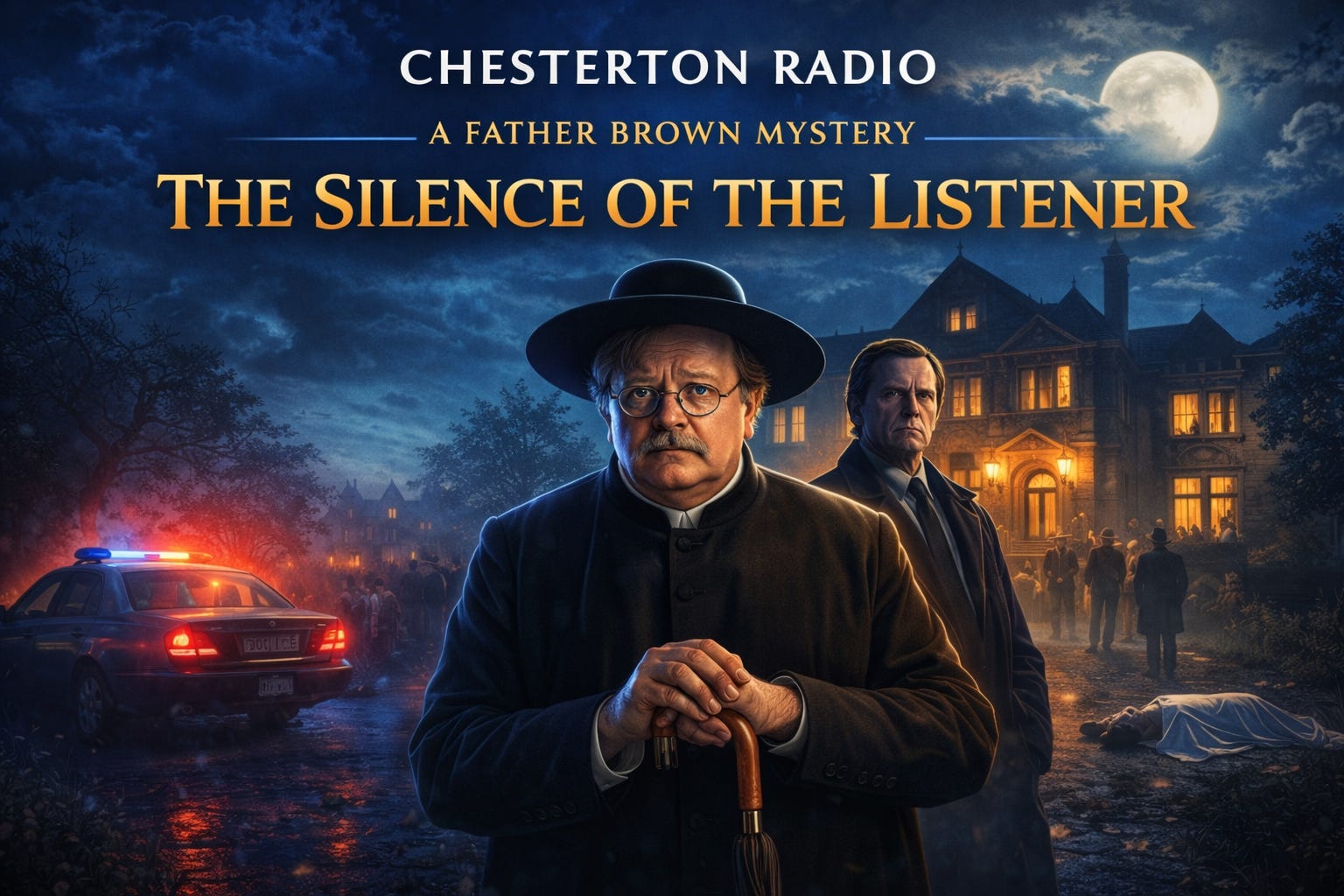
There are some houses that have a history and some that have only an ambition. The worst kind are those which have ambition enough to pretend to a history. They are not content to be new, comfortable, and expensive. They must also seem ancient, mysterious, and inevitable. They must have beams darkened by chemical artifice, stones imported from places where stones are old, and portraits painted last year in order to resemble ancestors who never existed. Such houses are not merely furnished; they are edited.
The Listening House, standing above the low and lonely roll of country outside Atchison, Kansas, had exactly that air of being revised by a man with money and a theory. Long ago there had indeed been a religious house on or near that hill. One could not walk there, especially in the evening, without feeling that some memory of bells still wandered in the air. But the present mansion was not old enough to have heard those bells. It merely wished, with all the vanity of modern culture, to borrow their authority.
It had been built by Dr. Lionel Vane, lecturer, essayist, moral psychologist, and founder of what the newspapers called the Listening Movement. This movement was one of those things which arise in every generation to assure men that morality can be made both easier and more flattering than it has hitherto been. Dr. Vane’s doctrine, repeated in books, interviews, retreats, conferences, and very expensive streaming subscriptions, was that the world did not need more argument but more attention. Men quarrelled, he said, because they did not listen. Nations fell apart because they did not listen. Families rotted because they did not listen. Churches declined because they did not listen. If only men would listen deeply enough to truth, truth would heal them almost by osmosis. Listening was the first virtue, the mother of virtue, and perhaps, if one were frank, almost the whole of virtue.
This was so agreeable a doctrine that thousands embraced it. It required from the wealthy nothing but attendance, from the idle nothing but reflection, and from the vain nothing but the opportunity to say, with touching humility, that they were still “doing the work of listening.”
On a windy April evening a small company had gathered at the Listening House for what had been announced as a private supper and strategic conversation. The phrase was typical of the place. It suggested intimacy without friendship and seriousness without danger. The company had been selected, as such companies always are, with care and calculation. There was Professor Adrian Kells, a moral philosopher of national reputation, famous chiefly for demonstrating that very little could ever be morally clear. There was Marianne Crowe, whose face and opinions appeared nightly on screens across the country, and who had managed the rare feat of turning indignation into elegance. There was Evelyn Strake, director of the Compassion Initiative, an impressive charitable network which raised millions by organizing polished events about poverty for people who would never have to endure it. There was Julian March, the youngest of them all, a writer, essayist, and social media celebrity whose plain-looking videos on discipline, self-denial, and authenticity had drawn a following so large that many older intellectuals resented him before they had heard a word he said. There were also two or three secondary guests, assistants and advisers, those useful shadows who are allowed to stand near important people in order to reassure them that they are important.
And among this company, arriving with a valise too old for fashion and an umbrella too large for convenience, was Father Brown.
No one had expected him except Dr. Vane, who had sent the invitation in a brief hand-written note so unlike his public style that it had surprised the priest almost into declining. Father Brown had met Lionel Vane years before, in England, at a university chapel where the famous lecturer had spoken brilliantly and quite sincerely about humility. There had been something then, beneath the brilliance, which reminded the priest of a man leaning very far over a cliff while discoursing on the laws of gravity. He had not fallen then. But Father Brown had never entirely ceased to worry about him.
A young woman at the desk in the entrance hall looked up from a tablet and said, “Name?”
“Brown,” said the priest.
She searched, frowned, and then glanced again.
“Oh. Father Brown?”
“Yes,” he said, smiling. “I’m afraid I’m the whole thing.”
She seemed uncertain whether that was meant humorously. Many modern people are uncertain on that point with priests because priests are among the last men allowed to be grave and comic at once.
“Dr. Vane is expecting you,” she said at last. “Dinner in twenty minutes. Cocktails in the west salon.”
“Thank you,” said Father Brown, and wandered toward the west salon with the air of a man mildly lost in his own parish.
The west salon looked west with determination. Its windows were enormous; its chairs low and expensive; its books artfully arranged by color rather than subject; its lamps dim enough to flatter faces and hide dust. The whole room had the studied softness of wealth trying to resemble wisdom. A fire burned, though the night was not cold enough to require it. Some people keep fires for heat; others keep them for atmosphere; and there are a few who keep them because they feel an undefined need to be seen in front of one.
Dr. Lionel Vane stood there with a glass in his hand and a smile that could still command a room. He was a broad man, silver-haired and heavy about the shoulders, with the large head and mobile features of a born speaker. There was even now something candid in his face, as if he were perpetually on the edge of saying more than prudence allowed. It was perhaps this quality, half honesty and half vanity, that had made him so powerful. He looked genuinely delighted to see Father Brown.
“My dear priest,” he said, striding forward. “You came.”
“I generally do,” said Father Brown. “Though not always to the right place.”
Vane laughed louder than the joke deserved, as successful men often do when they feel a sudden relief. “No, no. This is precisely the right place. Or it may become so before the night is over.”
Father Brown blinked. “That sounds hopeful.”
“It is,” said Vane. Then, lowering his voice, “Or fatal.”
Before the priest could reply, the others had turned, and Vane began the delicate operation of introducing one kind of celebrity to another while allowing each to believe he already knew all about the rest. Father Brown shook hands with Professor Kells, who wore an expression of courteous fatigue, as if the world had been disappointing him in increasingly subtle ways for thirty years. Kells’s hair was carefully untidy, his suit carelessly expensive, and his eyes restless with the habit of perpetual qualification.
“I’ve heard of you, Father,” said Kells. “You are interested in paradox.”
“Oh yes,” said Father Brown. “Everybody is. Some of us merely admit it.”
Kells smiled with academic politeness and moved away.
Marianne Crowe was a handsome woman in a severe dark dress that made her face appear brighter and more determined. She had the gift, now common and always ominous, of speaking as if everything she said had already been applauded somewhere else. She took Father Brown’s hand for half a second and said, “I think moral clarity is more important than ever right now.”
“That is true,” said Father Brown.
She stared at him a moment, almost disappointed that he had not objected.
Evelyn Strake was smaller, older, and much harder. She had a face of perfect administrative control, the sort of face that can announce budget cuts in the tone of a blessing. She was impeccably kind in exactly the manner that makes the recipient feel he has misused resources by existing. She acknowledged Father Brown without curiosity.
Julian March was altogether different. He was tall, pale, almost awkward, with dark hair falling over a forehead too serious for his age. He looked not like a man at ease with fame but like a student trapped in a theater costume of fame. When Vane introduced him, he shook Father Brown’s hand with genuine embarrassment.
“I read one of the old Father Brown stories in college,” he said.
Father Brown looked amused. “My goodness. I hope I behaved myself.”
Julian almost smiled. “Better than most of us, I think.”
There was in the younger man’s voice something strained but sincere. Father Brown noticed that he watched Dr. Vane not with admiration but with a fixed intensity that was almost filial and almost accusatory. It was the look of a disciple who has seen something.
Dinner was announced by a discreet chime, and they moved into a long room where the table shone under suspended lights shaped like drops of glass. Beyond the windows the plain was fading into one vast violet distance. There is a moment in certain American evenings when the land appears less like earth than like sea, as if one might launch upon it and be carried away into silence. The Listening House stood over such a silence now, all its lamps and conversations like signals from a ship too pleased with itself to understand the weather.
The first course passed in that polished sparring with which cultivated people test one another while pretending not to. Professor Kells observed that moral discourse had become too binary; Marianne Crowe deplored the coarsening of public debate; Evelyn Strake insisted on the need for scalable compassion; a younger consultant said something about narrative frameworks. Father Brown, who had been offered wine twice and declined it three times, devoted himself to soup with profound attention.
Only Dr. Vane seemed distracted. He smiled, responded, directed, but did not dominate. Once or twice he glanced toward Julian March, and each time the younger man looked away. It was not until the plates had been changed and the conversation had risen to that falsely relaxed height which follows expensive food that Vane set down his glass and said quietly:
“I owe you all an apology.”
The words were so unlike the rhythm of the evening that the room did not at first understand them. Marianne Crowe, who had just begun a sentence, stopped with unusual abruptness.
“An apology?” said Kells.
“Yes,” said Vane. “For years I have said something true in a way that was false.”
That is the sort of sentence before which most people instinctively retreat. Truth in a false way is much more alarming than falsehood in a false way. Falsehood is a burglar. Truth dressed falsely is a trusted servant who knows the house.
Vane went on. “I have said that listening is the beginning of moral renewal. It is. But I have permitted people to think it is also the fulfillment of moral renewal. It is not. Listening is not obedience. Attention is not repentance. Reflection is not charity. Agreement is not sacrifice.”
No one interrupted him. The thing had become too interesting.
“I built a movement,” he said, “that taught people to admire the good in the abstract while postponing it in the concrete. I encouraged them to linger forever in the vestibule of virtue.”
“That is melodramatic,” said Professor Kells, not loudly.
“No,” said Vane, “it is merely accurate.”
Evelyn Strake said, “Surely you are not suggesting that the work done through this platform has been meaningless.”
“I am suggesting,” said Vane, “that much of it has been decorative.”
This was so direct an insult to almost everyone at the table that the room seemed to contract around it.
Marianne Crowe recovered first. “Lionel, if this is about execution rather than vision, we can discuss governance tomorrow. But language like that is reckless.”
“Language like mine has been cautious for too long,” said Vane.
Father Brown, who had glanced down at the table for some vanished spoon, suddenly saw beside Vane’s hand a small white card. He could not make out the whole writing at first, but in another moment he recognized the text:
Be doers of the word, and not hearers only.
He looked up. Vane had followed his glance and covered the card with his hand, though not before Julian March had seen the gesture.
“What is this really about?” asked Julian.
Dr. Vane turned toward him slowly. “You know very well what it is about.”
The young man’s face tightened. “Then say it plainly.”
There was a silence in which one could hear the faint vibration of the lights.
Vane said, “I intend tomorrow morning to make a statement. A complete one. About the movement, its failures, my failures, and what must follow.”
Evelyn Strake’s voice hardened by half a degree. “What must follow?”
“A house-cleaning,” said Vane. “And perhaps some house-burning.”
Marianne Crowe stared at him. “You can’t be serious.”
“Oh, I’m serious enough at last,” said Vane. He leaned back. “The strange thing is, I owe it to the youngest man in the room.”
All eyes went to Julian March. The young man looked as if he had been struck, but not unexpectedly.
Vane lifted his glass as if to salute him. “There is still one of us,” he said, “who tried to live what the rest of us branded.”
No one spoke. The compliment sounded too much like an accusation.
Then the lights went out.
They did not flicker theatrically or fail by degrees. One moment the room was lit with modern perfection; the next it was blind. Someone gasped. A chair scraped. Glass rang against silver. From very far away, as it seemed, came a heavy small sound, like a man dropping to his knees or a book falling shut.
Then another sound followed it: not loud, not violent, but somehow conclusive.
When the emergency lights came on, they revealed Dr. Lionel Vane lying beside his chair.
He had not fallen with disorder. His body lay almost neatly, one arm bent under him, the other stretched out. In the stretched hand he still held the white card. His head was turned toward the fire. His expression was not twisted or terrified. It was, if anything, astonished.
Father Brown rose at once and knelt by him. The others hung back with that mixture of horror and reluctance peculiar to people who are very interested in tragedy provided they need not touch it. The priest laid two fingers to the neck, then to the wrist, and finally looked up.
“He is dead,” he said.
That, curiously enough, was when Marianne Crowe screamed.
The next hour was all confusion wearing the mask of process. Phones appeared. Security systems were checked. A backup generator hummed somewhere in the depths of the house. Staff members materialized and vanished. No one was allowed to leave. At length Inspector Hale arrived from town with a local deputy, and the modern machinery of inquiry began to move through the modern theater of self-importance.
Inspector Hale was a solid man with the expression of someone who had spent years being lied to by people less clever than they imagined. He did not appear intimidated by famous names, perhaps because he knew fame was only a particular style of lying. He viewed the body without sentiment and the room without reverence. He asked who had touched the deceased, who had moved, who had spoken, who had gone near the windows or doors. No one had left the dining room in the darkness, at least according to everyone else. No wound could be found. No overturned chair suggested a struggle. The doctor called from town could not determine the cause of death by mere inspection. It might be some seizure, some hidden condition, some poison, though none yet visible.
“A dead man in a closed room full of moral experts,” said Hale dryly. “That will be pleasant.”
He interviewed them one by one in the library. Father Brown, waiting his turn, wandered among the shelves. There were thousands of volumes, beautifully bound, many scarcely opened. One whole wall was given to ethics, spirituality, psychological resilience, justice, mindfulness, leadership, contemplative practice, and memoirs of redemption by people who still traveled with assistants. There was something almost sepulchral about such a library. It felt not like a place where men had sought wisdom but where they had stored the appearance of having done so.
On the writing desk stood another white card.
Be doers of the word, and not hearers only.
Father Brown regarded it for a long time.
When his turn came, Inspector Hale said, “You’re the priest.”
“I’m afraid so.”
“Do priests often get invited to this sort of thing?”
“Only when somebody is in more trouble than the others know.”
Hale grunted. “Did Vane have enemies?”
“Yes,” said Father Brown.
“Among this crowd?”
“Yes.”
“Which ones?”
Father Brown considered. “Probably all of them. But not in the same way.”
Hale leaned back. “That’s a priest’s answer.”
“No,” said Father Brown. “A priest’s answer would be longer.”
The inspector almost smiled. “Did you see anything at the table before the lights went out?”
“Yes. A card with a verse from Saint James.”
“What do you make of that?”
“It depends,” said Father Brown, “whether it was a warning, a confession, or a joke.”
“Do you think he was murdered?”
Father Brown looked at him with his bland brown eyes. “Yes.”
Hale sharpened. “How?”
“I don’t know yet.”
“By whom?”
“I don’t know that either.”
“Then why say yes?”
Father Brown folded his hands over the head of his umbrella. “Because accidents do not usually arrange themselves morally. This death already has the shape of a meaning. That may not be evidence in court; but it is often evidence in life.”
The interviews continued. Professor Kells said that Vane had become erratic in recent weeks and had lately shown a regrettable appetite for moral simplification. Marianne Crowe said that Vane was under pressure and perhaps unstable, though she added with magnanimity that geniuses often passed through turbulent periods. Evelyn Strake spoke of fiduciary duties, brand risk, and the need to distinguish private agitation from institutional commitments. Julian March said very little. He admitted to having met privately with Dr. Vane the previous afternoon and again that evening before dinner, but refused to describe the content in detail.
“It was personal,” he said.
“To you?” asked Hale.
“To him,” said Julian.
“And now he’s dead,” said Hale. “Personal has become relevant.”
Julian’s face did not change. “Then put me under suspicion.”
“We might,” said Hale.
“You probably should,” said Julian.
There are admissions that come from guilt and admissions that come from a species of honor. The difficulty is that they often sound alike.
Because the hour was late and the roads black with spring rain, Hale insisted that no one leave the house before morning. Rooms were assigned. The body was removed. The great house settled into that peculiar wakefulness which follows shock: doors opening softly, distant footsteps, too-bright lamps in corridors, people speaking low out of instinct rather than charity. Father Brown, who had been given a room at the end of a long upper passage, did not go to bed. He had a habit, inconvenient but useful, of remaining fully awake when others grew weary of pretense.
Near midnight he found Julian March sitting alone in the dark conservatory, where the moonlight made a white geometry among the glass frames and potted trees. The young man sat with his elbows on his knees and his hands clasped so tightly that they looked painful.
“You ought to sleep,” said Father Brown.
Julian gave a short laugh. “Priests say that?”
“Good priests do,” said Father Brown. “Bad priests tell people to pray harder when they are exhausted.”
Julian looked at him. “Do you think I killed him?”
“No,” said Father Brown.
The young man’s shoulders relaxed by an inch. “The inspector does.”
“Yes,” said Father Brown. “That is because the inspector is doing his duty. You are in the right place for suspicion. Young, intense, private meeting, dead mentor. It is a very serviceable arrangement.”
Julian almost smiled despite himself. Then he said, “I might as well tell you. I told him he was a hypocrite.”
“That was not very original,” said Father Brown.
Julian blinked. “You knew?”
“My dear boy, half the people in that room make a living by privately thinking everyone else is a hypocrite. The unusual thing would be saying it aloud.”
“I said more than that,” Julian went on. “I told him his whole movement let people hide from real obedience. I told him he had taught a generation to curate conscience instead of following it.”
“And he agreed?”
“Not at first.” Julian stared out at the moonlit plain. “Then suddenly he did. All at once. It was like watching a man wake up in a burning house.”
Father Brown was silent.
Julian continued, speaking now as if confession itself compelled a strange lucidity. “I believed in him. I mean really believed in him. Not like them.” He made a slight bitter gesture toward the sleeping house. “I thought he was telling us to become honest. To strip things down. To pay attention so that we might actually obey. I changed things. I gave away a lot. I cut away people, habits, distractions. I started going to confession again.” He glanced awkwardly at the priest. “Not yours. Another parish. But still.”
“That was sensible,” said Father Brown. “I am very irregular company.”
Julian ignored the joke. “When he found out how far I’d taken it, he looked almost frightened. Then he asked questions. More and more questions. Tonight before dinner I told him the rest.”
“The rest?”
“That I thought he hadn’t believed his own teaching enough to follow where it led.”
Father Brown considered this. “And that is all?”
Julian hesitated. “No.”
He reached into his pocket and produced a folded sheet of paper. “I gave him this.”
The priest unfolded it. It was a personal rule of life, written with severity and simplicity: daily prayer, almsgiving, fasting, restitution of old wrongs, manual service once a week in a shelter, limits on media and luxury, confession, concrete acts of mercy, no public discussion of private piety. At the bottom was written: To hear and not do is a refined form of lying.
Father Brown handed it back. “A dangerous document.”
Julian looked almost angry. “Because it’s extreme?”
“No,” said Father Brown. “Because it is sincere.”
The young man bowed his head.
“It isn’t a crime,” said Father Brown gently.
“Perhaps not,” said Julian. “But it felt like I had killed something in him.”
Father Brown did not answer.
The next morning broke in a washed blue light over the plains. There are few things more pitiless than morning after moral disaster. Night allows mystery, dignity, and excuse. Morning inventories. By ten o’clock Inspector Hale had received the preliminary report from the doctor: no obvious poison detected in the mouth or stomach contents, though tests would take time; no wound, no blunt force, no sign of strangulation. The heart had failed catastrophically, but whether from natural weakness or induced shock remained unclear.
“Men die of heart failure every day,” said Hale to Father Brown in the breakfast room.
“Yes,” said the priest. “But not all of them do it in the middle of denouncing their own life’s work.”
Hale stared at him. “You’ve got a theory.”
“I’ve got several,” said Father Brown. “That is why I do not trust them yet.”
He spent the next hours not in questioning but in wandering. He talked to the cook about menu changes, to a housemaid about the generator, to the groundsman about the hill, to the young woman at the desk about guests who had arrived earlier than expected. Such inquiries often seem useless to those who believe clues ought to sparkle. But Father Brown knew that the truth is generally hidden not by complexity but by dignity. One must go below the level at which important people explain themselves.
By noon he had learned three things. First, Dr. Vane had sent three e-mails late the previous night to his attorney, accountant, and board chair, all scheduled to release at nine the next morning; they had been intercepted by the attorney after Vane’s death, but not before producing panic. Second, Vane had ordered the staff to prepare the old chapel room—not one of the showy public rooms, but a plain stone chamber left from the original religious house—for a private address that morning. Third, Julian March had spent the past six months doing quietly and without publicity a surprising amount of menial charitable work in town, much of it under another name.
When Father Brown learned the last fact from a bewildered shelter director, he sighed deeply.
“What is it?” asked Hale, who had come with him.
“I was afraid of that,” said the priest.
“Afraid of what?”
“That he really meant it.”
Inspector Hale had little patience with spiritual shorthand. “Who meant what?”
“That young man,” said Father Brown. “He took a fashionable moral theory and committed the indecency of obeying it.”
Hale frowned. “And?”
“And,” said Father Brown, “that is not something fashionable moralists can safely survive.”
The priest asked that everyone gather in the old chapel room at three. The request itself created resentment, which was useful. Nothing reveals people so much as requiring them to sit somewhere plain.
The old chapel had been preserved almost accidentally. The modern house had grown around it as a shell grows around grit. Its stones were rough, its windows narrow, its wooden benches honest. There was no artifice here except the artifice of having left it alone. The room looked exactly like the sort of place where truths too awkward for the salon might choose to wait.
They assembled reluctantly. Professor Kells looked irritated by the very existence of straight-backed seating. Marianne Crowe wore the expression of someone enduring rustic authenticity for the sake of content. Evelyn Strake appeared as if she had already prepared a statement for donors. Julian March stood apart near the wall, pale and still.
Father Brown remained standing before them, hat in hand.
“I am sorry,” he said, “to gather you in a room where what I have to say may sound more serious than it ought. On the other hand, perhaps that is exactly what is wanted.”
No one replied.
“Dr. Vane was murdered,” he said.
Marianne Crowe exhaled sharply; Kells folded his arms; Hale watched the room.
“But not,” Father Brown went on, “in the ordinary sense. No dagger, no pistol, no little bottle hidden in the cuff. You are all disappointed, and I cannot help it. Modern people always want murder to be mechanical because then they may continue imagining that their souls are uninvolved.”
Hale said, “Get to the point, Father.”
“Yes,” said Father Brown. “The point is that one of you held up a mirror to a man, and the man died of seeing his own face.”
He turned to Julian. “Mr. March told Dr. Vane the truth—first about the movement, and then about himself. Not the flattering truth of self-expression; the mortifying truth of obedience. He had acted. He had really acted. Quietly, concretely, sacrificially. He had taken Dr. Vane’s rhetoric with the dangerous seriousness usually reserved for religion.”
Julian stared at the floor.
“Dr. Vane had expected, I think, to inspire reflection. He had not expected to meet incarnation. When he saw that one of his disciples had done what he himself had spent years postponing, all the elegant scaffolding collapsed. He suddenly understood that listening, unless it leads to obedience, is only a decorated delay.”
Professor Kells snapped, “This is moral melodrama. Men do not simply drop dead because they discover inconsistency.”
“No,” said Father Brown. “Most men survive it beautifully. They call it nuance. But Lionel Vane was not wholly false. That was his danger. There was enough real conscience in him to be shattered when it awoke.”
Evelyn Strake said coldly, “So your theory is that our founder was overcome by private guilt?”
“My theory,” said Father Brown, “is that he had already decided to destroy the machinery built around his dishonesty. Those e-mails this morning prove it. That card on the table proves it. He was going public. He was going to confess that he had taught people to admire sacrifice while insulating them from it. He was going to name his accomplices. Possibly even himself first.”
Marianne Crowe’s face had altered. “You’ve seen the e-mails?”
“No,” said Father Brown. “But I have seen enough panic to infer them.”
Hale coughed. “That inference is correct.”
Father Brown nodded. “Then the final scene becomes clear. Vane had made his turn. He praised Julian because Julian represented the thing he could no longer avoid. Then the lights went out—by accident, I think, through an overloaded circuit in a house more designed for image than use. In the darkness he was left alone, for one moment, with what he had at last admitted.”
He paused, looking at them almost sadly.
“And another person, seeing what was happening, finished the murder.”
Now every face lifted.
“Yes,” said Father Brown. “There was a murderer after all. I am sorry to disappoint the philosophers and satisfy the policemen.”
Hale stiffened. “Who?”
Father Brown turned slowly toward Evelyn Strake.
She did not move.
“You,” he said.
There are accusations that explode; this one seemed instead to freeze the air. Even Marianne Crowe looked genuinely shocked. Evelyn Strake’s face did not change by a line.
“On what basis?” she asked.
“On the basis,” said Father Brown, “that only one person in this house had both the motive and the temperament to make sure Dr. Vane did not recover from his honesty.”
“That is outrageous.”
“It is exact,” said Father Brown. “You knew about the e-mails.”
“I did not.”
“You did,” said Father Brown. “Because you accessed the office at eleven-thirty last night after the staff had left, and because your assistant printed one of the drafts this morning before the attorney stopped her. Also because you are the only person here who has been speaking, since breakfast, not about Lionel Vane’s death but about organizational continuity.”
A faint color touched her cheek.
“You saw,” the priest continued, “that if Vane lived through that confession, everything built around him might collapse—the funding, the prestige, the machine. You are a practical woman. You do not kill from passion. You kill from stewardship.”
“This is insane,” said Kells.
“No,” said Father Brown. “It is modern. During the blackout, Miss Strake crossed to Vane. She did not stab him or poison him. She simply prevented him from receiving the tablets he kept in his inner pocket for his heart. The doctor has since found the pocket unbuttoned and the pills scattered beneath the chair. He had reached for them. She removed them or knocked them away. In the darkness a few seconds are an eternity. When the emergency lights came on, the chance had passed.”
Inspector Hale stared. “How in thunder did you know about the pills?”
Father Brown looked mildly surprised. “Because the maid told me Dr. Vane always carried them and was fussy about checking them before speeches. Important men are oddly domesticated creatures. Their servants notice everything.”
All eyes went to Evelyn Strake. For the first time she looked not angry but tired.
“You cannot prove that,” she said.
Hale answered before Father Brown could. “Perhaps not yet. But we can search the room again, your clothes, and the camera blind spots. And if I’m right, you moved exactly when everyone else froze.”
Evelyn let out a long breath. “He was going to burn the whole thing down,” she said.
Nobody spoke.
“He had no right,” she said, and now the control was cracking into something fiercer. “Do you know how many people depended on it? How many salaries? Programs? Partnerships? Do you know what one wild confession would have done? He would have destroyed years of work because he had a late spiritual spasm at dinner.”
Father Brown shook his head. “No. He would have destroyed years of pretending.”
“Pretending pays for shelters,” she snapped.
“Sometimes,” said Father Brown, “and sometimes it merely pays for retreats about shelters.”
That struck harder than shouting could have done.
Julian March looked at her with a kind of horror beyond anger. “You let him die for a brand.”
She turned on him with sudden bitterness. “You sanctimonious child. You and your little rule of life. Do you think institutions can run on private purity? Grown things are messy.”
“Yes,” said Father Brown quietly. “Living things are. Corpses are very tidy.”
That was the end of it. Inspector Hale stepped forward. Evelyn did not resist. She looked, if anything, relieved to be handled by plain law after so many years of handling moral theater. As he led her out, she said only once, over her shoulder, “You have no idea what it takes to keep goodness funded.”
Father Brown answered, “No. But I know what it takes to keep it good.”
When she had gone, the old chapel seemed emptier than before, not because the villain had left it, but because the room had lost the last excuse for lying. Marianne Crowe sat down abruptly on one of the benches and covered her mouth. Professor Kells stared at the stones as if they had advanced a thesis too crude to refute. Julian remained motionless.
At length he said, “So I didn’t kill him.”
Father Brown looked at him with immense gentleness. “No,” he said. “Though you did help to wake him. And that is a dangerous mercy.”
Julian swallowed. “I wanted him to be true.”
“Yes,” said Father Brown. “And for one moment he was.”
The young man’s eyes filled, not dramatically but with the exhausted grief of someone who has lost not only a man but an explanation of the world. “Then what am I supposed to do now?”
Father Brown put on his hat. “The same thing you were supposed to do before. Pray. Obey. Distrust applause. Prefer small duties to large identities. And never found a movement.”
Despite everything, Julian gave a cracked laugh.
They went out from the chapel into the late afternoon. The wind had risen over the plain, and the modern wings of the house seemed suddenly frail around the old stone heart at its center. Inspector Hale was down the hall giving orders; deputies moved discreetly; somebody from the board had already arrived with a face prepared for controlled disaster. The machinery would continue. It always does. But something in the house had undeniably broken, and perhaps something better might one day begin where it had broken.
As Father Brown paused at the main door, Marianne Crowe came after him.
“Father,” she said. “Do you really think the rest of us are as bad as all that?”
Father Brown considered her with comic seriousness. “Oh no,” he said. “Much worse, probably. But also much better. That is the nuisance of human beings.”
She seemed about to ask another question, but he had already turned toward the descending path.
Inspector Hale caught up with him outside. The sky was immense and clear now, the plains stretching westward in bands of pale gold and blue.
“Well,” said Hale, “that was not exactly a normal murder.”
“There are no normal murders,” said Father Brown. “Only familiar ones.”
Hale walked beside him a few paces. “One thing I still don’t understand. Why did Vane keep those cards out where anyone might see them?”
Father Brown smiled faintly. “Because he was trying to make the truth visible before he found the courage to say it aloud. Men often begin by placing a sentence on a table and hoping God will do the rest.”
The inspector nodded slowly.
After a while he said, “You priests have a strange view of honesty.”
“Yes,” said Father Brown. “We think it ought to be survived.”
He reached the gate, where the road bent away toward town.
Hale said, “You really believe that young fellow’s sincerity set the whole thing off?”
“I do,” said Father Brown. “There is nothing so alarming to fashionable virtue as a man who quietly practices it. Hypocrisy can forgive almost anything except incarnation.”
He adjusted the old umbrella under his arm.
“Most people,” he said, “imagine that evil hates goodness because goodness condemns it. That is sometimes true. But more often evil hates goodness because goodness is inconvenient. It forces decisions. It makes theories expensive. It turns admired ideals into bills presented at the door.”
He looked back once at the great house on the hill.
“Lionel Vane died,” he said, “because he had spent years teaching men to hear the truth and one day encountered a man who had done it. At that moment he saw, not that truth was false, but that he had hidden in it. He might yet have lived honestly after that. God knows. But another person loved the hiding place too much to let him come out.”
The wind moved over the grass like the passing of an invisible hand.
Father Brown began to walk down the road.
After some distance he turned and called back, almost cheerfully, “Inspector!”
Hale, still by the gate, lifted a hand.
“The great danger,” shouted the priest, “is not that men will fail to hear the truth.”
“No?”
“No,” called Father Brown. “It is that they will listen to it so often they begin to think that is the same as obeying it.”
And he went on down into the widening evening, small against the prairie and yet somehow sufficient to it, while behind him the Listening House stood in a silence far more instructive than all its speeches.