

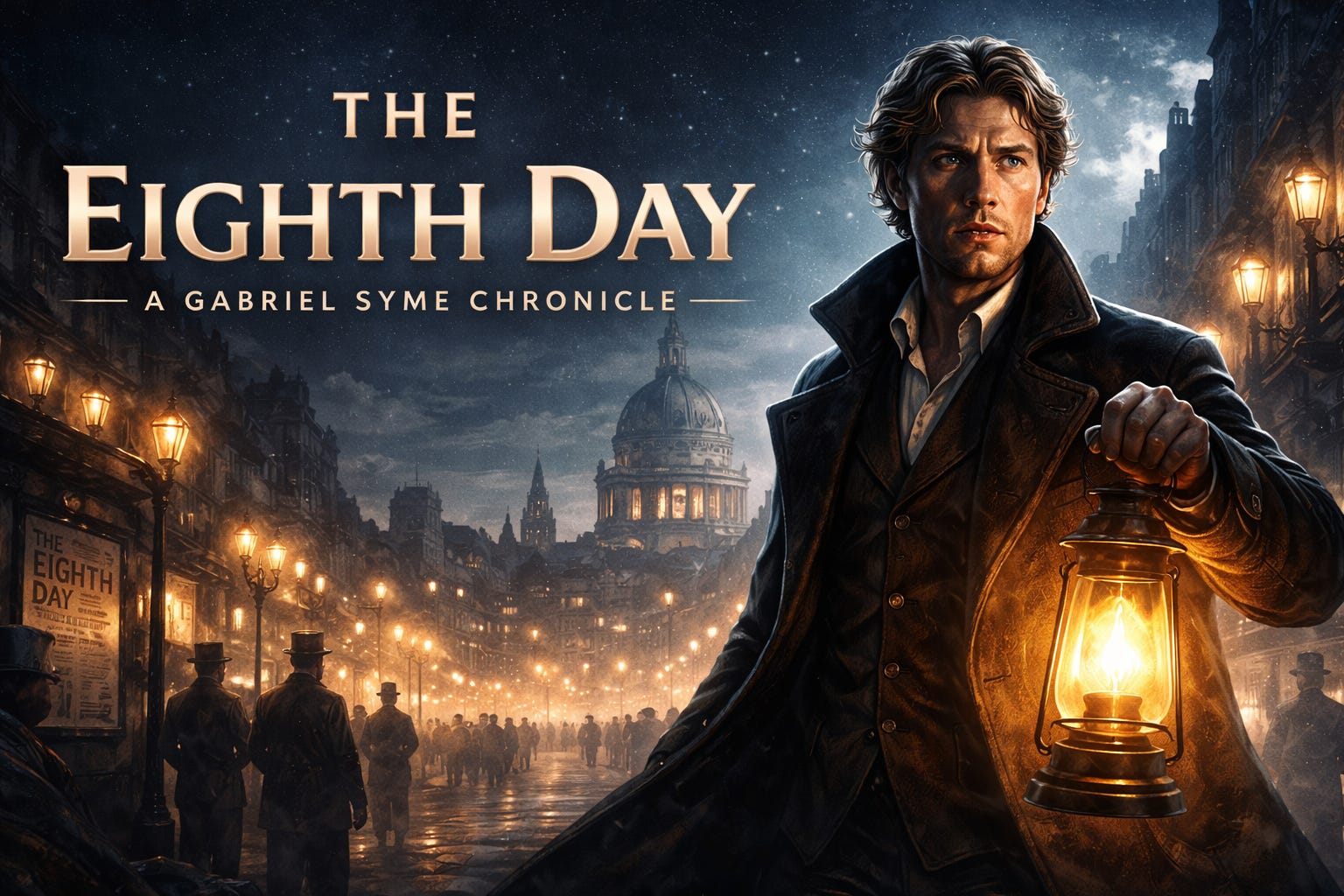
Each Thursday, we follow Gabriel Syme — first encountered in The Man Who Was Thursday — into the quieter conspiracies of modern ambition. The Eighth Day continues his strange vocation: tracing the places where noble causes overreach, where reform forgets restraint, and where progress attempts to abolish proportion. Syme does not merely pursue criminals; he hunts distortions. In a world determined to perfect the sun, he remains stubbornly loyal to midnight.
Gabriel Syme had always considered midnight a profoundly democratic institution.
It arrived whether invited or not. It silenced the powerful and the weak alike. It did not consult committees. It did not moderate itself for comfort. It was simply dark.
And therefore honest.
It was with some concern, then, that he learned there were no midnights left in London.
The letter had arrived without signature.
There is no longer any darkness in the City.
Come at once.
— E.
Syme burned the envelope after reading it. He did not know who “E” was. He suspected he would not like him.
He left his rooms in Saffron Hill and walked toward the financial district, where the rumor had begun: that the Corporation of London had quietly approved the “Continuous Illumination Act.”
The Act’s stated purpose was safety.
Darkness, after all, had long sheltered crime.
But Syme, who had infiltrated anarchists and philosophers alike, knew that every war on darkness risked abolishing more than crime.
The City glowed like a laboratory.
Electric lamps had multiplied until even alleyways were brilliant. The sky itself seemed embarrassed by so much effort and had withdrawn behind a permanent haze of reflected light.
There were no shadows.
There were also no stars.
A constable approached him with professional courtesy.
“Out late, sir?”
“It appears no one is,” Syme replied.
The constable smiled faintly.
“Safer this way.”
“Safer than what?”
“Than not knowing what’s in the dark.”
Syme looked around.
“And what’s in the light?”
The constable did not answer.
I. The Committee of Radiance
By means of credentials no honest man should possess, Syme gained entry to a late session of the Committee of Radiance.
They sat beneath a chandelier so immense it resembled a mechanical sun.
The chairman, Sir Percival Rook, addressed the room with polished certainty.
“Gentlemen,” he declared, “we have done what history demanded. Crime falls where illumination rises. Midnight was an outdated superstition.”
A murmur of approval followed.
“Consider,” Rook continued, “what darkness permitted: conspiracy, fear, vice, unregulated thought.”
Syme raised an eyebrow.
“Unregulated thought?”
Rook’s gaze flickered toward him.
“Who are you?”
“An admirer of the night,” Syme replied pleasantly.
There was polite laughter.
“You must understand,” Rook said smoothly, “midnight is not merely a time. It is a condition. It suggests secrecy. We are eliminating the condition.”
“And replacing it with?” Syme asked.
“Transparency.”
“Of whom?” Syme inquired.
Rook hesitated for a fraction of a second.
“Of everything.”
II. A World Without Pause
The practical effects were immediate.
Workers did not return home; the shift merely blended into the next.
Children slept less, because the sun never appeared to leave.
Churches found their vigils unnecessary.
Writers complained that ideas required dusk.
Even criminals seemed disoriented.
Syme met an old contact, a man who once fancied himself an anarchist prophet.
“This is worse,” the man whispered. “In darkness we at least felt alive. Now there is no pause. No boundary. No mystery.”
Syme nodded thoughtfully.
Midnight had been abolished.
But so had morning.
III. The Theology of Light
Syme visited St. Jude’s, where Father Benedict stood beneath electric bulbs that hummed faintly above the altar.
“They have made perpetual day,” Syme observed.
“Yes,” Father Benedict said dryly. “Without consulting the heavens.”
“And your opinion?”
The priest folded his hands.
“God created light. He also created darkness. One is not the enemy of the other.”
Syme paced.
“They claim darkness breeds evil.”
“And light,” the priest replied, “breeds pride.”
There was silence between them, which felt rebellious in a city without pause.
“Midnight,” Father Benedict continued, “reminds us that we do not control the hours. It is a limit. Remove the limit, and you remove humility.”
Syme smiled faintly.
“I suspected as much.”
IV. The Eighth Day
The movement behind the Act called itself The Eighth Day.
They argued that the seven-day cycle was inefficient. That night was a relic. That continuous productivity represented moral progress.
Syme secured a pamphlet.
The Eighth Day transcends nature.
Nature imposed cycles.
We impose improvement.
He laughed softly.
There it was again.
The refusal of limit.
The quiet war against proportion.
He attended a private gathering of the Eighth Day adherents.
They met in a hall bright as noon.
Rook stood before them.
“We have conquered midnight,” he proclaimed. “Soon we shall conquer fatigue, doubt, and dissent.”
Syme stepped forward.
“You have conquered stars,” he said mildly.
Rook frowned.
“Stars are irrelevant to governance.”
“They are inconvenient to control,” Syme replied.
There was a rustle in the room.
“You misunderstand,” Rook insisted. “We are freeing mankind from fear.”
“No,” Syme said gently. “You are freeing mankind from rest.”
V. The Necessary Dark
It was Syme who arranged the blackout.
Not an act of violence.
An act of interruption.
At precisely twelve o’clock — a time no longer recognized — the power failed across the City.
Darkness fell like a forgotten language returning.
Gasps filled the streets.
Children looked upward.
For the first time in months, stars pierced the haze.
The silence was profound.
Not empty.
Restful.
Rook stumbled from the committee hall, indignant.
“This is sabotage!”
Syme stood beside him in the square.
“This,” Syme said quietly, “is midnight.”
The crowd did not riot.
They did not panic.
They simply stood beneath the sky.
After several minutes, someone began to laugh — not hysterically, but with relief.
Father Benedict’s church bell rang once.
Rook looked shaken.
“You’ve undone months of progress.”
Syme shook his head.
“I have restored proportion.”
VI. The Pattern
As power slowly returned — moderated now by public resistance — Syme reviewed the Eighth Day pamphlet again.
Nature imposed cycles.
We impose improvement.
He folded it carefully.
It was the same impulse he had seen before.
The desire to perfect what was already good.
The instinct to eliminate limits in the name of virtue.
He did not yet know where that instinct began.
But he suspected it did not end in London.
He walked home beneath a sky that once again possessed stars.
Midnight had returned.
Not as an enemy of light.
But as its companion.
Syme smiled.
It is a dangerous thing to abolish what you do not fully understand.
It is fatal to abolish what you need.
And he suspected there were more such abolitions underway.
Closing Reflection
The Eighth Day continues.
Gabriel Syme remains where ideas grow ambitious.
Where good things swell beyond measure.
Where progress forgets proportion.
Next Thursday, the conspiracy deepens.
Daily story.
Daily reflection.
A quiet hour in a noisy age.
— Chesterton Radio