

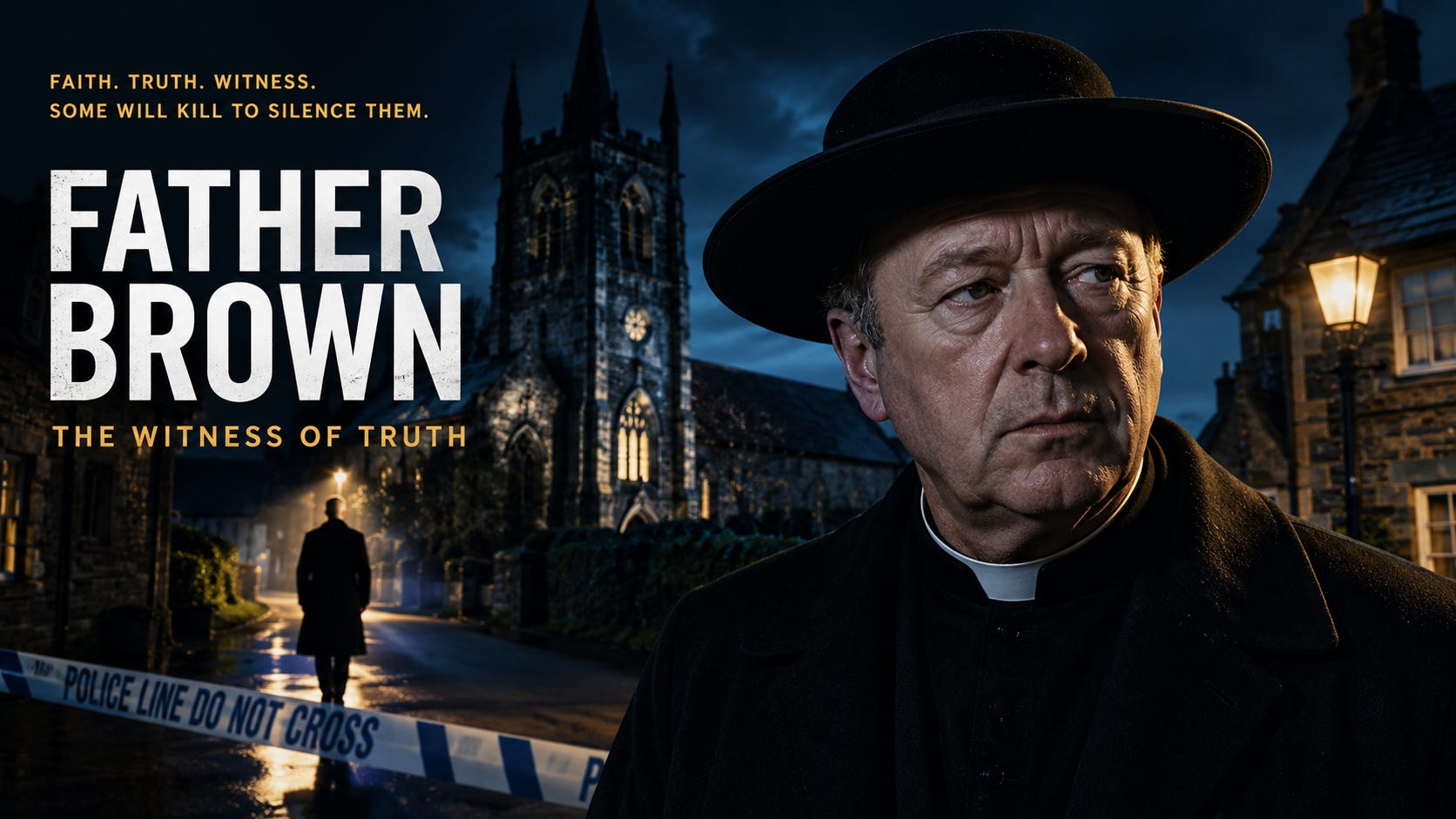
The rain had begun before dawn and had settled over the little village of St. Jude’s Crossing with the patient determination of an old creditor. It hung upon the hedges in silver drops and turned the narrow lanes into ribbons of dark glass. The church bells of Saint Michael’s sounded muted in the wet air, as though rung underwater.
Father Brown walked slowly beneath a black umbrella that was too small for him and too large for dignity. His cassock flapped about his boots as he crossed the churchyard. He had the appearance of a man who had forgotten where he was going but trusted Providence to remember for him.
The village had once belonged to the railway.
That was what the older men said.
In the days before the motorway and the humming anonymity of modern travel, St. Jude’s Crossing had stood proudly along the old North Mercia line. Trains had thundered through carrying soldiers, businessmen, lovers, drunks, bishops, salesmen, and at least one fugitive anarchist disguised as a music critic. The stationmaster had once been more important than the mayor.
Now the station sat abandoned at the edge of town like a stranded ship.
Yet something had awakened there.
Father Brown had first heard of it three days before from Mrs. Fitzwalter, who considered all new events either signs of progress or signs of the Apocalypse, depending entirely on whether they affected property values.
“A gentleman has bought the station,” she had announced after morning Mass.
Father Brown blinked mildly.
“That sounds expensive.”
“He’s converting it into a retreat center.”
“A retreat from what?”
“Modern civilization, apparently.”
Father Brown nodded thoughtfully.
“That sounds crowded.”
The gentleman in question was one Adrian Vale.
Mr. Vale had arrived from London six months earlier carrying an air of expensive exhaustion. He was famous enough that people recognized his name while remaining uncertain why. Some said he had been a television journalist. Others insisted he was a political consultant. One woman claimed he had once exposed corruption in Parliament. Another claimed he had hidden it.
In villages, fame becomes mythology almost immediately.
What everyone agreed upon was that Adrian Vale possessed charm of the polished metropolitan variety—the kind that resembles honesty because it has rehearsed sincerity until it moves naturally.
He had restored the abandoned station magnificently.
The platform lamps glowed again at night. The ticket hall had become a library and dining room. The old signal tower had been converted into a study overlooking the tracks. Visitors from London arrived every weekend to attend private discussions on philosophy, media ethics, politics, and spirituality.
They called the place The Lantern House.
Father Brown suspected that if Saint Francis had founded a monastery in modern England someone would immediately brand it.
Still, he had accepted Adrian Vale’s invitation to supper.
Which was why, on this rainy morning, he was walking toward the old station with his umbrella tilting dangerously in the wind.
The station appeared suddenly through the mist.
Warm golden lights shone from the tall windows. Smoke curled from brick chimneys. The platform clocks had been restored and glimmered through the rain like solemn faces.
Father Brown mounted the steps and knocked.
The door opened almost instantly.
A tall woman in a dark green coat greeted him.
“You must be Father Brown.”
“I frequently am.”
She laughed despite herself.
“I’m Evelyn March. Mr. Vale is expecting you.”
Miss March possessed the sort of beauty that looks carved rather than born. Her face seemed all sharp intelligence and disciplined restraint. Yet Father Brown noticed immediately that she was frightened.
Not alarmed.
Not nervous.
Frightened.
He followed her into the great hall.
The transformation of the station was astonishing.
The vaulted ceiling remained intact, but bookshelves lined the walls where train schedules once hung. Long oak tables occupied the center of the hall. Firelight flickered across brass fittings and old railway signs.
Several guests stood near the hearth.
Adrian Vale approached at once.
He was handsome in the slightly worn manner of a man who had survived too much applause. His hair was touched with gray at the temples, and his eyes possessed a restless brightness.
“Father Brown!” he exclaimed warmly. “Wonderful of you to come.”
“It was raining,” said Father Brown. “I had nowhere else to dry my umbrella.”
Vale smiled broadly.
“You see why I invited him,” he told the others.
The remaining guests were introduced.
Professor Julian Harcourt—a historian whose reputation for public skepticism had earned him television notoriety.
Dr. Miriam Bell—a psychiatrist specializing in media psychology.
Sir Lionel Keene—a retired judge with the grave face of a Roman senator.
And finally Thomas Reed.
The young man stood slightly apart from the others.
He was perhaps thirty, pale and serious, dressed plainly in a dark jacket. Unlike the others, he did not seem comfortable inside the atmosphere of cultivated brilliance.
Father Brown liked him immediately.
“Mr. Reed manages our archives,” Vale explained.
“Old papers and secrets,” Reed said quietly.
“Mostly old railway documents,” Vale corrected with a laugh.
Dinner began soon afterward.
The conversation ranged widely.
Professor Harcourt declared religion fundamentally theatrical.
Sir Lionel argued morality existed independent of belief.
Dr. Bell insisted modern people no longer feared sin but only humiliation.
Vale guided the discussion expertly, encouraging conflict without permitting hostility.
Father Brown mostly listened.
Occasionally he buttered bread with grave concentration.
At last Vale turned toward him.
“You’ve said almost nothing, Father.”
“That is because everyone else keeps saying so much.”
Laughter circled the table.
“But surely,” Harcourt pressed, “you have opinions regarding truth.”
Father Brown looked mildly surprised.
“Oh yes. Truth exists.”
Harcourt smirked.
“That’s a very ecclesiastical answer.”
“No,” said Father Brown. “It’s a very practical one. If truth didn’t exist, nobody could lie.”
A curious silence followed.
Father Brown noticed Thomas Reed watching Adrian Vale.
Not admiringly.
Fearfully.
The priest also noticed something else.
Whenever the conversation approached morality, Vale unconsciously touched the silver watch chain near his vest pocket.
Tiny habits often revealed enormous things.
After dinner Vale invited Father Brown to see the signal tower.
The narrow staircase wound upward above the old tracks.
Rain struck the windows in silver streaks.
“This was once the nerve center of the line,” Vale said. “Every train depended on the signals here.”
Father Brown peered out into darkness.
“Now nobody travels by rail.”
“People still travel,” Vale replied softly. “They just no longer know where they’re going.”
There was bitterness beneath the eloquence.
Father Brown glanced at him.
“You seem troubled, Mr. Vale.”
Vale hesitated.
Then he laughed.
“Do I? Perhaps I’ve spent too long around philosophers.”
He moved toward the desk.
A green-shaded lamp illuminated stacks of papers.
“One of the reasons I invited you,” Vale said carefully, “is that I’ve recently become interested in faith.”
Father Brown looked delighted.
“It’s an excellent subject. Very underrated nowadays.”
“But faith in what?” Vale asked sharply.
The question hung strangely in the room.
Father Brown answered gently.
“Truth, usually.”
Vale stared out the rain-streaked window.
“You know,” he said slowly, “I spent twenty years exposing lies for newspapers and television. Politicians. Corporations. Celebrities. Corrupt charities. Corrupt priests. Corrupt activists. Corrupt everyone. People called me courageous.”
“And were you?”
Vale smiled thinly.
“Sometimes. Sometimes I merely enjoyed destroying people.”
The rain intensified.
Far below them a train whistle echoed faintly from the active freight line miles away.
Vale’s face darkened.
“There’s something monstrous about modern scandal, Father. We pretend it serves truth. But often it serves appetite. The crowd doesn’t really hunger for justice. It hungers for blood.”
Father Brown nodded.
“Yes. That is why mobs always call themselves moral.”
Vale turned abruptly.
“Tell me honestly. Do you think a man can begin again?”
The priest considered.
“Oh yes. But usually not by rearranging furniture.”
Vale laughed despite evident tension.
Then footsteps sounded below.
Evelyn March appeared in the doorway.
Her face had gone white.
“Adrian,” she whispered, “Thomas is gone.”
Vale frowned.
“What do you mean gone?”
“He left the hall ten minutes ago. Sir Lionel just found blood near the lower platform.”
For a moment nobody moved.
Then Vale rushed downstairs.
Father Brown followed more slowly.
The lower platform lay dim beneath iron lamps.
Rain swept sideways across the tracks.
Near the edge of the platform dark stains glistened on wet concrete.
Sir Lionel stood nearby looking grim.
“There was a struggle,” he said.
Dr. Bell pointed.
A man’s hat lay near the rails.
Thomas Reed’s hat.
Vale stared at the tracks disappearing into darkness.
“My God.”
Professor Harcourt crouched beside the blood.
“There’s quite a lot of it.”
“And no body,” said Father Brown quietly.
Everyone turned toward him.
The priest bent carefully.
Rainwater diluted the crimson stains.
Then he looked toward the signal tower above.
A single light still burned there.
“Did anyone go upstairs after we came down?” he asked.
“No,” said Evelyn.
Father Brown nodded thoughtfully.
“Curious.”
Inspector Mallory arrived shortly after midnight.
He was a broad-shouldered man with tired eyes and the expression of someone permanently disappointed by human creativity.
“Evening, Father.”
“Good evening, Inspector.”
Mallory surveyed the platform.
“What exactly happened?”
Nobody knew.
Thomas Reed had vanished.
Blood had been found.
No witnesses existed.
The inspector interviewed everyone separately.
Father Brown waited near the fire while rain hammered the windows.
At last Mallory approached him.
“You’ve got the look,” he muttered.
“What look?”
“The look you get before somebody turns up dead.”
Father Brown sighed.
“That may simply be my face.”
Mallory sat heavily.
“What do you think?”
“I think everyone here is hiding something.”
“That narrows it considerably.”
Father Brown folded his hands.
“Mr. Vale is afraid.
Miss March is desperate.
Professor Harcourt is angry.
Sir Lionel feels guilty.
Dr. Bell knows more than she says.
And Thomas Reed…”
“Yes?”
Father Brown looked into the fire.
“Thomas Reed believed somebody intended murder.”
Mallory stared.
“How could you know that?”
“Because frightened men usually avoid the person they fear. Mr. Reed kept watching Adrian Vale.”
Mallory frowned.
“You think Vale killed him?”
“Oh no,” said Father Brown. “If Vale had killed him, he’d already have explained why it was morally necessary.”
The inspector groaned.
“That sounds uncomfortably specific.”
Father Brown said nothing.
The search continued until dawn.
No body appeared.
No footprints survived the rain.
No train had passed during the estimated time.
The mystery deepened by the hour.
At breakfast the atmosphere had grown brittle.
Professor Harcourt smoked furiously beside the windows.
Sir Lionel drank black coffee with judicial severity.
Evelyn March scarcely touched food.
Vale remained outwardly calm.
Only Father Brown seemed entirely ordinary.
He was studying marmalade.
Inspector Mallory entered carrying a small leather notebook.
“We found this in Reed’s room.”
Vale stiffened.
Mallory opened the notebook.
“It appears Mr. Reed kept records.”
“Records of what?” asked Harcourt.
The inspector looked grim.
“Everyone here.”
Silence descended.
Mallory continued.
“Mr. Reed had been collecting information regarding a scandal connected to Adrian Vale’s journalism career.”
Vale’s face hardened.
“What sort of scandal?”
Mallory studied the notebook.
“Several years ago a government minister committed suicide after an exposé conducted by your network.”
Nobody spoke.
“According to Reed’s notes,” Mallory continued, “evidence later emerged suggesting the minister had been innocent.”
Dr. Bell closed her eyes briefly.
Vale stared into space.
Professor Harcourt muttered, “Good Lord.”
Mallory looked up.
“Apparently Reed intended to publish something.”
All eyes turned toward Vale.
The journalist’s voice emerged cold.
“I didn’t kill him.”
Nobody answered.
Except Father Brown.
“Of course not.”
Vale looked sharply at him.
“Why are you so certain?”
“Because guilty men rarely invite priests to dinner before committing murder.”
Inspector Mallory snorted.
“That’s not evidence.”
“No,” said Father Brown. “But it’s psychology.”
Vale suddenly rose.
“You all think I destroyed Reed because he discovered the truth.”
“Did you?” Harcourt asked.
Vale’s face twisted.
“I destroyed many people. That’s the trouble. After a while you cannot remember which ones deserved it.”
He walked toward the windows.
“I spent years believing exposure was virtue. Every scandal raised ratings. Every ruined reputation made us important. We called it accountability. Perhaps sometimes it was. But eventually we no longer cared whether people were wicked. We merely cared whether they were vulnerable.”
Father Brown watched him sadly.
“There is something intoxicating about moral superiority.”
Vale laughed bitterly.
“Yes. Especially for sinners.”
At that moment a constable burst through the door.
“Inspector!”
Mallory turned.
“We found him.”
Everyone froze.
“Alive?”
The constable hesitated.
“In the tunnel.”
The old railway tunnel lay beyond the northern embankment.
It had been sealed for decades after part of the ceiling collapsed.
The search party reached it through wet undergrowth.
A narrow service entrance had recently been reopened during restoration.
Lanterns flickered inside the darkness.
Thomas Reed lay near the tunnel wall.
Dead.
A knife protruded from his chest.
Rainwater dripped steadily from stone overhead.
Inspector Mallory knelt beside the body.
“He’s been dead only a few hours.”
Father Brown looked quietly around.
The tunnel smelled of wet earth and rust.
Then he noticed something odd.
The dead man’s hands.
They were perfectly clean.
Outside, Mallory gathered everyone near the embankment.
“Now this is murder,” he announced grimly.
Professor Harcourt lit another cigarette with trembling fingers.
Sir Lionel removed his glasses.
Evelyn March looked near collapse.
Vale stood motionless.
Mallory continued.
“Mr. Reed left the hall around eleven. Sometime afterward he was stabbed in the tunnel.”
He turned toward Vale.
“You had motive.”
“Everyone here had motive,” Vale replied quietly.
That was true.
The notebook implicated them all.
Professor Harcourt had secretly collaborated with political organizations he publicly condemned.
Sir Lionel had suppressed evidence years earlier in a controversial trial.
Dr. Bell had conducted ethically dubious psychological experiments.
Evelyn March had once fabricated portions of an investigative report.
The notebook represented destruction for everyone.
Mallory began formal questioning.
Hours passed.
The rain ceased.
Clouds broke reluctantly apart.
Late in the afternoon Father Brown wandered alone along the abandoned tracks.
The old rails gleamed faintly in weak sunlight.
Someone approached behind him.
Evelyn March.
“I knew Thomas,” she said quietly.
Father Brown nodded.
“Yes.”
“He wasn’t a blackmailer.”
“No.”
“He wanted the truth exposed.”
“Yes.”
She clasped her hands tightly.
“You know something, don’t you?”
Father Brown looked at the horizon.
“I know Thomas Reed expected to die.”
She stared.
“What?”
“He came here because he believed somebody was dangerous. But he stayed because he believed somebody else could still be saved.”
Tears filled her eyes.
“Adrian?”
Father Brown did not answer directly.
“People are seldom entirely villains or entirely heroes. That is why murder becomes possible. We discover goodness in bad men and wickedness in good men and grow confused.”
Evelyn whispered, “Do you think Adrian killed him?”
Father Brown sighed.
“I think Adrian Vale has committed many sins. But I do not think murder is among them.”
That evening Inspector Mallory assembled everyone in the great hall.
“I have enough evidence to proceed,” he announced.
The room stiffened.
Mallory faced Adrian Vale.
“Thomas Reed intended to expose your role in the Harbury scandal. Witnesses confirm Reed confronted you privately several times this week.”
Vale remained calm.
“Yes.”
“You also visited the tunnel last night.”
Vale looked surprised.
“How do you know that?”
“A railway worker saw your lantern.”
Silence thickened.
Mallory continued.
“Furthermore, the murder weapon belongs to this house.”
He held up a narrow kitchen knife.
Evelyn gasped softly.
Mallory’s voice hardened.
“Unless you can explain yourself, Mr. Vale, I’m placing you under arrest.”
Vale slowly rose.
Then Father Brown spoke.
“You cannot arrest Adrian Vale.”
Mallory groaned.
“Why not?”
“Because Thomas Reed was dead before he entered the tunnel.”
Absolute silence.
Mallory stared.
“What?”
Father Brown folded his umbrella carefully.
“The body in the tunnel was staged.”
Sir Lionel frowned.
“That’s absurd. We all saw the wound.”
“Yes,” said Father Brown. “But Thomas Reed did not die there.”
Mallory crossed his arms.
“Explain.”
Father Brown looked toward the windows.
“Thomas Reed’s hands were clean.”
Nobody understood.
“The tunnel floor,” Father Brown continued, “is thick with damp clay and soot. Anyone struggling there would have filthy hands. Yet Reed’s hands were spotless.
Also, the blood on the platform yesterday evening was already diluted before the rain intensified. Which means it had been placed there earlier.
Finally…”
He paused.
“The knife wound was too theatrical.”
Professor Harcourt blinked.
“What does that mean?”
“It means someone wanted the body discovered as murder.”
Mallory frowned.
“So how did he die?”
Father Brown turned slowly.
“He was poisoned.”
A visible shock passed across several faces.
Dr. Bell went pale.
Father Brown continued softly.
“Thomas Reed died during dinner.”
The room exploded.
“That’s impossible!” cried Harcourt.
“We were all together!”
“Yes,” said Father Brown. “Which is precisely why the murderer later staged the body elsewhere.”
Mallory stared hard.
“Who?”
Father Brown looked sadly toward Dr. Miriam Bell.
The psychiatrist closed her eyes.
Nobody moved.
At last Mallory spoke.
“Doctor?”
She opened her eyes slowly.
“Yes,” she whispered.
Evelyn gasped.
Vale looked genuinely horrified.
Mallory advanced.
“Why?”
Dr. Bell laughed softly.
Not with amusement.
With exhaustion.
“Because Thomas Reed intended to publish everything.”
She looked toward Vale.
“You think you’re the only one who destroyed lives, Adrian? I helped design media manipulation studies for political campaigns. I taught organizations how to weaponize outrage. I studied fear professionally.”
Her voice cracked.
“Thomas said the truth must come out. He believed confession heals.”
She smiled bitterly.
“He was very young.”
Father Brown spoke quietly.
“No. He was very brave.”
Dr. Bell looked at him with sudden fury.
“You don’t understand! Modern society devours weakness. One scandal destroys everything. Careers. Families. Souls. We pretend exposure purifies corruption. Mostly it entertains strangers.”
“Yes,” said Father Brown. “That is why people become tempted to murder for reputation. Vanity is a small sin that grows enormous shadows.”
She whispered, “I only wanted time.”
Mallory stepped forward.
“You poisoned him?”
She nodded faintly.
“In the wine. I intended merely to frighten him at first. Then…”
Her composure shattered.
“He collapsed upstairs. Adrian found us. We panicked. Adrian thought the scandal would destroy everyone. We carried the body to the tunnel.”
All eyes turned toward Vale.
He looked suddenly ancient.
“I did not kill him,” he whispered.
“No,” said Father Brown. “But you helped hide the truth.”
Vale bowed his head.
“Yes.”
Mallory exhaled heavily.
“Well. That simplifies certain paperwork.”
Nobody laughed.
Constables escorted Dr. Bell away quietly.
Vale remained motionless near the fire.
After some time he spoke.
“I thought concealment might save people.”
Father Brown shook his head.
“No. Concealment only saves fear.”
The journalist stared into the flames.
“All my life I exposed lies publicly while hiding sins privately.”
“That is quite common,” Father Brown admitted.
Vale smiled sadly.
“Yes. Human civilization may depend upon it.”
“No,” said Father Brown gently. “Human civilization depends upon forgiveness. Which is a much stranger thing.”
The great hall had grown quiet.
Rain no longer touched the windows.
Beyond the station the abandoned tracks stretched into darkness beneath emerging stars.
Vale spoke again.
“Thomas believed truth could redeem people.”
Father Brown nodded.
“He was correct. Though redemption is often unpleasant.”
Sir Lionel rose stiffly.
“What happens now?”
Father Brown looked around the room.
“Now each of you must decide whether confession is worse than fear.”
Professor Harcourt muttered bitterly, “Modern society doesn’t forgive.”
“No,” said Father Brown. “But God does. Which is rather more important.”
Nobody answered.
The old station clock ticked softly overhead.
At last Vale approached the priest.
“Will you hear my confession?”
Father Brown blinked.
“Oh yes.”
They walked together toward the chapel Vale had built from the old baggage office.
It was small and unexpectedly beautiful.
A single lamp burned before the tabernacle.
The room smelled faintly of candle wax and rain-damp wood.
Vale hesitated at the doorway.
“I don’t know where to begin.”
Father Brown smiled.
“That is what confession is for.”
Outside, beyond the chapel windows, the abandoned railway stretched into the night like all the lost roads of mankind.
Yet somewhere beyond darkness lay destinations still.
For tracks are made not merely for wandering.
They are made for arriving.
Epilogue
Three months later the newspapers exploded.
The Harbury scandal was reopened.
Sir Lionel publicly admitted his judicial misconduct.
Professor Harcourt resigned from several committees.
Adrian Vale released a lengthy confession regarding years of manipulative journalism.
Public reaction proved exactly as savage as Dr. Bell had predicted.
Commentators sneered.
Politicians condemned.
Social media feasted.
And yet something strange occurred.
A few people forgave them.
Not many.
But enough.
The Lantern House remained open.
Though smaller now.
Quieter.
Less fashionable.
Father Brown visited again in autumn.
The leaves burned gold along the abandoned tracks.
Vale met him on the platform.
“You know,” Vale said thoughtfully, “I used to think truth was something one used against enemies.”
“And now?”
Vale glanced toward the little chapel.
“Now I think truth may be something that survives us.”
Father Brown smiled.
“Yes. Like grace.”
A freight train sounded faintly somewhere beyond the hills.
The old station lamps glowed warmly in the gathering dusk.
And Father Brown, listening to the distant whistle, thought once more that all men are travelers.
Even the lost ones.
Especially the lost ones.