

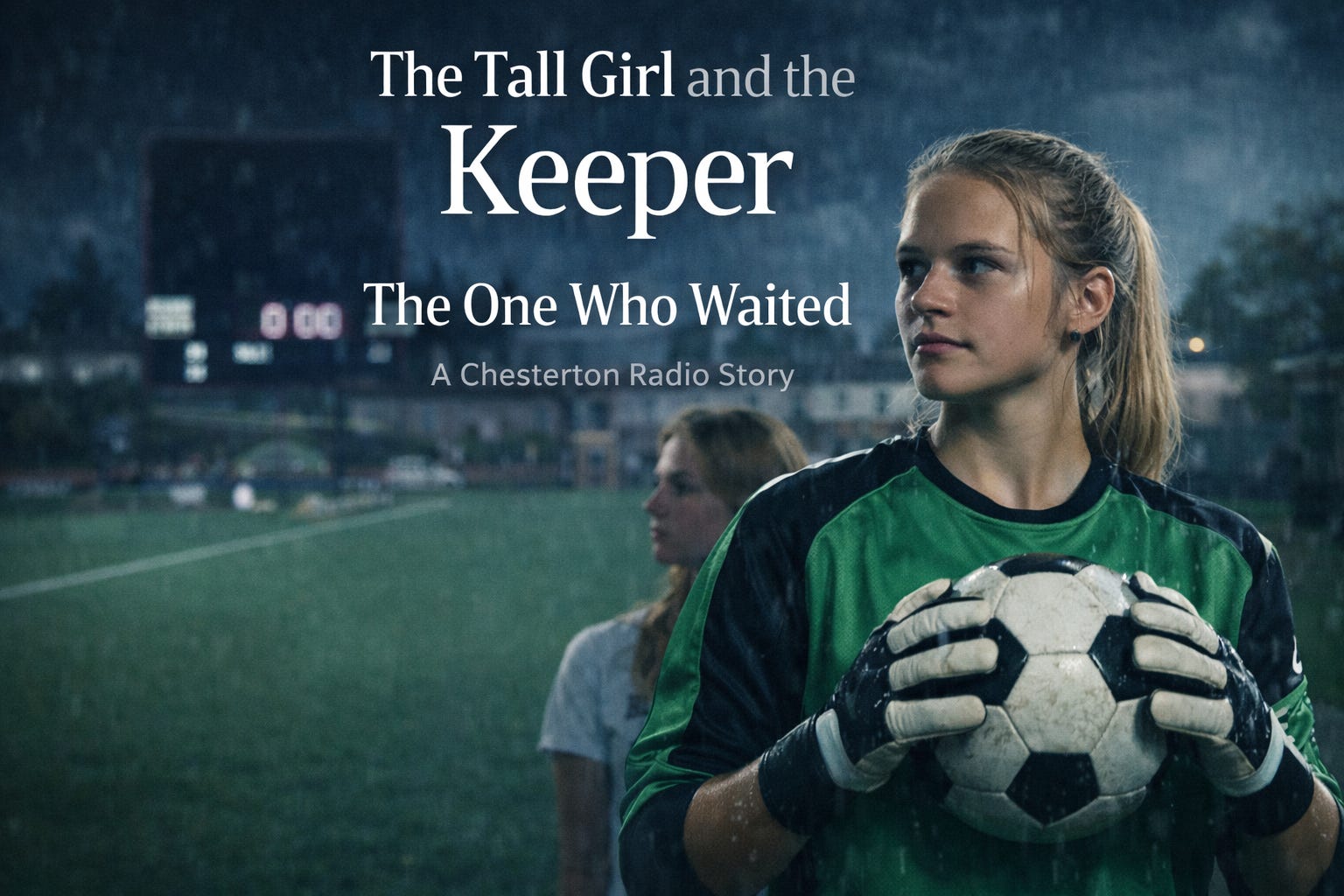
🎙️ From Chesterton Radio in Atchison, Kansas—
stories where the seen and the unseen meet.
This is The Tall Girl and the Keeper.
I don’t think anyone actually knew where she was supposed to be.
Not the coach.
Not the team.
Not even me.
But she kept ending up in the right place.
My sister wore her gloves all the time that year.
Not carried. Not clipped together. Not shoved into a bag with everything else.
On.
Like she might be called at any second.
Which, as far as anyone could tell, she wouldn’t be.
It was her freshman year.
She had been told she would compete for the position.
That had happened before. It had always worked out the same way—she competed, and then she played. It was almost predictable, the way certain things are predictable without anyone saying so out loud.
This time it didn’t happen.
A fifth-year keeper came back. Graduate student. Extra year from the COVID season. Older, louder, already known.
And just like that, the position was not a question anymore.
It was filled.
She didn’t argue.
That’s the first thing people get wrong when they try to tell this story.
They expect a confrontation. A conversation. Something where the injustice is recognized and corrected.
Nothing like that happened.
She just stood on the sideline.
Gloves on.
I used to sit in the stands and watch both of them.
It wasn’t subtle.
The other keeper—she yelled constantly.
Not always unfairly. That’s the thing. She wasn’t wrong most of the time.
“Mark up!”
“Step!”
“Where were you?”
It was the kind of noise that makes people feel like something is being controlled.
Like the game is being managed.
My sister didn’t say anything.
She stood there like she was already inside it.
One game, I went down and sat closer.
I was getting tired of trying to understand her from a distance.
“Why are you wearing your gloves?” I asked.
“I might go in,” she said.
“You’re not going in.”
“Then I’ll be ready anyway.”
“That’s not normal.”
“No.”
“You know you can admit this is stupid.”
“I know.”
“And?”
“It’s still where I’m standing.”
That was how she talked.
Like every sentence had already skipped three steps.
What bothered me wasn’t that she wasn’t playing.
It was that she didn’t act like someone who wasn’t playing.
She didn’t sulk. She didn’t detach. She didn’t try to make it obvious that something was wrong.
If anything, she paid more attention.
There were moments during games when something would happen—a bad angle, a late step, a goal that didn’t have to be a goal—and afterward, during halftime or practice, the coach would ask a question.
Not always to the keeper in the goal.
Sometimes to her.
“What should she have done there?”
The first time I heard it, I thought it was a joke.
It wasn’t.
“She committed too early,” my sister said once.
Or:
“Her angle was wrong.”
Or:
“She followed the player instead of the space.”
She didn’t explain it.
She didn’t soften it.
She didn’t sound like she was offering an opinion.
She sounded like she was describing something that had already happened.
The strange part wasn’t that she was right.
The strange part was that no one argued with her.
It was like she was already in the position.
Even when she wasn’t.
There were games that year they should have won.
Everyone knew it.
You could feel it in the stands, in the way parents talked afterward, in the quiet tone people used when they didn’t want to sound like they were criticizing the coach.
“If she was in…”
They never finished the sentence.
They didn’t have to.
At home, it was worse.
Not dramatic. Just… obvious.
“She’s ready,” my mom would say.
“Yes,” my dad would answer.
“Then why isn’t she playing?”
There wasn’t a good answer.
There was an answer.
But it wasn’t good.
I tried asking her directly.
“Doesn’t it bother you?” I said one night.
“What?” she asked.
“Not playing.”
“I am playing.”
“No, you’re not.”
“I’m here.”
“That is not the same thing.”
“Sometimes it is.”
That answer stayed with me longer than I wanted it to.
Mostly because I couldn’t tell if it was profound or just irritating.
With her, it was usually both.
There were stories from before that year that people would bring up, like they were trying to remind themselves of something.
The tournament.
She was in seventh grade. A high school senior team needed a keeper. Their keeper couldn’t play. They put her in.
Which sounds insane, if you think about it.
College coaches were there.
They saw her.
They checked the roster.
She wasn’t on it.
“Who is that?” they asked.
“You’ll have to wait a few years,” the coach told them.
I used to think that story was about talent.
Now I think it was about something else.
She had been in the wrong place.
Too early.
And still exactly where she needed to be.
That kept happening.
Even with college.
She’d been recruited by Division I schools since she was a kid. Not aggressively. Just steadily. Like people kept noticing her and didn’t want to forget.
She toured schools.
Came back unimpressed.
Which didn’t make sense to me at all.
“They’re incredible,” I said.
“They’re structured,” she said.
“That’s a good thing.”
“Sometimes.”
I pushed her on it once.
“What didn’t you like?”
“The feeling,” she said.
“What feeling?”
“That the coach owns you.”
That was the end of that conversation.
Because I knew what she meant.
And I didn’t have a way to argue with it.
There was a point where it looked like she might not go to college at all.
Not dramatically. Not as a statement.
Just… nothing felt right.
And then something shifted.
A new guidance counselor at her school.
Fresh out of Benedictine College.
Former striker.
They talked.
I don’t know about what.
With her, it’s never clear what part of the conversation actually matters.
But afterward, the counselor called her old coach.
“Don’t bring in a keeper,” she said. “I found your keeper.”
Three days later, we were in Kansas.
That part I remember clearly.
Not because anything dramatic happened.
Because nothing did.
It just… fit.
We sat in a room with the coach.
He talked about the program, expectations, the way they played.
Then he looked at my parents.
Which is what people do in those situations.
My parents didn’t say anything.
“Ask her,” they said.
He did.
She didn’t ask much.
Just one thing that mattered.
“If I come here, am I coming here to play the way I play?”
“Yes,” he said.
“I play high,” she said.
“I know.”
“Very high.”
“I know.”
“I’m not staying on the line because someone panics.”
“Good.”
“And if someone scores, I’m running up to them.”
“Fine.”
“And I’m not yelling at people to make everyone feel better.”
There was a pause.
“Also good,” the coach said.
That was it.
That was her negotiation.
“I asked for the field,” she told me later.
And somehow, that made sense.
But what didn’t make sense—what still didn’t make sense—was that even after all of that…
she still spent most of that year on the sideline.
Gloves on.
Ready.
Like the story had already started…
and no one else had caught up to it yet.
End of Part I
🎙️ This has been Chesterton Radio.
The story continues.
The Tall Girl and the Keeper — Part I: The One Who Waited

🎙️ From Chesterton Radio in Atchison, Kansas—
The Tall Girl and the Keeper — Part II: The Field That Opens

She started playing without anyone announcing it.
The Tall Girl and the Keeper — Part III: The Field Beyond the Lines

🎙️ From Chesterton Radio in Atchison, Kansas—