

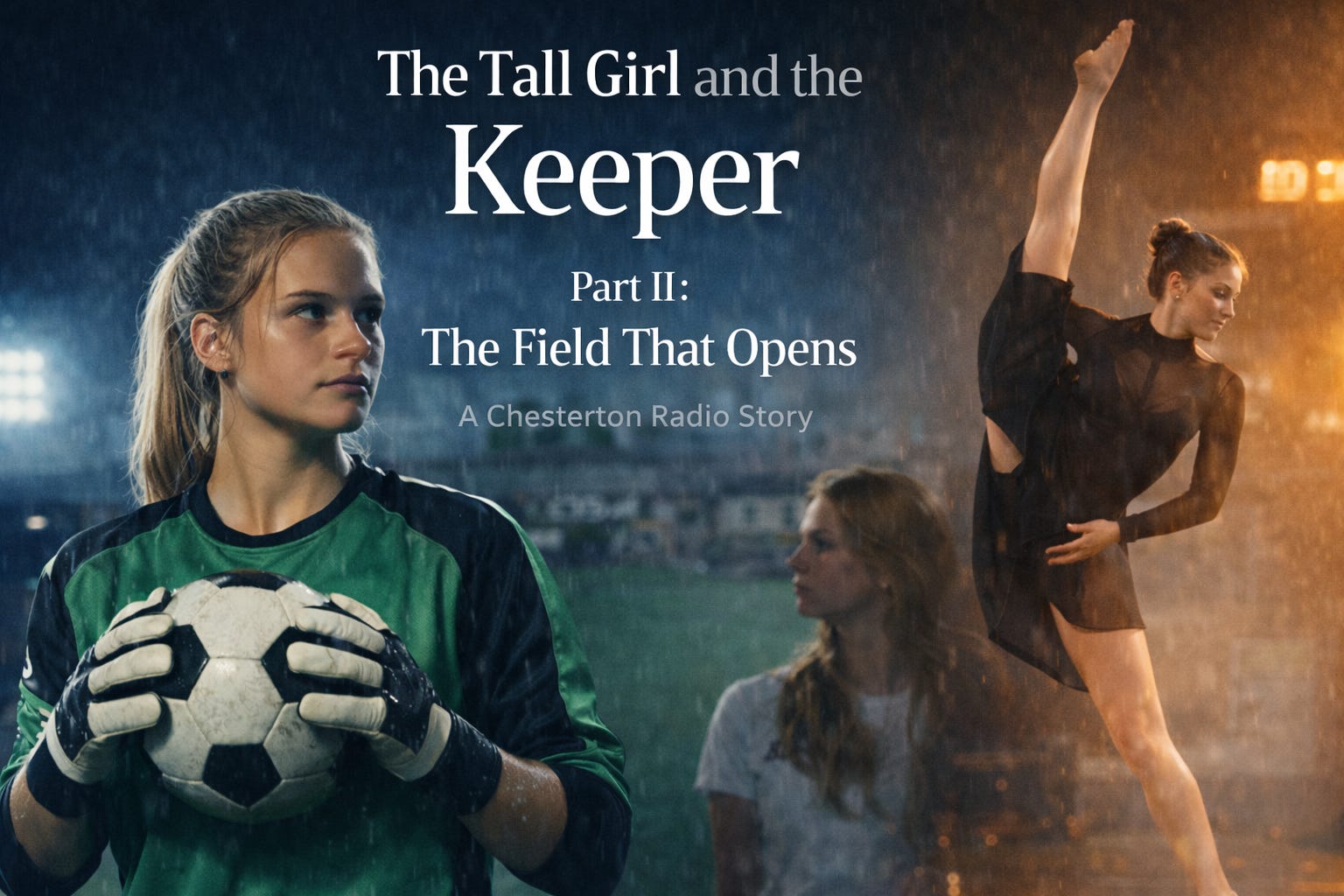
She started playing without anyone announcing it.
There wasn’t a moment you could point to. No meeting, no explanation, no sense that a decision had finally been made.
She was just… in.
I almost missed the first game.
Not literally. I was there.
But I was still watching it the way I had all year—half paying attention to the field, half paying attention to her on the sideline.
Except she wasn’t there.
She was in the goal.
The first thing I noticed wasn’t what she did.
It was what everyone else did.
They moved forward.
Not all at once. Not like a strategy had been announced.
Just… a little earlier.
The defenders stepped higher. The midfield pressed instead of waiting. The forwards made runs that assumed the ball would get there.
It took me a few minutes to realize why.
They weren’t looking back.
That’s not something you notice immediately.
It’s something you feel.
Like when a room gets quieter, or louder, and you don’t know exactly when it changed.
There was a play early in the game.
A through ball that, all year, would have turned into a problem.
I leaned forward automatically, waiting for it.
She was already there.
Not diving. Not reacting.
Just… there.
The ball met her like it had been sent to her on purpose.
She cleared it without urgency.
The striker actually stopped running.
Like the play had ended somewhere she hadn’t expected.
“How did she—?” someone behind me started.
They didn’t finish the sentence.
That kept happening.
Not spectacularly.
That’s the part people miss.
There wasn’t anything dramatic about it.
She didn’t look faster. She didn’t look stronger. She didn’t look like she was doing something no one else could do.
She just kept arriving first.
Later in the same game, we scored.
I stood up with everyone else, half watching the celebration, half watching her.
Because I had seen her do something once before that didn’t make sense.
She ran forward.
Not halfway.
All the way.
From the goal, across the field, to the girl who scored.
“You’re not supposed to be up there,” someone said, laughing.
“She scored,” my sister said.
“Yeah.”
“So I came.”
That was it.
No explanation.
She gave a quick high five, turned, and ran back.
It should have looked wrong.
It didn’t.
That was when something shifted for me.
Not about her.
About the position.
I had always thought of a goalkeeper as someone who stayed.
Someone who guarded a space.
She didn’t stay.
She moved through it.
After the game, I went down to the field.
They were talking about it already.
“How did you know she was going near post?” one of the defenders asked.
“She opened her hips,” my sister said.
“I didn’t see that.”
“You weren’t looking for it.”
There was no edge to it.
No correction.
Just… a fact.
A trainer came over.
“We need to run a test,” he said.
“A test?” someone asked.
“Routine.”
No one said what they were thinking out loud.
But it was obvious.
They didn’t think she was cheating.
They thought something didn’t add up.
“You good?” someone asked her.
“Yes.”
“That was insane.”
“No.”
“Yes, it was.”
“It was just clear.”
That was new.
Not the way she played.
The way she talked about it.
Like nothing unusual had happened.
Over the next few games, the pattern held.
And then it grew.
The team started playing differently.
Not because she told them to.
She didn’t tell anyone anything.
They just… trusted it.
One of the defenders said it to her during practice.
“We can go now.”
“Yes,” she said.
“Because you’re back there.”
“Yes.”
It wasn’t dramatic.
It wasn’t even emotional.
But it was true.
They could move forward because something behind them didn’t need to be managed.
It had already been understood.
And that changed everything.
Not just how they played.
How they felt.
They stopped hesitating.
They stopped checking.
They stopped playing like something might go wrong at any second.
They played like the next thing was already handled.
Which meant they could focus on what came after it.
I started going to more games.
Not because I suddenly loved soccer.
Because I couldn’t figure her out.
There was a game where they gave up a goal.
A normal goal. Nothing unusual about it.
A missed step. A bad angle. A shot that shouldn’t have gotten through but did.
The defender turned immediately.
“That’s on me—that’s on me—”
I watched my sister.
Because this was the part I understood.
This was where people showed themselves.
She didn’t turn.
“It’s already over,” she said.
“What?” the defender asked.
“Next one.”
That was it.
No frustration.
No correction.
No attempt to fix what had already happened.
She just moved on.
And somehow—
they did too.
That was the part I couldn’t explain.
She wasn’t just stopping things.
She was changing what mattered.
There were games where she played sick.
The first time, it didn’t seem like a big deal.
She wasn’t feeling well. She played anyway. They won.
Everyone took the wrong lesson from that.
The next time, it was worse.
You could see it.
Slower steps. Heavier movement. Just enough off that it changed the timing.
“You have no choice,” the coach said.
I was standing close enough to hear it.
And before she could answer, someone else did.
“No,” the backup keeper said.
“She does have a choice.”
That stopped everything for a second.
Not the game.
Just… the assumption.
“I’ll play,” my sister said.
And that was that.
But something had shifted.
Not visibly.
Not immediately.
Just enough that you could feel it.
During the game, it wasn’t a collapse.
That would’ve made sense.
It was worse.
Things started to… blur.
A pass that should’ve been cleared came back too quickly.
A second shot followed too closely after the first.
A third moment arrived before the previous one had finished.
She was still there.
Still moving.
Still arriving.
But now everything was arriving too.
There was a stretch where it felt like the game had lost its spacing.
Like everything that had once come one at a time was now coming all together.
“How is she still—?” someone near me started.
I didn’t answer.
Because I didn’t know anymore.
At halftime, I went down again.
“You shouldn’t be out there,” I said.
“I know,” she said.
“Then why are you?”
“Because I am.”
“That’s not good enough.”
“It has been.”
That answer bothered me more than anything she had said all year.
Because I wasn’t sure it was true anymore.
That was the first time I thought:
maybe this isn’t about how good she is.
Maybe it’s about how much one person can hold.
And maybe—
that has a limit.
End of Part II
The Tall Girl and the Keeper — Part I: The One Who Waited

🎙️ From Chesterton Radio in Atchison, Kansas—
The Tall Girl and the Keeper — Part II: The Field That Opens

She started playing without anyone announcing it.
The Tall Girl and the Keeper — Part III: The Field Beyond the Lines

🎙️ From Chesterton Radio in Atchison, Kansas—