

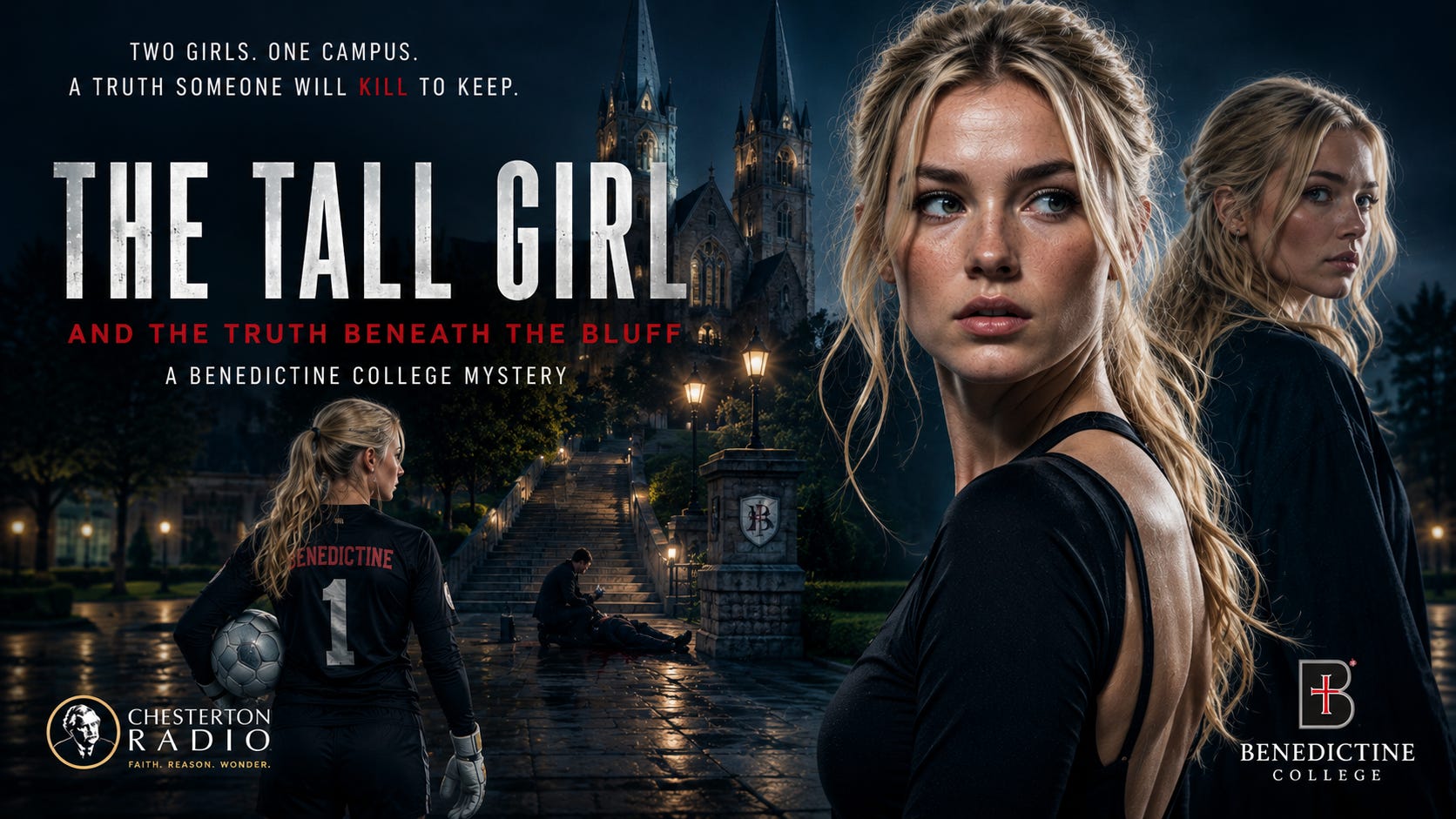
Intro
Good evening, friends, and welcome once again to Chesterton Radio — broadcasting from the old river town of Atchison, Kansas, where the bells still echo across the bluff, the chapel lamps still burn late into the night, and stories still matter because truth still matters.
Tonight we return to Benedictine College.
To stone walkways after rain.
To fog rolling up from the Missouri River.
To morning prayer beneath the Abbey bells.
And to a mystery that begins with something almost impossible:
A freshman dance-team girl known only as the Tall Girl discovers another student on campus who looks exactly like her.
But this is not merely a story about resemblance.
It is a story about identity. About false certainty. About the danger of secrets hidden in the name of mercy. And about the terrible moment when the truth arrives before people are ready to bear it.
A renowned archivist is found murdered beneath the library tower after morning prayer.
Witnesses saw a tall girl near the scene.
The problem is… there may have been two.
And standing between rumor, fear, and disaster is the Tall Girl’s older sister — the Keeper — legendary Benedictine goalkeeper, reader of false motion, defender of impossible shots, and perhaps the only person on campus who understands that what people think they saw is not always what truly happened.
So settle in tonight.
Listen carefully to the bells.
Watch the shadows moving across the bluff above the river.
And join us now for a new Chesterton Radio mystery:
“The Tall Girl and the Truth Beneath the Bluff.”
The Tall Girl learned very early in her freshman year at Benedictine College that height was not merely a measurement. It was a social fact, a public event, and sometimes a verdict.
She could not enter the cafeteria quietly. She could not slip into the back of a classroom unnoticed. She could not stand at the edge of a dance rehearsal without someone saying, “You should be in the center,” as though altitude alone were choreography. By October, nobody needed her actual name. She was the Tall Girl: the freshman on the dance team, the one with the long stride, the serious face, and the habit of looking at things a fraction too long.
Her sister had no such problem. Nobody called her by her name either, but in her case the title had been earned in glory.
She was the Keeper.
Senior goalkeeper. Benedictine legend. The girl who had once stopped three penalty kicks in one match and afterward looked mildly annoyed that anyone had expected less. She had a goalkeeper’s gift for reading deception: the shoulder that dipped too early, the planted foot that betrayed the shot, the striker who looked left because she had already decided right.
The Tall Girl noticed details.
The Keeper noticed intention.
That was why, when the first wrong thing happened, the Tall Girl saw it and the Keeper believed her.
It was a wet Wednesday morning in Atchison, Kansas, with fog coming up from the Missouri River and clinging to the bluff below campus. The bells from the Abbey church had just finished calling students to morning prayer. The Tall Girl stood outside the church steps with her dance bag over one shoulder, watching students cross the bricks in scattered groups.
Then she saw herself.
Not in a window. Not in the glass of a door. Across the green, beneath the arch near the library, stood another tall girl in a dark coat.
The same height. The same dark hair. The same long, composed stillness.
The Tall Girl did not move. Neither did the other girl. For a few seconds they stared at each other across the mist, like two versions of the same question.
Then the stranger turned and disappeared under the arch.
The Keeper, arriving beside her with a duffel bag and damp hair from early training, followed her gaze.
“What are you staring at?”
“The girl who looks like me.”
The Keeper squinted across the lawn. “I don’t see anyone.”
“She was there.”
“Was she taller than you? Because if so, I want to meet the monument.”
The Tall Girl did not smile.
That made the Keeper stop teasing.
“Seriously?”
“Seriously.”
The Keeper looked again toward the library archway. The fog had thickened. “Well,” she said, “that’s unsettling.”
“It was not just resemblance.”
“What was it?”
The Tall Girl searched for the right words. “She was watching me as if she had practiced seeing me.”
The Keeper frowned. “That is the creepiest sentence you’ve said this semester, and you take philosophy.”
By itself, the incident might have become only a strange campus story. Benedictine had plenty of those: odd noises near the old buildings, lights in windows after midnight, rumors about tunnels, ghost stories told by upperclassmen who had perfected the art of sounding sincere. But the Tall Girl saw the stranger again that evening during dance rehearsal.
She was in the observation balcony above the gym.
The dance team was preparing for the Spring Showcase, a campus performance tied to alumni weekend. The routine had a difficult turn sequence that required the Tall Girl to pass through center on the fourth count, pivot, and drop backward into the next line. She had practiced it enough that her body knew the music before her mind did.
Then, on the balcony, she saw the girl.
Still. Watching. Wearing the same dark coat.
The Tall Girl missed the count.
The line broke around her. Someone stumbled. Coach Ramirez stopped the music with a clap sharp enough to sting.
“Again,” the coach called. “Focus, please.”
The Tall Girl looked up.
The balcony was empty.
After rehearsal she told the Keeper, who listened with the seriousness of someone hearing a scouting report before a championship match.
“Could she be another freshman?” the Keeper asked.
“I would have noticed her.”
“Benedictine is small, but it’s not a dollhouse.”
“She looks like me.”
“Lots of people look alike from a distance.”
“This was not distance.”
The Keeper leaned against the rail outside the rec center, eyes narrowed toward the dark windows. “Did she move like you?”
The Tall Girl hesitated. “No.”
That answer interested the Keeper more than the resemblance.
“How?”
“She moved carefully. Like someone copying a dance after watching it on video.”
The Keeper said nothing for a while.
Then she said, “Find out her name.”
“I was hoping you would tell me I imagined it.”
“I’m your sister. I’m supposed to protect you, not lie to you.”
The name came the next day from a sophomore on the dance team who had seen the stranger near the library.
Eleanor.
No last name offered. No dorm named. No major known. Just Eleanor, a transfer student or visiting scholar or donor’s daughter, depending on which rumor had been improved most recently.
By Friday morning, everyone who was inclined to notice such things had noticed her.
Eleanor was not identical to the Tall Girl. Up close, the differences mattered. Eleanor’s face was a little narrower, her hair carried differently, her posture more consciously elegant. But across campus, in fog, in a dark coat, from the side or behind, she was close enough to create confusion. More disturbingly, she seemed aware of the confusion and never hurried to correct it.
The Tall Girl first spoke to her in the library stacks, between medieval history and theology.
“You’re Eleanor,” the Tall Girl said.
Eleanor turned from the shelves with a book in her hand. She did not seem surprised.
“And you are the Tall Girl.”
“I have another name.”
“I’m sure you do.”
It was not said cruelly. That made it worse.
“Why have you been watching me?”
Eleanor closed the book. “Why have you been watching me?”
“Because you appeared on campus looking like my reflection.”
Eleanor’s expression changed slightly. “That must be difficult for you.”
“For me?”
“To discover one is not as singular as one supposed.”
The Tall Girl almost laughed, but something in Eleanor’s calm stopped her. This was not ordinary rudeness. It was defensive, rehearsed, like a line memorized against fear.
“Who are you?” the Tall Girl asked.
Eleanor looked past her toward the tall windows facing the bluff.
“That,” she said quietly, “is apparently the question everyone has been avoiding.”
Before the Tall Girl could answer, Professor Adrian Vale stepped into the aisle.
He was the director of special collections, a severe man with white hair, rimless glasses, and the moral temperature of a locked cabinet. Students feared him because he treated overdue archive requests like sins against civilization. Faculty feared him because he remembered everything. Donors admired him because he made old paper sound like destiny.
“Miss Eleanor,” he said.
Eleanor stiffened.
Professor Vale looked at the Tall Girl, then back at Eleanor. The resemblance plainly displeased him.
“You should not be here,” he said to Eleanor.
“This is a library,” she replied.
“This section is not your concern.”
“That has not been established.”
Professor Vale’s face hardened. “There are truths one does not seize simply because one has found the shelf.”
Eleanor’s voice dropped. “And there are truths one does not hide simply because one is afraid of who may bear them.”
The Tall Girl felt suddenly invisible, though the conversation clearly involved her.
Professor Vale turned to her. “You should go.”
“I was here first.”
His eyes sharpened. “Then be wise enough to leave first.”
It was the kind of sentence that would have made most freshmen obey.
The Tall Girl did not obey quickly.
She looked once at Eleanor, once at Professor Vale, and then walked away with the peculiar feeling that she had entered the middle of a story in which someone had already written her part.
The murder happened three days later.
It was Wednesday, after morning prayer.
Father Gabriel had read from the Gospel of John in the Abbey church: “I have yet many things to say to you, but you cannot bear them now.” The line settled uneasily over the chapel. The Tall Girl remembered it because Eleanor was standing across the aisle, head bowed, wearing a dark coat almost identical to hers.
After prayer, students spilled into the cold morning. Fog still lay along the lower parts of campus. The bells had just stopped when a scream came from the direction of the old library terrace.
The Keeper moved first, as she always did. The Tall Girl followed, her dance bag banging against her hip.
At the bottom of a stone stairway below the archive entrance, Professor Adrian Vale lay twisted on the wet pavement. Blood had spread beneath his head into the cracks between the stones. One hand was clenched around a torn scrap of paper. His glasses lay several feet away.
The Keeper knelt beside him, checked for a pulse, and looked up.
“He’s dead.”
Students gathered above the terrace, whispering and crossing themselves. A campus security officer shouted for everyone to move back. Someone called 911. Someone else began crying.
The Tall Girl stood frozen, not looking at the body now but at the top of the stairs.
A tall figure in a dark coat stood under the archway.
For one second the figure turned.
It was Eleanor.
Or it was the Tall Girl’s own face in the mist.
Then the figure vanished.
The bells rang again. Three slow strikes from above the bluff, though morning prayer had ended and no service was beginning.
The first rumor began before the police arrived.
Someone had seen the Tall Girl near the archive stairs.
By lunch, the rumor had changed. Several people had seen her.
By dinner, people were no longer saying they had seen “the Tall Girl.”
They were saying they had seen “one of them.”
That was worse.
The Atchison police did not accuse the Tall Girl. Detective Mara Sloane, who took charge of the case, was too careful for that. She was a compact woman with tired eyes and the manner of someone who disliked nonsense but respected fear.
She interviewed the Tall Girl in a small office near Student Life.
“Tell me where you were between 7:05 and 7:25 this morning.”
“In the Abbey church, then outside with everyone else.”
“Were you alone?”
“In church? No. Leaving? Mostly.”
“Did you speak to Professor Vale recently?”
“In the library, three days ago.”
“About what?”
“Eleanor.”
Detective Sloane looked up. “The girl who resembles you.”
“Yes.”
“Does she resemble you enough that someone could mistake her for you?”
“At distance. In fog. If they wanted to.”
“That last part matters.”
“Yes.”
“Why?”
The Tall Girl looked out the office window toward the campus green. “Because most people don’t look. They recognize a shape and call it knowledge.”
The detective studied her for a moment, then wrote something down.
“You’re not a suspect,” she said.
“People think I am.”
“People think a lot of things before lunch.”
“But rumor can become evidence if enough people repeat it.”
Detective Sloane’s expression softened almost imperceptibly. “That is unfortunately true.”
After the interview, the Keeper found her outside the building.
“Well?”
“The police are cautious. The campus is not.”
The Keeper fell into step beside her. “Then we need facts.”
“We?”
“Yes, we. You notice details. I notice fakes. Between us, we are almost one competent person.”
Despite everything, the Tall Girl smiled.
Their first fact came from the soccer field.
The Keeper took her to the stadium after sunset, when the lights were on and the wind pushed against the netting. She made the Tall Girl walk from midfield to the penalty mark three times, then turn, then walk away.
“This is humiliating,” the Tall Girl said.
“Good. Humility sharpens the soul.”
“That sounds like something on a chapel poster.”
“It sounds true because I said it.”
The Keeper watched her carefully, then demonstrated the same walk herself. Afterward she stood thinking, arms folded.
“The person I saw under the arch after the scream moved wrong.”
“You said that before.”
“I mean specifically wrong. She moved like a dancer trying not to look like a dancer.”
The Tall Girl frowned. “Eleanor?”
“Maybe. But the girl under the arch took short steps before turning. You don’t. You use your full stride unless you’re on a count.”
“A count?”
The Keeper nodded. “That’s what bothered me. She moved in beats.”
The Tall Girl felt a chill. “Someone had practiced my movement from rehearsal.”
“Or Eleanor had.”
“Why would she do that?”
“To be seen as you. Or to make everyone unsure whether they had seen you.”
The second fact came from Cassian Rook.
He appeared the next morning outside the Raven Roost, immaculate in a black coat, holding coffee he did not seem to drink. Cassian had graduated the previous year but remained attached to Benedictine through donor projects and academic fellowships no one could explain. He was brilliant, charming, and almost certainly dangerous. The Tall Girl had once heard a professor describe him as “a young man who mistakes intelligence for absolution.”
Cassian smiled when he saw the sisters.
“The famous pair. The tower and the wall.”
The Keeper said, “What do you want?”
“To prevent injustice.”
“That would be a new hobby for you.”
He looked at the Tall Girl. “Professor Vale removed a restricted file from special collections the night before he died.”
“How do you know?”
“Because unlike most people, I read sign-out ledgers when no one is looking.”
“That is not reassuring,” said the Keeper.
“The file concerned Eleanor,” Cassian continued. “And possibly you.”
The Tall Girl said nothing.
Cassian seemed pleased by her silence. “The Vale family funded several foreign student and adoption scholarships twenty years ago through a charitable foundation tied to Benedictine donors. Some records were sealed. Some were altered. Professor Vale found something.”
“What?”
“If I knew the ending, I wouldn’t be here enjoying the middle.”
The Keeper stepped toward him. “Rook.”
He sighed. “Very well. Vale believed Eleanor’s identity had been constructed from another girl’s records. Yours may have been used as part of the construction.”
“That’s impossible,” the Tall Girl said, though she did not know why.
“Impossible things are usually just possible things with better public relations.”
Cassian turned to go, then paused.
“One more thing. Vale was not killed by the fall.”
The Keeper’s eyes narrowed. “Who said he fell?”
“Exactly.”
He walked away before either sister could stop him.
The Tall Girl hated that Cassian’s information was useful. Evil, she thought, should have the courtesy to be stupid.
That afternoon, they went to the archive.
It was sealed, officially. But Benedictine was an old campus with old buildings, and old buildings have memories in the form of side doors, loose latches, and windows that no administrator remembers exist. The Tall Girl knew one because dance team members had once used it to retrieve decorations after a locked-room scheduling error. The Keeper disapproved of breaking rules in theory and excelled at it in practice.
Inside, the archive smelled of paper, stone, and cold metal shelving. Professor Vale’s office had been searched by police, but hurriedly. The Tall Girl could tell because the obvious drawers were open and the boring ones were untouched.
“Always start with what people find too dull to hide,” she whispered.
“You are a strange freshman.”
“In a crisis, that’s an asset.”
They found the sign-out ledger in a lower drawer beneath a stack of donor correspondence. The last entry was in Vale’s precise handwriting:
Restricted File 17-B: Eleanor / Voss transfer discrepancy. Removed to tower room.
The Keeper read it twice.
“Voss?”
The Tall Girl swallowed. “That’s us.”
“Why would our name be in an archive file?”
Before the Tall Girl could answer, footsteps sounded in the hall.
They ducked behind a shelving unit as the archive door opened.
Eleanor entered.
She moved directly to Vale’s desk, not like a curious student but like someone who already knew where things should be. She opened the ledger drawer, found it empty, and went very still.
“You can come out,” she said. “One of you breathes like an athlete.”
The Keeper muttered something uncomplimentary but stepped into the open.
Eleanor looked from her to the Tall Girl.
“So you found it.”
“What is this file?” the Tall Girl asked.
Eleanor’s composure faltered for the first time.
“I came to Benedictine because Professor Vale wrote to me. He said my records were false. He said someone else’s history had been used to make mine acceptable.”
“Our history?”
“I don’t know. He said he would explain after morning prayer yesterday. He said the truth had to be given in the right order, because people cannot bear it all at once.”
The Gospel line returned to the Tall Girl with force.
“I have yet many things to say to you…”
The Keeper said, “Who else knew?”
Eleanor hesitated.
“Cassian Rook.”
The Keeper groaned. “Of course.”
“And Dr. Halberg,” Eleanor added. “The vice president for advancement. The Vale Foundation donors are his responsibility.”
That name changed the air.
Dr. Halberg was one of those administrators every campus produces: polished, gracious, unfailingly institutional. He appeared at donor dinners, alumni events, chapel dedications, and scholarship receptions. He could speak for twenty minutes without saying anything one could quote against him. He had welcomed Eleanor personally when she arrived.
The Tall Girl had seen him talking with Professor Vale outside the library two days before the murder. Vale had looked angry. Halberg had looked afraid.
The third fact came from the Keeper’s memory.
They stood later beneath the stadium lights, because the Keeper thought better near goalposts. The Tall Girl read the ledger entry again on her phone, where she had photographed it.
“Think about the morning,” she said. “What did you see before I reached the stairs?”
The Keeper closed her eyes.
“Mist. Students coming from chapel. Professor Vale on the stones. Blood on the right side of his head. His glasses near the third step. Papers scattered. The figure under the arch.”
“What else?”
The Keeper was silent.
The Tall Girl waited.
The Keeper opened her eyes. “A footprint.”
“What kind?”
“Cleat.”
The Tall Girl stared. “Soccer cleat?”
“Yes.”
“Why didn’t you say that?”
“Because half the athletes on campus wear cleats, and I didn’t know if it mattered.”
“But now?”
The Keeper’s face darkened. “Now I remember the pattern.”
“Whose?”
“Mine.”
The Tall Girl felt the stadium lights suddenly too bright.
“That’s impossible.”
“My old cleats disappeared from the locker room last week. I thought someone had moved them.”
“Who had access?”
“Team, coaches, equipment staff. Half the athletic building if someone knew the door code.”
“Could Eleanor have taken them?”
“Maybe. But Eleanor doesn’t move like a soccer player.”
The Tall Girl looked toward the dark ridge of campus. “Who does?”
The Keeper did not answer. She did not need to.
Coach Marcus Elian had been the women’s soccer assistant coach for three years and a beloved figure around campus athletics. He worked especially with goalkeepers, which meant he knew the Keeper’s habits, equipment, and schedule. He had also once worked for a charitable foundation connected to international youth programs before coming to Benedictine.
The sisters found that last fact online in an old alumni magazine article. The foundation’s name was not Vale, but it appeared in the same donor network Cassian had mentioned.
By then the mystery had become more than a murder. It was a web of money, identity, and mercy corrupted into secrecy.
The Tall Girl began to understand why the morning prayer line mattered. The question was not merely who killed Professor Vale. The question was what truth had become unbearable, and to whom.
The answer nearly killed Eleanor.
It happened that night in the Abbey church.
All three girls received notes: the Tall Girl, the Keeper, and Eleanor. Each note said the same thing.
Come to the west gallery after Compline if you want the truth Professor Vale died for. Come alone.
Naturally, none of them came alone.
They met outside the church doors under a sky full of low clouds. Eleanor looked pale and angry.
“I suppose,” she said, “we are all equally bad at following instructions.”
The Keeper flexed her injured shoulder from practice. “It’s one of our gifts.”
Inside, the church was dim except for sanctuary lamps and the faint glow of candles. The west gallery above the nave was accessible by a narrow staircase. The Tall Girl went first, then Eleanor, then the Keeper.
At the top, a folder lay on the wooden rail.
Eleanor reached it first.
The Keeper shouted, “Don’t!”
Eleanor stopped, startled. The Tall Girl saw it then: the railing around the folder had been cut nearly through from behind. Not enough to collapse immediately. Enough to give way when someone leaned over it.
The Keeper lunged and pulled Eleanor back just as the rail cracked.
A section of wood broke loose and crashed into the pews below.
For a moment no one moved.
Then Eleanor began shaking.
The Keeper held her by both shoulders. “You’re alright.”
Eleanor stared at the broken railing. “That was meant for her.”
“No,” the Tall Girl said quietly.
Both looked at her.
“It was meant for whichever one of us came to be the Tall Girl.”
Detective Sloane arrived within minutes. This time there was no talk of accidents. The chapel was sealed, the railing photographed, the notes bagged as evidence. The folder on the rail contained only blank paper.
“A lure,” Detective Sloane said.
The Tall Girl looked across the nave at the broken wood. “Not just a lure. A test.”
“For what?”
“To see who was afraid enough to come.”
Detective Sloane studied her. “And who was?”
“All of us.”
The final turn came from Cassian, though not because he became good. Cassian did not become good. He merely found it strategically interesting to oppose someone worse.
He met the Tall Girl after midnight on the overlook above the Missouri River. She had not told him to meet her there. He was already waiting, which was one of his habits.
“You’re close,” he said.
“That sounds like either encouragement or a threat.”
“With me, efficiency requires both.”
She stood beside the stone wall. Below them, the river was a black ribbon under the clouds.
“Professor Vale hid a copy of the real file,” Cassian said. “Not in the archive.”
“Where?”
“In the one place Benedictine keeps secrets more securely than locked cabinets.”
“The donor wall?”
He smiled. “Very good.”
It was exactly the kind of hiding place Vale would choose: public, respectable, invisible by being always seen. In the advancement office, a polished wall displayed engraved plaques honoring major benefactors. Behind one removable panel—dedicated to the Vale Foundation—they found a thin envelope taped to the stone.
The Tall Girl, the Keeper, Eleanor, Cassian, and Detective Sloane opened it together at three in the morning in a conference room that smelled of stale coffee and institutional carpet.
The truth was not what any of them expected.
Eleanor was not the Tall Girl’s twin. She was not her lost sister. She was not secretly born under the Voss name.
But her legal identity had been built using documents borrowed from a charitable student-transfer file connected to the Tall Girl’s family. Years earlier, the Voss family had helped sponsor a child-rescue scholarship through a donor network tied to Benedictine alumni. That aid had been misused. Eleanor had been moved through that system with incomplete records. To make the paperwork pass inspection, administrators and foundation officers had copied portions of legitimate donor-family documentation and attached them to Eleanor’s file.
The Tall Girl’s family had not lost a child.
Eleanor had lost a history.
Professor Vale had discovered the fraud. He intended to expose it after morning prayer, partly from conscience and partly from vanity. He had written that the truth had to be revealed carefully because Eleanor could not bear being made into a scandal, the Tall Girl could not bear being made into an unwitting instrument, and the Keeper, though strong enough to stand first, would defend before she understood.
The Keeper read that line and went quiet.
“Fair,” she said at last.
But the file also named the person most threatened by exposure.
Dr. Halberg.
As advancement officer, he had not created the original fraud, but he had discovered it years earlier and covered it up to protect the college’s donor network. Coach Elian had helped move records and obtain athletic access, including the Keeper’s cleats, but Halberg had ordered the cover-up and killed Vale when Vale refused silence.
They found Halberg in the old tower room at dawn, burning the remaining copies.
He tried to talk first. Men like Halberg always do. He spoke of institutional harm, donor confidence, innocent students, the danger of partial truths, the cruelty of exposure. He sounded almost pastoral.
The Tall Girl listened until he said, “There are truths young women cannot bear.”
Then the Keeper stepped forward.
“No,” she said. “There are truths guilty men cannot survive.”
Halberg ran.
He did not get far.
He fled down the stairs toward the lower terrace, the same route Vale had been dragged after the fatal blow. The Keeper moved before anyone else. She did not chase where he was. She cut off where he had to be. At the bottom of the stairs, Halberg slipped on the wet stone, and the Keeper caught him with the clean, brutal certainty of a saved penalty kick.
Detective Sloane arrested him beneath the same arch where the false Tall Girl had been seen.
Coach Elian confessed later to planting the cleat print and helping stage the sighting. Eleanor had not killed anyone. She had been manipulated, watched, frightened, and used. Her resemblance to the Tall Girl had been coincidence first, then weapon.
Cassian vanished before the official statements began, leaving only a note on the conference table:
Truth is wasted on people who only want innocence.
The Tall Girl kept it, not because she agreed with it, but because someday she intended to prove it wrong.
The next morning, the three young women sat together in the Abbey church.
The Tall Girl.
The Keeper.
Eleanor.
The bells rang over Atchison. Light came through the stained glass slowly, not in a blaze but in degrees. Father Gabriel again read the line from John:
“I have yet many things to say to you: but you cannot bear them now.”
This time the Tall Girl understood it differently.
The words were not an excuse for secrecy. They were not permission for powerful men to hide the truth until it was convenient. They were a mercy and a warning. Truth must come with charity, but charity without truth becomes a locked room where the innocent suffocate.
After prayer, Eleanor stood uncertainly beside them.
“I don’t know who I am now,” she said.
The Tall Girl looked at her—not as a mirror, not as a rival, not as a stolen life, but as a person whose story had been mishandled by everyone who claimed to protect it.
“No,” she said. “But now at least you know where not to begin.”
The Keeper adjusted the strap of her gear bag. “And you both know one thing.”
“What?” Eleanor asked.
The Keeper nodded toward the soccer field below the bluff.
“If anyone tries to knock either of you down again, I’m taking it personally.”
Eleanor laughed. It was small, but real.
Across campus, students were beginning to walk to breakfast. Rumors would still move. They always did. The Tall Girl knew that some people would remember the confusion longer than the correction. Some would always think first of the two tall girls in dark coats, the murder under the tower, the bells after morning prayer.
But she also knew that truth had begun its slower work.
Not lightning.
Dawn.
And as the three of them crossed the Benedictine campus above the Missouri River, the Tall Girl noticed that Eleanor no longer tried to match her stride. She walked unevenly at first, then naturally, then freely.
The Keeper noticed too.
She smiled without saying anything.
A goalkeeper knows when the false motion is over.
Outro
You’ve been listening to another original mystery from Chesterton Radio.
Tonight’s story reminded us that the most dangerous lies are often wrapped in good intentions. Again and again, people in this mystery claimed they were protecting others from painful truths. But truth delayed too long becomes distortion… and distortion eventually demands a victim.
The Tall Girl learned that identity cannot be built from appearances alone. The Keeper learned that false motion always reveals itself eventually. And perhaps all of them discovered something hidden inside this morning’s Gospel:
“I have yet many things to say to you: but you cannot bear them now.”
Truth arrives the way dawn arrives over the Missouri River below the Benedictine bluff — slowly, patiently, mercifully. Not all at once. Not to destroy us. But to make it possible at last to see.
Here at Chesterton Radio, we’re building something unusual: a modern radio theater rooted in mystery, faith, wonder, classic storytelling, and the enduring sanity of the Christian imagination. From original Father Brown adventures to new mysteries like the Tall Girl series… from old-time radio deep dives to daily reflections and broadcasts from Atchison, Kansas… this is our attempt to keep alive the kind of storytelling that believes truth still matters and beauty still belongs in ordinary life.
If tonight’s story meant something to you, we invite you to support Chesterton Radio and help us continue creating original mysteries, dramas, broadcasts, podcasts, and daily programming.
Visit:
There you’ll find original stories, daily reflections, feature-length mysteries, podcasts, and our growing archive of broadcasts and essays.
And for our continuous live stream of classic radio, music, mysteries, and companionship through the long hours of the day and night, visit:
Your subscriptions and support truly help keep these stories alive.
Until next time…
Keep a lamp burning somewhere in the house.
Keep a good book near the chair.
And remember:
False motion can deceive almost everyone…
except the Keeper.
Good night from Chesterton Radio.