

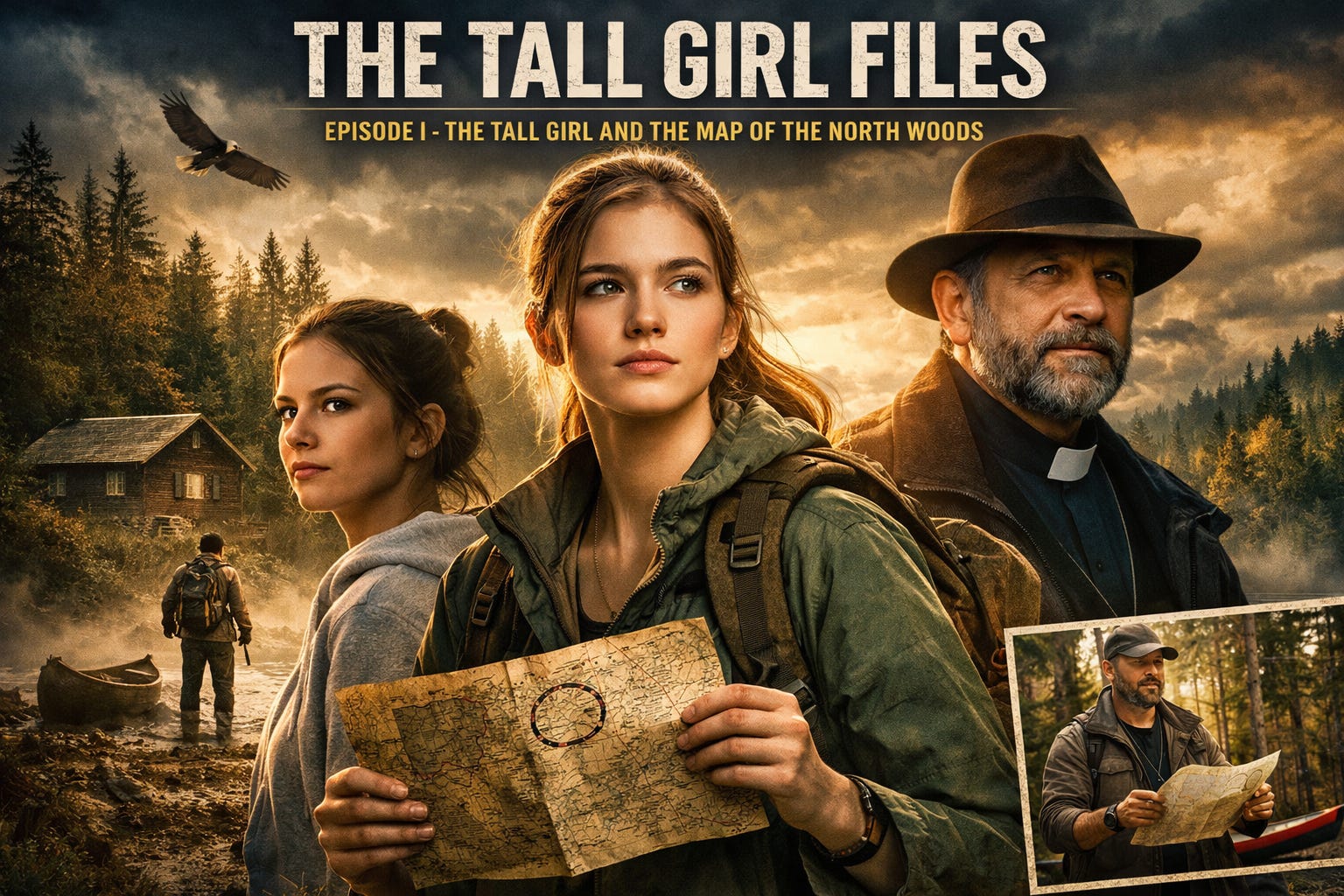
When the Tall Girl first came to Benedictine, she discovered almost at once that colleges resemble old kingdoms more than new institutions.
Each had its towers, banners, rival tribes, songs, loyalties, courts, processions, and hereditary legends. Freshmen arrived imagining lectures and deadlines and practical affairs, and then found themselves in a world full of ceremony.
The Tall Girl had entered that world by a door she had opened herself.
She had come to Benedictine on a dance team scholarship, which meant she arrived not merely as another freshman but as someone who had already survived an audition that felt suspiciously like a professional tribunal. For three days the judges had watched every turn, every landing, every line of the arms with a seriousness that suggested that Western civilization might depend upon the result.
When the acceptance letter arrived she had laughed aloud, partly from relief and partly from the sudden and exhilarating realization that, for once, something in her life had been achieved entirely on its own merits.
She was not here because of her sister.
She was here because she had earned it.
The Tall Girl liked this at once.
She liked the height, the stone, the steps, the river light beyond the grounds, the long views, the cross-topped roofs, the sense that one had not come merely to a school but to a citadel. She liked, too, that almost no one here knew her history, which is one of the greatest pleasures of beginning life in a new place.
At home, or near enough to home, she had long been a creature of labels, and some of them were not her own. She had been so-and-so’s daughter, so-and-so’s sister, the girl from the Chesterton Academy crowd, the freshman with the unusual name, the dancer, the tall one, the Catholic one, the one from that family. At Benedictine she was, for one radiant week, merely a freshman carrying too many books, learning too many names, and pretending that she already knew where the science building was.
This freedom might have lasted longer had not one of the older girls on the dance team stopped in the middle of warmups, stared at her with frank surprise, and said, “Wait. Are you related to the goalie?”
The Tall Girl, who had been stretching in peace, looked up and smiled.
“I have a sister,” she said carefully.
The older girl pointed at her as if accusing her of a spectacular fraud.
“I knew it. You’ve got the same eyes.”
Now there are moments in life when one may lie, clarify, deny, or surrender. The Tall Girl had not yet decided which sort of college woman she meant to become, but she had already learned that surrender often saves time.
“Yes,” she said. “She’s my sister.”
There followed the sort of reaction usually reserved for royalty returning incognito from exile.
“Your sister,” said the other girl solemnly, “is a legend.”
This was absurd, and also not entirely new.
Her sister was not, in the ordinary way, a legend. Legends do not generally major in theology and business. Legends do not forget where they set down their water bottle. Legends do not laugh at bad puns, drive ordinary used cars, and carry three pens because two might fail at a decisive moment. But there was no use protesting. In every school and parish and town, one or two people are always in danger of becoming legends simply because they have done difficult things calmly while others were panicking.
Her sister had that danger about her.
The Tall Girl had long ago ceased trying to explain it.
What struck her now was not that someone recognized the connection, but that so few others did. On campus her sister moved quietly, almost anonymously, except among those who had cause to remember soccer. She was a senior now, and seniors possess a special invisibility. Freshmen look at them with awe for a week or two, and then discover that seniors have already begun to vanish into the future. They are half present, half packed. They are thinking of graduation, jobs, missions, houses, distant airports, adult responsibilities, and God knows what. They walk across campus with the serenity of those who have already begun saying goodbye in secret.
The Tall Girl saw her sister that evening near the chapel steps, talking to two friends in the orange light before supper.
She was easy enough to spot. Not because she was the tallest person there—though she nearly was—but because she had the peculiar stillness common to goalkeepers, lifeguards, and people who know that everything may become urgent with no warning. Her face, when she turned, had the open and practical look the Tall Girl had known all her life: affectionate but not sentimental, amused but not careless, attentive without appearing to work at it.
“Well?” her sister said as they walked toward the dining hall. “How was day one?”
“I’ve already been discovered.”
“By whom?”
“Dance team.”
“That was fast.”
“They identified me as your sister.”
Her sister winced in mock embarrassment.
“I’m so sorry.”
“They called you a legend.”
“That is much worse.”
“It was very solemn,” said the Tall Girl. “You’d have thought I’d admitted being cousin to Charlemagne.”
Her sister laughed.
“Give it a week. Then they’ll only care if you know the choreography.”
The Tall Girl glanced sideways. “You really don’t mind, do you?”
“Mind what?”
“That people know you.”
Her sister considered it.
“I mind if it becomes nonsense. I don’t mind if people are kind.”
This was typical of her. She had a way of rescuing words from melodrama and placing them back on their feet.
They crossed the lower walk where the lamps were coming on one by one. Boys in sweatshirts were arguing about something theological and probably unnecessary. Two girls hurried past discussing an exam as if the professor had declared war. The chapel bell sounded overhead.
It was one of those college evenings that seem to promise not happiness exactly, but the possibility of a life one may yet grow equal to.
The Tall Girl had been thinking, in that secret part of the mind where plans are most alive before they are spoken, about the summer.
Not next week, or next month, but summer—because the young think in enormous leaps, and wisely. One of the brochures she had picked up at an activities table concerned a wilderness expedition program: hiking, canoeing, route-finding, primitive camping, leadership, endurance, all conducted with a seriousness that made it sound half military and half monastic. She had not shown it to many people yet, because there are some aspirations so tender that one dislikes exposing them to practical voices. But the thing had caught her imagination at once.
She wanted, very badly, to go somewhere large enough to make ordinary vanity ridiculous.
She wanted weather, maps, mistakes, firewood, stars, bruises, rivers, strange paths, and the sort of fatigue that makes one honest.
Most of all, she wanted to do something that was not dance, not school, not performance, not anyone’s expectation. Something difficult and clean and real.
At supper she mentioned it at last.
“I’m thinking,” she said, while breaking a roll with unnecessary care, “about doing an Outward Bound type of thing this summer.”
Her sister did not answer immediately, which meant she was taking the idea seriously.
“That sounds exactly like you,” she said.
“Is that good?”
“Yes. Which is why it may also be dangerous.”
“Why dangerous?”
“Because things that are exactly like you are the ones you don’t prepare for enough.”
The Tall Girl smiled. “That sounds like a proverb carved above the gate of a castle.”
“It ought to be.”
“Do you think I could do it?”
Her sister looked at her for a moment with that direct and oddly restful gaze goalkeepers have—the look of someone measuring distance, likelihood, force, and truth all at once.
“Yes,” she said. “I think you could do it. But not because you’re dramatic. Because when you’re scared, you don’t become silly. That’s rarer.”
The Tall Girl was about to reply when her sister’s phone, face-down on the table, vibrated twice.
Her sister glanced at it, frowned slightly, and turned it over.
“Everything all right?” asked the Tall Girl.
“I don’t know.”
The message was from a number neither of them recognized.
It contained only this:
Is your sister still planning on the North Woods trip? She should call me. It matters.
Beneath the message was a first name—Tom.
The Tall Girl stared. “Who is Tom?”
Her sister slid the phone across. “No idea.”
But the Tall Girl, looking harder now, had a sudden prickling memory.
The expedition brochure. A small photo. A staff list. A bearded man in a weatherproof jacket standing beside a canoe.
“Wait,” she said. “I think he might be one of the guides.”
Her sister’s expression changed at once, not into alarm exactly, but into concentration.
“Did you sign up already?”
“Not officially. I requested information.”
“And gave your number?”
“I think I gave mine, not yours.”
“Maybe he tracked you through an emergency contact or the school.” Her sister tapped the message. “But why send this instead of something normal?”
The Tall Girl read it again. It was not only the words but the shape of them. Not “Have her call.” Not “We need paperwork.” Not “Schedule changed.” There was that odd phrase: It matters.
Something in her—a quite unreasonable and therefore possibly useful instinct—sat up at once.
“Should I reply?”
“Maybe,” said her sister. “But not yet.”
“Why not yet?”
“Because messages that say ‘it matters’ usually do.”
That night the Tall Girl looked up the expedition program again. It was based several states north, with regional orientation meetings held through affiliated colleges and outdoor groups. Its literature was competent but ambitious; it promised character, challenge, simplicity, and perspective, which are the four things that brochures always promise when they intend to give you rain and sore feet.
The guide named Tom was indeed on the staff list.
She drafted a reply twice and deleted it twice.
At eleven-thirty she was still awake, not from fear but from that more electric form of uncertainty in which the mind begins inventing stories because it dislikes blank spaces. She had nearly decided to sleep on it when her phone buzzed.
This time the message came directly to her.
If you still mean to come north this summer, don’t let them change your route. Keep the old map. I may not be reachable tomorrow.
There are few things stranger than a message that sounds like the second half of a conversation one has never had.
The Tall Girl sat upright in bed.
She stared at the screen until the words lost grammar and became pure omen.
Then, very sensibly, she took a screenshot and sent it to her sister.
The reply came in thirty seconds.
Stay where you are. I’m coming over.
Her sister arrived wearing a sweatshirt over athletic shorts and carrying the severe expression of one who has been interrupted while planning tomorrow properly. The Tall Girl let her in; they sat on the edge of the bed beneath the weak dorm light and read both messages several times.
“This isn’t normal,” said the Tall Girl.
“No.”
“Could it be a prank?”
“Yes. But not a stupid one.”
“That sounds worse.”
“It usually is.”
Her sister asked practical questions. Had the Tall Girl posted publicly about the trip? No. Had she told many people? Almost none. Had she ever spoken to this Tom by phone? No. Had the program sent any official packet? Only an automated email and brochure materials.
At last her sister said, “Tomorrow we find out if he’s real, reachable, and still employed.”
“You make that sound ominous.”
“I make everything sound ominous after ten-thirty.”
The Tall Girl hesitated.
“Do you think I should drop it?”
Her sister looked surprised.
“Because of two messages? No.”
“What then?”
“I think,” she said, “you should become very interested.”
This answer was so precisely what the Tall Girl had hoped and feared that she laughed despite herself.
“You’re impossible.”
“That’s not the word. The word is ‘older.’”
The next day they began making calls.
The first listed number for the program went to voicemail. The second reached an office manager who was friendly, distracted, and unhelpful. Yes, Tom worked with them. Or had. Or perhaps was currently on leave. She would have to check. No, she did not know why he would be contacting participants privately. No, she did not know anything about maps. Yes, there had been some “routing updates” for summer treks. No, she could not explain further because the coordinator was traveling.
When the Tall Girl asked whether Tom was missing, the woman laughed in mild surprise and said she certainly hoped not.
This did not satisfy either sister.
By afternoon the matter would have rested, as many mysteries do, in a swamp of half-information had not providence—or comedy—sent Father Brown across the quadrangle.
He was not, strictly speaking, supposed to be there. That is to say, there was some official reason for his presence, involving a guest lecture and a dinner with benefactors and perhaps one of those distinguished occasions at which colleges prove themselves more medieval than they admit. But Father Brown always appeared to be somewhere for reasons larger and smaller than the official ones. He moved about the modern world with the air of a man who has taken a wrong train into every century and found all of them interesting.
The Tall Girl had met him before, in that indirect way by which one meets priests who are also family friends and family myths. He was not physically remarkable. Indeed, he was so little physically remarkable that people who wished the world to be theatrical were always disappointed in him for at least ten minutes. Then, if they had sense, they discovered that he possessed the larger dramatic quality of seeing straight through things.
He found the sisters near the statue outside one of the academic buildings, sitting with papers spread between them: brochures, printouts, the screenshots of the messages, and an absurdly cheerful expedition pamphlet featuring a canoe on a silver lake.
Father Brown looked from one face to the other and said, “I see either a mystery or a scholarship application.”
“A mystery,” said the Tall Girl.
“Then I am relieved,” said Father Brown. “Scholarship applications are generally much harder.”
Her sister handed him the phone with the messages. He read them without hurry.
“Do you know this man?”
“No,” said the Tall Girl.
“Do you know whether he is honest?”
“No.”
“Excellent,” said Father Brown.
The Tall Girl blinked. “How is that excellent?”
“Because it leaves us with the thing itself instead of our opinions. One gets much further that way.”
He asked a number of questions so plain that they were almost invisible.
Why had the first message gone to the sister instead of the Tall Girl? Why mention the trip in a way suggesting prior knowledge, but not identify the problem? Why say “don’t let them change your route” instead of “ask for the old route”? Why say “keep the old map,” as if someone expected the map to be taken away?
At the last question all three were quiet.
Her sister said slowly, “That’s true.”
Father Brown nodded. “People usually hide what they are afraid may be lost. They do not usually warn strangers to keep things unless they expect someone else to remove them.”
“Then he’s trying to protect the map?” asked the Tall Girl.
“Possibly. Or to protect you by means of the map. The distinction matters.”
Her sister folded her arms. “What do you think happened?”
Father Brown looked out across the lawn where students moved in clusters under the noon light.
“I think,” he said, “that when an outdoorsman becomes mysterious, the mystery is seldom in the wilderness. It is usually among the civilized arrangements around it.”
That afternoon the matter, being now officially mysterious, improved rapidly.
The Tall Girl received an email from the program office containing revised preliminary materials for summer participants. It was brisk, professional, and entirely ordinary except for one thing: attached was a route sheet and topographic sketch that did not match the brochure at all.
The old brochure map, the one she had downloaded the night before, showed a long northern loop through lakes, ridges, and a place marked only as Old Mission Trail Spur.
The new sheet omitted that spur entirely.
Instead the route made an efficient curve eastward through safer, better documented ground.
“Maybe they just updated it,” said the Tall Girl.
“Maybe,” said her sister, in the tone that means the opposite.
Father Brown, when shown both maps, looked at them for so long that the Tall Girl began to suspect he knew less geography than anyone involved. At last he put a finger on the old version.
“This,” he said, “is ugly.”
Neither sister understood.
“The new one is neat. It has the trim, sensible look of officials. This older one has the look of reality. See? It wanders. It has an inconvenient spur. It risks weather and bog and confusion. Nature usually looks uglier than management.”
“That is the most unromantic defense of wilderness I’ve ever heard,” said the Tall Girl.
“It is also why I trust it.”
Her sister leaned in. “What about the spur?”
Father Brown tapped the words.
“People do not generally erase things unless the things are troublesome.”
By evening a reply came from Tom’s number, though no one had yet texted again.
It was only a photograph.
No explanation. No greeting. No words.
Just a photograph of a folded paper map lying on what looked like a wooden table.
Across the map, in dark ink, a circle had been drawn around a point northwest of the official route. Near the circle, in hurried block letters, was written:
NOT ON THEIR CHART
The Tall Girl stared at it until she felt the curious sensation of the world becoming at once larger and more exact.
“This is insane,” she whispered.
Her sister took the phone. “Or very sane. Depending on what he found.”
Father Brown, seeing the image, sighed in a manner almost cheerful.
“Ah,” he said. “Now we have a proper beginning.”
The Tall Girl turned. “A beginning of what?”
“Of your adventure.”
“That seems optimistic.”
“No,” said Father Brown. “Optimism says things will turn out well. Adventure says things will turn out interestingly.”
Her sister gave him a level look. “That is not reassuring.”
“Of course not,” said Father Brown. “Truth seldom is at first.”
The matter might still have remained deliciously abstract had not the next morning provided the one development that transforms oddity into urgency: absence.
Tom did not appear for a scheduled orientation video call with several prospective participants. An assistant moderator apologized, improvised, and carried on with talking points about equipment, conditioning, hydration, and travel plans. When the Tall Girl asked whether Tom would reschedule, the assistant looked briefly startled and said that Tom was “away dealing with something.”
“What something?” the Tall Girl asked.
“I’m not sure,” said the assistant. “A family matter? I think. Or a field issue.”
There are lies that are wicked and lies that are merciful and lies that are administrative. This was the third kind, and the most suspicious.
After the call, the Tall Girl and her sister walked the edge of the soccer field in a strong afternoon wind. Practice was over; the nets were empty; scraps of tape moved along the track like pale insects.
Her sister stood looking at the goal as if it were a proposition.
“You know,” said the Tall Girl, “I still can’t tell whether you think I should go.”
Her sister smiled faintly. “I think you should find out what this is.”
“That wasn’t the question.”
“No. But it’s the real one.”
The Tall Girl shoved her hands into her jacket pockets. “Suppose it is dangerous?”
Her sister did not answer at once.
At last she said, “Everything worth doing is dangerous in one of the useful ways. The trick is to know whether the danger makes you clearer or merely more foolish.”
“And which is this?”
“I don’t know yet.”
She stooped, picked up a ball lying near the touchline, and tossed it lightly from hand to hand.
“Do you know what people misunderstand about goalkeeping?”
“Everything?”
“Most things,” said her sister. “They think it’s about reaction. It isn’t. Not mostly. It’s about angles. If you see the angles early enough, half the danger disappears before it arrives.”
She set the ball down and stood facing the empty net.
“The goal always looks huge to people who panic. But from the right place, at the right time, it becomes smaller than they think.”
The Tall Girl watched her.
This was not a speech. Her sister did not make speeches. She was talking as she always did when the subject was practical, but something in the words stayed.
“So what am I supposed to do with that?” asked the Tall Girl.
Her sister glanced at her.
“Watch the angles.”
That evening, as if to obey, the Tall Girl spread all the evidence on her desk and tried to look at the thing not emotionally but geometrically, as her sister might have done.
There was the first message to the wrong phone.
The second message to the correct one.
The old brochure map.
The revised official map.
The photograph with the circle.
The vanished guide.
The evasive office.
The missing trail spur called Old Mission Trail Spur.
If one stood in the middle of all those facts and spun around, the thing seemed huge and foggy. But if one moved slightly—if one asked not “What is happening?” but “What is being hidden?”—the shape narrowed.
Something existed off the official route.
Something had caused a guide to warn a participant he did not know personally.
And someone else was trying to remove or replace the map that led there.
The Tall Girl sat very still after this thought.
Then she did something simple and, because simple, effective.
She searched old regional trail forums, archived newsletters, and scanned hiking club bulletins until midnight.
Near one o’clock she found, buried in a ten-year-old PDF from a historical society, a passing reference to a network of missionary footpaths and portage routes in the northern forests used in the nineteenth century by priests, traders, and settlers. Several were unmaintained. One branch, the document said, had fallen off most modern recreation maps despite remaining visible in dry seasons.
Its local name was the Old Mission Trail.
The Tall Girl whispered “Oh” to the empty room.
The name on Tom’s map was not poetic, then. It was literal.
A trail once used by missionaries still existed, or half existed, somewhere in the northern woods—and the current program had just removed the spur that approached it.
The next morning she met Father Brown and her sister for coffee, which for one of them was coffee, for another tea, and for Father Brown something that might have been coffee if one were charitable and nearsighted.
When she showed them the historical reference, Father Brown’s face brightened.
“Mission trails,” he said softly. “Now that is interesting.”
“Why?” asked the Tall Girl.
“Because the modern world remembers roads built for commerce and forgets paths built for souls. The second are usually the more enduring.”
Her sister leaned over the printout. “So the old map leads near a forgotten mission path.”
“And the new one does not,” said the Tall Girl.
Father Brown nodded. “Which means your vanished guide may have stumbled upon something at the intersection of memory and convenience. Those are dangerous intersections. Civilization is forever building parking lots over them.”
The Tall Girl sat back.
For the first time since the strange messages began, she was not merely intrigued. She was committed.
Not to recklessness. Not to melodrama. Not even, exactly, to the trip. She was committed to the fact that this had become her kind of question.
There was a path older than the official chart.
There was a man who had tried to preserve its location.
There were people tidying away that fact.
And somewhere behind all this, faint but undeniable, was the beginning of a road she had not expected to travel.
Her sister saw the look in her face and almost laughed.
“Oh dear,” she said. “You’ve got it.”
“Got what?”
“The thing you get when a mystery stops being interesting and becomes personal.”
Father Brown lifted his cup in mild salute.
“That is usually the point,” he said, “at which Providence becomes difficult to distinguish from plot.”
The Tall Girl folded the old map carefully, more carefully than any paper deserved, and placed it inside her notebook.
Outside, bells began again over the college hill. Students crossed the walks under a high blue sky. Somewhere beyond all these ordered buildings and known paths, far to the north, a vanished guide had marked a place that was not on their chart.
And for the first time, she knew with perfect certainty that she meant to find it.
End of Episode I