

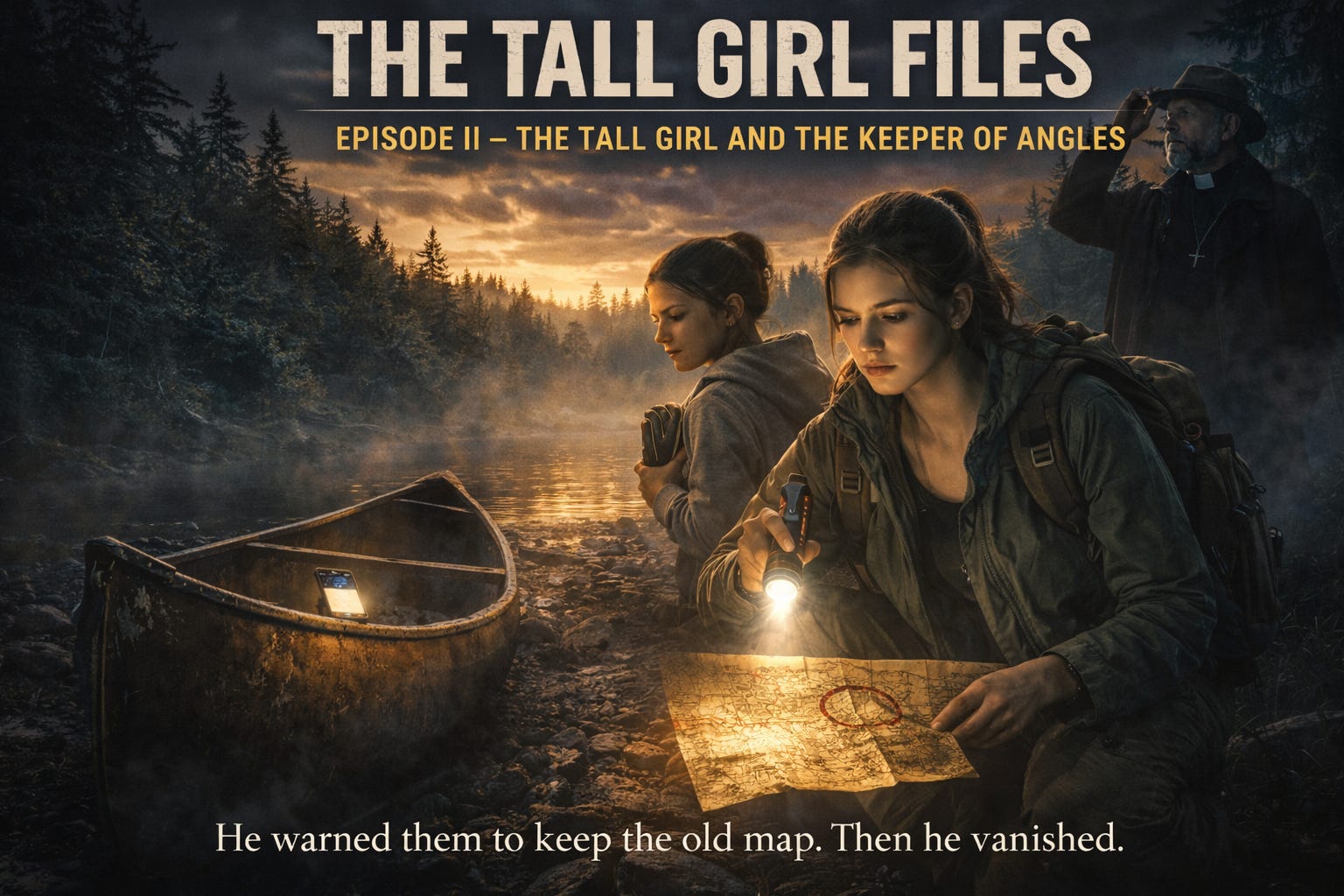
The Tall Girl did not sleep much that night.
Not because she was frightened, though it would have been reasonable enough to be frightened, but because the mind behaves oddly once it has been entrusted with a question large enough to matter. There are questions that merely occupy one’s thoughts, as a tune occupies the ear or an advertisement occupies a fence. And there are questions that alter the dimensions of the room. One goes to bed in an ordinary dormitory and wakes, or half wakes, in the shadow of a forest several states away.
Until two days before, the North Woods expedition had been a pleasing ambition. It belonged to that category of future event in which one pictures only the noble parts: the clean air, the canoe gliding over silver water, the campfire, the clear stars, the improved character. Such visions are among the most merciful of human illusions. If people saw beforehand the blisters, wet socks, awkward silences, bad coffee, insects, strained muscles, and poor decisions by moonlight, they would undertake far fewer adventures and perhaps become much worse people.
But now the expedition had changed its character.
There was a vanished guide.
There were two messages sent with the peculiar urgency of one who fears interruption.
There was the old map, and the new map, and the missing trail spur.
There was the phrase Old Mission Trail, which had seemed, at first glance, poetic and then, upon investigation, proved literal—which is often how the world deceives sensible people. It wraps its facts in the appearance of legend so that modern minds will dismiss them.
And there was Father Brown’s remark that when an outdoorsman becomes mysterious, the mystery is seldom in the wilderness but in the civilized arrangements around it.
The Tall Girl lay awake turning that sentence about in her mind like a key that had not yet found its lock.
At Benedictine the night carried its own order. Doors shut gradually. Laughter receded down the hall. A few distant voices argued about theology in the manner of those who are certain that a conclusion reached after midnight is inherently more profound. Then even that died away, and the bells marked the hour with a calm that made insomnia seem less like failure and more like participation in some ancient watch.
She rose once, crossed to the desk, and unfolded the printed map again beneath the small pool of her lamp.
The old route wandered northward with the irregular candor Father Brown trusted. The revised route moved tidily east as if apologizing for any possible inconvenience. And there, on the older sheet, lay the missing spur, a little line with a little label, the sort of cartographic detail the practical overlook and the imaginative overvalue—until it becomes the one thing on which the whole story turns.
Old Mission Trail Spur.
She folded the paper once more and slipped it back into her notebook.
Then she sat by the window and looked out over the dark hill and the dim lights of campus buildings and thought with a curious steadiness, This has ceased to be theoretical.
That was what had changed.
Not the danger. She did not yet know whether there was danger. Not the mystery. That had been present from the first message. What had changed was proximity. She could feel the story drawing lines around her. It had not become her duty exactly, nor yet her vocation, but it had become the sort of thing one could no longer watch from the audience.
By the time she slept, the bells had marked two.
When morning came, it came with such cheerful decisiveness that the whole world seemed to deny the existence of secrets. Sunlight struck the stone buildings cleanly. Students crossed the lawns with coffee cups and backpacks and precisely the expression of people who had not spent the night wondering whether a vanished guide had discovered something hidden on a forgotten missionary route.
The Tall Girl met her sister outside the dining hall.
Her sister was already in training gear, hair pulled back, carrying gloves and a water bottle, looking entirely composed in that way athletes do when they have long since accepted discomfort as part of the landscape.
“How much sleep?” her sister asked.
“Enough to become suspicious of daylight.”
“That’s a good beginning.”
“Is it?”
“Yes. Too much cheerfulness in the presence of a mystery is very dangerous.”
They walked together across the campus toward the soccer field. The Tall Girl had learned already that conversations with her sister were best held while moving. Her sister did not avoid seriousness, but she preferred to arrive at it sideways, in motion, on a path, rather than sitting solemnly as though receiving ambassadors.
“I found something else,” the Tall Girl said.
“Oh?”
“The Old Mission Trail.”
Her sister glanced sideways. “I thought that was what you found yesterday.”
“I found that it existed. Last night I found a little more.”
She told her about the historical society reference, about the missionary footpaths and portage routes, about how one branch had fallen off modern recreation maps while remaining physically present in dry seasons.
Her sister listened with that practical stillness the Tall Girl had known since childhood—the stillness of someone catching a ball in the mind before catching it with the hands.
“So it wasn’t just a romantic name,” her sister said.
“No. It was an actual route.”
“Used by priests and traders?”
“And settlers, apparently.”
Her sister nodded slowly. “Then Father Brown was right.”
“That’s encouraging.”
“It is?”
“Yes. I prefer mysteries in which at least one person knows what he’s talking about.”
Her sister laughed.
“But there’s another thing,” said the Tall Girl. “If the mission trail connected settlements and water routes, it probably crossed a lot of ignored land.”
“Meaning?”
“Meaning somebody moving things quietly through the woods would prefer a forgotten trail to a current one.”
Her sister gave her a look of mild approval that the Tall Girl valued more than most praise.
“That,” she said, “is not a bad thought.”
“It’s Father Brown’s fault.”
“Then it is probably dangerous.”
They had reached the field by then. Practice had not started. The grass still held the coolness of the morning. Nets hung slack and empty, and beyond them the trees stirred in a wind that had not yet decided whether to be autumnal or merely inconvenient.
Her sister dropped her bag near the sideline and stood for a moment looking at the goal with an expression the Tall Girl had seen a thousand times but never fully understood. It was not concentration exactly. It was more like recognition. As if the rectangle of white posts and netting constituted a recurring moral problem to which she had pledged some private loyalty.
Her sister bent, picked up a ball left near the touchline, and rolled it once beneath her shoe.
“You asked yesterday what I meant about angles,” she said.
“I did.”
“Come here.”
The Tall Girl obeyed, though with some suspicion.
“Stand there,” her sister said, pointing to the top of the penalty area.
“This feels instructional.”
“It is.”
The Tall Girl took her place. Her sister moved backward toward the goal line, then adjusted her position by two or three feet with an instinctive economy that made the movement look inevitable.
“Now,” said her sister, “pretend you’re a striker.”
“I have no idea how to pretend that.”
“You don’t need to. Only imagine you want the ball past me.”
“That part is easy.”
“Good. What does the goal look like?”
“Large.”
“How large?”
The Tall Girl considered. “Large enough to be encouraging.”
Her sister stepped forward two strides.
“And now?”
The Tall Girl frowned. “Smaller.”
“How much smaller?”
“Annoyingly smaller.”
“That,” said her sister, “is half the profession.”
She tossed the ball toward the Tall Girl, who trapped it clumsily enough to prove the point about her not being a striker.
“People think goalkeeping is about reaction,” said her sister. “It isn’t. Not mainly. Sometimes you react. Sometimes you dive. Sometimes you do dramatic things people talk about afterward. But the real work is geometry.”
She tapped her temple.
“It starts here. Angles. Distances. Timing. What the shooter sees. What you let her think she sees. Where the danger will be in two seconds, not where it is now.”
The Tall Girl sent the ball back.
“If you stand in the wrong place,” her sister went on, “the whole goal opens up. It becomes enormous. Every mistake multiplies itself. But if you stand in the right place early enough, half the danger disappears before it arrives.”
She moved again, demonstrating some invisible line between ball, body, and post.
“The trick,” she said, “is not to admire the size of the problem.”
“That sounds theological.”
“It’s athletic,” her sister said. “Which is usually theology in cleats.”
The Tall Girl laughed.
“Look,” said her sister. “From the wrong angle, the goal is terrifying. From the right angle, it becomes manageable. Same field. Same striker. Same ball. Different position.”
She pointed at the posts.
“Most people panic because they keep staring at the whole opening. But the opening is not the truth. The truth is the line.”
“What line?”
“The line between the threat and the place it wants to reach.”
The Tall Girl was quiet for a moment.
“You’re saying the mystery is like that.”
“I’m saying most mysteries are.”
Her sister stepped out of the goal and handed her the ball.
“Right now you’re looking at messages, maps, missing people, trail revisions, a vague office, and a priest who gets cheerful when things turn strange.”
“That last part is certainly one of the problems.”
Her sister smiled.
“But maybe it’s one line,” she said. “One path. One obstruction. One thing somebody wants reached, and one thing somebody wants prevented.”
The Tall Girl turned the ball in her hands.
“And how do I find that?”
Her sister shrugged in the calm infuriating way of older sisters who have already worked out what younger people are only beginning to suspect.
“Watch the angles.”
Practice began to gather around them then: players arriving, bags thumping down, voices carrying across the field. The Tall Girl stepped aside and watched her sister join the others.
It struck her suddenly that almost everyone who had praised her sister over the years had praised the dramatic things: impossible saves, collisions survived, penalty kicks stopped, games preserved. Very few spoke about position. Very few admired her for standing in the right place before anybody else knew where the right place would be. Yet that was likely the larger part of her greatness, as the invisible part of almost every excellence is larger than the visible part.
The Tall Girl left the field with that thought in her mind, and with the odd sense that her sister had not merely offered advice but had given her the principle on which the entire mystery might turn.
By noon she and Father Brown were seated with trays in the campus dining hall, which was one of those agreeable modern institutions whose food improves markedly if one is discussing dangerous ideas.
Father Brown had, that morning, delivered a lecture on paradox to an audience that had expected uplift and received clarity, which is not the same thing. He seemed contented in the aftermath, as he often did after mildly alarming respectable people.
The Tall Girl handed him the historical printout on the Old Mission Trail.
He read it carefully, his brow lowering slightly as he moved down the page.
“Mission paths,” he said. “Yes. I thought something of the kind.”
“You did?”
He folded the paper and laid it beside his plate.
“The phrase had the wrong sort of poetry.”
“The wrong sort?”
“Yes. Real old things often sound sentimental to modern ears, because modern ears assume anything devout must also be decorative. But missionary roads were practical things. They existed because someone needed them.”
Her sister arrived then, tray in hand, and sat opposite them.
“What have we learned?” she asked.
“That Father Brown distrusts decorative religion,” said the Tall Girl.
“I distrust decorative anything,” said Father Brown. “Particularly when it pretends to be practical.”
Her sister looked at the paper.
“So the trail was real.”
“Yes,” said Father Brown. “And probably more important than the present mapmakers realize.”
“Why?”
“Because roads are among the most revealing things a civilization makes. They show not what people admire, but what they need.”
The Tall Girl leaned forward.
“And what did mission roads show?”
“That souls were worth walking to,” said Father Brown simply. “But also that missionaries usually went where communities already existed or were forming. Where there are people, there is trade. Where there is trade, there are paths. Where there are paths, there are opportunities—not all of them honorable.”
Her sister nodded. “So an old mission route might now serve some entirely different traffic.”
“Quite.”
“Smuggling?” asked the Tall Girl.
Father Brown lifted one shoulder. “Possibly. Or concealment of some other kind. The point is not the criminal imagination, which is usually dreadfully repetitive. The point is the geography. Forgotten routes are irresistible to modern men because modern men assume that whatever they have forgotten has ceased to exist.”
“That sounds stupid,” said the Tall Girl.
“It is,” said Father Brown, “which is why it happens constantly.”
Her sister smiled faintly. “That also sounds theological.”
“Everything sounds theological if you are sufficiently attentive.”
The Tall Girl took out the two route maps and spread them between the trays.
“Then let’s be attentive. What do you see?”
Father Brown looked from one to the other.
“The new one is tidy,” he said.
“You said that before.”
“And I was right before.”
He placed one finger on the revised route.
“This has the look of an institution reducing liability. It is neat, sensible, and boring. That is not in itself suspicious. In fact it may be wise. People often make prudent decisions for entirely good reasons.”
He moved the finger to the older route.
“This, however, is untidy in a way reality usually is. It wanders. It tempts weather. It acknowledges inconvenient ground. And here—”
He tapped the little spur.
“—here is the offense.”
“The spur?”
“The omission,” he said. “The spur was not merely left unexplored. It was erased.”
Her sister considered. “If they no longer wanted groups near it, the simplest explanation is safety.”
“Yes,” said Father Brown. “And that may still be true.”
“But?”
“But safety rarely explains secrecy. If a path washes out, one says so. If there is a bear problem, one says so. If a bridge collapses, one says so. People are very fond of explaining danger. What they do not explain readily are embarrassments.”
“Embarrassments for whom?” asked the Tall Girl.
Father Brown looked at her.
“Ah,” he said. “Now you are finding the angle.”
The next week passed in a curious mixture of ordinary campus life and steadily increasing inward tension. The Tall Girl attended classes, rehearsed with the dance team, met girls who were already planning social calendars six months ahead, and nodded through conversations about entirely normal things while carrying in her notebook the folded map of an abnormal one.
At rehearsal she found herself watching formations differently. The coach corrected alignment; a half-step altered the whole picture. One dancer too far forward made the line look crooked. One turn performed from the wrong mark threw off the shape of everything around it. The Tall Girl, moving with the others across the polished floor, thought unexpectedly of her sister in the goalmouth.
Maybe that was what families did at their best: lend each other a grammar for the world.
Her sister had not given her conclusions. She had given her a way of seeing.
Three days later the expedition program sent a formal email inviting prospective participants to an orientation and equipment session at a regional outdoor training center several hours north. The language was brisk, encouraging, and impersonal. It mentioned schedules, readiness, safety protocols, waiver forms, and the exhilarating educational benefits of controlled hardship.
At the bottom was the name of a regional coordinator.
Tom’s name appeared nowhere.
The Tall Girl read the email twice, then forwarded it to her sister.
Her phone rang within a minute.
“Well?” said her sister.
“Well what?”
“Are you going?”
The Tall Girl looked again at the cheerful professionalism of the message.
“Yes.”
“You already decided before I called.”
“Yes.”
“Good.”
“That’s all?”
“No. Also take notes. Also don’t trust people who smile too efficiently. Also if anyone mentions route changes, ask why.”
The Tall Girl smiled. “You make everything sound tactical.”
“Everything is tactical,” said her sister. “Most people are just too disorganized to notice.”
The drive north took her through a landscape that seemed to grow older mile by mile. The towns thinned. The roads narrowed and then straightened with the stubborn confidence of engineers unconcerned with romance. Fields gave way to woods, and the woods thickened until they no longer seemed decorative but sovereign. Lakes flashed unexpectedly between stands of pine. Weather moved in loose gray bands over distant ridges.
She found herself thinking of the line Father Brown had used: the modern world remembers roads built for commerce and forgets paths built for souls.
The training center appeared at last on the edge of a long dark forest and looked exactly like the sort of place that promises character development through dampness. It was built of weathered wood and stone, with canoes stacked on racks, coils of rope, maps posted under glass, and the faint smell of lake water, fuel, and institutional coffee.
Inside, a dozen or so participants had gathered.
The Tall Girl studied them automatically.
One young man wore the expression of someone who had been preparing for wilderness life since infancy and had only lately realized other people were allowed in. Another appeared so urban and polished that his boots looked rented from a better person. Two girls in matching fleeces whispered continuously, probably converting anxiety into language. A broad-shouldered older student with a campus ministry sweatshirt stood alone reading the wall map as if it were an exam.
The Tall Girl signed in at the desk.
The woman there, brisk and outdoorsy in the deliberate institutional way, smiled and handed her a folder.
“First session starts in fifteen minutes.”
“Is Tom here?” asked the Tall Girl.
The woman’s smile changed almost imperceptibly.
“No.”
“Will he be joining later?”
“I don’t believe so.”
“I had questions for him.”
“So did we,” said the woman, and immediately appeared to regret having said it.
The Tall Girl waited.
The woman looked down at her paperwork, which is the bureaucratic equivalent of drawing a curtain.
“That sounds as if he’s missing,” said the Tall Girl.
The woman glanced up sharply, then away.
“Please take a seat. We’ll begin shortly.”
The Tall Girl did not move.
“I heard from him,” she said quietly.
The woman’s eyes returned to hers at once.
“When?”
“Recently.”
“How recently?”
“Two nights before the office said he was unavailable.”
For a second the woman looked less like a coordinator than a person who had accidentally stepped into the wrong conversation.
Before she could answer, another staff member called her name from the back room. She muttered something about beginning shortly and withdrew.
The Tall Girl took a seat near the side wall, her folder unopened in her lap, and watched the room fill. She had the distinct sensation that something had shifted merely by her saying she had heard from Tom. A single sentence had altered the lines of behavior in the room. That, she thought, was either very promising or very bad.
The orientation began with the usual material. Equipment expectations. Emergency procedures. Weather planning. Water purification. Group discipline. Appropriate footwear. The coordinator spoke clearly and well, but with the unmistakable strain of someone balancing official speech upon unofficial facts.
At last she paused.
“There has been one staffing change,” she said. “Some of you may have corresponded earlier with Tom Heller. He will not be leading any summer groups this season.”
The Tall Girl raised her hand at once.
“Why not?”
The coordinator hesitated.
“He is unavailable.”
The Tall Girl heard her own voice become calmer.
“That answer was already given. It was not informative the first time.”
Several students turned to look at her.
The coordinator’s expression tightened. “Mr. Heller is away from the program.”
“Voluntarily?”
“That is enough for now.”
“It is not enough if he was assigning routes.”
One of the other participants, the broad-shouldered older student, frowned. “What’s going on?”
The room shifted. One could feel the collective movement of strangers deciding whether to remain passive.
The Tall Girl reached into her notebook and drew out the folded map.
“I received messages from him,” she said. “He warned me not to let anyone change the route and told me to keep the old map.”
The coordinator stared.
“Where did you get that?”
“From Tom.”
“Show me.”
The Tall Girl did not move.
“First tell me whether he’s missing.”
Silence.
The coordinator looked around the room, and in that instant the Tall Girl understood something very simple: the woman had hoped to get through the whole session without saying it aloud.
At last she exhaled.
“He never checked back in from a scouting trip.”
The room seemed to contract around the sentence.
“When?” asked the older student.
“Four days ago.”
“Was there a search?”
“Yes.”
“And?”
“No sign.”
The Tall Girl unfolded the map and laid it across the table in front of her.
“Was he scouting here?”
The coordinator looked down.
The circle, hand-drawn in dark ink, enclosed a point northwest of the currently approved route. Beside it stood the hurried words:
NOT ON THEIR CHART
The woman went pale.
“Where did you get this?” she asked again, but now the question sounded less suspicious than afraid.
“I told you. He sent it.”
“That’s impossible.”
“Why?”
The coordinator swallowed.
“Because his phone was found.”
No one spoke.
“Where?” asked the Tall Girl.
The woman looked at the map as if it had accused her.
“In his canoe,” she said.
“And where was the canoe?”
Another pause.
Then, quietly:
“Near the Old Mission Trail.”
There are moments in life when confusion becomes structure so suddenly that one almost hears the pieces lock.
The Tall Girl felt exactly that.
The vanished guide.
The missing spur.
The erased route.
The old mission path.
The found phone.
The unfound man.
And now the room itself had become part of the geometry, because the staff were no longer merely informative or unhelpful; they were involved, whether through fear, embarrassment, caution, or some combination of all three.
“What was he doing there?” asked the older student.
“Route assessment,” said the coordinator.
“Alone?” said someone else.
“He preferred solo scouting.”
“Did he report a hazard?”
“No.”
“Then why remove the spur?” asked the Tall Girl.
The coordinator closed her eyes briefly, like a person who has resisted a door only to find it opening inward.
“We were reviewing route liabilities.”
“That’s an administrative phrase,” said the Tall Girl. “It doesn’t mean anything.”
The woman looked at her.
“It means,” she said, “that Mr. Heller believed there was unauthorized activity near the old trail.”
The room stirred at once.
“What kind of activity?” asked one of the girls.
“We didn’t know.”
“You didn’t know?” said the older student. “Then why let him go back?”
The coordinator’s composure cracked, if only by an inch.
“Because he insisted,” she said. “Because he thought he could verify it and report back. Because he’d been on those routes for years and believed he knew what he was doing.”
The Tall Girl thought of the messages again. Don’t let them change your route. Keep the old map.
He had known, then, or suspected enough to distrust official handling.
“Did he say what he found?” she asked.
The coordinator shook her head. “Only that something was using the old trail. Those were his words.”
“Something?”
“Something,” repeated the woman. “And that if the revised maps went out before he returned, we should not assume the matter was finished.”
The Tall Girl stared at the circle on the map.
Outside the windows the pines stood in long dark ranks under a sky the color of cold tin.
Something was using the old trail.
A foolish sentence, if one heard it wrongly. A precise sentence, if one heard it correctly.
Not a ghost. Not a legend. Not some romantic nonsense of hidden monasteries and lost pilgrims. Something practical. Deliberate. Present tense.
A route had not merely existed. It had been reactivated.
The session dissolved shortly afterward into partial explanations and administrative apologies, which are the natural sounds made by institutions when reality arrives before policy has prepared for it. The participants were told the northern route was suspended. Alternative sessions would be offered. Refunds, deferrals, and reassignment options would be discussed later.
No one looked satisfied.
The Tall Girl stepped outside into the late afternoon and walked beyond the parking area until the building sounds faded behind her. Before her, the forest rose in long shadowed layers, as if the land itself preferred secrecy.
She drew the map from her notebook once more.
The ink circle looked almost crude in the outdoor light. But there was authority in crude marks when they had been made in haste by someone who believed time might fail him.
The trees stood silent.
Somewhere beyond them a canoe had been found with a phone inside it.
Somewhere beyond them a man had vanished on a trail no longer present on the official chart.
And somewhere beyond them lay the line her sister had told her to find—the true angle from which the whole impossible opening would become narrow enough to face.
Footsteps sounded behind her on the gravel.
She turned.
Father Brown was coming up the path, hat on, hands tucked into his coat pockets, with the air of a man who had not so much arrived as emerged from a neighboring paragraph.
She stared. “What are you doing here?”
“I was invited,” he said.
“By whom?”
“By Providence, I think. Though a regional chaplain was involved in the paperwork.”
The Tall Girl laughed despite herself, then handed him the map.
He studied it in silence for a long moment.
At last he said, “Ah.”
“That is what you said last time.”
“Yes,” said Father Brown. “But now I mean it more specifically.”
She told him what had happened in the session, all of it: the missing guide, the found phone, the old trail, the evasions, the phrase about unauthorized activity.
Father Brown listened without interruption, looking not at her but into the trees beyond her shoulder.
When she finished, he was quiet for a few seconds.
Then he said, “Your sister was right.”
“That is not a shocking development.”
“No,” said Father Brown. “But it is an important one. The angle has appeared.”
“What angle?”
“The one between disappearance and erasure.”
She frowned.
“I don’t understand.”
“Your guide vanished near the one route they quietly removed from use. That may still be coincidence, though I begin to doubt it very much. But if it is not coincidence, then the trail itself is no longer background. It is motive.”
The Tall Girl folded her arms against the wind.
“So what do we do?”
Father Brown looked at the dark line of the forest.
“We follow the path.”
“It isn’t on the chart.”
He turned to her with the faintest suggestion of a smile.
“Then,” he said, “we shall have to use the older map.”
End of Episode II