

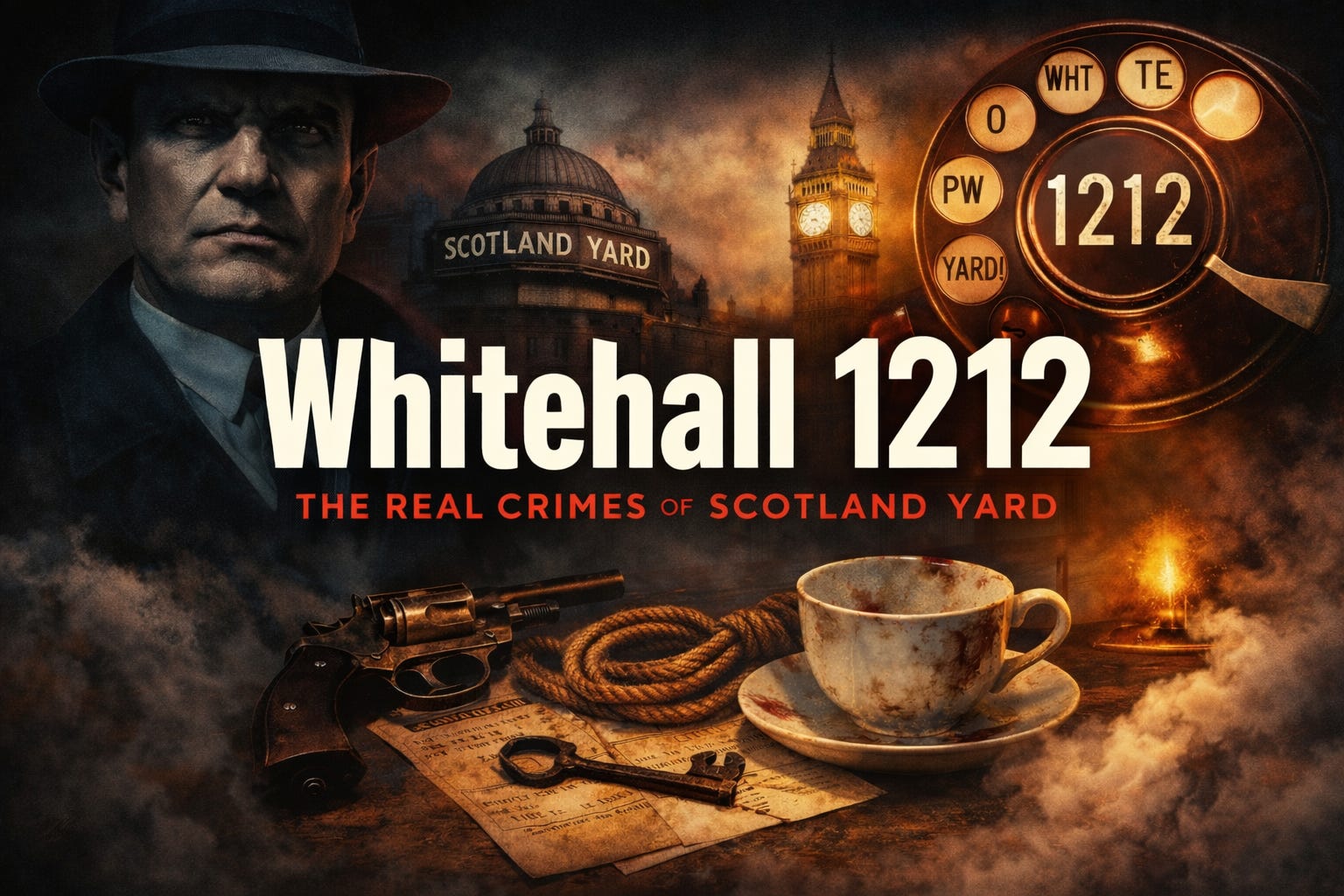
There are crime dramas that entertain us.
And there are crime dramas that judge us.
One of the most popular marathon collections on Chesterton Radio belongs to a series whose title sounds less like poetry and more like a switchboard:
Whitehall 1212.
But Whitehall 1212 was not a phrase. It was a number — the telephone number of Scotland Yard.
If you dialed it, justice answered.
And that is precisely what this remarkable 1951–1952 BBC crime series dramatized.
The Black Museum: Where Objects Remember
Each episode is introduced by Chief Inspector John Davison, caretaker of Scotland Yard’s Black Museum — the real collection of artifacts connected to notorious crimes.
A rope.
A revolver.
A glove.
A teacup.
The story begins not with a scream, but with an object.
“This is a length of cord…”
From that cord unfolds greed, calculation, desperation — and ultimately consequence.
There is something profoundly Chestertonian in this method. The object is not symbolic. It is evidence. And evidence is reality’s refusal to cooperate with lies.
Crime, in Whitehall 1212, is not glamorous. It is not clever. It is not romantic.
It is a rupture in the moral order — and the episode exists to close that rupture.
Wyllis Cooper’s Cool Precision
The guiding hand behind the series was Wyllis Cooper, previously known for his atmospheric work on Quiet, Please.
Here, Cooper is restrained.
No orchestral hysteria.
No theatrical excess.
The pacing mirrors investigation itself — steady, procedural, inevitable.
The cast of British actors delivers performances that feel institutional rather than melodramatic. Justice arrives not as spectacle, but as process.
And that distinction is everything.
A Comparison: Orson Welles and the Other Black Museum
Listeners may also know The Black Museum, hosted by Orson Welles.
Both series draw from Scotland Yard’s grim cabinet of curiosities. Both dramatize real cases. Both begin with artifacts.
But the tone differs.
Welles gives us Gothic gravitas — theatrical, sonorous, almost Shakespearean.
Whitehall 1212 is cooler. Straighter. Judicial.
If Welles invites you to marvel at crime’s strangeness, Whitehall 1212 invites you to respect justice’s patience.
Both are excellent. But the latter feels less like entertainment and more like civic memory.
Why It Resonates on Chesterton Radio
Modern crime entertainment often invites us to admire the criminal mind.
Whitehall 1212 assumes something older — that crime is wrong, that truth matters, and that justice is deliberate.
It assumes evil leaves fingerprints.
And perhaps that is why it remains one of the most listened-to crime features on Chesterton Radio.
🎧 Listen Now
If you would like to experience the full dramatic arc uninterrupted:
▶ Whitehall 1212 – Marathon Collection
Prefer individual episodes?
▶ Whitehall 1212 – Complete Playlist
Whitehall 1212 Chesterton Radio Playlist
Why We Preserve It
Chesterton once wrote that tradition is the democracy of the dead.
Whitehall 1212 is tradition in audio form.
At Chesterton Radio, we air these dramas not because they are nostalgic curiosities — but because they remind us that storytelling once assumed moral gravity.
We are listener-supported.
No corporate sponsors.
No algorithm-chasing sensationalism.
No glamorization of wickedness.
Only restored classics sustained by those who believe stories still shape souls.
If this kind of storytelling matters to you, consider becoming a supporting subscriber.
Your support keeps the signal alive — and keeps justice ringing.
The Number Still Rings
The artifacts in the Black Museum were preserved so society would remember.
The radio series preserved those cases so listeners would reflect.
Chesterton Radio preserves the series so that moral clarity is not forgotten.
Whitehall 1212.
A telephone number.
A warning.
A witness.
And, if we are fortunate — still an answer.