

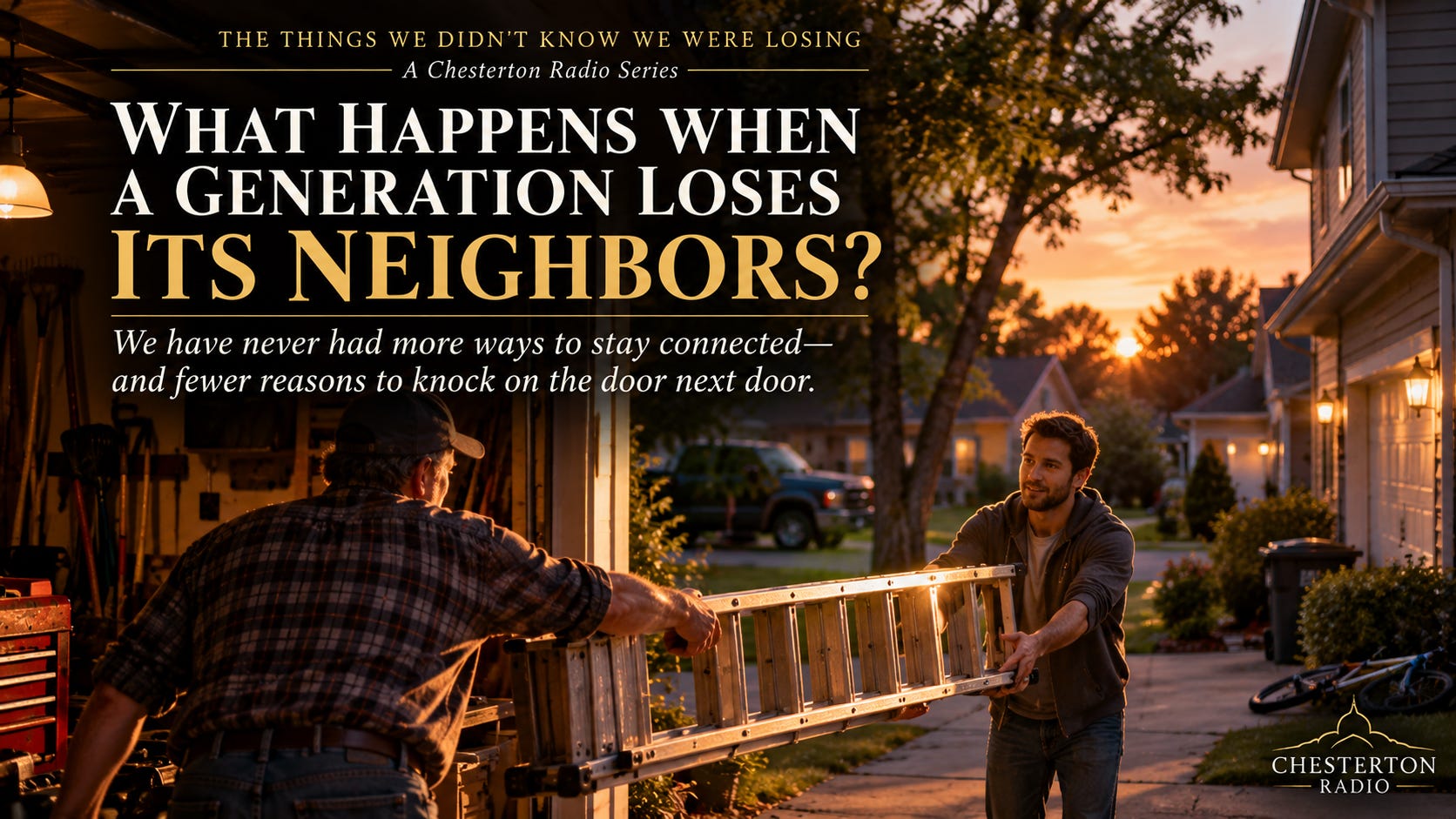
THE THINGS WE DIDN’T KNOW WE WERE LOSING
A Chesterton Radio series about the ordinary things that held a civilization together.
We have never had more ways to stay connected—and fewer reasons to knock on the door next door.
There was once a household tool almost everyone possessed but not everyone actually owned.
The neighbor’s ladder.
You didn’t own the ladder. Mr. Henderson did.
This arrangement had obvious disadvantages.
If a branch landed on the roof, the gutters needed cleaning, or a baseball somehow found its way into a place no baseball had any business being, you could not simply walk into your garage and retrieve a ladder.
You had to walk next door.
And knock.
This was terribly inefficient.
It may also have been good for us.
Because Mr. Henderson had to answer the door.
You asked about the ladder. He said sure, but first asked how your boy was doing after spraining his ankle. You learned that his wife had been under the weather. He mentioned that somebody had been checking car doors along the street. You told him you were leaving town Friday and asked whether he’d mind keeping an eye on the place.
Then you carried the ladder home.
A few days later you had to return it.
Which meant knocking again.
Nothing particularly important had happened.
Except, of course, that nearly everything important had happened.
Two people who happened to occupy adjoining pieces of real estate had become slightly less like strangers.
The ladder had done its work.
What Was a Neighbor?
There is a difference between the person who lives next door and a neighbor.
The first is a geographic fact.
The second is a relationship.
A neighbor knew enough about the ordinary pattern of your life to recognize when the pattern changed.
He knew which car belonged in your driveway.
She knew the names of your children.
He knew you worked late on Thursdays. She knew your mother had been ill.
A neighbor might have your spare key.
He might feed the dog while you were away or recommend a plumber when water began appearing somewhere water emphatically did not belong.
She might bring over a casserole after somebody died.
He might shovel the last twenty feet of your sidewalk simply because he was already outside with the snow blower.
And neighbors possessed one authority that has almost completely disappeared from American childhood: the ability to tell your child to stop doing something foolish.
Worse, they might then tell you that your child had been doing something foolish.
This was not always appreciated by the child.
It was nevertheless a remarkably effective communications network.
None of it had a name.
Nobody called it a “mutual-aid ecosystem.” Nobody formed a committee to establish a neighborhood social-support infrastructure.
It was simply the accumulation of hundreds of small obligations between people who lived near one another.
The strange thing is how many of those obligations have disappeared.
Not because we abolished them.
Because we solved them.
The Disappearance of Necessity
Suppose you need a ladder today.
You can buy one without speaking to another human being.
Need a socket wrench?
It can arrive tomorrow.
Need someone to watch the children Saturday evening? There are services for that.
Need a plumber?
You don’t have to walk next door and ask, “Who did you use?”
You can read 147 reviews written by people you’ve never met.
Going away for a week? Your lights can turn themselves on. Your thermostat can report its temperature to your telephone. Your doorbell can show you who is standing on the porch while you are six states away.
Even the old request to collect the newspaper has become increasingly unnecessary, if only because there may no longer be a newspaper lying on the porch.
Most of this is wonderful.
There is no particular virtue in having the wrong wrench.
A reliable professional babysitter may be much better than imposing on the teenager down the street. Online reviews can save us from dreadful contractors. Cameras and alarms can provide security that old-fashioned neighborliness never could.
Modern life has relieved us of countless inconveniences.
But perhaps some of those inconveniences were doing something we did not notice.
They were giving us reasons to knock.
We tend to imagine friendship as beginning with affection: two people discover that they like one another and therefore begin doing things together.
Often life works in the opposite direction.
People begin doing things together because something needs doing.
Affection catches up later.
The fence needs repairing.
The branch needs moving.
The car needs a jump.
The dog has escaped.
The package was delivered to the wrong house.
Someone needs a ladder.
The need creates the encounter.
The encounter creates familiarity.
Familiarity, repeated often enough, may become trust.
And somewhere along the way, the person next door becomes your neighbor.
Perhaps one of the unnoticed consequences of becoming more self-sufficient is that we have become much better at preventing this process from starting.
The Small Errand
We underestimate the social importance of trivial conversation.
There is a modern temptation to believe that meaningful relationships are built through meaningful conversations.
Sometimes.
But communities may depend just as much on conversations that are almost aggressively unimportant.
“Morning.”
“Need a hand?”
“Keep it until Saturday.”
“How’s your mother?”
“Storm took half your tree down.”
“We’re grilling. Want one?”
“Your garage door’s still open.”
“Your dog got out.”
None of these remarks belongs in a collection of great human utterances.
But repeat them for five years and something happens.
The man across the street ceases to be “the man across the street.”
He becomes Bill.
And once he is Bill, other things become possible.
The great mistake may be assuming that community begins when people become close friends.
Usually it begins much earlier.
It begins when people become known.
That distinction matters because the evidence suggests that many Americans aren’t particularly well acquainted with the people around them.
A 2025 Pew Research Center survey found that only 26% of American adults said they knew all or most of their neighbors. Sixty-two percent knew only some, while 12% said they knew none. Pew also found a modest decline from 2018, when 31% said they knew all or most of their neighbors. Pew Research Center
Those numbers aren’t proof of some lost golden age. They don’t tell us whether Americans in 1926 were having wonderful conversations over white picket fences.
But they tell us something about 2026.
It is entirely possible to live among people without knowing them.
The People Who Notice
There is another old neighborhood function that is difficult to measure.
Neighbors noticed.
This can sound ominous.
Nobody wants Mrs. Kravitz stationed permanently behind the curtains with binoculars.
Privacy is a real good, and we’ll come back to it.
But there is a difference between surveillance and human notice.
A camera can tell you that a person entered your yard at 2:17 p.m.
A neighbor knows the person is your brother.
A sensor can report that the front door hasn’t opened.
A neighbor knows that Mrs. Peterson normally walks her terrier every morning at seven and hasn’t appeared for two days.
Technology can monitor a house with astonishing precision.
It cannot know that something doesn’t seem right unless someone has first told it what “right” is.
A neighbor can.
The newspaper is still outside.
The blinds haven’t opened.
The dog has been barking much longer than usual.
There’s a truck in the driveway that doesn’t belong there.
The garage door has been open since breakfast.
The little girl who bicycles past every afternoon hasn’t appeared all week.
Most of the time these things mean nothing.
Occasionally they mean something.
There is comfort in living among people who know the difference.
Pew found in 2018 that 58% of Americans said they had a neighbor they would trust with a set of house keys for an emergency. The figure was higher among people who had lived in their community longer. Pew Research Center
A house key is an interesting measure of neighborliness.
It says more than I know your name.
It says:
If something goes wrong, you may enter my house.
That is a considerable distance for two strangers to travel.
And nobody gets there by waving through the windshield.
The Adults Who Weren’t Your Parents
Children once had another reason to know the neighbors.
The neighbors were outside.
There was the man forever working on a car with its hood raised.
The woman who grew tomatoes.
The retired fellow with the woodworking shop.
The family with the basketball hoop.
The older boy who could repair bicycles.
The couple whose children had already grown up but who somehow still knew the names of every child on the block.
These adults occupied an interesting position.
They were not your parents.
They were not your teachers.
They were not quite friends.
They were simply grown-ups you knew.
That gave children a larger human world.
A child could discover that Mr. Henderson knew engines but couldn’t cook, while Mrs. Henderson could grow almost anything but had no idea why the lawn mower wouldn’t start.
He discovered that adults had different skills, personalities, opinions, senses of humor and ways of living.
Sometimes one of these adults became unexpectedly important.
In the previous essay in this series, Who Will Be the Grandparents When the Grandparents Are Gone?, we considered how an older person who is not a relative can quietly become a grandparent-like presence in a young person’s life. The relationship may begin not through a formal mentoring program but while repairing something, cooking, gardening or simply being around. Who Will Be the Grandparents Wh…
The neighborhood was once particularly good at creating such accidents.
Sometimes the person who taught you something important was simply the person who happened to live three houses down.
Nobody matched you.
Nobody performed a background search for compatible interests.
You were both outside.
That was enough to begin.
The Right to Be Left Alone
There is a danger in all of this.
The past becomes very attractive once enough time has passed to remove the mosquitoes.
Old neighborhoods were not invariably little Edens of fellowship.
Neighbors could be nosy.
They could gossip.
They could enforce conformity with considerable enthusiasm.
They could be prejudiced, suspicious, territorial and mean.
The same intimate knowledge that allowed someone to notice you were sick also allowed someone to know things about your life that you desperately wished he did not know.
For some people, leaving a small community was liberation.
Privacy matters.
Anonymity can even be merciful.
There are times when a person desperately needs the freedom to begin again somewhere nobody knows what happened in tenth grade.
Nor is mobility some modern curse. People move for education, marriage, opportunity, family and adventure. Many of us have richer lives precisely because we were not required to remain within three miles of the house where we were born.
So the object cannot be to reconstruct a world in which everyone knows everyone else’s business.
The better distinction may be between being watched and being looked after.
They can look remarkably similar from the outside.
Both involve somebody noticing what you’re doing.
The difference is love, restraint and permission.
A good neighbor knows enough to help and enough to leave you alone.
That is not an easy balance.
Civilization rarely is.
Then Something Breaks
The illusion of complete independence tends to work wonderfully until the lights go out.
Then the neighborhood reappears.
A storm comes through.
A tree falls.
The basement begins filling with water.
The power disappears.
The car won’t start.
Someone slips on the ice.
A dog gets loose.
Someone dies.
Suddenly geography matters again.
The person fifty feet away is more useful than the friend five hundred miles away.
This does not diminish the distant friendship. It simply reveals that physical proximity remains a unique human resource.
Research on disasters gives some support to what ordinary experience suggests. Studies of communities affected by floods and other disruptions have found connections between social cohesion, social capital and community resilience. Research following the 2011 Brisbane flood, for example, found considerable stability in neighborhood social capital and an increase in collective efficacy after the disaster, particularly in flooded neighborhoods. PubMed Other research describes social cohesion as an important part of how communities exchange information and cope during disruption. PubMed Central (PMC)
Again, none of this means that a friendly neighbor substitutes for professional emergency services.
When the house is burning, call the fire department.
But while you are calling, the person next door may already be pounding on the door.
That matters.
Emergencies reveal something ordinary life allows us to forget:
The neighborhood never disappeared.
The relationships did.
The houses remained exactly where they were.
Connected Everywhere, Known Nowhere
There is a paradox here that is too easy to turn into a complaint about technology.
So let’s not.
The ability to maintain relationships across distance is one of the great gifts of modern life.
A grandmother can see a grandchild who lives a thousand miles away.
Old friends can remain in one another’s lives after moving across the country.
A person with an unusual interest can find a community of people who share it rather than spend a lifetime believing he is the only human being on earth fascinated by nineteenth-century steam whistles.
Online friendships can be genuine friendships.
Distance matters much less than it once did.
That is good.
But distance has not ceased to matter altogether.
Your friend in Oregon can listen when your marriage is in trouble.
He cannot smell smoke coming from your garage.
Your daughter in Florida can call every evening.
She cannot notice that you fell while clearing the driveway.
Your online community can explain exactly how to repair the broken gate.
It cannot hold the other end.
The problem isn’t that distant relationships are unreal.
The problem is imagining that they make local relationships unnecessary.
Human beings occupy bodies.
Bodies occupy places.
Eventually something needs lifting.
That is when the person next door becomes interesting.
Perhaps this is why community attachment is so strongly associated with actually knowing neighbors. In Pew’s 2018 research, 77% of adults who knew all or most of their neighbors said they felt attached to their local community, compared with 32% of people who knew none of their neighbors. That is an association, not proof that knowing neighbors causes attachment, but the relationship is striking. Pew Research Center
A community, apparently, is easier to love when it contains people rather than merely addresses.
We May Have Needed the Need
Perhaps we have misunderstood dependence.
We tend to use the word negatively.
To be dependent is to lack something.
Independence means success.
There is much truth in that. Adults should be capable. Children should grow. People should learn to solve their own problems.
But complete independence is neither possible nor obviously desirable.
The man who owns every tool still needs someone to manufacture them.
The woman who never asks her neighbor for help still depends upon thousands of strangers for electricity, water, roads, food, medicine and communication.
Modern life has not eliminated dependence.
It has made dependence less visible.
Instead of depending on five people whose names we know, we may depend upon five thousand people whose names we don’t.
That arrangement is extraordinarily efficient.
It may also change us.
Because the small dependence between neighbors was reciprocal.
Today I need your ladder.
Tomorrow you need my truck.
Next week neither of us needs anything, but we stand in the driveway talking for twenty minutes because now we know each other.
The original transaction disappears.
The relationship remains.
That may be what the ladder was doing all along.
How a Neighborhood Begins
This leaves us with an awkward question.
Suppose you don’t know your neighbors.
What are you supposed to do?
Walk next door, ring the bell and announce:
“Hello. Modern social fragmentation concerns me, and I would like to establish a meaningful local relationship”?
Probably not.
The beauty of the old system was that nobody had to admit to wanting friendship.
You just needed a wrench.
Perhaps the way back is similarly modest.
There is a branch down after the storm.
“Need a hand?”
You have too many tomatoes.
“Want some?”
A package has been delivered to the wrong porch.
You carry it over rather than letting the delivery company solve it.
Someone is struggling to move a table.
You grab the other end.
You are going away.
“Would you mind keeping an eye on the place?”
None of these things guarantees friendship.
That’s not the point.
The purpose is not to manufacture intimacy.
It is to create the small encounters from which intimacy sometimes grows.
And this requires a little vulnerability.
Offering help is one kind.
Asking for it may be harder.
It means admitting that you do not possess every tool, every skill and every answer.
That may be precisely why it works.
Someone gets to be useful.
In Who Will Be the Grandparents When the Grandparents Are Gone?, we argued that there is a profound difference between being cared for and being needed. Who Will Be the Grandparents Wh…
The same principle applies here.
Perhaps people do not merely need neighbors who will help them.
Perhaps people need the chance to help their neighbors.
Community requires both sides of the transaction.
The Ladder
So imagine a street.
Nothing remarkable about it.
A new family has moved into the house next door.
You have waved a few times.
You know the man’s first name, although you are not completely certain whether his wife is Sarah or Susan and have reached the point where it is becoming socially dangerous to ask.
One Saturday you see him outside.
He is attempting some awkward job along the edge of the roof.
He has a small stepladder.
It is clearly not going well.
You could remain inside.
There are plenty of reasons.
You are busy.
He hasn’t asked.
You don’t want to intrude.
He can buy what he needs.
He has a phone.
He is an adult.
Instead, you open the garage.
“I’ve got a ladder.”
He looks over.
“Really?”
“Yeah. Hang on.”
You bring it across.
Perhaps nothing happens.
Perhaps he says thanks and returns it Sunday.
Perhaps six months later you still barely know each other.
That is possible.
But perhaps while carrying it back he notices what you’re working on.
Perhaps you talk.
Perhaps next winter he clears the end of your driveway because he’s already outside.
Perhaps your wives meet.
Perhaps his boy discovers your workbench.
Perhaps, ten years from now, when something goes badly wrong at two in the morning, yours is the number he calls.
Nobody can know.
That is the risk of knocking.
The door may open onto almost nothing.
But it may open.
There was once a household tool almost everyone possessed but not everyone actually owned.
The neighbor’s ladder.
Maybe it was never really about the ladder.
Maybe civilization has sometimes begun with nothing more complicated than having something your neighbor needs.
And opening the garage.
A Note from Chesterton Radio
The Things We Didn’t Know We Were Losing looks at the ordinary things that quietly held human life together: grandparents, neighbors, family tables, useful work, shared stories, and the thousand little customs whose importance becomes visible only when they begin to disappear.
If these essays make you remember something worth keeping, please consider becoming a paid subscriber to Chesterton Radio. Your support helps us continue creating original essays, stories, audio programs and broadcasts.
And perhaps before you go, look out the window.
Do you know the people next door?
Sources & Further Reading
Pew Research Center — “How connected do Americans feel to their neighbors?” (2025). In a nationally representative survey of 9,482 U.S. adults, Pew found 26% knew all or most of their neighbors, 62% knew some, and 12% knew none; it also found slight declines in knowing and trusting neighbors compared with earlier surveys. Pew Research Center
Pew Research Center: How connected do Americans feel to their neighbors?
Pew Research Center — “How urban, suburban and rural residents interact with their neighbors” (2018). Examines neighbor familiarity, face-to-face interaction, trust and willingness to leave house keys with neighbors across different kinds of American communities. Pew Research Center
Pew Research Center: How Americans interact with their neighbors
Pew Research Center — “Americans’ satisfaction with and attachment to their communities” (2018). Finds a strong association between knowing one’s neighbors and feeling attached to the local community. Pew Research Center
Pew Research Center: Community attachment and social connections
Wickes et al. — “The resilience of neighborhood social processes: A case study of the 2011 Brisbane flood.” Examines social capital and collective efficacy before and after a major flood and provides useful evidence about neighborhood relationships during disruption. PubMed
PubMed: The resilience of neighborhood social processes
Fan et al. — “Emergent social cohesion for coping with community disruptions in disasters.” Research examining the role of social cohesion and neighborhood information-sharing during disasters. PubMed Central (PMC)
NIH/PMC: Emergent social cohesion and disasters