

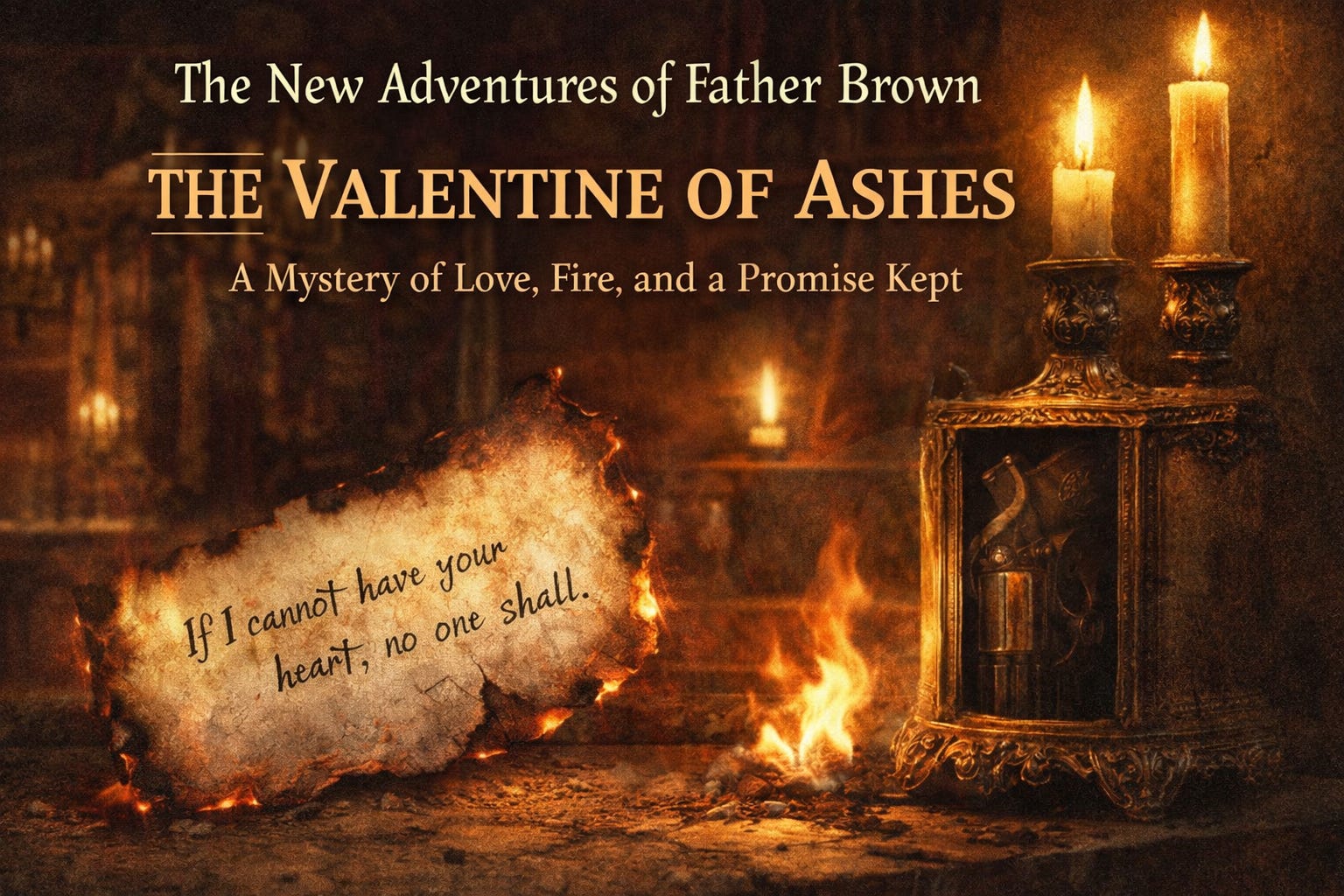
A Mystery of Love, Fire, and a Promise Kept
The trouble with romance, Father Brown once remarked, is that it is usually mistaken for ownership.
The remark was made on the morning of February 14th, just before someone attempted murder.
I. A Public Proposal
The great hall of Harrowby Manor glittered with red roses and crystal lamps. Sir Alistair Vane, widowed magnate and benefactor of half the county, had chosen Valentine’s Day to announce his engagement to the much younger Miss Clara Moreton.
It was, as such announcements go, theatrical.
There were musicians hidden behind palms, champagne flowing like optimism, and a velvet box opened beneath a chandelier. The diamond flashed like captured lightning.
Then the lights went out.
There was a sharp crack — not loud enough for panic, but sharp enough for destiny.
When the candles were relit, Sir Alistair lay slumped in his chair, a dark bloom spreading across his waistcoat.
Not dead.
But not far from it.
And in his trembling hand was not the ring — but a scrap of scorched paper.
II. The Ashen Heart
Inspector Mallory, who had once again found Father Brown in the wrong place at precisely the right time, paced irritably.
“It was staged,” Mallory said. “Dramatic blackout. Single shot. No weapon found. And this.”
He handed Father Brown the scrap.
It was half a valentine card. The edges burned. Across it, in careful ink:
If I cannot have your heart, no one shall.
“A jealous lover,” Mallory said firmly.
“Yes,” said Father Brown gently. “But not the one you think.”
III. The Obvious Suspects
Miss Clara was pale but composed.
“I love him,” she said simply. “And I did not shoot him.”
There was also Mr. Edmund Harrow, Sir Alistair’s former business partner, recently dismissed. A severe man who had once been overheard saying Sir Alistair’s engagement would “ruin everything.”
And there was Lady Margaret Vane — Sir Alistair’s sister — who had always managed his affairs and now stood displaced by youth and lace.
“Love makes people reckless,” Mallory insisted.
“Yes,” said Father Brown. “But love is not the same thing as pride.”
IV. The Burned Message
Father Brown examined the card more closely.
“It was burned after it was written,” he murmured.
“Of course it was burned,” said Mallory. “That’s how melodramatic threats work.”
“No,” said Father Brown. “It was burned carefully. The edges are too even. Someone wished it to look destroyed — but not destroyed entirely.”
He looked toward the musicians’ gallery.
“Tell me, Inspector — who arranged the lighting?”
“Lady Margaret insisted on candles,” Mallory said. “Said it was more romantic.”
Father Brown nodded.
“Romance is often a matter of lighting.”
V. A Curious Kind of Love
It was Lady Margaret who broke first — not under accusation, but under conversation.
“You must understand,” she said quietly. “I gave my life to him. Managed his estates. Nursed him after his wife died. I was… necessary.”
“Yes,” said Father Brown.
“And then this girl appears. Twenty-five. Soft voice. Wide eyes. Suddenly I am an inconvenience.”
“Love can become possession,” said Father Brown.
“I loved my brother!”
“Yes,” said Father Brown gently. “But you loved your place in his life more.”
She did not deny it.
VI. The Truth of the Shot
The pistol was eventually found — hidden in the hollow base of a candelabrum.
Lady Margaret had not intended to kill her brother.
The bullet had been aimed low. Meant to wound. To frighten Clara away. To prove that romance brought danger.
And the valentine?
Written by Lady Margaret to resemble Clara’s hand. Burned partially to create a theatrical clue. A jealous lover’s note.
“It was all very careful,” Mallory muttered.
“Yes,” said Father Brown. “Except for one thing.”
“What?”
“You wrote heart,” Father Brown said quietly to Lady Margaret. “But you aimed for his pride.”
VII. The Greater Love
Sir Alistair survived.
And when he was told the truth, he did not rage.
He dismissed no one.
Instead, he did something that startled everyone.
He forgave her.
“You were afraid,” he told his sister. “Afraid of being left alone. I should have seen it.”
Clara, pale but resolute, took Lady Margaret’s hand.
“Then let us not leave you,” she said.
Father Brown, watching, smiled faintly.
“You see,” he said to Mallory, “the world imagines love as a duel — two people fighting over possession. But Christian love is an invitation.”
Mallory grunted. “Nearly got a man killed.”
“Yes,” said Father Brown. “Because it mistook love for ownership.”
He adjusted his umbrella.
“The strange thing is this: the only love that survives is the one willing to lose.”
VIII. The Ashes
Later that evening, Father Brown burned the remaining half of the valentine in the manor fireplace.
“Why destroy evidence?” Mallory demanded.
“It has served its purpose,” Father Brown replied. “It was a lie about love.”
The card curled and blackened.
And for a moment, in the glow of the fire, it looked like a heart turning to ash.
✦ Epilogue Reflection
On Valentine’s Day, Father Brown preached briefly in the small village chapel:
“Love that grasps will always fire the first shot. Love that gives will always be wounded first. But it is only the second kind that saves.”