


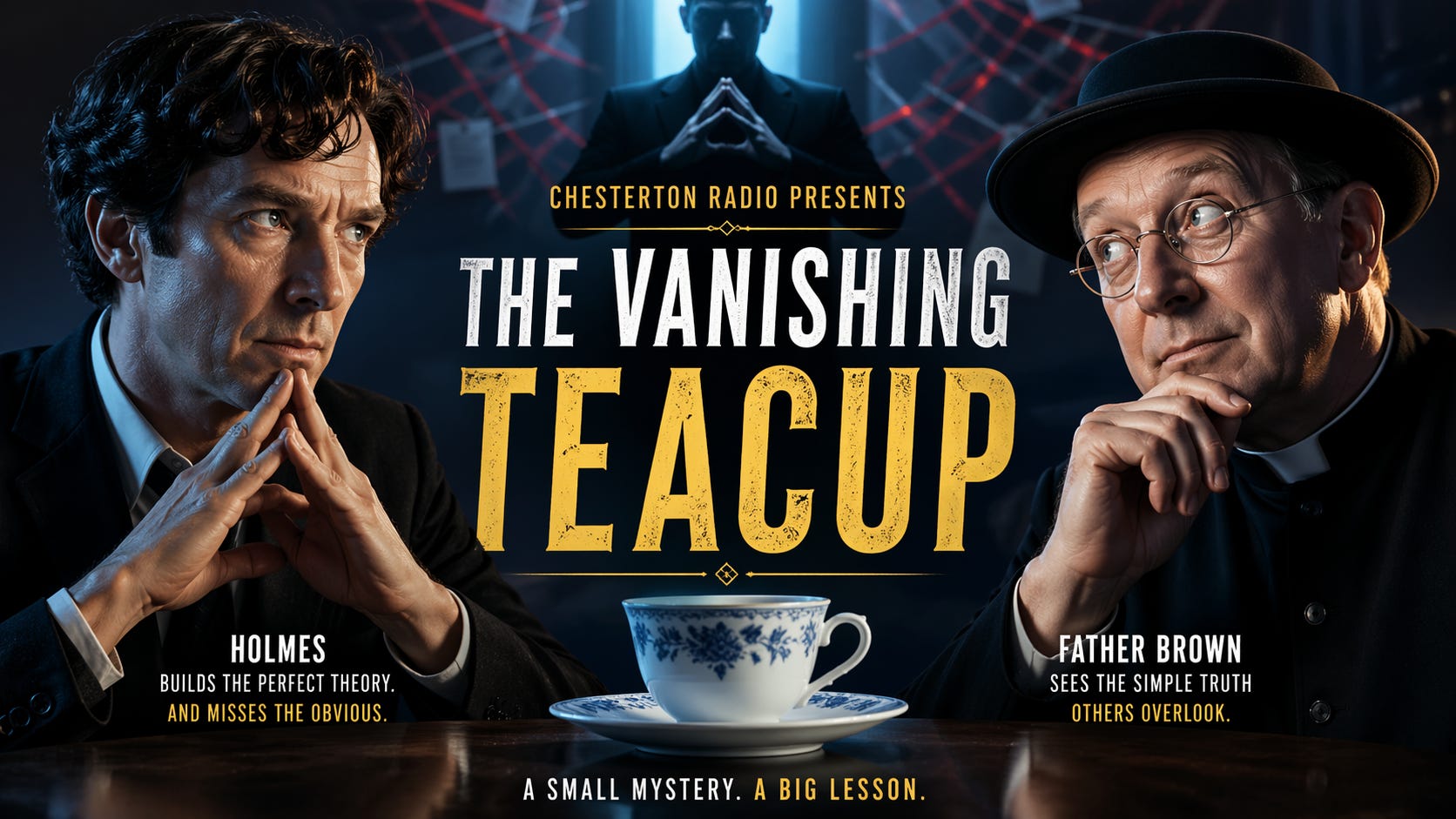
What if the smallest mystery is the most dangerous?
In this Chesterton Radio deep dive, we step into The Case of the Vanishing Teacup—a deceptively simple puzzle that draws Sherlock Holmes into one of his most subtle defeats. What begins as a missing object becomes something far more revealing: a test of intellect, pride, and the limits of reason itself.
Set against the quiet tension of an English drawing room, Holmes constructs a brilliant theory—elegant, airtight… and entirely wrong. Opposite him stands Father Brown, whose method is not brilliance, but humility—seeing what others overlook precisely because it is too ordinary to impress.
And in the shadows? The quiet hand of Moriarty, orchestrating not a crime, but an experiment—one designed to expose a fatal flaw in the greatest detective alive.
In this broadcast, we explore:
Why small mysteries distort great minds
The philosophical divide between Holmes and Father Brown
How pride—not theft—lies at the heart of the case
And why the obvious is often the last thing intelligence will accept
This is not merely a story about a missing teacup.
It is a story about how we see—and how we fail to see.
🎙️ Broadcast from Chesterton Radio, Atchison, Kansas
Where even the smallest mysteries are worth examining… slowly.
The Case of the Vanishing Teacup

“The object of opening the mind, as of opening the mouth, is to shut it again on something solid.”


