

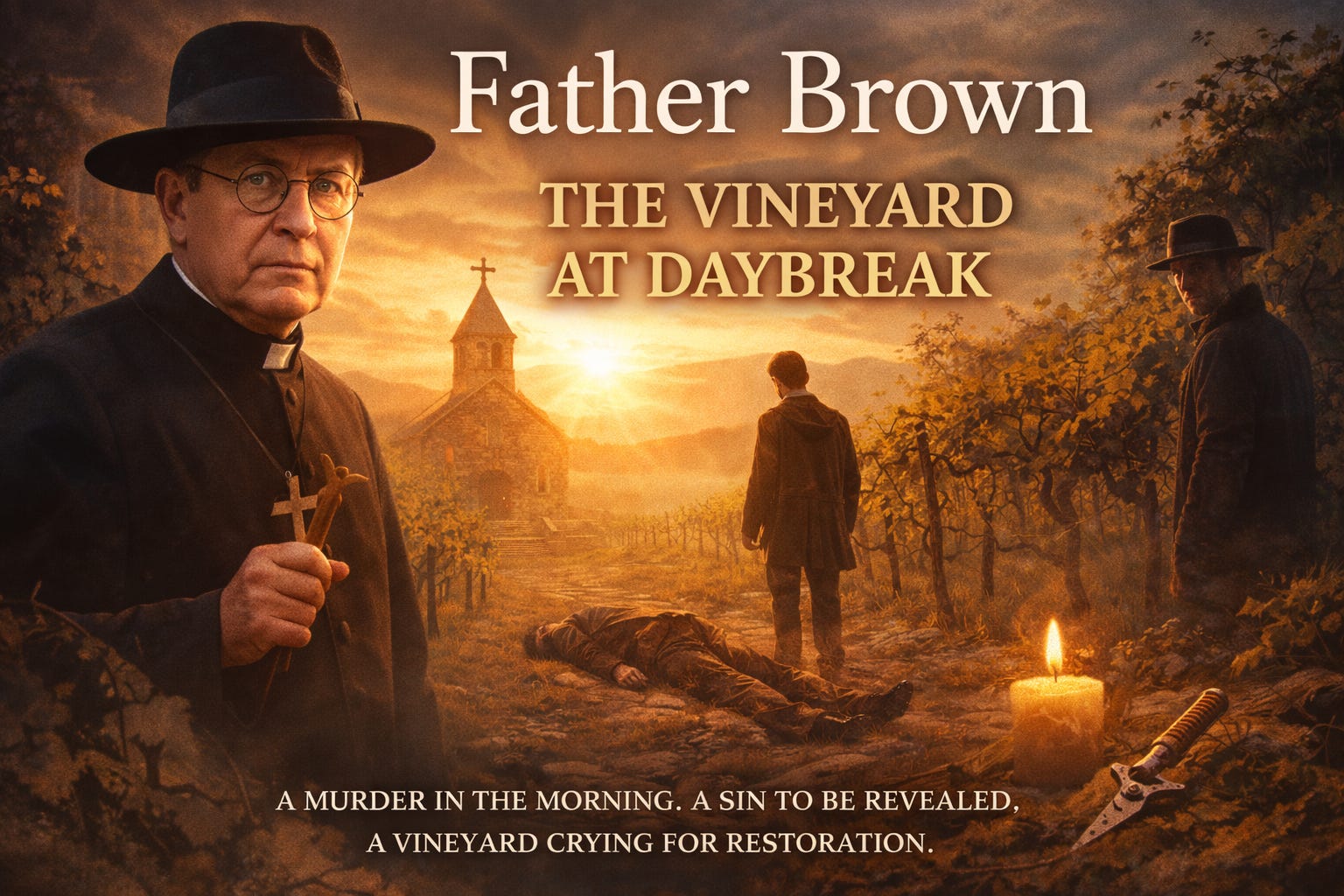
I. The Man Who Was Sought
The village of Ashcombe Vale lay in a fold of the English countryside where the hills seemed less like geography and more like a gesture of prayer. It was the sort of place where the church bell was not an interruption but an agreement, and where the sunrise did not merely illuminate the valley but forgave it.
On a certain morning in late February—when winter has grown weary of itself but spring has not yet found its courage—a man was discovered lying face down between the rows of vines in the old Hartwell vineyard.
His name was Mr. Julian Hartwell.
He was the proprietor of Hartwell & Sons Vineyards, though the “sons” existed only in theory. His wife had died years before, and no children had followed her. He lived alone in the stone manor that overlooked the vineyard, a house built with the kind of confidence that suggests inheritance and the kind of silence that suggests regret.
The first to find him was a farmhand named Peter Mallory, who had come early to prune the vines before frost gave way to thaw. Peter would later say that he had thought at first the master was kneeling in prayer.
“It looked as though he’d fallen forward in devotion,” Peter told the constable, “as if he’d been overcome by the sunrise.”
He had indeed fallen forward. But devotion was not the cause.
The wound was small and precise. A puncture just below the left shoulder blade.
It was the sort of wound one might miss in the golden wash of dawn.
II. The Vineyard and the Vine
By midmorning, Ashcombe Vale buzzed in its quiet, English way. The villagers gathered in clusters near the low stone wall that separated the churchyard from the Hartwell fields. They spoke softly, as if murder were something that might overhear them.
Inspector Mallory of the county police (no relation to Peter, though he disliked the coincidence) arrived with the grave briskness of a man who had seen too much to be surprised and too little to be cynical.
Father Brown arrived on foot.
He had risen early that morning and prayed Lauds in the small sacristy of St. Jude’s. The psalms had been particularly insistent.
“Convert us, O God of hosts: and shew us thy face, and we shall be saved.”
He had lingered over that line.
Now, walking the path between the vines, he murmured another:
“Seek ye the Lord, while he may be found.”
Inspector Mallory greeted him with a nod.
“Morning, Father. I was told you might be coming.”
“I often do,” Father Brown said gently. “When someone has gone where he can no longer explain himself.”
The Inspector glanced toward the body, now covered with a canvas sheet.
“Not an accident. The wound’s too deliberate.”
“Yes,” said Father Brown. “It is rarely accidental when a man is struck from behind.”
They stood in silence for a moment as the sun climbed higher over the ridge, gilding the church spire beyond.
“It’s almost poetic,” the Inspector muttered. “A vineyard at sunrise.”
“Yes,” said Father Brown quietly. “But vineyards are not always peaceful. They have been known to host betrayal.”
III. The Widow’s Friend
Three persons were of immediate interest.
First: Miss Eleanor Gray.
She was not a widow, though many in the village referred to her as such in tone if not in fact. She had been Hartwell’s close companion for several years—close enough to inspire speculation, distant enough to avoid scandal.
She lived in a modest cottage at the edge of the property, ostensibly as Hartwell’s “estate secretary.”
When questioned, she was pale but composed.
“He was troubled,” she admitted. “Not frightened—troubled.”
“By whom?” asked the Inspector.
“By himself.”
That answer hung in the air like incense.
“He spoke often of restitution,” she continued. “Of setting things right before it was too late.”
Father Brown’s round face did not move, but his eyes sharpened slightly.
“Restitution,” he repeated. “That is a dangerous word.”
“For whom?” asked the Inspector.
“For everyone,” said Father Brown.
IV. The Son That Wasn’t
Second: Mr. Edward Crane.
A man in his early thirties, sharp-featured and sharp-tempered. He had arrived in Ashcombe two weeks prior, claiming to be Hartwell’s illegitimate son.
The claim had been received with outrage by Hartwell, who denied it with icy dignity.
But Crane had persisted.
There had been arguments. Raised voices. Threats implied, if not spoken.
“I had every right to demand acknowledgment,” Crane insisted when questioned. “But I didn’t kill him.”
“Were you here at dawn?” the Inspector asked.
“No.”
“Can anyone confirm that?”
“No.”
Father Brown studied the man quietly.
“You wished to be recognized,” he said softly.
“Yes.”
“Recognition is a powerful hunger.”
Crane’s jaw tightened.
“It’s not hunger to want the truth.”
“No,” said Father Brown. “But it may be hunger to want it publicly.”
V. The Faithful Servant
Third: Peter Mallory, the farmhand who had found the body.
He had worked the vineyard for twelve years.
“He was a hard master,” Peter said. “But a just one.”
“Did he speak to you yesterday?” asked the Inspector.
“Yes. About changing his will.”
Both men looked up.
“He said he meant to leave the vineyard to the church.”
“To St. Jude’s?” the Inspector asked, incredulous.
“Yes, sir.”
The Inspector turned slowly toward Father Brown.
“That’s… unexpected.”
Father Brown nodded.
“It would have been.”
VI. The Thorn in the Vine
The murder weapon was eventually discovered beneath one of the vine posts.
A slender pruning awl—sharp, narrow, easily concealed.
It belonged to the vineyard.
It bore no fingerprints.
“It’s as if the vineyard killed him,” the Inspector muttered.
“Or someone who knew it intimately,” Father Brown replied.
They walked together between the rows.
“You heard Peter,” the Inspector said. “If Hartwell was changing his will—if he meant to give everything to the church—there are motives in every direction.”
“Yes,” said Father Brown. “And none of them are quite what they seem.”
They reached the spot where the body had fallen.
Father Brown crouched.
“What is it?” asked the Inspector.
“A detail,” said the priest.
He pointed to the soil.
The earth had been disturbed—not in struggle, but in kneeling.
There were impressions.
Hartwell had been on his knees before he fell.
VII. The Turning
That evening, Father Brown requested to speak privately with Miss Gray.
They sat in the dim parlor of her cottage, a single candle between them.
“He was going to confess something,” she said at last.
“To whom?”
“To you.”
Father Brown folded his hands.
“And what was the confession?”
She hesitated.
“Years ago, there was a partnership. A man named Crane—Edward’s father. They owned the vineyard together. But when Crane fell into debt, Hartwell bought him out. For far less than it was worth.”
“And the son?”
“He was left with nothing.”
Father Brown nodded.
“So Mr. Hartwell intended restitution.”
“Yes. He planned to divide the estate. Half to Edward Crane. Half to the parish.”
“And you?”
“I was not included.”
There was no bitterness in her voice.
“Did you know this before yesterday?”
“Yes.”
“And you approved?”
“I urged him to do it.”
Father Brown studied her face in the candlelight.
“You loved him.”
“Yes.”
“And you let him give everything away.”
“Yes.”
Father Brown smiled faintly.
“Then you did not kill him.”
VIII. The Man Who Sought Too Late
The next morning, Father Brown walked alone to the vineyard.
He found Edward Crane standing near the place where the body had been discovered.
“You came back,” said the priest.
“I wanted to see it,” Crane replied.
“To see what?”
“To see where he knelt.”
Father Brown nodded.
“You know about the will.”
“Yes.”
“And you know he meant to restore what was taken.”
Crane’s face twisted.
“He told me at dawn. He asked me to meet him here. He said he would sign new papers today.”
“And yet,” said Father Brown gently, “he died before he could.”
Crane’s voice dropped to a whisper.
“I didn’t believe him.”
“You thought it was another humiliation.”
“Yes.”
“So you brought the awl.”
Crane did not deny it.
“I meant only to frighten him. To make him swear it.”
“And when he knelt?”
Crane’s face crumpled.
“He knelt to pray.”
Silence filled the rows of vines.
“He said, ‘Let us seek the Lord while He may be found.’”
Father Brown closed his eyes briefly.
“And you mistook repentance for condescension.”
Crane’s voice broke.
“I thought he was mocking me.”
“You were hungry,” said Father Brown softly. “And hunger can mistake bread for insult.”
Crane sank to his knees in the very place where Hartwell had knelt.
“I didn’t mean to kill him.”
“No one does,” said Father Brown. “That is why it is called sin and not strategy.”
IX. The Face Shown
Inspector Mallory listened grimly as the confession was given.
“It was pride,” he muttered afterward.
“Yes,” said Father Brown. “And despair.”
They stood once more at the edge of the vineyard.
“The irony,” the Inspector said, “is that the restitution was real.”
“Yes.”
“He died seeking forgiveness.”
“And Edward killed him seeking recognition.”
The Inspector sighed.
“Tragic.”
Father Brown shook his head.
“Not entirely.”
The Inspector looked at him sharply.
“A man who kneels in the vineyard at dawn is not entirely lost,” said Father Brown. “And a man who weeps over what he has done is not entirely damned.”
He looked toward the church spire glowing in the morning light.
“Conversion is often too late for this world. But it is never too late for the next.”
X. The Vineyard Restored
Weeks later, the vineyard stood quiet once more.
The estate was divided according to the unsigned draft Hartwell had prepared. The parish received a portion; Edward Crane, the rest.
Edward did not return to live there.
He left funds for the church and departed for London, a quieter man than he had arrived.
Father Brown stood one final time among the vines.
He touched the bark of a gnarled vine trunk.
“Convert us, O God,” he murmured.
The vineyard had nearly been lost to pride, reclaimed by repentance, and stained by impatience.
Yet it would bear fruit again.
For vineyards are resilient things.
They are cut back so that they may grow.
And in the strange arithmetic of heaven, even a murder at sunrise may yet become the beginning of mercy.
Chesterton Radio
Original Father Brown mysteries.
Daily Morning Prayer.
The Wireless Archive.
If this story moved you, consider joining the Chesterton Radio Listener Club on Substack.
For it is better to seek the Lord while He may be found —
and better still to be found by Him.