

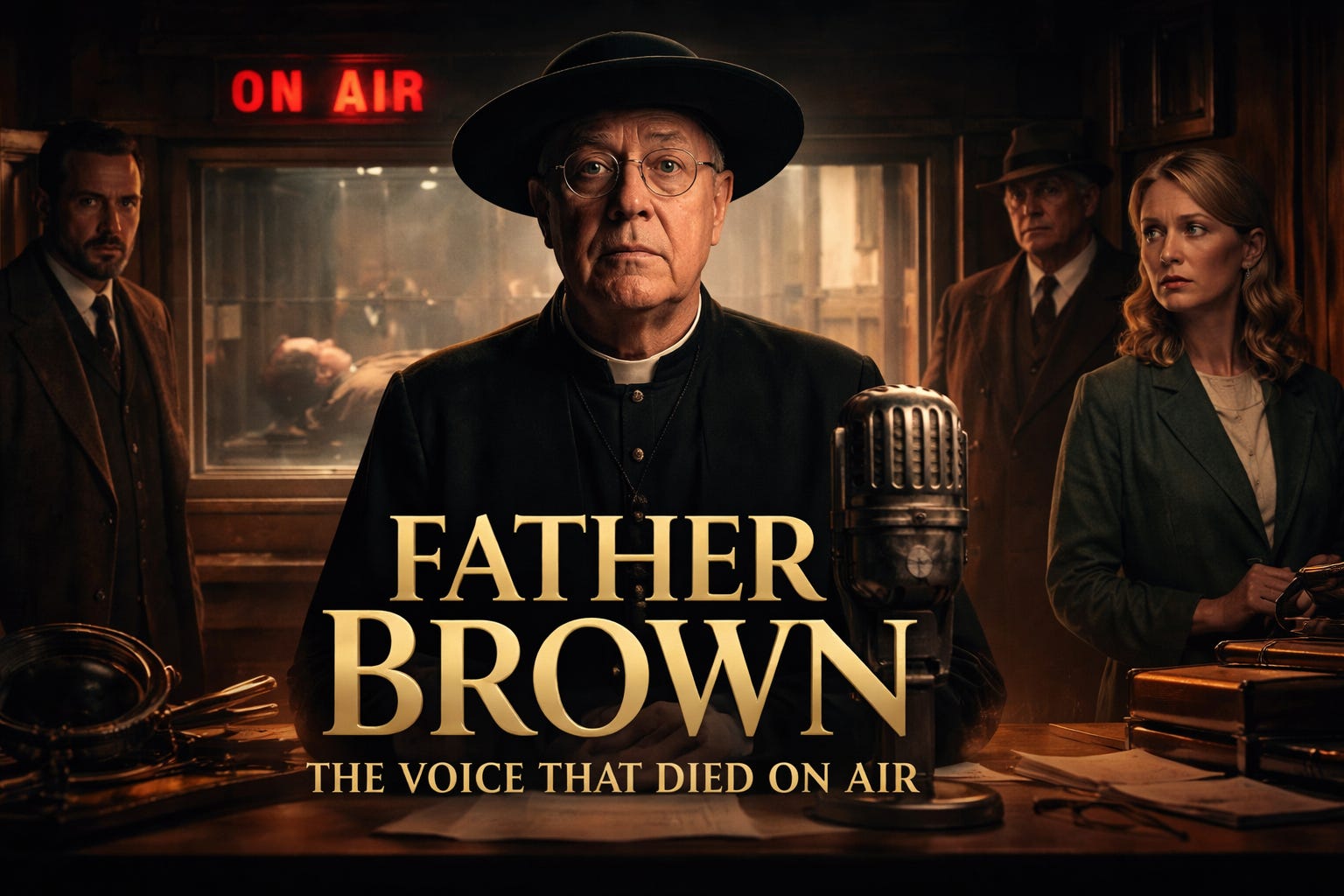
I. A Voice in the Dark
There are few things more intimate than a whisper and few more impersonal than a crowd. Radio, that modern miracle, contrives to be both at once.
It was on such an evening — when countless anonymous listeners sat in lamplit parlors, kitchens smelling of tea, lonely boarding rooms, and hospital wards — that the voice of Adrian Vale entered their lives.
Vale had the sort of voice that did not merely speak but seemed to arrange itself architecturally around the mind. It was deep without heaviness, solemn without boredom, and persuasive without apparent effort. Women trusted it. Men envied it. Donors financed it.
The program was called Midnight Mysteries, broadcast live from St. Gabriel’s Radio Theatre in London — though its reach had grown far beyond that city’s soot-streaked skyline.
On this particular evening, the invited studio audience included patrons, journalists, and two men who did not belong together: Inspector Mallory of Scotland Yard and a large Frenchman whose mustache curled upward like a theatrical flourish.
The Frenchman was Flambeau.
And beside him, seated somewhat modestly near the aisle, was Father Brown.
Flambeau leaned over and whispered, “My friend, we have come to listen to a murder.”
Father Brown adjusted his spectacles.
“Yes,” he said mildly. “I only hope it is fictional.”
II. The Man Who Exposed Lies
Adrian Vale had built his fame upon exposure.
He revealed fraudulent mediums who faked table-rappings with hidden wires. He humiliated miracle-cure salesmen by presenting medical experts on air. He once destroyed the reputation of a parliamentarian with documents read aloud before a million listeners.
He was hailed as a defender of truth.
But truth is a dangerous profession, and those who sell it wholesale may begin to dilute it retail.
Backstage before the broadcast, Vale was restless.
Miss Eleanor Shaw, producer and custodian of both budget and conscience, noticed his agitation.
“You are going further tonight,” she said quietly.
Vale smiled thinly.
“Truth must go where it is unwelcome.”
“Even if it destroys the program?”
He did not answer.
Instead, he reached into his coat and withdrew a folded paper.
“By the end of tonight’s broadcast,” he said softly, “a man will be unmasked.”
III. The Donor
Lucian Harrow was the station’s largest benefactor. He sat in the gallery with an expression of cultivated indifference.
He was a man who had made a fortune importing antique religious artifacts from war-ravaged regions of Europe. Some praised him as a rescuer of culture. Others whispered about provenance.
Harrow’s eyes met Vale’s through the studio glass.
It was not a friendly exchange.
Flambeau nudged Father Brown.
“There is a duel without swords.”
“Yes,” said the priest. “But words are sharper.”
IV. The Broadcast Begins
The red light glowed.
Vale leaned forward.
“Good evening, wherever you may be listening…”
The script began conventionally — a dramatic story of betrayal and murder in a candlelit manor.
But Father Brown noticed something peculiar.
Vale was not merely reading. He was watching someone — measuring the room.
At precisely twenty-three minutes into the broadcast, Vale deviated from the script.
“And now,” he said, voice deepening, “we come to a story not written in fiction, but in our own city…”
Miss Shaw stiffened behind the glass.
Inspector Mallory leaned forward.
Harrow’s hands tightened on the armrest.
Vale continued.
“A man who has profited from stolen sanctities…”
He faltered.
His hand moved toward the microphone.
“And now,” he whispered, “the mask falls—”
He inhaled sharply.
His body jerked.
He collapsed against the desk.
The microphone captured the dull thud.
The red light still glowed.
Across Britain, the silence was unbearable.
V. Chaos in the Booth
Flambeau was first to his feet. Mallory forced open the studio door.
Vale lay motionless.
The engineer, Thomas Reed, stared in horror at the soundboard.
Miss Shaw pressed her hands to her mouth.
Father Brown entered quietly.
He did not look at the body first.
He looked at the microphone.
VI. The Locked Room
Inspector Mallory quickly established the facts:
The studio door had been locked from inside.
No one entered during the broadcast.
Vale drank only from a sealed bottle opened before witnesses.
No obvious poison was found in the glass.
The coroner later confirmed: cyanide poisoning.
Flambeau folded his arms.
“Then the poison was hidden in something he touched.”
“Yes,” said Father Brown. “Or breathed.”
The priest gently unscrewed the microphone casing.
A faint bitter-almond scent lingered.
Cyanide dust lined the inner mesh.
VII. The Red Herrings
Suspicion fell swiftly:
Thomas Reed, the engineer — who had access to equipment.
Eleanor Shaw, who had argued with Vale earlier.
Lucian Harrow, who stood to be disgraced publicly.
Each had motive.
Each had opportunity — or so it seemed.
Reed admitted he had once been humiliated on air by Vale during an exposé of a failed invention.
Miss Shaw confessed she feared Vale’s recklessness would bankrupt the station.
Harrow admitted he had threatened legal action if slandered.
But none could have entered the locked booth during broadcast.
Flambeau, pacing, declared: “It is a magician’s trick! The poison was planted beforehand!”
Father Brown nodded.
“Yes. The question is — by whom?”
VIII. The Script
Late that night, Father Brown examined Vale’s annotated script.
In the margin beside the climactic accusation were three words written faintly in pencil:
“After inhale — pause.”
The priest frowned.
He examined further.
The microphone stand bore minute scratches near the adjustment collar.
Father Brown asked quietly, “Who adjusted the microphone before broadcast?”
Miss Shaw replied, “Mr. Vale always insisted on positioning it himself.”
“Alone?”
“Yes.”
IX. The Paradox of Martyrdom
The next morning, Father Brown visited Lucian Harrow privately.
“You were prepared to be accused,” said the priest.
“Yes.”
“But you were not surprised when he died.”
Harrow’s composure faltered slightly.
“I thought it was theatre.”
“Ah,” said Father Brown softly. “So did he.”
The truth unfolded slowly.
Vale had intended to accuse Harrow dramatically — and then collapse, appearing poisoned by an outraged enemy. The scandal would have elevated him into martyrdom.
He had planted cyanide dust within the microphone mesh — intending to inhale a tiny amount, enough to cause dramatic distress but not death.
But he miscalculated.
Perhaps the dose.
Perhaps his own fragility.
Perhaps death itself.
He had rehearsed martyrdom.
And died in earnest.
X. The Moral Reckoning
Inspector Mallory resisted the conclusion.
“You’re telling me he killed himself for ratings?”
Father Brown shook his head gently.
“No. He killed himself because he loved applause more than truth.”
Flambeau looked grave.
“He exposed frauds,” he said.
“Yes,” said Father Brown. “But he had become one.”
Miss Shaw wept quietly when told.
“He wanted to be necessary,” she whispered.
Father Brown nodded.
“The modern temptation is not merely to lie — but to perform sincerity.”
XI. The Final Broadcast
A week later, St. Gabriel’s aired a special announcement.
No dramatics.
No music.
Miss Shaw spoke plainly:
“Mr. Adrian Vale died during last week’s broadcast. The circumstances were tragic and self-inflicted. We ask your prayers.”
There was no further scandal.
Lucian Harrow quietly withdrew funding.
The station survived — modestly.
Flambeau and Father Brown walked home through fog-lit streets.
“You have solved a murder without a murderer,” said Flambeau.
“No,” said Father Brown softly. “There was a murderer.”
“Who?”
“A man who believed that being admired was the same as being good.”
The bells of a nearby church began to ring the hour.
Father Brown paused.
“There is only one voice worth dying for,” he said gently. “And it does not need our theatrics.”
Flambeau looked at him sideways.
“And that voice?”
Father Brown smiled faintly.
“The one that speaks when the microphone is off.”
They walked on.
Behind them, in countless homes, the wireless sets hummed faintly — carrying other voices, other dramas.
But some listeners would always remember the night when the voice stopped.
And wonder whether it had ever truly been alive.
End
If you’d like, I can now:
Deepen the theological paradox further
Insert more investigative tension and red herrings
Format this in full Substack-ready form with intro/outro and Listener Club invitation
Create the best 16:9 cinematic Substack image prompt in “prestige streaming drama” style
Your next move. 🎙️