

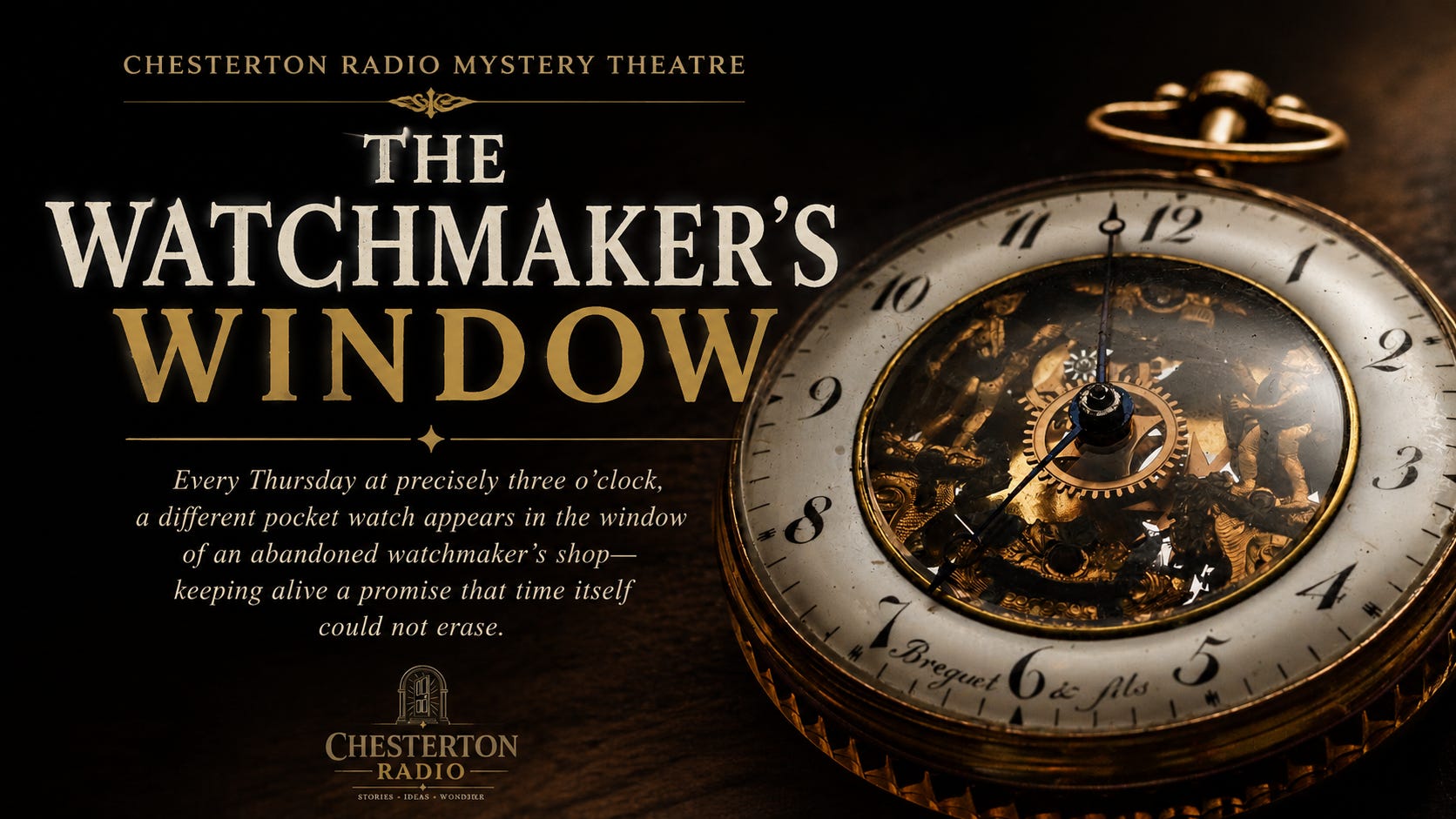
Opening
There are places that seem to exist just beyond the maps.
Not because they cannot be found...
...but because they can only be discovered.
One of those places stands on Commercial Street in Atchison, Kansas.
It is a narrow brick building with books on its shelves, coffee on the stove, and an old brass bell above the front door.
People come there carrying questions.
Sometimes they leave with answers.
More often...
they leave with better questions.
This is The Little Station on Commercial Street.
The bell has just rung.
Someone has stepped inside.
And, as often happens in such places...
another mystery is about to begin.
Tonight’s story is called...
The Watchmaker’s Window
Every town has a place that people pass without noticing.
An old storefront.
A faded sign.
A familiar window.
The remarkable thing is not that such places exist.
The remarkable thing is that every once in a while...
someone stops long enough to wonder why.
Tonight’s mystery begins with an abandoned watchmaker’s shop...
and a single pocket watch that keeps a very unusual appointment.
Chapter One
Every Thursday at Three
There are some mysteries that arrive with a crash.
A window breaks.
A shot is fired.
Someone runs down a dark street.
Those are the mysteries that attract policemen.
The better mysteries usually begin much more quietly.
A familiar habit changes.
An old promise is remembered.
Or someone notices something that everyone else has stopped seeing.
Thomas Mercer had learned that lesson from running a small radio station.
People imagined that broadcasting was about microphones and transmitters.
It wasn’t.
It was about paying attention.
Every morning, before the first program went on the air, Thomas walked the same route along Commercial Street.
The routine had begun as exercise.
It had become something rather different.
He greeted Mr. Alvarez while the bakery still smelled of cinnamon and fresh bread.
He waved to Mrs. Garrison unlocking the flower shop.
If old Ben Tucker was sitting on the courthouse bench before eight o’clock, Thomas knew it would rain before evening. Ben had been right so often that no one any longer considered it remarkable.
Commercial Street possessed a hundred such little certainties.
Thomas enjoyed every one of them.
On Thursday afternoons, however, there was another certainty.
At precisely three o’clock, he looked toward the old watchmaker’s shop.
The watch in the window would be different.
No one remembered exactly when the habit had begun.
Some claimed it had always happened.
Others insisted they had first noticed it after the flood fifteen years earlier.
Thomas himself had been watching for almost six years.
Not once had the display failed to change.
Never early.
Never late.
Always Thursday.
Always three o’clock.
And always without anyone seeing who had done it.
The shop belonged to Emil Hartmann, the last watchmaker in Atchison.
Mr. Hartmann had repaired clocks, watches, and music boxes for nearly fifty years before retiring.
His wife died one autumn.
He followed her the next spring.
The little brick shop had remained exactly as it was.
Dust gathered.
The brass sign tarnished.
The clock in the rear window stopped forever at eleven minutes past nine.
Yet each Thursday...
a different watch appeared.
Thomas paused across the street.
Today’s watch was silver.
Last week it had been gold.
The week before, a railroad watch with a cracked enamel face.
He smiled to himself.
Perhaps there was a perfectly ordinary explanation.
There usually was.
Still...
ordinary explanations were entitled to be interesting.
A voice interrupted his thoughts.
“You’re looking at the window again.”
Thomas turned.
Chief Eleanor Brooks stood beside him holding two paper cups of coffee.
She offered him one.
“I’ve been caught.”
“You have.”
She glanced toward the abandoned shop.
“I’ve seen you stop here at least a dozen Thursdays.”
“I’ve lost count.”
“And?”
“And what?”
“Have you solved it?”
Thomas accepted the coffee.
“No.”
She laughed.
“That’s unusual.”
“I’ve never claimed to solve mysteries.”
“You merely ask inconvenient questions until somebody else does.”
“I prefer to think of it as curiosity.”
Chief Brooks took a sip.
“My officers think teenagers are sneaking in through the back.”
“They’ve checked?”
“Every window.”
“The roof?”
“Twice.”
“The cellar?”
She smiled.
“Thomas...”
“Yes?”
“The building doesn’t have a cellar.”
“That’s one possibility eliminated.”
She shook her head.
“You’re impossible.”
“So my sister tells me.”
For a moment they stood in comfortable silence.
The afternoon sun reflected softly from the shop window.
The silver pocket watch rested upon a faded square of blue velvet.
Its hands showed exactly three o’clock.
Not two fifty-nine.
Not three-oh-one.
Exactly three.
Thomas frowned.
“That’s curious.”
“What is?”
“The watch is running.”
Chief Brooks looked more closely.
“So?”
“So every other clock in that shop stopped years ago.”
She looked through the dusty glass.
The grandfather clock near the back wall still pointed stubbornly to eleven minutes past nine.
A wall clock above the workbench had stopped just before six.
Even the regulator hanging beside the door had surrendered to time.
Only the pocket watch was alive.
Ticking steadily.
Patiently.
Keeping perfect time.
Chief Brooks folded her arms.
“I don’t suppose watches can wind themselves.”
“Not the ones Mr. Hartmann repaired.”
“Perhaps whoever changes them winds them.”
Thomas nodded.
“Perhaps.”
She studied his face.
“You’re thinking something.”
“I usually am.”
“What is it?”
Thomas continued watching the little silver watch.
“If someone enters that shop every Thursday...”
“Yes?”
“...why do they never disturb the dust?”
Chief Brooks looked again.
The windows were gray with years of neglect.
The shelves behind them wore an undisturbed blanket of dust.
Even the velvet beneath the watch seemed untouched.
No footprints.
No wiped surfaces.
Nothing.
Only...
a different watch.
She looked back at Thomas.
“I don’t like impossible things.”
He smiled.
“I’ve noticed.”
“Are you going to investigate?”
Thomas took another sip of coffee.
“I wasn’t planning to.”
“And now?”
He watched the second hand make another quiet circuit of the dial.
“No.”
Chief Brooks raised an eyebrow.
“No?”
“I’m going to wait.”
“For what?”
Thomas smiled in that infuriatingly patient way that had puzzled friends for years.
“For someone to make the first mistake.”
Across the street, the silver watch continued to mark the passing seconds.
Neither of them noticed the elderly woman standing beneath the awning of the old hardware store.
She watched them for a long moment.
Then she looked toward the watchmaker’s window.
A faint smile crossed her face.
“About time,” she whispered.
And without another glance, she walked slowly toward the river.
Chesterton Radio Mystery Theatre
Story No. 0003
The Watchmaker’s Window
Chapter Two
The Shop That Kept Thursday
Thomas Mercer had never believed in hurrying a mystery.
People hurried because silence made them uncomfortable.
Mysteries preferred silence.
On Friday morning he stood once again across Commercial Street, a paper cup of coffee warming his hands while the town settled into another ordinary day.
The watch was still there.
Silver.
Open-faced.
Its white enamel dial gleamed faintly behind the dusty glass.
The hands still marked precisely three o’clock.
It had stopped.
Thomas smiled.
“So you only live on Thursdays.”
The remark was intended for no one in particular.
“Talking to watches now?”
Chief Eleanor Brooks crossed the street carrying a folder tucked beneath one arm.
“I’ve talked to transmitters,” Thomas replied. “Compared with those, watches are excellent conversationalists.”
She handed him the folder.
“I did you a favor.”
“I was hoping you might.”
“The county recorder. Building records.”
Thomas opened the folder.
The watchmaker’s shop had been built in 1909.
Brick walls.
Tin ceiling.
Oak floors.
No basement.
No attic beyond a shallow crawl space beneath the roof.
One front entrance.
One rear entrance opening into the alley.
Exactly as Eleanor had said.
“No secret passages.”
“I knew you’d ask.”
“No adjoining buildings?”
“They were all inspected when the bakery renovated five years ago.”
Thomas looked up at the old storefront.
“Interesting.”
“No, disappointing.”
“I was hoping for interesting.”
“You were hoping for hidden tunnels.”
Thomas laughed.
“I admit it.”
The brass sign above the door still read:
EMIL HARTMANN
WATCHES • CLOCKS • JEWELRY REPAIRED
The lettering had once been painted black.
Now it had weathered into soft gray.
A small card still hung inside the door.
Back in Five Minutes
Chief Brooks noticed Thomas smiling.
“What?”
“I’ve always admired optimism.”
“What optimism?”
“He never came back.”
She laughed despite herself.
“You have an odd sense of humor.”
“I’ve owned a radio station long enough.”
The front windows were remarkably clean.
Not polished.
Simply...
not as dirty as they should have been.
Thomas leaned closer.
The lower corners held months of dust.
Yet directly before the silver watch the glass carried only a faint haze.
Someone had looked after that window.
Not recently.
Repeatedly.
Over years.
Chief Brooks followed his gaze.
“You noticed it.”
“I did.”
“My officers missed it.”
“They were looking for footprints.”
“And you?”
“I’ve learned that people polish what they love.”
Just then the bakery door opened behind them.
Miguel Alvarez stepped onto the sidewalk carrying a tray of sweet rolls.
“You two still trying to solve old Emil’s window?”
Thomas looked over.
“You knew him?”
Miguel grinned.
“Knew him?”
“My father argued with him every Tuesday for twenty-three years.”
“What about?”
“Whether clocks should run fast.”
Chief Brooks smiled.
“That’s a very specific argument.”
“Oh, they were very specific men.”
Miguel set the tray on a café table.
“My father insisted every shop clock should gain two minutes.”
“And Mr. Hartmann?”
“Said accurate time was an act of charity.”
Thomas nodded thoughtfully.
“That sounds like him.”
Miguel shrugged.
“People brought him broken watches from three counties.”
“He repaired them all?”
“Almost.”
“Almost?”
Miguel looked toward the old shop.
“There was one he never would.”
Thomas waited.
“It belonged to Judge Whittaker.”
“Why not?”
Miguel lowered his voice.
“Said the watch wasn’t broken.”
Chief Brooks folded her arms.
“Was it running?”
“No.”
“So why wasn’t it broken?”
Miguel smiled.
“You’d have to ask Emil.”
“But he’s been dead twenty years.”
“Exactly.”
Thomas looked again at the silver watch in the window.
“What happened to Judge Whittaker?”
“Died.”
“When?”
Miguel thought for a moment.
“About a year after Emil retired.”
“Family?”
“None.”
“And the watch?”
Miguel spread his hands.
“No idea.”
Back at the station, Thomas unlocked the door beneath the old brass bell.
Its familiar note echoed softly through the room.
Anna looked up from the desk.
“You’ve found another mystery.”
“Is it that obvious?”
“You haven’t touched your coffee.”
Thomas looked down.
She was right.
The cup was still full.
He placed the county records on the counter.
“Do we have old city newspapers?”
She pointed toward the archive shelves.
“Bound volumes.”
“What year?”
“All of them.”
“I married well.”
Anna laughed.
“So I’ve been told.”
By early afternoon the reading table had disappeared beneath newspapers.
Thomas turned page after page.
Retirements.
Store openings.
School concerts.
Advertisements.
Nothing.
Then...
A photograph.
Commercial Street Merchants Celebrate Centennial
Nearly forty shopkeepers stood outside their businesses.
Thomas reached for a magnifying glass.
There was Emil Hartmann.
Standing proudly outside the watchmaker’s shop.
Beside him stood Judge Whittaker.
The judge held a silver pocket watch in his hand.
Its chain hung from his waistcoat.
The two men appeared to be laughing.
Thomas looked more closely.
The newspaper caption listed every merchant.
Every one.
Except...
the judge.
Curious.
He turned the page.
Nothing.
No article.
No explanation.
Only the photograph.
Anna appeared carrying fresh coffee.
“You’ve got that look.”
“What look?”
“The one that means you’ve found something.”
Thomas tapped the photograph.
“I’ve found someone.”
“Who?”
“I don’t know.”
“You’ve lost me.”
Thomas handed her the magnifying glass.
She studied the picture.
“I only see two old gentlemen.”
“So did I.”
“What am I missing?”
Thomas pointed toward the judge’s watch chain.
“No.”
“Yes.”
She leaned closer.
“I don’t believe it.”
The chain disappeared beneath the judge’s waistcoat...
But emerged again...
On the opposite side.
Impossible.
Unless the newspaper photograph had been printed backward.
Thomas quickly examined the storefront signs.
Every word in the picture read correctly.
The image had not been reversed.
He looked again at the chain.
There was only one explanation.
The judge had been wearing two watches.
One on each side.
Anna frowned.
“Who carries two pocket watches?”
Thomas closed the newspaper gently.
“Someone,” he said quietly,
“who intends one of them never to tell the correct time.”
Outside, the old brass bell rang as another visitor entered the station.
Neither Thomas nor Anna looked up.
For the first time, the mystery was no longer about who changed the watches.
It was about why one particular watch mattered enough to remain in a window for twenty years.
And Thomas had the distinct feeling that somewhere in Atchison...
someone was still keeping an appointment every Thursday at three o’clock.
End of Chapter Two
Chesterton Radio Mystery Theatre
Story No. 0003
The Watchmaker’s Window
Chapter Three
The Appointment
Thomas had long ago discovered that every town possessed at least one unofficial historian.
Not the person who wrote books.
Nor the one who gave speeches at anniversaries.
The true historian was the one who never threw anything away.
In Atchison, that person was Harold Bennett.
Harold had retired from the Santa Fe Railroad fifteen years earlier and now spent his mornings repairing clocks in the back room of an antique shop on Parallel Street.
He insisted he was not a watchmaker.
“I’m merely patient,” he often said.
Thomas found him bent over an open mantel clock, a jeweler’s loupe pressed into one eye.
Without looking up, Harold said,
“Your regulator is still losing twenty-three seconds a week.”
Thomas laughed.
“I haven’t brought it.”
“You were going to ask me about the watchmaker.”
Thomas leaned against the doorway.
“Am I becoming predictable?”
“No.”
Harold smiled.
“Commercial Street is.”
The old man carefully closed the brass case before removing the loupe.
“Sit down.”
Thomas obeyed.
“You knew Emil Hartmann well?”
Harold nodded.
“For forty years.”
“Were you friends?”
“We disagreed too often to be merely acquaintances.”
Thomas smiled.
“About watches?”
“About everything.”
Harold poured coffee into two chipped mugs.
“People think watchmakers spend their lives repairing springs.”
“They don’t?”
“No.”
“They repair promises.”
Thomas looked up.
“I don’t follow.”
Harold lifted an old pocket watch from the bench.
“Look at this.”
The case was badly worn.
The engraving almost invisible.
“Do you know why people carried watches?”
“To tell the time.”
Harold shook his head.
“No.”
“They carried memories.”
He opened the case.
Inside the lid was an inscription.
To Charles. Christmas, 1919.
“Most watches weren’t bought.”
“They were given.”
“Weddings.”
“Graduations.”
“Retirements.”
“A father’s last gift.”
He closed the case gently.
“When people brought Emil a watch...”
“...they rarely wanted the watch repaired.”
“They wanted the memory repaired.”
Thomas thought of the silver watch in the window.
“Did Emil ever display customers’ watches?”
“Never.”
“Never?”
Harold’s answer was immediate.
“His window belonged only to him.”
Thomas frowned.
“So every Thursday...”
“...those were Emil’s watches.”
Harold nodded.
“Every one.”
A silence settled over the workshop.
Finally Thomas asked,
“Did he have family?”
“No.”
“No children?”
“No.”
“Anyone who inherited the shop?”
Harold looked toward the dusty front windows.
“That depends.”
“On what?”
“On what you mean by inherited.”
Harold rose and crossed to an old filing cabinet.
From the bottom drawer he withdrew a worn ledger bound in cracked brown leather.
“I wondered when someone would ask.”
Thomas accepted it carefully.
“What is it?”
“Emil’s appointment book.”
“You have this?”
“He asked me to keep it.”
Thomas looked up sharply.
“When?”
“The week before he died.”
“You never mentioned it?”
Harold smiled.
“You never asked.”
Every page was filled with names.
Dates.
Repairs.
Tiny notes in Emil Hartmann’s careful handwriting.
Thomas turned slowly through the years.
Nothing unusual.
Then he reached the final entries.
The writing had grown noticeably weaker.
Appointments became fewer.
Names repeated.
One line, however, occupied an entire page.
Every Thursday.
For nearly three years.
The same entry.
Three o’clock.
No name.
Only two words.
Window Watch
Every Thursday.
Three o’clock.
Without exception.
Thomas counted silently.
There were more than one hundred entries.
Each identical.
Each crossed through with a neat blue pencil.
Completed.
He looked at Harold.
“What does this mean?”
Harold shook his head.
“I never knew.”
“You never asked him?”
“I did.”
“And?”
“He smiled.”
“That’s all?”
“He said...”
Harold paused, almost hearing the old watchmaker’s voice again.
“’Some appointments matter whether anyone else understands them or not.’”
Thomas closed the ledger.
Outside, the courthouse clock struck eleven.
Neither man spoke.
Finally Thomas said,
“I’ve been assuming someone is continuing Emil’s tradition.”
Harold looked thoughtfully at him.
“Haven’t you?”
Thomas hesitated.
“I don’t know.”
Harold smiled.
“Good.”
“Why good?”
“Because the moment you become certain...”
“...you stop seeing.”
As Thomas prepared to leave, Harold called after him.
“There is one more thing.”
Thomas turned.
“Judge Whittaker.”
“Yes?”
“He wasn’t Emil’s best customer.”
“No?”
“He was his worst.”
“Worst?”
“They argued every Thursday.”
“For how long?”
Harold smiled.
“Nearly thirty years.”
Thomas blinked.
“About watches?”
“No.”
“About time.”
Walking back toward Commercial Street, Thomas slowed as he passed the old watchmaker’s shop.
The silver watch still rested on its square of faded blue velvet.
Silent now.
Its hands remained fixed at exactly three o’clock.
He looked beyond it into the dim interior.
For the first time, he noticed something he should have seen days earlier.
Behind the display case...
barely visible through years of dust...
stood a single wooden chair.
It faced the window.
Not the workbench.
Not the shelves.
The window.
As though someone had once spent every Thursday afternoon sitting there...
waiting.
Thomas removed his notebook from his coat pocket.
Across a blank page he wrote a single sentence.
The watch is not the appointment.
He underlined it once.
Then closed the notebook.
Across the street, the bakery clock began striking noon.
For the first time since the mystery had begun, Thomas believed he was no longer investigating a disappearing watch.
He was investigating a meeting.
The only question that remained was this:
Who had been keeping it?
End of Chapter Three
Chesterton Radio Mystery Theatre
Story No. 0003
The Watchmaker’s Window
Chapter Four
Thursday at Three
The following Thursday, Thomas arrived on Commercial Street at half past two.
He carried no notebook.
No camera.
No plan.
Only a folding chair borrowed from the station and a determination to let the afternoon unfold without interfering.
Chief Brooks appeared a few minutes later.
“I had a feeling you’d be here.”
“I had a feeling you would too.”
She unfolded her own chair beside his.
“I’ve told the patrol officers to stay away.”
Thomas looked at her.
“Why?”
“Because if someone has kept this appointment for twenty years...”
“...they deserve the courtesy of one uninterrupted afternoon.”
Thomas smiled.
“I couldn’t have said it better.”
By a quarter to three the street had settled into its usual rhythm.
Mrs. Dawson left the pharmacy carrying a paper bag.
Two boys pedaled bicycles toward the river.
Miguel Alvarez swept the bakery steps.
Nothing seemed unusual.
Nothing ever did on Commercial Street.
The courthouse clock began striking the quarter hour.
Thomas looked toward the watchmaker’s window.
The silver watch still rested upon its square of faded blue velvet.
Motionless.
At two minutes before three, an elderly woman appeared from the east end of the street.
Thomas recognized her immediately.
She was the woman he had seen a week earlier beneath the hardware store awning.
She wore a navy coat despite the August warmth and carried a small bouquet of fresh daisies.
She did not glance toward Thomas or Chief Brooks.
Instead, she crossed the street and stopped before the watchmaker’s window.
For nearly a minute she simply stood there.
Then she smiled.
Not at the watch.
At the empty shop beyond it.
Chief Brooks whispered,
“Do you know her?”
Thomas shook his head.
The courthouse clock began striking three.
One...
Two...
Three...
As the final note faded across the square, the old woman reached into her handbag.
She removed a small brass key.
Without hesitation she unlocked the shop door.
The bell above it gave a single cheerful ring.
She stepped inside.
Closed the door.
No mystery.
No hidden passage.
No secret entrance.
Chief Brooks looked at Thomas.
“Well.”
“I did say someone would eventually make the first mistake.”
They waited.
Neither moved.
Through the dusty window they could just make out the old woman crossing the shop.
She paused before the display.
Lifted the silver watch.
Placed it carefully into a velvet-lined tray.
Then selected another.
A heavy gold hunter-case watch.
She wound it gently.
Held it to her ear.
Smiled at the familiar ticking.
Finally she placed it in the window exactly where the silver watch had rested.
She straightened the blue velvet with one careful hand.
Nothing more.
Nothing less.
After another moment she left the shop.
Locked the door.
Returned the key to her handbag.
And turned to find Thomas standing beside her.
She regarded him without surprise.
“I wondered how long it would take.”
Thomas removed his hat.
“I hope we’re not disturbing you.”
“No.”
She looked back toward the window.
“I’ve been expecting someone eventually.”
Chief Brooks stepped forward.
“My name is Eleanor Brooks.”
“I know.”
The old woman smiled kindly.
“You were six when your father first brought his wristwatch to Emil.”
The Chief blinked.
“You remember that?”
“I remember nearly everyone.”
“My name,” the woman said, “is Clara Hartmann.”
Thomas looked at her in surprise.
“Your husband?”
“My brother.”
She laughed softly.
“Everyone assumes I was his wife.”
“He never married.”
“I know.”
For a moment the three stood together in the afternoon sunshine.
Finally Thomas asked the question that had waited twenty years.
“Why?”
Clara looked toward the watch in the window.
“Because Thursday at three was Emil’s favorite hour.”
Thomas said nothing.
She continued.
“When business was slow, Judge Whittaker walked over from the courthouse.”
“They argued?”
“For thirty years.”
“About time?”
She nodded.
“The judge insisted punctuality was the greatest virtue.”
“And Emil?”
“He said keeping an appointment mattered more than keeping perfect time.”
She smiled at the memory.
“They never convinced one another.”
Thomas thought of Harold’s words.
“They weren’t arguing about watches.”
“No.”
“They were arguing about life.”
Clara rested one hand upon the shop door.
“The judge died first.”
“Emil missed him terribly.”
She laughed again.
“He pretended otherwise.”
“When Emil knew he had little time left...”
“...he asked me for one favor.”
Thomas already knew what it would be.
“Every Thursday...”
She nodded.
“...at three o’clock.”
“He wanted one watch in the window.”
“So the appointment would never be missed.”
“For whom?”
Clara looked at him with gentle surprise.
“For Emil.”
Thomas frowned.
“I don’t understand.”
She smiled.
“Neither did I.”
She looked once more through the dusty glass.
“He believed that if someone, somewhere, noticed the watch...”
“...then people would remember that keeping faith with ordinary habits is one of the ways we keep faith with ordinary people.”
Thomas looked at the gold watch quietly marking the afternoon.
“So it was never about the watches.”
“No.”
“It was about remembering.”
Chief Brooks glanced toward the silent shop.
“You’ve done this every Thursday?”
“For twenty years.”
“You never told anyone?”
Clara chuckled.
“If I’d explained it...”
“...people would have tried to improve it.”
Thomas laughed.
“They certainly would.”
“They’d have restored the building.”
“Made a museum.”
“Printed brochures.”
She shook her head.
“Emil didn’t want admiration.”
“He wanted one watch.”
“One hour.”
“One promise.”
Thomas looked once more through the window.
The dust.
The faded velvet.
The worn wooden chair facing the street.
He finally understood.
The chair had never been placed there for customers.
It had been placed there for conversation.
For thirty years, every Thursday at three, Emil Hartmann and Judge Whittaker had sat together, disagreed about almost everything, and parted as friends.
When the judge died, Emil had kept the appointment alone.
When Emil died, Clara kept it for him.
Not because anyone demanded it.
Because promises sometimes deserve witnesses even after the people who made them are gone.
As the courthouse clock resumed its quiet ticking over the square, Thomas smiled.
Some mysteries end with a hidden key.
Others end with a hidden room.
This one ended with something far rarer.
An ordinary promise...
kept exactly on time.
End of Chapter Four
Epilogue
The Time We Keep
The following Thursday, Thomas arrived on Commercial Street a few minutes before three.
Not because he doubted Clara Hartmann would come.
Some habits, once understood, no longer required proof.
He simply wished to be there.
The afternoon was warm, and a light breeze stirred the flags above the courthouse square. Children hurried home from the public library with books tucked beneath their arms. A delivery truck rumbled past the bakery, and somewhere a church bell marked the half hour.
Everything seemed perfectly ordinary.
At precisely three o’clock, Clara appeared.
She carried no flowers this week.
Only her handbag.
She unlocked the watchmaker’s door, stepped inside, and remained no longer than a minute.
When she emerged, the silver watch had been replaced by a slender gold one with a white porcelain face.
She locked the door again.
Looked toward Thomas.
And smiled.
No words were needed.
Some conversations had already been completed.
That evening the bell above the door of Chesterton Radio rang softly as the last visitor departed.
Anna was straightening books on one of the shelves.
Thomas stood by the front window, watching the lights come on across Commercial Street.
“What are you thinking?” she asked.
Thomas waited a moment before answering.
“I’ve been thinking about time.”
Anna smiled.
“That’s a dangerous subject.”
“I always assumed watches measured time.”
“And now?”
“I think they measure something else.”
She closed the book in her hands.
“What?”
“The things we refuse to let time take from us.”
Anna considered that.
“The people?”
“The promises.”
He looked toward the old brass bell above the door—the bell that had found its own way home.
“I used to think old objects survived because they were well made.”
“And now?”
“I think they survive because someone decides they’re worth remembering.”
Before locking up for the night, Thomas reached into the drawer beneath the counter and removed a small notebook.
On the first empty page he wrote:
Story No. 3
The Watchmaker’s Window
Some people keep perfect time.
The best people keep their promises.
He closed the notebook.
Outside, the courthouse clock struck nine.
Its sound drifted quietly down Commercial Street.
The watches in Emil Hartmann’s shop would remain still until another Thursday arrived.
The promise, however, never stopped.
Thomas switched off the last lamp.
As he stepped through the front door, the old brass bell gave its familiar, cheerful note.
He paused for just a moment.
Then smiled.
Somewhere in every town, he thought, there is an old watchmaker’s window.
Most people pass it without a glance.
But every once in a while...
someone notices.
And every good mystery begins the same way.
Not with a crime.
Not with a clue.
But with a person who cares enough to ask,
“Why?”
The lights of the Little Station on Commercial Street faded into the quiet Kansas evening.
Another story had been told.
Tomorrow, perhaps, another mystery would come through the door.
The bell would be ready.
And so would they.
End
The Last Word
Closing
There are two kinds of time.
The first is measured by clocks.
The second is measured by promises.
Clocks tell us when to arrive.
Promises tell us why.
Emil Hartmann understood something that is easily forgotten in a hurried world.
The greatest appointments are not always written in a calendar.
Sometimes they are written in memory.
Sometimes in friendship.
And sometimes in the quiet decision to keep doing a small kindness long after everyone else has forgotten why it mattered.
Perhaps that is why old towns are filled with mysteries.
Not because they hide secrets...
but because they remember them.
If you should ever find yourself walking along Commercial Street, pause for a moment before you hurry on.
Look into the old shop windows.
Listen for the courthouse clock.
And if you hear the old brass bell above the station door...
come in.
The coffee is warm.
The conversation has already begun.
And there will always be room for one more friend around the table.
Until next time...
good night from The Little Station on Commercial Street.
Thank you for spending another evening with Chesterton Radio Mystery Theatre.