

Introduction
There are moments in history when people suddenly realize that freedom is not as permanent as they once assumed.
In 1940, as war spread across Europe and the memory of the Great Depression still lingered in American life, writer Arch Oboler brought a remarkable drama to the airwaves. Broadcast as part of Everyman’s Theater and featuring the powerful voice of Raymond Massey, This Precious Freedom asked a question that remains surprisingly urgent today:
What does freedom actually mean?
More than eighty years later, the answers remain as elusive—and as important—as ever.
This Chesterton Radio feature explores the drama itself, the extraordinary career of Arch Oboler, and the enduring relationship between liberty, responsibility, meaningful work, and human dignity.
Part I
In the spring of 1940, freedom suddenly felt less permanent than Americans had once imagined.
Across the Atlantic, Europe was already at war. Democracies that had seemed secure only a generation earlier were falling before regimes that promised certainty, efficiency, national greatness, and order. Newspapers carried daily reports of armies on the move and governments collapsing. The language of liberty still filled political speeches, but many people around the world had begun to wonder whether liberty itself was becoming obsolete.
At home, Americans were living through a different kind of uncertainty.
The Great Depression had officially begun to loosen its grip, yet its shadow remained. Millions remembered unemployment, foreclosures, soup lines, and the humiliating discovery that years of hard work could disappear almost overnight. Factories had reopened, but confidence had not fully returned. Prosperity felt fragile. Stability felt temporary.
Freedom, in such a world, became a more complicated idea.
It was no longer enough to praise liberty in the abstract. People wanted to know what it meant in practice.
What good was political freedom if a man could not find work?
What good was economic security if it required surrendering one’s independence?
Could a society preserve both prosperity and liberty?
Could ordinary people remain free while facing powerful economic and political forces beyond their control?
These questions hung heavily over the age.
They also hung over the radio airwaves.
No medium in American history has ever entered so deeply into the everyday lives of ordinary people as radio did during the 1930s and 1940s. Newspapers informed. Motion pictures dazzled. Radio accompanied life itself.
It sat in kitchens and living rooms.
It played beside sewing machines and workbenches.
It spoke during supper.
It remained awake after everyone else had gone to bed.
Radio became the nation’s common voice.
Millions listened together.
Millions argued together.
Millions imagined together.
And among the most ambitious figures ever to use that voice was Arch Oboler.
Today, Oboler is remembered primarily for horror.
Mention his name to old-time radio enthusiasts and the conversation quickly turns toward strange sounds, psychological terror, and the unforgettable experiments of Lights Out. His reputation as one of radio’s great masters of suspense remains secure.
Yet horror was only one corner of his remarkable career.
Oboler possessed something increasingly rare among popular storytellers. He believed entertainment could carry ideas.
Not lectures.
Not propaganda.
Ideas.
Questions.
Moral challenges.
Dilemmas that demanded reflection rather than passive consumption.
For Oboler, radio represented more than a business. It represented an opportunity.
A nation of listeners had gathered around their receivers.
The question was what to do with that audience.
Many broadcasters supplied comedy.
Many supplied adventure.
Many supplied pleasant distractions.
Oboler sought something more difficult.
He wanted drama capable of engaging the conscience.
He wanted stories that treated ordinary citizens as thoughtful human beings rather than customers.
He wanted radio that mattered.
It was from this impulse that Everyman’s Theater emerged.
The title itself reveals the ambition.
Not kings.
Not celebrities.
Not superheroes.
Everyman.
The ordinary citizen.
The worker.
The parent.
The neighbor.
The person whose daily life forms the foundation of every society.
The idea carried a distinctly democratic spirit.
The great dramas of history often focus upon exceptional individuals. Everyman’s Theater turned its attention elsewhere. It asked what was happening in the lives of ordinary people and what those lives revealed about larger questions.
The result was a series unlike almost anything else on American radio.
It addressed labor.
War.
Prejudice.
Democracy.
Economic insecurity.
Human dignity.
Citizenship.
Responsibility.
Freedom.
And perhaps no theme mattered more than the last.
Freedom occupied a curious place in American life.
Everyone praised it.
Few defined it.
Politicians invoked it constantly.
Citizens assumed they understood it.
Yet the moment someone attempted a serious definition, complications appeared.
Freedom from government?
Freedom from poverty?
Freedom from coercion?
Freedom to worship?
Freedom to speak?
Freedom to own property?
Freedom to pursue happiness?
Freedom to live according to conscience?
Each answer illuminated part of the picture while leaving another part in darkness.
This uncertainty forms the beating heart of This Precious Freedom.
The drama does not approach liberty as a slogan.
It approaches liberty as an experience.
A lived reality.
Something encountered by ordinary men and women attempting to navigate the practical difficulties of everyday life.
This distinction matters enormously.
Abstract discussions of freedom often drift into ideology. Oboler preferred human beings.
Instead of asking what philosophers thought about liberty, he asked how liberty felt.
How did it shape the life of a worker?
How did it affect a family?
How did economic insecurity influence one’s ability to act freely?
Could freedom survive fear?
Could freedom survive dependency?
Could freedom survive prosperity purchased at the cost of responsibility?
These questions remain striking because they refuse easy answers.
Oboler understood something modern political discourse frequently forgets.
Human beings rarely surrender freedom because they hate freedom.
More often they surrender freedom because they fear uncertainty.
Certainty possesses enormous psychological appeal.
Freedom requires choice.
Choice creates responsibility.
Responsibility generates risk.
Risk produces anxiety.
Many individuals eventually discover they would rather exchange some portion of liberty for a promise of security.
History contains countless examples.
The temptation remains constant.
What makes This Precious Freedom remarkable is its recognition of this tension long before it became fashionable to discuss it.
The drama emerged at a moment when authoritarian governments around the world were promising order, efficiency, stability, and economic progress. Millions found those promises attractive.
Freedom seemed messy by comparison.
Democracy argued with itself.
Markets fluctuated.
Citizens disagreed.
Institutions moved slowly.
Liberty often appeared inefficient.
Yet Oboler recognized that inefficiency and freedom frequently travel together.
A free society is noisy.
A free society contains disagreement.
A free society allows mistakes.
A free society permits uncertainty.
The alternative may appear attractive for a time.
The cost often arrives later.
Raymond Massey proved an ideal interpreter of these concerns.
Some actors possess voices designed for romance.
Others possess voices suited to comedy.
Massey possessed a voice built for seriousness.
Not solemnity.
Seriousness.
The difference matters.
Solemnity merely sounds important.
Seriousness communicates conviction.
Massey’s voice carried weight because listeners sensed intelligence behind it. His performances suggested a man wrestling honestly with difficult questions rather than reciting predetermined answers.
This quality makes his work in This Precious Freedom especially effective.
The drama asks listeners to think.
Massey’s performance invites them to do so.
He never forces conclusions.
He guides reflection.
That distinction reveals much about the finest radio acting.
Unlike film, radio depends almost entirely upon imagination. The audience collaborates in creating the experience. Actors cannot rely upon visual spectacle. They must construct emotional reality through voice alone.
Massey excelled at this art.
His performance transforms abstract civic questions into human concerns.
Freedom ceases to be a political theory.
It becomes personal.
And once freedom becomes personal, it becomes difficult to ignore.
Perhaps this explains why the drama still feels surprisingly modern.
The specific circumstances have changed.
The underlying concerns have not.
Today’s citizens face different technologies, different economies, and different institutions. Yet many of the questions remain remarkably familiar.
What happens when economic forces become too large for ordinary individuals to understand?
How should societies balance security and liberty?
Can citizens remain genuinely free if they become economically dependent?
What responsibilities accompany rights?
How can communities preserve human dignity amid rapid change?
These are not historical questions.
They are contemporary questions.
Indeed, they may be permanent questions.
The modern world often treats freedom primarily as an individual possession.
My rights.
My choices.
My autonomy.
My independence.
Such ideas matter.
Yet Oboler’s drama hints at a broader vision.
Freedom is not merely something we possess.
It is something we sustain.
No individual creates liberty alone.
Freedom depends upon institutions, traditions, laws, habits, and cultural assumptions built across generations.
It requires citizens willing to accept responsibility.
It requires communities capable of trust.
It requires moral commitments that cannot be enforced by legislation alone.
In this respect, Oboler’s concerns occasionally approach those later expressed by G.K. Chesterton himself.
Chesterton frequently argued that freedom detached from responsibility eventually destroys itself. Rights matter precisely because human beings possess obligations. Liberty flourishes when individuals understand not only what they may do, but what they ought to do.
The language differs.
The underlying insight remains surprisingly similar.
Freedom survives not merely because constitutions protect it.
Freedom survives because citizens value it enough to bear its burdens.
That burden is often heavier than slogans suggest.
A free society asks much of its people.
It asks them to think.
It asks them to participate.
It asks them to disagree without hatred.
It asks them to tolerate uncertainty.
It asks them to accept responsibility for decisions that cannot be delegated elsewhere.
These demands are rarely comfortable.
Yet they remain essential.
This Precious Freedom recognizes that truth.
The drama understands liberty not as an entitlement but as a trust.
Not as a possession but as an inheritance.
Not as a guarantee but as a responsibility passed from one generation to the next.
And perhaps that is why the program continues to resonate long after the circumstances that inspired it have faded into history.
Its deepest subject is not politics.
Its deepest subject is human nature.
The drama understands that every generation faces the same temptation.
To exchange responsibility for comfort.
To exchange uncertainty for certainty.
To exchange freedom for promises.
Sometimes the exchange appears reasonable.
Sometimes it even appears wise.
Only later does the bill arrive.
Arch Oboler saw that danger clearly.
He understood that freedom becomes most vulnerable not when people openly reject it, but when they quietly stop appreciating it.
The greatest threat to liberty is often forgetfulness.
And radio, at its best, served as a remedy against forgetting.
That was the true achievement of Everyman’s Theater.
It reminded ordinary citizens that the ideas shaping civilization belonged to them.
Not merely to politicians.
Not merely to intellectuals.
To everyone.
To Everyman.
And in 1940, few reminders were more necessary than that.
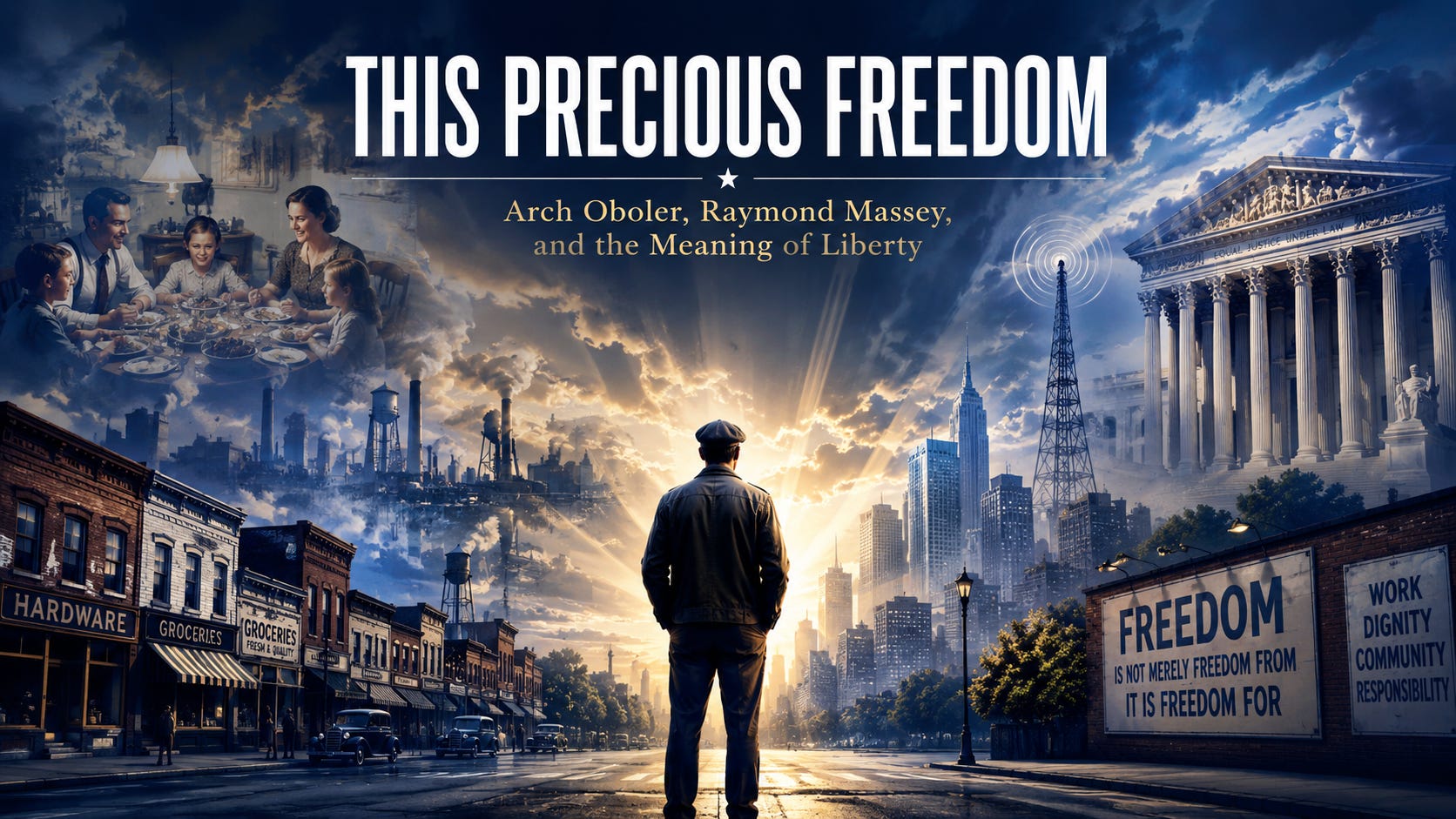
THIS PRECIOUS FREEDOM
Arch Oboler, Raymond Massey, and the Meaning of Liberty
Part II
One of the most remarkable things about Arch Oboler’s work is how often it refuses to remain trapped in its own era.
Many radio programs are inseparable from the years that produced them. Their references grow obscure. Their assumptions become dated. Their concerns fade into history. They become artifacts—interesting perhaps, even entertaining, but largely confined to the past.
Oboler’s finest work behaves differently.
His stories emerge from specific historical circumstances, yet they continually point beyond those circumstances toward something more enduring.
This Precious Freedom is one of those works.
Its immediate backdrop belongs unmistakably to 1940. The economic wounds of the Depression were still fresh. Totalitarian governments were expanding across Europe. Democracy seemed less secure than many Americans had previously assumed.
Yet beneath those historical realities lies a question that no generation escapes:
What is freedom actually for?
The question sounds simple until one attempts an answer.
Modern discussions of liberty often focus upon limits.
What should government be allowed to do?
What should government not be allowed to do?
These questions matter enormously.
But they address only part of the issue.
A society can remove restraints and still leave people directionless.
A society can guarantee rights and still leave citizens isolated.
A society can expand choices indefinitely while quietly eroding the conditions that make meaningful choice possible.
Oboler understood that freedom involves more than the absence of chains.
Freedom also requires purpose.
The distinction is subtle but important.
Imagine a ship released from its moorings.
It is undeniably free.
Nothing restrains it.
Nothing confines it.
Yet if it lacks a destination, its freedom quickly becomes aimlessness.
The ship drifts.
It wanders.
Eventually it becomes subject to currents it never intended to follow.
Human beings often experience something similar.
Freedom detached from purpose can become surprisingly fragile.
People begin seeking direction elsewhere.
Institutions step forward.
Ideologies step forward.
Movements step forward.
Strong personalities step forward.
Someone promises certainty.
Someone promises meaning.
Someone promises to remove the burden of choosing.
The offer is always tempting.
The cost is often hidden.
This insight appears repeatedly throughout Oboler’s work.
Whether writing horror, fantasy, social drama, or political allegory, he remained fascinated by the ways ordinary people respond to fear and uncertainty.
Fear changes behavior.
Fear narrows horizons.
Fear encourages dependence.
Fear makes complicated answers seem intolerable.
Under sufficient pressure, people begin searching for simple solutions to complex problems.
The twentieth century provided countless examples.
The twenty-first century continues to provide them.
This is one reason why This Precious Freedom feels unexpectedly contemporary.
The details differ.
The underlying dynamics remain familiar.
Today’s anxieties may involve automation rather than industrial unemployment.
Artificial intelligence rather than mechanization.
Globalization rather than wartime economics.
Digital dependency rather than mass manufacturing.
Yet the deeper concerns remain remarkably similar.
Will technological change leave ordinary people behind?
Can communities survive rapid transformation?
How should societies balance efficiency with human dignity?
What happens when economic systems become too large and complicated for individuals to understand?
These questions echo through modern life.
Oboler recognized early that economic concerns are never merely economic.
Work matters for reasons extending far beyond income.
Human beings seek usefulness.
They seek contribution.
They seek the satisfaction that comes from participating in something larger than themselves.
A paycheck may sustain life.
Meaning sustains the spirit.
This insight places Oboler in a tradition reaching far beyond radio.
Great writers have long understood that labor shapes identity.
The craftsman.
The farmer.
The teacher.
The builder.
The engineer.
The merchant.
The artist.
Each occupies a role that extends beyond personal gain.
Work becomes a form of participation in the life of a community.
When meaningful work disappears, something larger than income often disappears with it.
A sense of purpose begins to erode.
A sense of belonging weakens.
Individuals start feeling disconnected from the structures that once gave their lives coherence.
Oboler repeatedly returned to this concern because he understood that freedom and dignity are closely related.
A society that wishes to preserve liberty must also preserve conditions in which ordinary people can live meaningful lives.
Citizens who feel powerless eventually begin acting powerless.
Citizens who feel irrelevant eventually begin withdrawing from civic life.
The result is not merely economic decline.
The result is democratic decline.
Freedom requires participants.
Democracy requires citizens.
Both become difficult to sustain when large numbers of people lose confidence in their ability to shape their own futures.
This Precious Freedom never reduces these realities to statistics.
That is one of its greatest strengths.
Numbers inform.
Stories reveal.
A report may tell us how many people lost jobs.
A story helps us understand what losing a job feels like.
A survey may describe public anxiety.
Drama allows us to experience anxiety from the inside.
Radio excelled at this form of understanding.
Unlike newspapers, it could enter emotional life directly.
Unlike motion pictures, it required listeners to participate imaginatively.
The audience completed the experience.
Voices became faces.
Words became places.
Ideas became human beings.
Oboler exploited this capacity brilliantly.
His dramas often function less as arguments than as conversations.
Rather than dictating conclusions, they invite reflection.
Rather than providing certainty, they encourage engagement.
The distinction reveals why so much of his work has aged well.
Propaganda rarely survives its moment.
Questions endure.
This Precious Freedom asks questions.
What responsibilities accompany liberty?
What sacrifices are necessary to preserve it?
What obligations do citizens owe one another?
Can freedom survive if people cease caring about the common good?
These questions remain unresolved because they are permanently unresolved.
Every generation must answer them again.
No constitution settles them forever.
No institution eliminates them.
No victory secures them permanently.
Freedom requires continual renewal.
Perhaps that is the drama’s deepest insight.
Many people imagine liberty as something achieved.
A destination reached.
A problem solved.
History suggests otherwise.
Freedom resembles a garden more than a monument.
Monuments can be built and left alone.
Gardens require attention.
They require cultivation.
Neglect has consequences.
The weeds always return.
The comparison may sound old-fashioned.
It is also true.
The institutions supporting liberty are never self-sustaining.
They depend upon habits.
Trust.
Participation.
Responsibility.
Restraint.
These qualities cannot be manufactured by government decree.
They emerge from culture.
From families.
From neighborhoods.
From schools.
From churches.
From civic organizations.
From countless ordinary interactions that teach individuals how to live alongside one another.
This reality helps explain why so many thinkers from different traditions ultimately arrive at similar conclusions.
Political freedom alone is insufficient.
Economic freedom alone is insufficient.
Personal freedom alone is insufficient.
Something more is required.
A moral framework.
A shared understanding of human dignity.
A belief that other people possess value beyond their usefulness.
Without such foundations, liberty becomes increasingly difficult to maintain.
This is where Oboler’s vision feels surprisingly Chestertonian.
Not because he and Chesterton agreed about everything.
They certainly did not.
But both men distrusted systems that treated human beings as abstractions.
Both resisted reducing people to economic units.
Both believed ordinary lives possessed profound importance.
Both recognized that civilization depends upon countless small loyalties and responsibilities often overlooked by grand political theories.
Chesterton frequently defended what he called the romance of ordinary life.
The family table.
The neighborhood.
The local shop.
The familiar street.
The modest home.
These were not insignificant things.
They were the building blocks of civilization.
Oboler’s dramas often reveal a similar instinct.
His attention remains fixed upon ordinary people confronting extraordinary pressures.
The scale differs.
The principle remains.
Civilization is ultimately measured not by the power of its institutions but by the quality of life experienced by ordinary citizens.
This conviction gives Everyman’s Theater much of its enduring power.
The series consistently treated average listeners as worthy subjects of serious drama.
That alone was an act of respect.
Radio executives often assumed audiences desired escape.
Many certainly did.
The Depression had given them ample reason.
Yet Oboler believed listeners also desired meaning.
He believed they could engage difficult ideas if those ideas were presented through compelling stories.
History suggests he was right.
Millions listened.
Millions responded.
Millions discovered that radio could entertain the imagination while simultaneously engaging the conscience.
The achievement deserves greater recognition today.
Modern media frequently separates information from entertainment.
One becomes homework.
The other becomes distraction.
Oboler sought something more integrated.
Stories capable of delighting audiences while encouraging reflection.
Drama capable of addressing public concerns without becoming didactic.
Art capable of serving citizenship without sacrificing artistry.
Such ambitions remain rare.
They remain valuable.
And they remain desperately needed.
For all our technological sophistication, modern societies continue wrestling with many of the same questions that occupied listeners in 1940.
How can freedom survive concentration of power?
How can communities preserve human dignity amid rapid change?
How can citizens remain engaged rather than passive?
How can economic systems serve human beings rather than the reverse?
No algorithm can answer these questions.
No policy can answer them completely.
They belong to the realm of wisdom.
That is why stories continue to matter.
Stories help societies think.
Stories preserve memory.
Stories explore possibilities.
Stories remind people that they are not the first generation to confront uncertainty.
Everyman’s Theater performed this service for its own age.
This Precious Freedom remains one of its finest examples.
The drama understands that liberty cannot be reduced to slogans, elections, markets, regulations, rights, or institutions alone.
All these things matter.
None is sufficient.
Freedom ultimately concerns the kind of people we become and the kind of society we choose to build together.
That realization lies at the heart of the program.
It also explains why the title remains so effective.
Not freedom.
This precious freedom.
The phrase carries a subtle warning.
Precious things are valuable.
Precious things are fragile.
Precious things can be lost.
One does not take them for granted.
One protects them.
One passes them onward.
Arch Oboler understood this truth during one of the most uncertain moments of the twentieth century.
His message still reaches across the decades.
Freedom is not merely freedom from restraint.
It is freedom for responsibility.
Freedom for meaningful work.
Freedom for family.
Freedom for community.
Freedom for conscience.
Freedom for truth.
Freedom for the difficult and rewarding task of governing oneself.
Those freedoms are neither automatic nor permanent.
Each generation receives them as an inheritance.
Each generation decides what to do with them.
And that, more than eighty years later, remains the enduring achievement of This Precious Freedom.
It reminds us that liberty is not simply a political arrangement.
It is a human responsibility.
And responsibilities, unlike slogans, never go out of date.
Closing Thoughts
Great radio dramas often survive because they tell compelling stories.
The finest survive because they tell enduring truths.
Arch Oboler understood that freedom is not merely a political slogan or a constitutional principle. It is a living inheritance that must be renewed by each generation. It depends not only upon institutions and laws, but upon ordinary citizens willing to accept the responsibilities that accompany liberty.
That insight gives This Precious Freedom its lasting power.
The questions it asks are not confined to 1940.
They belong to every age.
And perhaps that is why the drama still speaks so clearly today.
Freedom remains precious precisely because it is never guaranteed.
It is something we receive.
Something we preserve.
And something we pass on.
— Chesterton Radio
Listen to Arch Oboler’s Everyman’s Theater presentation of “This Precious Freedom” starring Raymond Massey below.