


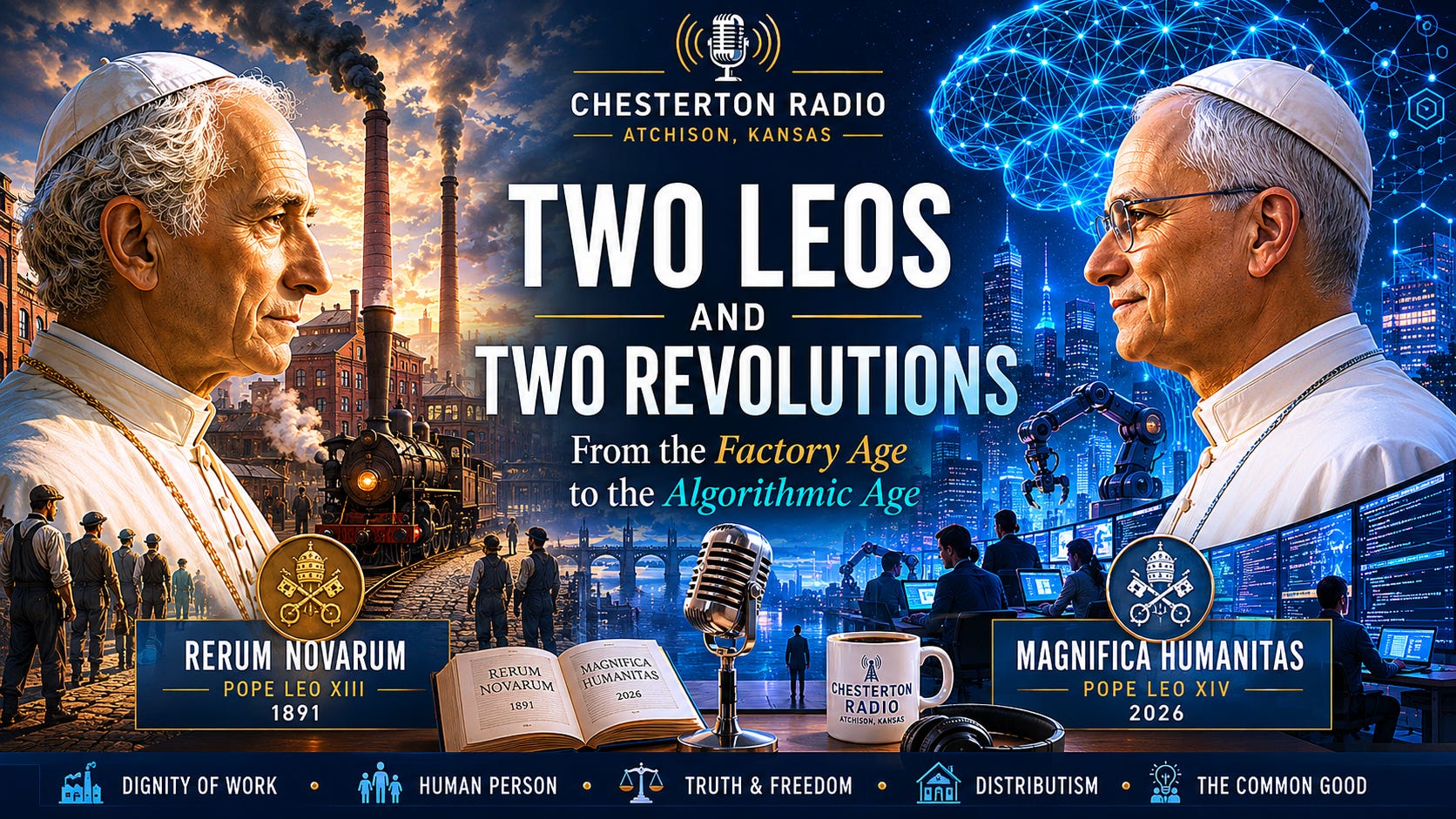
In 1891, Pope Leo XIII looked upon the smoking factories and mechanized labor of the Industrial Revolution and asked a question that would define modern Catholic social thought:
What happens to the human person when machines begin reorganizing civilization?
More than a century later, Pope Leo XIV confronts a different kind of machine — not steam engines and assembly lines, but algorithms, artificial intelligence, synthetic media, and systems increasingly capable of replacing not merely human labor, but human judgment itself.
In this major Chesterton Radio deep-dive broadcast from Atchison, Kansas, we explore the striking conversation between two encyclicals separated by 135 years:
Magnifica Humanitas by Pope Leo XIV
Together, they form a remarkable meditation on technology, labor, dignity, ownership, freedom, and the future of civilization itself.
This is not merely a discussion about economics or artificial intelligence. It is a discussion about what a human being is for.
Along the way, we explore:
The Industrial Revolution vs. the AI Revolution
Chesterton and Belloc on the “Servile State”
Distributism and the human scale
Automation and the meaning of work
AI companions, synthetic reality, and digital isolation
Whether modern systems risk reducing man to machinery
The permanent things that technology cannot replace
Drawing on G.K. Chesterton, Hilaire Belloc, Catholic social teaching, literature, philosophy, and modern technological culture, this broadcast asks whether civilization can remain truly human in an age increasingly shaped by machines.
Thoughtful, literary, atmospheric, and deeply humane, this is one of Chesterton Radio’s most ambitious original broadcasts yet.
📻 Broadcast from Chesterton Radio in Atchison, Kansas.
Read the original encyclicals:
Support Chesterton Radio and help keep the signal alive:
The Chesterton Radio Substack
The Open Door 24/7 live stream
Original broadcasts, deep dives, stories, and reflections devoted to preserving the permanent things in an age of noise


