

There are some people who say “I love you” easily.
And there are others who seem to say it in a hundred different ways without ever speaking the words.
A cup of coffee made exactly right.
A windshield scraped before the frost has finished forming.
A prescription remembered.
A hand at the small of your back.
Coming home.
And staying.
But are the things we do enough?
Or are there some truths that, eventually, have to be given a name?
Tonight on Chesterton Radio, an original story about two people who have built nearly everything that looks like a marriage—and the one thing they have never been able to say.
Two Out of Three.
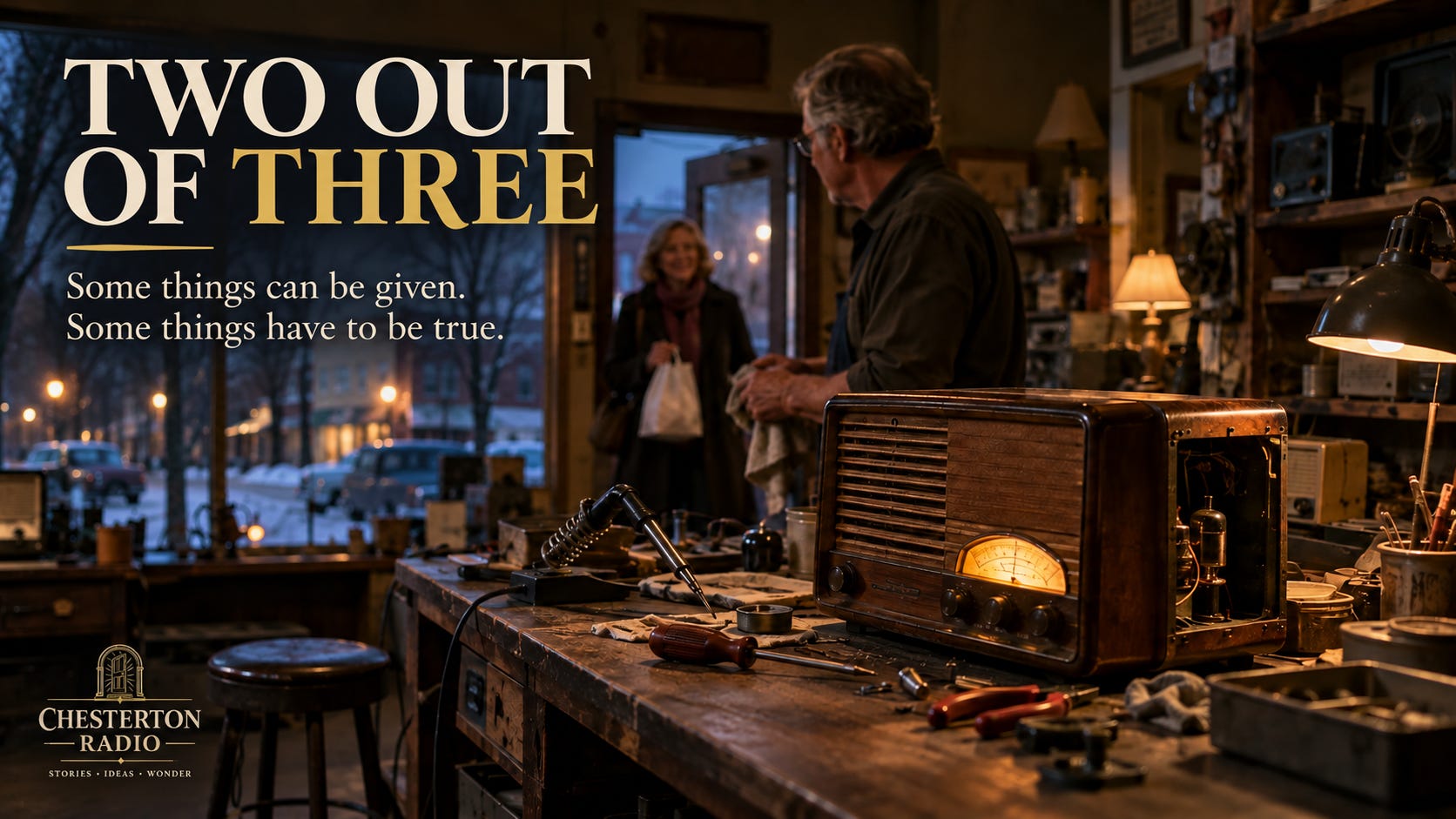
TWO OUT OF THREE
Part One: Pretty Much
By the time Daniel Mercer came back from the bar with two drinks, Maggie had already been rescued from her cousin Elaine.
Daniel saw this from halfway across the reception hall and slowed down.
Elaine was seventy-two, wore purple whenever the occasion permitted it, and had developed over the years a conversational technique that consisted largely of trapping people between herself and furniture.
Maggie had been pinned against the edge of the dessert table for nearly ten minutes.
Now she was free.
Daniel stopped beside her.
“You escaped.”
“I was released.”
“Good behavior?”
“Her daughter called.”
“Divine intervention.”
Maggie accepted the drink he handed her and looked at it.
“Gin?”
“With tonic.”
“Lime?”
“Two.”
She took a sip.
“You may stay.”
“That was the plan.”
They stood together near the back wall of St. Catherine’s parish hall while Maggie’s niece danced with her new husband beneath several hundred feet of white Christmas lights that somebody had strung from the basketball hoops.
The hall had been disguised as well as a Catholic parish hall could be disguised.
The folding tables were covered in linen. The metal chairs wore white slipcovers. Eucalyptus branches had been laid across the centerpieces. Three enormous arrangements of cream roses stood where, on Wednesday nights, the Knights of Columbus normally set up bingo.
None of this quite concealed the scoreboard.
HOME 0.
GUEST 0.
Maggie nodded toward it.
“Marriage begins.”
Daniel followed her gaze.
“Scoreless.”
“It’s early.”
“They’ll learn.”
She elbowed him.
He smiled.
On the dance floor, the bride was laughing at something her husband had said. She was twenty-eight and beautiful in the particular way brides are beautiful when they have forgotten that anyone is watching them.
Maggie watched for a moment.
“She looks happy.”
“She should. We paid enough.”
“You paid for nothing.”
“I bought a toaster.”
“You bought them the good toaster.”
“It had four slots.”
“That’s practically a dowry.”
Daniel took a drink.
Across the room, someone had begun banging a fork against a glass.
The practice spread immediately.
Daniel frowned.
“What are we doing?”
“They want them to kiss.”
“Why?”
“It’s a wedding.”
“They already got married.”
Maggie looked at him.
“You really are a romantic.”
“I’m practical.”
“That’s what unromantic people call themselves.”
The bride and groom kissed to applause.
Daniel lifted his glass toward them.
“There. Everybody happy?”
“Temporarily.”
“That’s the spirit.”
Maggie laughed.
It was one of the things Daniel liked most about her—that he could generally make her laugh without appearing to have tried.
He had been doing it for eleven years and eight months, although neither of them kept count in quite that way.
Daniel knew because the first time Maggie came into his shop had been in March.
She had brought him a Zenith tabletop radio that had belonged to her father.
The radio had hummed, crackled, and occasionally produced a voice from somewhere beneath the static if the tuning dial was held precisely between two stations.
Maggie had set it on the counter and said, “Can you save it?”
Daniel had looked at the radio.
Then at her.
“Probably.”
“That didn’t sound very confident.”
“I haven’t opened it yet.”
“So you don’t know?”
“That’s generally why people bring things to me.”
She had stared at him for half a second and then laughed.
The radio took him three days.
Maggie took longer.
A polka began.
Daniel glanced toward the dance floor.
“No.”
“I didn’t say anything.”
“You were about to.”
“I was thinking it.”
“You think loudly.”
Maggie put down her drink.
“Come on.”
“I don’t polka.”
“You don’t dance.”
“I dance.”
“You shift your weight according to music.”
“That is the technical definition.”
She caught his hand.
He resisted just enough to maintain dignity and then followed her.
Neither of them danced particularly well.
Maggie had learned some kind of formal dance as a girl from a nun who believed that every young woman should know how to waltz properly and every young man should understand that his hand belonged above the waist.
Daniel had learned nothing.
What they had instead was repetition.
Eleven years of weddings.
Christmas parties.
Anniversaries.
Summer concerts in the park.
One embarrassing New Year’s Eve at the Moose Lodge.
They knew the geometry of each other.
Daniel knew how far Maggie would step backward without looking.
Maggie knew that Daniel’s left knee bothered him if he turned too quickly.
His hand settled automatically into the small of her back.
Her fingers rested on his shoulder.
“Try smiling,” she said.
“I am.”
“That’s not a smile.”
“This is my festive face.”
“You look like you’re waiting for test results.”
He smiled.
“There.”
“That’s worse.”
They made it halfway around the dance floor before Daniel nearly collided with a child.
Maggie pulled him back.
“You almost killed a flower girl.”
“She moved unpredictably.”
“She’s six.”
“Exactly.”
“You’re blaming her?”
“I’m identifying the hazard.”
Maggie laughed again.
He liked that sound.
He liked the way she laughed with her whole face, the skin gathering at the corners of her eyes, her head tilting slightly back as though laughter were something that entered her from below.
They finished the dance.
At the edge of the floor Maggie leaned toward him.
“Don’t look now.”
Daniel immediately looked.
“Daniel.”
“What?”
“I said don’t look.”
“That never means don’t look.”
Elaine was approaching.
Daniel glanced toward the opposite side of the hall.
“Cake.”
“What?”
“We need cake.”
“We already had cake.”
“Second cake.”
They moved away before Elaine could reach them.
At the dessert table Daniel selected a slice of chocolate cake for Maggie and lemon for himself.
“You hate lemon cake,” she said.
“It was this or carrot.”
“You like carrot.”
“There were raisins.”
“Ah.”
He held out a fork.
She shook her head.
“You take it.”
“You’ll need one.”
“I have one.”
“You left it at the table.”
Maggie looked down.
Then across the room.
Then at him.
“You’re irritating.”
“I’m observant.”
“You notice absolutely nothing until it becomes inconvenient.”
“I noticed the fork.”
“Exactly.”
They returned to their table.
Maggie’s sister Colleen was there with her husband, Pete, who had removed his tie and was already telling someone about the price of diesel fuel.
Daniel placed Maggie’s cake in front of her.
Colleen looked at it.
“You brought her cake?”
“She became disoriented.”
“I was ten feet away.”
“Could’ve been anywhere.”
Maggie took the fork from him.
“You see what I live with.”
Colleen looked from Maggie to Daniel.
“I’ve seen what he lives with.”
“Thank you,” Daniel said.
“I wasn’t taking your side.”
Pete turned around.
“Dan, you hear they’re closing the hardware store?”
Daniel sat.
“No.”
“End of the month.”
“Who told you?”
“Frank.”
“Frank knows everything twenty minutes before it happens.”
“He says the owner’s done.”
Daniel frowned.
“That’s a shame.”
“Everything’s online now.”
“So I’m told.”
“What do you even do when you need one screw?”
Daniel cut into his cake.
“You go online and buy fifty.”
Pete pointed at him.
“Exactly.”
Maggie leaned closer to Daniel.
“Don’t get him started.”
“I said six words.”
“You know your influence.”
“You’re blaming me now?”
“Yes.”
Daniel looked toward Pete, who had already begun explaining the collapse of American retail to another man at the table.
“Fair.”
Maggie smiled and went back to her cake.
A minute later Daniel noticed that she had shifted in her chair.
Then again.
She slipped one heel slightly out of her shoe beneath the table.
Daniel looked down.
“When did those start hurting?”
“They don’t.”
He looked at her.
“They’re fine.”
“You’ve taken your left shoe off.”
“I’m resting it.”
“It’s a shoe, Maggie.”
She sighed.
“An hour ago.”
“Your flats are in the car.”
“I know.”
He stood.
“I’ll get them.”
“You don’t have to.”
“I’m aware.”
“It’s freezing.”
“So is the car.”
“Daniel.”
He held out his hand.
“Keys.”
She looked up at him for a moment, then reached into her small evening bag and gave them to him.
“Blue tote behind the passenger seat.”
“I know where they are.”
“Of course you do.”
He put on his coat.
Outside, November had settled hard over the parking lot.
The rain from earlier had stopped, leaving the pavement black beneath the streetlights. Bare maple branches moved against a low sky. Daniel pulled his coat closed as he crossed toward Maggie’s Subaru.
He unlocked it, opened the rear door, and found the canvas tote where she had said it would be.
Inside were the flats, an umbrella, two grocery receipts, a paperback novel, one glove, and three peppermint candies.
He took the shoes.
Then he noticed the windshield beginning to frost.
Daniel started the car.
He turned the heater on and set the defroster high.
He stood there for a moment, half in and half out of the car, watching his breath drift through the open door.
Somewhere beyond the parish hall the bells of St. Catherine’s struck nine.
Daniel closed the door and walked back inside.
Maggie was laughing at something Colleen had said when he returned.
He set the shoes beside her chair.
“Your chariot is warming.”
She looked at him.
“You started the car?”
“It was frosting.”
“Thank you.”
“You’re welcome.”
That was all.
She changed shoes under the table.
Daniel sat beside her and finished his cake.
An hour later, somebody Daniel had never met before sat down in Pete’s empty chair.
She was a cheerful woman in her early sixties wearing a blue dress and an elaborate silver necklace.
She introduced herself as Jean.
Maggie knew her vaguely through the bride’s mother.
Daniel forgot the connection almost immediately.
Jean talked easily.
She had driven down from Omaha that afternoon. Her husband had stayed home because he had caught whatever cold their grandchildren had brought over the previous weekend.
“He never misses weddings,” she said. “He’s furious.”
“Tell him there’ll be another one,” Daniel said.
Jean laughed.
“There always is.”
She turned toward Maggie.
“This was lovely, though. They look so happy.”
“They are,” Maggie said.
“How are you related again?”
“She’s my niece.”
“Oh, that’s right. Your sister’s girl.”
Maggie nodded.
Jean looked at Daniel.
“And you must be Maggie’s husband.”
There was nothing unusual in the question.
It had happened before.
At hotels.
At restaurants.
At the hospital when Maggie broke her wrist.
At parish picnics where people were too polite to ask directly and simply assumed.
Daniel smiled.
“Oh, we’re not married.”
Jean immediately put a hand to her chest.
“Oh, forgive me.”
“No need.”
“How long have you been together?”
Maggie said, “It’ll be twelve years in March.”
Jean’s eyebrows rose.
“Twelve years?”
“Almost.”
“Well.” She laughed, relieved to have escaped her mistake. “You might as well be married.”
Daniel smiled.
“Pretty much.”
Jean laughed.
So did someone else at the table.
Maggie smiled too.
The conversation moved on.
Jean began telling them about her daughter’s destination wedding in Mexico.
Daniel listened for perhaps thirty seconds and then saw Pete returning with two cups of coffee.
“Saved by caffeine,” he murmured.
Maggie looked at him.
“What?”
“Nothing.”
Pete sat down and handed Daniel a cup.
Daniel began asking him whether the hardware store building had been sold.
The conversation shifted.
The band started another song.
Somebody dropped a tray near the kitchen.
A child ran past carrying three glow sticks.
Nothing happened.
And yet Maggie sat very still.
Pretty much.
She picked up her water glass.
The ice had mostly melted.
Across the table Daniel was explaining to Pete why the hardware store’s old freight elevator was probably worth more than the building.
He was animated now, at least by Daniel’s standards.
His hands moved when he talked about mechanical things.
He understood them.
Loads.
Bearings.
Gears.
Failures.
Causes.
Things that could be taken apart and inspected.
Pretty much.
Maggie looked toward the dance floor.
Her niece was dancing with her father.
Colleen stood nearby wiping her eyes with a napkin.
Maggie felt no envy.
That surprised her.
She had never wanted another wedding.
Not really.
The first one had been large enough.
White dress.
Church.
Photographer.
Cake.
Promises spoken clearly and in front of witnesses.
None of it had prevented a man from standing in their kitchen fourteen years later and saying that he had fallen in love with somebody else.
Ceremony did not protect you.
Maggie had learned that much.
So no, she did not need Daniel to put a ring on her finger.
She did not need another aisle.
Another dress.
Another room full of people applauding promises.
That was not it.
Pretty much.
Daniel turned toward her.
“You okay?”
“Yes.”
“You’re quiet.”
“I’m at a wedding.”
“That has never stopped you before.”
She smiled.
“Tired.”
Daniel studied her briefly.
“Want to go?”
“No. Not yet.”
“All right.”
And because Daniel was Daniel, he accepted the answer.
No interrogation.
No wounded insistence that she tell him what was wrong.
He reached beneath the table and squeezed her hand once.
Then he went back to his conversation.
Maggie looked down at their hands.
His fingers remained against hers for another second before he let go.
Pretty much.
They stayed until the bride and groom left.
Rice was forbidden by the parish because of the birds, confetti because of the carpet, and sparklers because Father Brennan had apparently seen enough in forty years of weddings.
So everyone stood outside holding small paper bags filled with dried flower petals.
Daniel regarded his.
“This is ridiculous.”
“Throw them.”
“At what?”
“The bride and groom.”
“I know that.”
“Then why did you ask?”
“I was hoping you’d hear it.”
Maggie smiled.
The doors opened.
Everyone cheered.
The bride came out laughing, one hand lifting her dress from the wet pavement.
Petals flew through the cold air.
Daniel threw his approximately six feet too late.
They landed on Pete.
Pete turned.
Daniel pointed toward a child.
Maggie laughed despite herself.
“There’s something wrong with you.”
“You knew that early.”
“Yes.”
“You stayed.”
The words landed more heavily than he intended.
Or perhaps only more heavily than they would have that morning.
Maggie looked at him.
Daniel had already turned toward the parking lot.
He put his hand lightly at the center of her back as they walked.
An old habit.
Not possessive.
Not even conscious.
Just there.
At the car Daniel opened Maggie’s door first.
“You don’t have to do that.”
“You say that every time.”
“And yet.”
“And yet.”
She got in.
The interior was warm.
The windshield was clear.
Daniel walked around to the driver’s side.
Maggie watched him through the glass.
His coat collar was turned up. His hair had gone almost entirely gray over the last few years, though he still insisted it was “mostly brown in favorable lighting.”
He opened the door and sat down.
“You comfortable?”
“Yes.”
“Too warm?”
“No.”
He pulled onto the road.
The town was quiet.
Most of the storefronts were dark now.
A pharmacy sign blinked red at the corner.
A diner near the highway still had six cars in the lot.
Wet pavement reflected the traffic lights in long broken streaks.
Daniel drove with one hand resting near the top of the steering wheel.
After a few blocks he said, “Good wedding.”
“It was.”
“Food was decent.”
“You had three pieces of cake.”
“Two and a half.”
“You stole mine.”
“You stopped eating it.”
“I was talking.”
“Abandoned property.”
Maggie looked out the window.
Daniel glanced over.
“What?”
“Nothing.”
“You’re doing it again.”
“Doing what?”
“Going quiet.”
“I’m tired.”
“You said that.”
“I remain tired.”
He nodded.
“Fair.”
They drove another mile.
The radio was tuned to an oldies station.
A song neither of them especially liked ended.
The announcer came on and began talking about tomorrow’s weather.
Daniel reached over and turned the volume down.
“Thirty-two tonight.”
“I heard.”
“Plants are done.”
“They were done last week.”
“The geranium was hanging on.”
“The geranium has been dead since October.”
“It had one flower.”
“It had a memory of a flower.”
Daniel smiled.
“You have no faith.”
“In geraniums? None.”
They turned onto Maple Street.
The houses were small and old, porches close to the sidewalk, bare trees standing between them.
Light glowed from living room windows.
A television flickered blue behind one set of curtains.
Someone had already put up Christmas lights around a porch railing though Thanksgiving was still two weeks away.
Daniel slowed at their driveway.
Their house was a narrow two-story built sometime before the First World War. White siding. Small front porch. Detached garage that leaned slightly left despite Daniel’s repeated insistence that it did not.
He pulled in.
Before getting out he looked at Maggie.
“You sure you’re okay?”
She met his eyes.
“Yes.”
“All right.”
He believed her.
That hurt too.
Inside, the house was warm and dim.
Daniel turned on the lamp beside the front door.
Maggie hung her coat on the hook.
Daniel took hers down again.
“What?”
“Wet.”
“It’s barely wet.”
He carried it toward the kitchen.
“You’ll put it on tomorrow and complain that it smells damp.”
“I don’t complain.”
Daniel stopped and looked back at her.
She smiled.
“Fine.”
He hung the coat over the back of a kitchen chair.
Maggie went to the counter and removed her earrings.
One.
Then the other.
She placed them in the small ceramic dish where Daniel kept loose screws, batteries, a pocketknife, three keys neither of them could identify, and occasionally his wedding ring from Claire.
Not often.
But sometimes.
There was no ring there tonight.
Two coffee mugs sat beside the sink from that morning.
Daniel picked them up.
“You want tea?”
“No.”
“Water?”
“No.”
He rinsed the cups.
Maggie leaned against the counter.
It was all so ordinary.
That was the problem.
The magnets on the refrigerator.
Her grocery list in Daniel’s handwriting because she had dictated it while looking for her shoes that morning.
The mail piled beneath the wooden bowl by the door.
His reading glasses beside her paperback.
Her cardigan over the kitchen chair.
His coat on the hook beneath hers.
A house built from accumulation rather than declaration.
She had never minded that before.
Or she had told herself she did not.
Daniel opened the refrigerator.
“You want the rest of that chicken tomorrow?”
“Yes.”
“I’ll make soup.”
“You hate making soup.”
“I hate bad soup.”
“You make bad soup.”
“I make practical soup.”
“There should be laws.”
He shut the refrigerator.
Maggie smiled faintly.
Daniel crossed to the thermostat and adjusted it one degree.
“You’re cold.”
“I’m fine.”
“You keep rubbing your hands.”
“I’m wearing a sleeveless dress in November.”
“Poor planning.”
“You liked the dress.”
Daniel looked at her.
“I did.”
Something in Maggie’s chest tightened.
Daniel seemed to notice nothing.
Or perhaps he noticed something and did not know what it was.
He checked the back door.
Turned off the kitchen light.
Maggie walked upstairs ahead of him.
Their bedroom was at the front of the house.
One dresser belonged mostly to Maggie.
The other mostly to Daniel.
A chair in the corner belonged to neither of them because it had ceased being furniture years ago and had become a place where clothing waited to be classified.
Maggie changed in the bathroom.
When she returned, Daniel was sitting at the edge of the bed removing his shoes.
“You snore when you drink gin,” she said.
“I had one.”
“You had two.”
“Second was mostly ice.”
“Alcoholic ice.”
Daniel looked up.
“I’ll sleep downstairs if I become dangerous.”
“I’ll wake you.”
“That seems unnecessarily punitive.”
Maggie pulled back the blankets.
Daniel turned off the bedside lamp.
Darkness settled into the room.
Outside, a car passed slowly on the wet street.
Its headlights moved across the ceiling and disappeared.
Daniel shifted beside her.
The mattress dipped in the familiar way.
Maggie lay on her back.
She could hear the small household sounds that became audible only at night.
The furnace.
A pipe ticking somewhere in the wall.
The refrigerator compressor downstairs.
Daniel breathing beside her.
For almost twelve years she had known the sound of that breathing.
She knew when he was asleep.
She knew when he was pretending to sleep because he wanted to avoid a conversation.
She knew the small catch in his breath when his shoulder hurt.
She knew that if he woke before dawn, he would lie still rather than move because he believed, despite all available evidence, that this prevented waking her.
She knew how much coffee he could drink after seven without ruining his sleep.
She knew which shirts he believed were still wearable long after civilization had judged otherwise.
She knew where he kept the spare keys.
He knew which medicine she forgot to take.
Which foods gave her heartburn.
Which of her cousins could be safely seated together at Thanksgiving.
Which side of the bed she needed when her back hurt.
He knew she would want the flats before she asked.
Pretty much.
Maggie stared into the darkness.
Daniel turned slightly.
The bed settled again.
She waited.
Five minutes.
Perhaps ten.
She could not tell.
“Daniel?”
“Hmm?”
He was not asleep yet.
Maggie swallowed.
The question seemed absurd now that she had decided to ask it.
Too simple.
Too late.
Too large for a dark bedroom after a wedding.
She nearly let it go.
She had let it go before.
Not in words.
But in every other possible form.
Every birthday card where Daniel had signed simply his name.
Every time someone introduced them as husband and wife and he corrected them.
Every anniversary they did not technically have.
Every moment she had decided that actions mattered more than language.
Daniel had stayed.
That mattered.
Daniel had chosen her, day after day, for almost twelve years.
That mattered.
He had come to the hospital when her mother died and sat beside her until morning.
He had rebuilt the porch steps because she worried her sister might fall.
He had driven three hours through an ice storm because Maggie’s car had broken down outside Des Moines.
He had remembered her father’s birthday seven years after her father was gone.
He knew.
He noticed.
He stayed.
Surely that was enough.
It had been enough.
Until tonight.
Pretty much.
“Maggie?”
His voice was more awake now.
She turned her head toward him though she could barely see his face.
“Yes.”
“What is it?”
The room seemed suddenly very quiet.
Maggie drew in a breath.
“Do you love me?”
Daniel did not move.
Not at first.
That was the first answer.
Then she felt his breathing change.
A small intake of air.
His hand moved beneath the blanket.
Toward her, perhaps.
Then stopped.
Maggie waited.
In the darkness Daniel stared at the ceiling.
His mouth opened.
Nothing came.
Seconds lengthened.
Maggie could hear the furnace moving air through the vent.
A car turned somewhere at the end of the block.
Daniel swallowed.
“Maggie…”
She closed her eyes.
There it was.
Not the word.
Everything around the word.
All the years surrounding the place where it should have been.
Maggie turned onto her side, away from him.
Her voice, when it came, was almost gentle.
“That’s what I thought.”
TWO OUT OF THREE
Part Two: The Things We Give
Daniel was awake when the furnace came on at five seventeen.
He knew the time because the red numbers on the clock were reflected faintly in the window.
5:17.
Beside him, Maggie was breathing evenly.
He could not tell whether she was asleep.
Normally he could.
After nearly twelve years Daniel knew the difference between Maggie sleeping and Maggie lying still because she wanted him to think she was sleeping. Real sleep loosened something in her. Her shoulders settled. Her breathing changed. Occasionally she made a small sound in the back of her throat that she denied making.
This morning he could not tell.
He lay on his back and watched the ceiling.
The words were still there.
Do you love me?
He had spent most of the night trying to determine what he should have said.
Every answer he found seemed wrong.
Yes was wrong.
No was worse.
He had considered telling her that the question was unfair, but even in the darkness he knew better than that.
There was nothing unfair about asking a man you had lived with for almost twelve years whether he loved you.
That was, if anything, an extremely patient question.
At five twenty-three Daniel got out of bed.
Maggie did not move.
He carried his clothes into the bathroom and dressed with the door closed.
Downstairs, the house was cold.
Daniel turned up the thermostat.
He filled the coffee maker.
Four scoops.
Six cups of water.
He had once tried making five because Maggie was away for the weekend and discovered that the machine somehow produced worse coffee in smaller quantities. He had no explanation for this.
While it brewed, he opened the refrigerator.
Eggs.
Half an onion.
Milk.
The leftover chicken from the wedding day.
He had promised soup.
That seemed ambitious at five thirty in the morning.
He took out the eggs.
By five forty-five there were two plates on the kitchen table.
Daniel looked at them.
Then at the stairs.
He poured Maggie’s coffee.
A little milk.
No sugar.
He set it at her place.
Then he stood there.
He could go upstairs.
Wake her.
Say something.
He had been thinking of things to say since midnight.
About last night.
That seemed possible.
Maggie, about last night—
No.
Maggie, I don’t want you to think—
Worse.
Maggie, you know how I feel about—
Hopeless.
Daniel picked up his coffee.
Outside the kitchen window, the first gray light was beginning to show above the neighboring roofs.
The thermometer beside the back door read twenty-eight.
He saw frost on Maggie’s car.
Daniel put on his coat.
The scraper made a dry rasping sound against the windshield.
Daniel worked from the driver’s side toward the middle.
The frost was thickest along the bottom edge.
He scraped the side windows, then the mirrors.
When he finished, he opened the driver’s door and started the engine.
The gas gauge rose.
Just under a quarter tank.
Daniel frowned.
He made a mental note.
The defroster began pushing cold air.
He turned the fan down until the engine warmed.
When he looked toward the house, Maggie was standing in the kitchen window.
She had one hand around the coffee mug.
Daniel raised the scraper.
She didn’t wave.
He finished the windshield.
When he came back inside, she was sitting at the table.
Her hair was still slightly flattened on one side from sleep. She wore the blue robe Daniel had bought her three Christmases ago after the old green one finally tore beneath the arm.
She looked at the second plate.
“You made eggs.”
“I’ve been accused of worse.”
“They’re getting cold.”
“So am I.”
He removed his coat.
Maggie took a drink of coffee.
Daniel sat across from her.
For several seconds they ate.
The clock above the stove ticked.
Daniel cleared his throat.
“About last night.”
Maggie looked at him.
He had expected her to help.
Not consciously.
But somewhere in the mechanics of their life, Maggie usually supplied the next piece when he could not find it.
A joke.
A question.
A way around the awkward part.
She did not.
Daniel put down his fork.
“I didn’t…”
He stopped.
Maggie waited.
“I don’t want you to think…”
Again nothing.
Maggie took another sip of coffee.
Daniel looked toward the window.
“I scraped your car.”
“I saw.”
“It’s twenty-eight.”
“I know.”
“Gas is low.”
“I’ll get some.”
“I can take it at lunch.”
“You don’t have to.”
Daniel looked at her.
The phrase had always meant one thing between them.
You don’t have to.
I know.
Last night at the wedding she had said it when he went for her shoes.
He had answered automatically.
I’m aware.
This morning neither of them completed the exchange.
Maggie looked down at her eggs.
“Thank you for the coffee.”
Daniel nodded.
“You’re welcome.”
At eight thirty-seven, the bell above the door of Mercer Repair rang.
Daniel looked up from an Oster blender.
“Morning.”
Frank Donnelly carried an old wooden radio through the door as though transporting a sick animal.
Daniel recognized the set before Frank reached the counter.
“Philco.”
“That’s what it says.”
“Forty-one, maybe forty-two.”
“You can tell by looking?”
“I can read the label.”
Frank set it down.
“Smartass.”
Daniel turned the radio around.
The cloth over the speaker was stained brown at one corner. One of the knobs had been replaced with something that clearly belonged to another appliance.
“What happened?”
“Nothing happened. It stopped.”
“When?”
“Tuesday.”
“Was it making noise?”
“It was a radio, Dan.”
“Noise it wasn’t supposed to make.”
“Buzzing.”
“Before it stopped?”
“Couple weeks.”
Daniel nodded.
“Probably capacitor.”
Frank leaned on the counter.
“Can you fix it?”
“Probably.”
“You always say probably.”
“I haven’t opened it yet.”
Frank pointed at him.
“That’s exactly what you told me about the toaster.”
“And I fixed the toaster.”
“Eventually.”
“You brought me a toaster made during the Eisenhower administration.”
“My mother bought that toaster.”
“Your mother expected too much from appliances.”
Frank smiled.
“If anybody can save it, you can.”
Daniel put the radio on the bench behind him.
“We’ll see.”
Frank didn’t leave.
Daniel waited.
Frank looked around the shop.
There were shelves of things awaiting judgment.
A KitchenAid mixer.
Three lamps.
Two turntables.
A vacuum cleaner.
A green metal fan with blades heavy enough to amputate something important.
Near the window sat the Zenith radio Maggie had brought Daniel almost twelve years ago.
It wasn’t waiting for repair.
It lived there.
Maggie had told him to keep it at the shop because that was where her father would have liked it.
Daniel kept it tuned to the local AM station.
Frank followed his gaze.
“You all right?”
“Fine.”
“You look terrible.”
“Thank you.”
“Wedding run late?”
“A little.”
“Good time?”
“Yeah.”
Frank nodded.
Then he waited.
Daniel knew this technique.
Frank had perfected it over seventy years.
Silence, in Frank’s hands, was not an absence. It was a crowbar.
Daniel picked up a screwdriver.
Frank said, “All right.”
“All right what?”
“Nothing.”
“Good.”
Frank put on his cap.
“Call me about the radio.”
“I will.”
“Don’t throw it away.”
“I don’t throw anything away.”
Frank glanced around the shop.
“I know. That’s the problem.”
The bell rang as he left.
Daniel stood alone.
The old Philco sat on the counter.
If anybody can save it, you can.
Daniel picked it up and carried it to the bench.
He removed the back panel.
Dust.
Old wiring.
Wax capacitors.
Nothing surprising.
He switched on the bench lamp and bent closer.
Here was a problem.
A real one.
Current came in.
Something failed.
Current stopped.
Find the failure.
Replace the failed component.
Test.
If it worked, return it.
If it didn’t, keep looking.
Daniel reached for the meter.
His phone vibrated.
He looked at the screen.
Maggie.
For one irrational second he felt relief.
Then he opened the message.
Can you pick up my prescription? I forgot it yesterday.
Daniel typed:
Already called it in.
Three dots appeared.
Stopped.
Appeared again.
Thank you.
Daniel looked at the words.
He typed:
Need anything else?
This time there were no dots.
After a minute he put the phone down.
At noon Daniel took Maggie’s Subaru to the gas station.
He filled the tank.
He checked the oil.
He bought her prescription at Jensen’s Pharmacy and, because he was there, picked up the peppermint antacids she kept in her desk.
At the grocery store next door he bought milk, carrots, celery, egg noodles, onions and the cereal Maggie liked.
He stood in the soup aisle trying to remember whether they had chicken stock.
They did.
Probably.
He bought two cartons anyway.
At the checkout he saw a small bunch of yellow flowers in a bucket beside the register.
He considered them.
Then walked past.
Flowers would mean something.
Daniel wasn’t sure what.
He was beginning to suspect that this was the problem with almost everything.
Maggie came home at five twelve.
She knew Daniel had been there before she opened the door.
The porch light was on.
He always turned it on if he expected her after dark.
Inside, the house smelled of chicken and thyme.
Her prescription sat on the counter in its white paper bag.
Beside it were the antacids.
She stopped.
There they were.
Peppermint.
Not berry.
Daniel knew she hated berry.
Maggie closed her eyes.
For years she had believed this was what mattered.
Her first husband, Stephen, had been good with words.
Very good.
He could make an apology sound like a wedding vow.
He had written things in birthday cards that made her cry.
He had told her he loved her every morning when he left for work.
Sometimes twice.
Then one Thursday evening he had stood in their kitchen with his hands flat against the counter and told her there was someone else.
Maggie had remembered afterward how absurdly polite the conversation had been.
She had asked how long.
He had told her.
She had asked whether he loved the woman.
He had said yes.
As if love were the explanation.
As if the word itself were a court order.
After Stephen, Maggie had stopped trusting declarations.
Then came Daniel.
Daniel, who forgot Valentine’s Day but remembered to replace the batteries in her smoke detectors.
Daniel, who rarely bought flowers but changed the oil in her car before she realized it was due.
Daniel, who had sat beside her mother’s hospital bed for nine hours without once telling Maggie everything would be all right because he knew it wouldn’t.
Daniel did not say things.
Daniel stayed.
She had thought she understood the bargain.
Now there was a white pharmacy bag on the counter.
And Maggie didn’t know what it meant.
The back door opened.
Daniel came in carrying a toolbox.
“You’re home.”
“So are you.”
“Temporarily.”
He put the toolbox on the floor.
“What happened?”
“Cabinet.”
“What cabinet?”
Daniel pointed.
The door above the sink had been crooked for six months.
Maggie had complained about it often enough that it had become part of the house.
Now it hung perfectly straight.
“You fixed it.”
“Hinge was loose.”
“I know.”
“Two screws were stripped.”
“I didn’t know that.”
“I did.”
Of course you did, she thought.
Daniel washed his hands.
“Soup’s almost done.”
“You made soup.”
“I said I would.”
“You also said you make practical soup.”
“This is extremely practical.”
“Is it edible?”
“Unclear.”
He reached for a spoon.
Maggie watched him taste the broth.
He frowned.
Added salt.
Tasted again.
“Better.”
“Daniel.”
He turned.
Maggie looked at the prescription bag.
Then at him.
“You keep doing things for me.”
Daniel waited.
“Yes.”
“Why?”
He looked genuinely confused.
“What do you mean?”
“The car. The prescription. The soup. The cabinet.”
“The cabinet needed fixing.”
“I know.”
“You asked me to fix it.”
“Six months ago.”
“I got to it.”
Despite herself, Maggie almost smiled.
Daniel saw it and smiled too.
For one second they were themselves again.
That made it worse.
Maggie looked away.
“Why do you do these things?”
Daniel put the spoon down.
“Because they need doing.”
“No.”
He frowned.
“No?”
“That’s not what I’m asking.”
“I don’t understand what you’re asking.”
“I know.”
Something in her voice made him stop.
Maggie leaned against the counter.
“Why did you drive to Des Moines in an ice storm when my car broke down?”
Daniel stared at her.
“What?”
“Seven years ago.”
“I remember.”
“Why?”
“Because you were stranded.”
“Why did you sit at the hospital all night when Mom died?”
Daniel’s expression changed.
“Maggie.”
“Why did you rebuild Colleen’s porch steps?”
“They were dangerous.”
“Why did you start my car last night?”
“It was frosting.”
“Why did you remember my prescription today when I didn’t?”
Daniel said nothing.
Maggie folded her arms.
“You have an answer for every single one.”
“Because there is an answer.”
“Yes. There is.”
Daniel looked at her.
The furnace came on.
Warm air moved through the kitchen.
Finally he said, “Because that’s what we do.”
Maggie looked down.
Almost.
So close.
Daniel took a step toward her.
“Maggie—”
“No.”
He stopped.
“I’m not doing this for you anymore.”
“Doing what?”
“Finishing the sentence.”
Daniel stared at her.
Maggie picked up the prescription bag and walked upstairs.
They ate soup at six thirty.
It was, despite Maggie’s predictions, good.
She told Daniel so.
He said, “Don’t sound so surprised.”
She said, “I want to encourage you.”
He said, “I don’t respond well to praise.”
She said, “I’ve noticed.”
And for perhaps thirty seconds they were all right.
Then they weren’t.
After dinner Daniel washed the bowls.
Maggie dried them.
It was another of their routines.
He washed.
She dried.
Daniel believed dishwashers were designed primarily to make glasses cloudy.
Maggie believed Daniel had been born seventy years old.
She dried the second bowl and put it in the cupboard.
The repaired door closed perfectly.
She stared at it.
Daniel noticed.
“What?”
“Nothing.”
He turned back to the sink.
Maggie put down the towel.
“Tell me about Claire.”
The water continued running.
Daniel’s hands stopped beneath it.
After a moment he shut off the faucet.
“What about her?”
“Whatever you couldn’t say last night.”
Daniel dried his hands.
“Maggie.”
“There it is again.”
“What?”
“My name.”
He looked at her.
“You say my name whenever the next word is the one you don’t want to say.”
Daniel pulled out a chair and sat down.
Maggie remained standing.
After a while he said, “Claire…”
Maggie almost laughed, though nothing was funny.
“I know about Claire, Daniel.”
“No.”
His answer came more quickly than she expected.
“You know what happened.”
Maggie waited.
Daniel looked toward the dark kitchen window.
For a long time he said nothing.
Then:
“She was thirty-six.”
Maggie sat across from him.
“I know.”
“She made coffee that morning.”
Daniel rubbed one thumb against the side of his hand.
“She always made terrible coffee.”
Maggie said nothing.
“She used too much. I used to tell her that. Every morning. She’d say coffee was supposed to hurt a little.”
A small smile appeared.
Then vanished.
“She left at seven forty. I remember because she came back inside for her gloves.”
Daniel looked at the table.
“That was the last time I saw her.”
Maggie had heard the facts before.
A winter morning.
Claire driving to work.
An aneurysm.
A traffic light.
A stranger calling an ambulance.
But Daniel had never told it this way.
Not the coffee.
Not the gloves.
Not the last ordinary morning.
“For months afterward,” he said, “people kept bringing food.”
Maggie waited.
“Casseroles. Soup. Bread. Things in foil pans. Everybody brought something because nobody knew what else to do.”
His voice remained steady.
“I remember being angry about it.”
“The food?”
“That I kept eating it.”
Maggie looked at him.
“I’d wake up and be hungry. That seemed wrong.”
Daniel gave a small shrug.
“Then I’d go to work. Somebody would say something funny. I’d laugh.”
He looked embarrassed by the memory.
“The first time that happened, I went into the bathroom afterward and threw up.”
“Oh, Daniel.”
He shook his head.
“No. I’m not telling you because I want…”
He stopped.
Maggie waited.
He tried again.
“Everything kept happening.”
The refrigerator hummed.
A car passed outside.
“Bills came. Grass grew. The furnace broke. My mother needed groceries. People got married. Babies were born.”
He looked at Maggie.
“And Claire stayed thirty-six.”
There was nothing Maggie could say to that.
So she didn’t.
Daniel looked down at his hands.
“Eventually people started telling me I was young.”
Maggie knew what that meant.
Young enough to start again.
Young enough to meet someone.
Young enough to remarry.
“I hated them for it,” Daniel said.
“They meant well.”
“I know.”
“That doesn’t always help.”
“No.”
Silence returned.
Maggie spoke carefully.
“And then you met me.”
Daniel looked at her.
“Eventually.”
“Eleven years and eight months ago.”
He almost smiled.
“You count.”
“You count.”
“I know because of the radio.”
“I know.”
The Zenith.
Her father’s radio.
Can you save it?
Probably.
Maggie folded her hands on the table.
“So what happened?”
Daniel frowned.
“With what?”
“With us.”
He looked away.
“Nothing happened.”
“Daniel.”
“I don’t know what you want me to say.”
“The truth.”
“I’ve always told you the truth.”
“I know.”
Something in her answer surprised him.
Maggie continued.
“That’s part of the problem.”
Daniel leaned back.
“I never promised you something I couldn’t give you.”
There it was.
Maggie felt something inside her go very still.
“Couldn’t?”
Daniel heard it too late.
He looked at her.
“Maggie—”
“No. Keep going.”
“I didn’t mean—”
“Yes, you did.”
Daniel stood.
He crossed to the sink, then stopped there with his back to her.
Maggie waited.
Finally he said, “I loved Claire.”
“I know.”
“I mean…”
He pressed both hands against the edge of the counter.
“I loved her.”
“I know, Daniel.”
“No.”
He turned.
“You keep saying that like we’re talking about a fact.”
“Aren’t we?”
“I don’t know.”
His frustration was beginning to show now, not with Maggie exactly, but with language itself.
“I don’t know how to explain this.”
“Try.”
Daniel looked at her.
“It was everything.”
Maggie said nothing.
“I don’t mean she was perfect.”
“I never thought she was.”
“She wasn’t. She drove too fast. She spent money we didn’t have. She could stay angry for three days over something I’d forgotten after twenty minutes.”
A faint smile.
“She hated my mother for almost a year because of a Thanksgiving turkey.”
“What happened?”
“I don’t even remember.”
“That seems unfair to the turkey.”
Daniel laughed.
One sound.
Unexpected.
Maggie smiled despite herself.
Then the smile left him.
“But I loved her.”
Maggie nodded.
“I know.”
“And when she died…”
He stopped.
Maggie waited.
Daniel looked toward the ceramic dish on the counter.
Loose screws.
Old keys.
A pocketknife.
No ring tonight.
“When she died, that was it.”
Maggie felt cold despite the furnace.
“What was it?”
“That part.”
“What part?”
Daniel looked at her.
“That.”
He could repair a radio manufactured before his father was born.
He could rebuild a motor.
He could listen to a failing bearing and tell you whether it would last a week or a year.
And now, when the only thing Maggie needed was a noun, Daniel had none.
She waited.
Finally he said:
“I already gave that away.”
Maggie stared at him.
Daniel’s face was open in a way she rarely saw.
He believed he had finally told her the truth.
That was the terrible part.
He wasn’t rejecting her.
He wasn’t punishing her.
He was offering this explanation almost tenderly.
As though she might be comforted by knowing that the thing she wanted had once existed.
Just not for her.
Maggie looked down at the table.
A strange little laugh escaped her.
Daniel frowned.
“What?”
She looked at him.
“Love isn’t a kidney, Daniel.”
For half a second his mouth almost moved toward a smile.
Then he saw her face.
“Maggie.”
“You don’t get one.”
“I didn’t say that.”
“You just did.”
“No. I said—”
“You gave it away.”
Daniel rubbed his forehead.
“That’s not what I meant.”
“Then tell me what you meant.”
“I don’t know how.”
“Yes.”
Her voice sharpened for the first time.
“That is becoming extremely clear.”
Daniel flinched.
Maggie immediately regretted it.
She looked away.
“I’m sorry.”
“No.”
“I shouldn’t have said it like that.”
“You should.”
“No, I shouldn’t.”
She took a breath.
“I am not angry at Claire.”
“I know.”
“I don’t want what you had with Claire.”
Daniel looked surprised.
“I couldn’t have it if I wanted it. I’m not her. You’re not the man you were at thirty-five. Whatever the two of you had belongs to the two of you.”
Daniel sat down again.
Maggie’s voice softened.
“I would never ask you to make it smaller so there’d be room for me.”
“I know.”
“Do you?”
“Yes.”
“Then what are you protecting?”
Daniel had no answer.
Maggie leaned toward him.
“I don’t need you to tell me I’m the love of your life.”
He looked at her.
“I don’t need you to tell me you never loved anybody the way you love me. I don’t need you to rank us, Daniel.”
“I wouldn’t.”
“I know.”
She paused.
“I don’t even need a ring.”
His eyes shifted briefly toward the ceramic dish.
Maggie saw it.
“That isn’t what last night was about.”
“I know.”
“Do you?”
“Yes.”
She waited.
Daniel’s shoulders dropped.
“I need you.”
The words were quiet.
Maggie closed her eyes for a moment.
“I know.”
“I mean it.”
“I know you do.”
“I don’t know what I’d do without you.”
She opened her eyes.
Daniel looked almost frightened now.
“I want you here.”
Maggie swallowed.
There they were.
Two enormous truths.
And the empty space beside them.
She stood and walked to the counter.
Her prescription was still there.
Daniel had remembered it when she had forgotten.
Beside it were the peppermint antacids.
Not berry.
Never berry.
On the table were two bowls from the soup he had promised to make.
In the driveway was a car with a full tank of gas.
Above the sink was a cabinet door that no longer sagged.
Outside, her windshield was clear because a man had stood in twenty-eight-degree darkness scraping frost from it while she watched from the kitchen.
Maggie turned toward him.
“Do you know what Stephen used to say to me every morning?”
Daniel shook his head.
“‘I love you.’”
He said nothing.
“Every morning. Sometimes when he was halfway out the door he’d come back and say it because he couldn’t remember whether he’d already said it.”
Daniel looked down.
“I believed him.”
“Maggie—”
“And maybe he meant it when he said it. I don’t know anymore.”
She folded her arms.
“When he left, I decided words were cheap.”
Daniel looked at her.
“Then I met you.”
Her voice softened.
“You didn’t say anything.”
A faint, sad smile.
“You just showed up.”
Daniel’s eyes met hers.
“When Mom died, you showed up.”
She counted them without intending to.
“When my car died, you showed up.”
“When Colleen needed help, you showed up.”
“When I was sick, you showed up.”
“When I was scared, you showed up.”
“You always show up.”
Daniel said quietly, “Of course.”
Maggie nodded.
“That’s what I told myself.”
“What?”
“That ‘of course’ was enough.”
Daniel stared at her.
“For a long time, it was.”
Maggie looked around the kitchen.
Their kitchen.
His coffee.
Her tea.
His ridiculous collection of screwdrivers in the junk drawer.
Her magnets on the refrigerator.
Two lives so thoroughly mixed that separating them would require an inventory.
She looked back at him.
“You made my coffee this morning.”
Daniel said nothing.
“You scraped my windshield.”
Silence.
“You filled my car.”
Silence.
“You remembered my medicine.”
Daniel’s eyes dropped.
“You bought the right antacids.”
“Maggie—”
“You made soup you don’t even like making.”
“It wasn’t bad.”
She almost laughed.
“That’s not the point.”
“I know.”
“You fixed a cabinet hinge that’s been crooked since spring.”
“I should’ve done that sooner.”
“Daniel.”
He stopped.
Maggie’s eyes filled, but she did not cry.
Not yet.
She stepped closer.
“I am not asking you for flowers.”
“I know.”
“I’m not asking you for a wedding.”
“I know.”
“I’m not asking you to forget Claire.”
“I would never—”
“I know.”
She waited until he looked directly at her.
“I am asking you one thing.”
Daniel stood very still.
Maggie looked at the man who knew how she took her coffee.
The man who could tell she was cold because she rubbed her hands together.
The man who knew which shoes were in which bag in her car.
The man who remembered her dead father’s birthday.
The man who had organized twelve years of his life around the assumption that she would be there tomorrow.
And who believed he had nothing left to give her.
Her voice was quiet.
“What exactly do you think you’ve been giving me for twelve years?”
Daniel opened his mouth.
Nothing came.
Again.
Maggie waited.
For once she did not help him.
She picked up her coffee mug from the counter, though the coffee inside had been cold for hours.
Then she walked upstairs.
Daniel remained in the kitchen.
After a while the furnace stopped.
The house became very quiet.
He looked toward the sink.
The cabinet door above it was straight now.
Daniel crossed the kitchen.
He opened it.
Closed it.
The hinge moved perfectly.
He opened it again.
Smooth.
No sag.
No resistance.
Nothing left to adjust.
Daniel rested his hand on the small brass knob.
Upstairs, a floorboard creaked.
He looked toward the ceiling.
Then back at the cabinet.
For the first time in a very long while, Daniel Mercer stood in front of something that worked exactly as it should and had absolutely no idea what to do next.
TWO OUT OF THREE
Part Three: The Empty Side
Maggie packed the first suitcase after breakfast.
Daniel heard the zipper from the kitchen.
He was standing at the sink with one hand on the cabinet door.
The hinge moved perfectly now.
He opened it.
Closed it.
Opened it again.
Upstairs, something slid along the closet rod.
A hanger.
Then another.
Daniel let go of the cabinet.
He stood still for a moment.
Then he went upstairs.
Maggie was folding sweaters on the bed.
One suitcase lay open beside her.
The second sat on the floor.
Daniel stopped in the doorway.
She looked up.
Neither of them spoke.
Finally he said, “How long?”
Maggie folded the sweater in her hands.
“I don’t know.”
Daniel nodded.
He looked at the suitcase.
Then at the one on the floor.
“You’re going to Colleen’s?”
“Yes.”
“For a few days?”
“I don’t know.”
Again.
Daniel hated that answer.
Not because it was cruel.
Because it was accurate.
Maggie placed the sweater into the suitcase.
Daniel watched her.
She had arranged everything neatly.
Jeans along one side.
Sweaters along the other.
Shoes wrapped in an old grocery bag.
The blue robe was folded at the bottom.
Daniel looked at it.
“You’ll want the heavier coat.”
Maggie stopped.
“Daniel.”
“It’s supposed to be twenty-two tomorrow night.”
“I know.”
“And the Subaru’s—”
He stopped.
The Subaru had a full tank.
He had filled it yesterday.
Maggie looked at him.
Daniel looked toward the closet.
“You have your charger?”
“Yes.”
“Medicine?”
“Yes.”
“Your gray sweater is still—”
“Daniel.”
This time her voice was softer.
He stopped.
For perhaps ten seconds neither of them moved.
Then Daniel said, “I don’t know what I’m supposed to do.”
Maggie’s face changed.
Not much.
Enough.
“I know.”
“I told you I want you here.”
“I know.”
“I meant it.”
“I know.”
Daniel looked at her.
She pressed her lips together.
“That’s why this is so hard.”
Daniel had no answer.
Maggie turned back to the suitcase.
He watched her fold another sweater.
For nearly twelve years there had been very few moments in which Daniel did not know what useful thing to do next.
He could carry something.
Fix something.
Drive somewhere.
Make coffee.
Check the furnace.
Call the pharmacy.
There was always a practical kindness available if you looked hard enough.
Now there was nothing.
Maggie zipped the first suitcase shut.
Daniel reached for it.
“I can get that.”
She almost told him he didn’t have to.
He could see it.
Then she let go of the handle.
“Okay.”
He carried the suitcase downstairs.
Of course he did.
The frost had already begun to form on the Subaru.
Thin white crystals traced the edges of the windshield.
Daniel put the suitcase into the back.
Maggie came out carrying the second.
He took it from her without asking.
She let him.
He placed it beside the first.
Then he looked at the windshield.
Maggie saw him look.
Daniel went to the garage.
The scraper hung on its nail.
He took it down.
Neither of them said anything.
The blade made a dry, familiar sound against the glass.
Scrape.
Scrape.
Scrape.
Maggie stood beside the driver’s door with her arms folded against the cold.
Daniel cleared the windshield.
Then the side windows.
Then the mirrors.
He started to walk around toward the passenger side.
“Daniel.”
He stopped.
“It’s enough.”
He looked at the remaining frost.
“It’ll block the mirror.”
“I can see.”
Daniel nodded.
He handed her the scraper.
Maggie took it.
For a moment their hands touched.
Then didn’t.
Daniel opened the driver’s door for her.
Maggie sat down.
He closed it halfway, then paused.
She lowered the window.
Cold air spilled into the car.
Daniel put his hands into his coat pockets.
Maggie looked at him.
“I’ll call.”
“All right.”
“If something comes up—”
“I know.”
A small smile almost appeared.
Daniel nodded.
“Tell Colleen the porch rail is loose.”
Maggie stared at him.
Then she laughed once.
Barely.
“Of course it is.”
“She’ll pretend it isn’t.”
“I’ll tell her.”
Daniel stepped back.
Maggie started the engine.
The car idled for a moment.
Then she pulled out of the driveway.
Daniel stood beside the curb until the taillights disappeared at the end of Maple Street.
He did not wave.
He did not run after her.
He did not call her name.
When the street was empty again, Daniel went inside.
The furnace was running.
The house was warm.
Nothing had changed.
Except the house no longer contained Maggie.
The first morning alone, Daniel made six cups of coffee.
He didn’t realize it until the pot was half full.
He stood at the counter watching the dark stream drip into the carafe.
Four scoops.
Six cups of water.
Exactly the way he had made it every morning for years.
Daniel looked toward Maggie’s chair.
Empty.
He opened the cabinet.
Took down his mug.
Then, without thinking, took down hers.
He set both on the counter.
Stared at them.
Put Maggie’s back.
At work he repaired a desk lamp.
Then the motor on a stand mixer.
Then a turntable whose owner had insisted repeatedly that the problem was “definitely not the belt.”
It was the belt.
At noon Daniel ate a ham sandwich.
At six he locked the shop.
At six fifteen he heated leftover soup.
At seven he read the paper.
At ten thirty he went upstairs.
Everything went perfectly.
That was the disturbing part.
The second morning he made four cups.
Progress.
He poured one.
Left the rest.
At the grocery store that evening he put Maggie’s cereal into the cart.
He did not notice until the checkout line.
The box sat between eggs and a jar of mustard.
Daniel stared at it.
He picked it up.
He considered returning it to the aisle.
The line behind him grew.
Daniel put it back in the cart.
At home he placed it in the pantry.
There was already half a box there.
He closed the door.
The third night Daniel heard something funny on the radio.
An announcer had mispronounced the mayor’s name in a way Maggie would have enjoyed.
Daniel turned toward the passenger seat.
“Did you—”
He stopped.
The seat was empty.
Daniel faced the windshield again.
The traffic light turned green.
He drove home.
On the fourth morning he found one of Maggie’s shoes under the bed.
Not the dress shoes from the wedding.
An old brown loafer with a worn heel.
Daniel picked it up.
Looked for its mate.
Found nothing.
He set the shoe on top of her dresser.
Then moved it two inches because it wasn’t straight.
He stood there for several seconds.
Then went to work.
On Friday, Frank Donnelly came in for the Philco.
Daniel had replaced two capacitors, cleaned the volume control and repaired one cracked solder joint.
The radio worked.
Mostly.
Frank stood at the counter while Daniel tuned through the dial.
Static.
A voice.
Static.
Music.
Then static again.
Frank frowned.
“That doesn’t sound fixed.”
“It is fixed.”
“That’s a lot of static for fixed.”
“That’s AM radio.”
Frank leaned closer.
A trumpet came through the speaker.
Then faded.
Daniel adjusted the tuning.
“There.”
Frank listened.
“Not bad.”
“High praise.”
Frank looked around the shop.
The Zenith near the window was playing softly.
Maggie’s father’s radio.
Frank nodded toward it.
“Where’s your better half?”
Daniel kept his eyes on the Philco.
“She’s staying with her sister.”
Frank waited.
Daniel hated that about him.
“For how long?”
“I don’t know.”
Frank looked at Daniel.
Then at the shop.
“Place is quieter.”
Daniel turned.
“What does that mean?”
“Nothing.”
“It means something.”
Frank shrugged.
“She talks.”
“You talk.”
“Not like Maggie.”
Daniel looked back at the radio.
Frank said, “How much?”
“Forty-five.”
“For a radio that still has static?”
“Sixty.”
Frank grinned.
“Forty-five it is.”
He paid.
Daniel carried the Philco to the door.
Frank took it.
Before leaving he said, “Tell Maggie I said hello.”
Daniel almost replied automatically.
I will.
Instead he said, “If I see her.”
Frank looked at him.
Daniel wished he hadn’t said it.
Frank nodded once.
“Yeah.”
The bell above the door rang.
Daniel stood alone.
The Zenith played softly from the window.
Someone on the radio laughed.
Daniel turned toward the workbench.
For one second he thought:
Maggie would say—
Then there was nothing after it.
Claire had been gone twenty-three years.
Daniel still remembered the first months after her death as a series of ordinary events committed in bad taste.
Eating breakfast.
Changing furnace filters.
Paying the gas bill.
Buying toothpaste.
Laughing.
Especially laughing.
The first time somebody at the shop had made him laugh after Claire died, Daniel had gone into the bathroom and thrown up.
Life continuing had felt obscene.
The world should have recognized what happened.
Traffic should have stopped.
Stores should have closed.
At minimum the weather should have been worse.
Instead there had been a warm Tuesday in February.
Daniel remembered being furious about it.
Now Maggie was alive.
That mattered.
He reminded himself of it every day.
Maggie had not died.
Maggie had gone to Colleen’s house three miles away.
He could call her.
He could drive there.
He could probably see the roof of Colleen’s subdivision from the grain elevator.
This was not grief.
Daniel knew the difference.
Claire had been taken.
Maggie had chosen to leave.
Claire could never come back.
Maggie could.
Therefore this was different.
Entirely different.
Daniel repeated this reasoning several times.
His body remained unconvinced.
He still poured the wrong amount of coffee.
He still woke at three in the morning and listened for breathing that wasn’t there.
He still turned toward an empty chair when something happened.
He still found himself measuring the day against a person who was absent.
The mechanics were alarmingly similar.
Daniel disliked that.
On Saturday Maggie texted.
Did I leave my gray sweater there?
Daniel was at the kitchen table.
He looked toward the stairs.
Yes.
Then he deleted it.
He typed:
I think so. I’ll check.
Deleted that.
He went upstairs.
The gray sweater was hanging over the back of the bedroom chair.
He brought it down.
He placed it on the table.
Then he replied:
Found it.
Three dots appeared.
Thanks. I’ll get it sometime.
Daniel stared at the screen.
He typed:
You can come whenever you want.
He looked at the sentence.
Deleted it.
Typed:
I can bring it over.
Deleted that too.
Finally:
Okay.
Maggie replied with a thumbs-up.
Daniel set the phone down.
He had never realized language could contain so many traps.
The box was in the bedroom closet.
Daniel found it because he was looking for a garment bag.
Maggie had asked for the black wool coat she wore to funerals and December Masses.
Daniel thought it might be under Claire’s old coat.
He had not opened that side of the closet in months.
Perhaps longer.
The coat was still there.
Claire’s.
Dark green wool.
Out of fashion long before she died.
Daniel had kept it for no reason he could explain.
He moved it aside.
Behind it sat a cardboard box.
The tape across the top had yellowed.
Daniel knew what was inside.
Mostly.
He sat on the floor.
For several minutes he did nothing.
Then he opened it.
A Christmas ornament.
Glass.
Red.
Claire had bought it at a craft fair because she thought every married couple should own one ornament neither person particularly liked.
A photograph.
Claire sitting on the hood of a car Daniel no longer remembered owning.
Hair blowing across her face.
One hand raised toward the camera.
A cassette tape.
Some handwritten labels.
A receipt from a furniture store.
A record in a paper sleeve.
A motel postcard from Wisconsin.
Daniel smiled at that.
They had stayed there during a trip to visit Claire’s aunt and spent most of the night listening to an ice machine cycle loudly in the hallway.
At the bottom of the box was an envelope.
Daniel’s name was written on it.
Not formally.
Just:
Dan.
Claire’s handwriting.
He stared at it.
The envelope had been opened.
Daniel remembered none of this.
He unfolded the letter.
The paper had become soft along the creases.
Claire had dated it.
May 12, 1989.
Daniel read.
Dan,
I’m writing because when I try to say this while you’re in the room you look at me like I’m asking you to defuse something.
That sounded like Claire.
Daniel sat against the closet wall.
He kept reading.
I know you care about me.
That is not the argument.
You drove across town at eleven last night because I told you the furnace was making a noise. You fixed my alternator in the rain. You bring soup when I’m sick even though your soup is terrible.
Daniel stopped.
He looked toward the bedroom door.
Practical soup.
He lowered his eyes to the paper.
You do everything except tell me what any of it means.
I don’t need speeches.
God knows I don’t want speeches from you.
But you act as though saying something makes it more dangerous.
Maybe it does.
Things matter more after you name them.
But they don’t matter less just because you refuse to.
Daniel read that line twice.
Then a third time.
The room seemed very still.
Claire continued.
If you’re frightened, say you’re frightened.
If you don’t know, say you don’t know.
But don’t fix my car and my furnace and then stand there pretending I’m supposed to understand the rest without help.
It’s exhausting.
And for the record, your soup really is terrible.
C.
Daniel sat with the letter in his hands.
For a while there was no thought at all.
Only recognition.
Not of Claire.
Of himself.
Thirty-four years earlier.
A different kitchen.
A different woman.
The same man.
Memory had changed Claire.
Daniel had always known memory did that.
It softened voices.
Improved complexions.
Removed petty arguments.
Allowed the dead to become better organized than the living.
But he had not realized memory had changed him too.
He had remembered himself as the young man who loved Claire without fear.
That was the story.
Daniel and Claire.
The great love.
The one great thing.
Complete.
Absolute.
Given once.
Finished by death.
He had repeated the story so many times that it had become indistinguishable from fact.
But there he was in Claire’s handwriting.
Thirty-five years old.
Fixing alternators.
Driving across town because a furnace made a noise.
Making soup.
Refusing to say what any of it meant.
Daniel read the letter again.
Things matter more after you name them.
But they don’t matter less just because you refuse to.
He closed his eyes.
For a moment he could see Claire in the kitchen of their first house.
Not the idealized Claire.
Claire angry.
Hands on hips.
Hair pulled back.
The refrigerator humming behind her.
“You cannot keep doing this.”
“Doing what?”
“That.”
“What?”
“Exactly.”
Daniel opened his eyes.
He remembered.
Not all of it.
Enough.
The argument had been about something stupid.
Or perhaps every argument was about something stupid until eventually you understood what it was really about.
Claire had accused him of keeping one foot outside everything.
Daniel had denied it.
She had said he could repair every machine in town but apparently believed emotions were exempt from maintenance.
He had told her that didn’t make any sense.
Claire had told him he was missing the point with unusual efficiency.
Then, suddenly, another memory surfaced.
The first time he told her.
Daniel had revised that memory too.
He had remembered candlelight.
A summer evening.
Something cinematic.
There had been no candlelight.
It had happened in a parking lot behind a grocery store.
Claire had been furious with him.
She had opened the passenger door.
Daniel had said, “Wait.”
Claire had said, “Why?”
He had said nothing.
She had started to get out.
And Daniel had finally said it.
“I love you.”
Claire had stopped.
Then she had turned toward him.
She had not cried.
She had laughed.
Not cruelly.
With relief.
“Was that so difficult?”
And Daniel, apparently incapable of improving with the moment, had said:
“Yes.”
Claire had laughed harder.
Daniel sat on the bedroom floor with the letter in his hands.
The mythology gave way all at once.
Not the love.
Never the love.
That remained.
If anything, it became more real.
Claire had not been loved by some younger, braver version of Daniel.
She had been loved by Daniel.
The same Daniel.
The one who repaired things instead of naming them.
The one who brought soup.
The one who showed up.
The one who thought silence was more honest than uncertainty.
Claire had not received a heart Daniel later lost.
She had fought her way through the same walls Maggie had been standing in front of for twelve years.
Daniel lowered the letter.
A thought came.
He rejected it immediately.
Then it returned.
Claire had been loved before Daniel could say so.
He knew that now.
He could see it in every line of her letter.
The alternator.
The furnace.
The soup.
All the evidence had been there.
Daniel simply had not known what to call it.
He stood.
The room shifted slightly.
Not physically.
Something else.
He looked at the gray sweater on the bed.
Maggie’s.
Downstairs was her cereal.
In the bathroom was her shampoo.
At the shop was her father’s radio.
On the kitchen counter were peppermint antacids he had bought without thinking.
The Subaru had a full tank of gas because he could not tolerate the idea of Maggie driving around with less than half.
Daniel sat back down.
“No.”
He said it aloud.
The house offered no argument.
Daniel looked again at Claire’s letter.
You do everything except tell me what any of it means.
He thought of Maggie.
You keep doing things for me.
Why?
He had answered:
Because they need doing.
Because that’s what we do.
He thought of the hospital.
Des Moines.
The porch steps.
The windshield.
Coffee.
Medicine.
Soup.
A cabinet hinge.
He thought of Maggie standing in the kitchen.
What exactly do you think you’ve been giving me for twelve years?
Daniel had no answer.
Now, for the first time, he was frightened that he did.
That evening he took Maggie’s gray sweater to Colleen’s.
He did not go inside.
He put it in a grocery bag and left it by the front door.
Then he texted Maggie.
Sweater’s outside.
A minute later:
Thanks.
Daniel sat in the truck.
He could see light in Colleen’s kitchen.
A shape crossed the window.
He could not tell whether it was Maggie.
He opened their message thread.
Typed:
Can we talk?
Deleted it.
Typed:
I found something.
Deleted it.
Typed:
I was wrong.
His thumb hovered.
He deleted that too.
Daniel put the phone face down on the passenger seat.
For once, silence felt different.
Not safer.
Incomplete.
He started the truck and drove home.
The house was cold when he returned.
He adjusted the thermostat.
Then stopped.
Maggie wasn’t there to be cold.
Daniel turned it back down.
He made one cup of coffee.
At ten he went upstairs.
Claire’s letter lay folded on the nightstand.
Daniel picked it up.
He read the first line.
Then stopped.
He didn’t need to read it again.
He folded it carefully along the old creases and slid it back into the envelope.
For twenty-three years he had believed Claire had taken something with her when she died.
Not deliberately.
Not cruelly.
But permanently.
A capacity.
A part of him.
The one thing he had only ever possessed once.
Now Daniel understood how unfair that had been to Claire.
She had never asked him to stop.
She had never asked him to turn their marriage into a border he could never cross.
She had never asked to become the reason he remained less alive.
He had done that.
Daniel placed the letter in the drawer beside the bed.
Then he looked toward Maggie’s side.
The pillow had not moved in six nights.
The blanket remained almost perfectly flat.
Her blue robe still hung behind the bathroom door because she had forgotten it.
Daniel could return it tomorrow.
He knew that immediately.
Practical.
Useful.
Safe.
Instead he left it there.
He sat on the edge of the bed.
And for the first time since Maggie had gone, Daniel stopped thinking about what she did.
He thought about Maggie.
Her laugh when he insulted something she liked.
The way she said his name when he was being impossible.
Her certainty that the garage leaned left.
Her refusal to accept raisins in carrot cake.
The way she mocked his shirts.
The way she could tell when he wanted to leave a conversation.
The way she knew when not to speak.
The weight of her hand on his shoulder when they danced.
The sound of her breathing beside him at three in the morning.
The question she had asked.
Do you love me?
Daniel took out his phone.
Opened Maggie’s name.
His thumb hovered over Call.
He could do it.
Three miles.
One phone call.
A dozen words.
Maybe fewer.
Instead he locked the screen.
Set the phone on the nightstand.
Not because he had nothing to say.
That excuse was gone.
He simply understood, finally, that when he spoke next, he could not hide inside the things he did for her.
He would have to tell her what they meant.
Daniel lay down.
The mattress did not move on the other side.
For twenty-three years he had thought the empty place belonged to Claire.
It had taken Maggie leaving for him to understand that emptiness could have more than one shape.
TWO OUT OF THREE
Part Four: The Third Thing
Daniel waited four days.
Not because four was the correct number.
There was no correct number.
He waited because on the first day he wanted Maggie back in the house.
On the second day he wanted the empty side of the bed gone.
On the third day he wanted to stop finding her everywhere.
On the fourth day he understood that none of those was a good enough reason to go to her.
So he waited one more morning.
He made coffee.
Four cups.
Not six.
He poured one mug.
He did not take down Maggie’s.
At seven thirty he drove to the shop.
At ten he repaired a lamp.
At eleven twenty he called a woman in town and told her that her KitchenAid mixer needed a gear housing that would cost almost as much as a new mixer.
She told him to fix it anyway because it had belonged to her mother.
Daniel understood.
At twelve thirty he ate a sandwich at the workbench.
At one he looked toward Maggie’s father’s Zenith radio near the window.
It played softly.
The announcer was talking about temperatures falling into the twenties overnight.
Daniel thought about Maggie’s Subaru.
He wondered if she had enough washer fluid.
Then he stopped himself.
At two fifteen he closed the drawer beneath the workbench.
Claire’s letter was not there.
He had left it at home.
That was deliberate.
He did not need to carry Claire with him to explain Claire.
At four thirty he locked the shop.
At four thirty-five he unlocked it again because he had forgotten his gloves.
At four forty he drove toward Colleen’s house.
Halfway there he almost turned around.
Not because he had changed his mind.
Because he had no idea what he was going to say.
For most of his life Daniel had believed that not knowing the exact answer was a reasonable excuse for remaining silent.
Claire had objected to this.
Maggie had objected to it.
Apparently two women separated by several decades had independently arrived at the conclusion that Daniel Mercer’s silence was not always evidence of wisdom.
Daniel turned onto Colleen’s street.
The porch light was already on.
There was a basketball hoop over the garage and a plastic turkey stuck into the flower bed despite Thanksgiving still being more than a week away.
Daniel parked at the curb.
He sat in the truck.
On the passenger seat was nothing.
He had almost brought Maggie’s blue robe.
She had forgotten it at the house.
Daniel had picked it up that morning, folded it, placed it in a grocery bag, carried it to the truck and then stopped.
The robe was now back behind the bathroom door.
Bringing it would give him something to do.
Something useful to hold.
A reason to be there other than the actual reason.
Daniel got out empty-handed.
As he walked toward the porch, he noticed the loose railing immediately.
Colleen had been warned.
She had done nothing.
Daniel put one hand on it.
It moved almost half an inch.
Unacceptable.
He looked at the screws.
Phillips.
Probably stripped.
He had a driver in the truck.
Daniel stood there for a moment.
Then removed his hand.
Not today.
He rang the bell.
Colleen opened the door.
She looked at Daniel.
Then past him toward the driveway.
“You didn’t bring tools.”
Daniel glanced at the railing.
“No.”
“That’s new.”
“Your railing’s loose.”
“I know.”
“You’re going to fall.”
“I’ve managed fifty-nine years.”
“That isn’t evidence.”
Colleen looked at him for a moment.
Then stepped aside.
“She’s in the kitchen.”
Daniel entered.
The television was on in the living room.
Pete was watching something involving men in camouflage whispering into cameras.
He looked up.
“Dan.”
“Pete.”
Pete started to rise.
Colleen put a hand on his shoulder.
“No.”
Pete sat back down.
“Right.”
Daniel took off his coat.
Colleen pointed toward the kitchen.
“She made chili.”
Daniel nodded.
“Any good?”
Colleen stared at him.
Daniel realized he had asked the wrong question.
“Never mind.”
He walked down the hall.
Maggie was sitting at the kitchen table reading the newspaper.
A mug of tea sat beside her.
She looked up.
Daniel stopped in the doorway.
For a moment neither spoke.
Then Maggie folded the newspaper.
“Hi.”
“Hi.”
Her hair was pulled back.
She wore jeans and a gray sweater.
The gray sweater.
Daniel recognized it.
He had left it in a grocery bag on Colleen’s porch.
Seeing her wearing it produced an irrational sense of satisfaction.
Maggie noticed him looking.
“What?”
“Nothing.”
“You’re staring.”
“I brought that over.”
“I remember.”
Daniel nodded.
This was going extremely well.
Maggie waited.
Finally she said, “Did something happen?”
“No.”
The answer came quickly.
She studied him.
“No?”
“No.”
“Everyone okay?”
“Yes.”
“The shop?”
“Fine.”
“The furnace?”
“Fine.”
“The house?”
“Still standing.”
“The garage?”
“Leaning.”
Maggie almost smiled.
Daniel saw it.
Then it disappeared.
“Then why are you here?”
Daniel pulled out the chair across from her.
He did not sit.
“Because I need to tell you something.”
Maggie’s expression changed.
Not softer.
More careful.
Daniel sat down.
The refrigerator hummed behind them.
Somebody on the television in the other room whispered urgently about deer.
Daniel folded his hands.
Then unfolded them.
Maggie waited.
He had spent four days not rehearsing.
This had seemed wise at the time.
Now he reconsidered.
“I found something.”
Maggie said nothing.
“A letter.”
Her eyes narrowed slightly.
“From Claire.”
Maggie looked down.
Daniel immediately understood what she thought.
“No.”
She looked up.
“Not like that.”
“Like what?”
“Not a message. Not something she wrote before she died. Just an old letter.”
Maggie nodded slowly.
“Okay.”
“From when we were younger.”
“How much younger?”
“Thirty-four years.”
“That qualifies.”
Daniel almost smiled.
Maggie waited.
He tried again.
“She was angry with me.”
“That also sounds plausible.”
“You didn’t know her.”
“I know you.”
Daniel looked at her.
A little of the old rhythm.
Then it was gone.
“She wrote because I wouldn’t talk.”
Maggie sat very still.
Daniel continued.
“She said I fixed things. Brought soup. Showed up when something went wrong.”
Maggie looked at him.
“And wouldn’t tell her what any of it meant.”
A long pause.
Maggie leaned back.
Daniel nodded.
“I know.”
“You know what?”
“How it sounds.”
Maggie folded her arms.
“How does it sound?”
“Like I’ve been doing this longer than I thought.”
That surprised her.
He could see it.
Daniel looked down at the table.
“I remembered it differently.”
Maggie said nothing.
“I remembered Claire and me as…”
He stopped.
“Easy isn’t the word.”
“No.”
“But certain.”
Maggie watched him.
“I remembered myself differently too.”
“How?”
Daniel rubbed one thumb against the edge of the table.
“Braver.”
Maggie’s eyes dropped.
Daniel continued.
“I thought I knew with her.”
“You did know.”
“Yes.”
He looked up.
“But not immediately.”
Maggie waited.
Daniel took a breath.
“I thought loving Claire was something that happened once.”
There.
The sentence existed outside him now.
Maggie did not move.
“I thought there was one version of it.”
He looked for the rest.
“One place.”
“No. That’s not…”
He shook his head.
Maggie did not help him.
Daniel noticed.
Months earlier—weeks earlier—she would have.
She would have given him the next word.
She would have translated.
Not now.
Daniel started again.
“I thought there was one thing you gave somebody.”
He looked directly at her.
“And if it was real, there couldn’t be another.”
Maggie swallowed.
Daniel continued before he lost the nerve.
“I thought if I loved you, it meant I hadn’t loved her enough.”
The refrigerator clicked off.
The kitchen became noticeably quieter.
Maggie looked at him.
For a long moment neither spoke.
Then she said, “Daniel.”
He waited.
Her eyes had filled slightly, but her voice remained level.
“I never asked you to love her less.”
“I know.”
“Did you?”
“No.”
“Because sometimes I wondered if you thought I did.”
“I know.”
Maggie looked away.
Daniel said, “That was me.”
She turned back.
“All of it.”
“What was?”
“The rules.”
“What rules?”
Daniel almost laughed at himself.
“All the ones I never told anybody existed.”
Maggie said nothing.
Daniel leaned forward.
“I decided Claire had been the great love of my life.”
“She was.”
“Yes.”
Maggie frowned.
Daniel shook his head.
“That’s not the part I was wrong about.”
He took a breath.
“She was.”
He let the sentence stand.
“I loved her.”
Maggie nodded.
Daniel continued.
“And somehow I decided that because that was true, nothing else could ever be true in the same way.”
“Not the same way.”
“No.”
Daniel looked at her.
“That’s what I didn’t understand.”
Maggie waited.
He spoke more slowly now.
“It doesn’t have to be the same.”
Something changed in her face.
Small.
But there.
Daniel continued.
“I thought if there was room for you, it meant I had made Claire smaller.”
Maggie closed her eyes briefly.
“And I wasn’t going to do that.”
“I know.”
“So I made everything else smaller instead.”
Maggie looked at him.
Daniel sat back.
There it was.
Perhaps the truest sentence he had said yet.
Maggie looked at the table.
After a moment she said, “Would you know any of this if I hadn’t left?”
Daniel could have lied.
Not convincingly.
But he could have tried.
“No.”
Maggie nodded.
“No?”
“No.”
“You wouldn’t?”
Daniel shook his head.
“I’d still be making soup.”
Despite herself, Maggie laughed.
One short sound.
Then her hand rose to her mouth.
Daniel smiled.
“I’d still be fixing things.”
“You’re going to keep fixing things.”
“Yes.”
“I know.”
Daniel nodded.
“But I would still think that was an answer.”
Maggie looked at him.
“And now?”
“Now I know it wasn’t the whole answer.”
She glanced toward the living room.
The television continued murmuring.
Then she said, “So what happens?”
Daniel frowned.
“With what?”
“With us.”
The question landed differently than it had days earlier.
Daniel considered it.
“I don’t know.”
Maggie’s eyebrows rose.
“That sounds familiar.”
“I know.”
“Not reassuring.”
“No.”
He took a breath.
“I’m not asking you to come home tonight.”
Something in Maggie’s shoulders loosened.
Daniel noticed.
That mattered.
“I didn’t come here to get you back into the house.”
“Then why did you come?”
Daniel looked at her.
“Because you asked me a question.”
Her face changed.
He continued.
“What exactly did I think I’d been giving you for twelve years.”
Maggie looked down.
“I’ve been thinking about it.”
“I assumed.”
“I thought it was companionship.”
She said nothing.
“Loyalty.”
Silence.
“A home.”
He looked around Colleen’s kitchen.
“All the things around it.”
Maggie’s eyes returned to his.
Daniel struggled.
“I thought I was giving you everything I had left.”
Maggie inhaled quietly.
Daniel shook his head.
“But that wasn’t true.”
“What wasn’t?”
“Left.”
Maggie waited.
Daniel looked at his hands.
“I kept thinking Claire had taken something with her.”
“She didn’t.”
“I know that now.”
He looked up.
“She died.”
“Yes.”
“She didn’t take anything.”
Maggie’s eyes filled again.
Daniel continued.
“She didn’t ask me to stop.”
“No.”
“She didn’t ask me to…”
He stopped.
Maggie waited.
Daniel tried again.
“I blamed her for something I did.”
“That isn’t fair to you either.”
“I know.”
He looked surprised by her answer.
Maggie said, “You were thirty-six too.”
Daniel nodded.
“That doesn’t mean you had to stay thirty-six.”
He looked at her.
The line struck deeper than she probably intended.
Claire stayed thirty-six.
Daniel had said that himself.
But maybe, in one corner of his life, Daniel had stayed there too.
Not frozen exactly.
Something more subtle.
He had kept one door locked and then called the locked room sacred.
Daniel looked down.
“I thought I was being faithful.”
Maggie said nothing.
“Maybe I was just afraid.”
“Of what?”
He considered.
For once he did not reach for the first available answer.
“Doing it again.”
“What?”
“Having something I could lose.”
Maggie looked at him for a long time.
Daniel’s throat tightened.
He did not look away.
“I don’t know when it happened.”
Maggie frowned slightly.
Daniel’s heart began beating harder.
This was absurd.
He had stood beside hospital beds.
He had buried Claire.
He had given eulogies.
He had testified in court once over a business dispute involving a fire.
Nothing had made him feel quite as exposed as sitting in Colleen’s kitchen with Pete whispering about deer in the next room.
Daniel continued.
“But she’s been gone twenty-three years, Maggie.”
Maggie waited.
“And somehow I’ve spent twelve of them coming home to you.”
Her eyes closed.
Daniel stopped.
He let the sentence exist.
No explanation.
No correction.
Nothing practical to put beside it.
When Maggie opened her eyes, they were wet.
Daniel looked down.
“I don’t know when it happened.”
Her voice was quiet.
“When what happened?”
Daniel looked at her.
There were three answers.
Need.
Want.
And the one he had spent twelve years refusing to name.
He could not say the word yet.
Not here.
Not now.
But this time the silence was not empty.
Daniel said:
“The third thing.”
Maggie stared at him.
Then she laughed.
Not because it was funny.
Not exactly.
It was half laugh, half something else.
She wiped beneath one eye with her thumb.
Daniel watched her.
“That took you twelve years?”
He almost corrected her.
Then did.
“Eleven years and eight months.”
Maggie laughed harder.
“You are unbelievable.”
“I’ve heard that.”
She looked at him.
For the first time since the wedding, he saw the familiar Maggie fully.
Not gone.
Not fixed.
Just there.
Daniel smiled.
Then Maggie’s expression became serious again.
“You understand this doesn’t make everything disappear.”
“I know.”
“You don’t get to say one good thing and reset the clock.”
“I know.”
“You hurt me.”
“I know.”
Daniel paused.
“I didn’t mean to.”
“I know that too.”
He nodded.
Maggie folded her hands around her mug.
The tea had gone cold.
Daniel noticed.
He almost offered to warm it.
He did not.
Growth.
Maggie looked at him over the rim.
“So.”
“So.”
“What now?”
Daniel thought.
“Coffee.”
She raised an eyebrow.
“Coffee?”
“Tomorrow.”
“At the diner?”
“If you want.”
“I do.”
Daniel nodded.
“What time?”
“Nine.”
“Eight-thirty.”
“Nine.”
“Eight-forty-five.”
Maggie smiled.
“Fine.”
Daniel stood.
He reached for his coat.
Maggie looked surprised.
“You’re leaving?”
“You said coffee tomorrow.”
“I did.”
Daniel put on his coat.
He looked toward the porch.
“Your railing’s loose.”
Maggie closed her eyes.
“Daniel.”
“I know.”
He opened the door.
Cold air entered.
“Tomorrow?”
“Nine.”
“Eight-forty-five.”
She pointed at him.
“Nine.”
Daniel smiled.
“Nine.”
He stepped outside.
Then turned back.
Maggie was still standing in the kitchen doorway.
Daniel almost said something.
He did not.
Not because he was hiding.
Because this time there was no need to fill the space.
He nodded.
Maggie nodded back.
Daniel went home.
They did not fix everything over coffee.
Daniel had not expected to.
Maggie, wisely, had not expected to either.
They drank coffee at the diner.
Three days later they had dinner.
A week after that Maggie came to the house for her blue robe and stayed for soup.
“It improved,” she said.
Daniel nodded.
“I changed the stock.”
“You bought different soup.”
“That is slander.”
Two weeks after that she stayed overnight.
Then she went back to Colleen’s.
The following weekend she stayed two nights.
Nothing was announced.
No suitcase returned permanently.
No conversation defined what phase they were in.
Daniel tried not to ask.
This required considerable discipline.
At some point Maggie’s toothbrush appeared again in the bathroom.
Daniel noticed immediately.
He said nothing.
Two weeks later her cereal returned to the pantry.
Then the cardigan to the chair.
Then one paperback beside his reading glasses.
Then another.
One evening Daniel came home and found the blue robe hanging behind the bathroom door.
He stood looking at it for several seconds.
Maggie called from downstairs.
“You planning to join me?”
“Yes.”
“You’ve been upstairs five minutes.”
“Bathroom.”
“You don’t lie well.”
Daniel went downstairs.
Maggie was sitting on the couch.
She looked at him.
“What?”
“Nothing.”
He sat beside her.
Their shoulders touched.
For the first time in months, nothing in the contact hurt.
March came slowly.
Winter was reluctant to leave.
Piles of gray snow remained along parking lots.
The river ran high and brown.
Bare branches showed the faintest suggestion of buds.
On the first Thursday of the month, Maggie came into Mercer Repair carrying two white paper bags.
The bell above the door rang.
Daniel looked up from the workbench.
“You’re late.”
“Hello to you too.”
“I’ve been starving for eight minutes.”
“You ate lunch.”
“That was six hours ago.”
“Civilization has survived worse.”
She put the bags on the counter.
Daniel looked inside.
“Chinese.”
“You object?”
“No.”
“You’re making the face.”
“What face?”
“The face where you pretend you’re not criticizing my decisions.”
“I’ve never made that face.”
“You’re making it now.”
Daniel closed the bag.
“Egg rolls?”
“Two.”
“Then we’re fine.”
Maggie removed her coat.
She hung it on the hook beside the back room.
Daniel watched her.
She caught him.
“What?”
“Nothing.”
“There it is again.”
“What?”
“Nothing.”
Daniel smiled.
Maggie walked toward the workbench.
“What are you working on?”
“Emerson.”
The radio sat open beneath the bench lamp.
Dark wooden case.
Cream dial.
Two knobs.
Daniel had spent most of the afternoon replacing a resistor and cleaning decades of grime from the contacts.
Maggie leaned over it.
“How old?”
“Late forties.”
“Does it work?”
“Define work.”
“That sounds promising.”
Daniel switched it on.
The tubes warmed.
A low hum emerged.
Then static.
Daniel adjusted the tuner.
More static.
A fragment of music.
Gone.
He turned the dial slightly.
Music returned.
An orchestra.
Faint.
Then clearer.
Then a burst of static.
Maggie listened.
“Fixed?”
Daniel adjusted one knob.
The music returned.
He listened.
“Getting there.”
Maggie nodded.
“Story of your life.”
Daniel looked at her.
She smiled.
Then lifted the takeout bags.
“I’ll get plates.”
She started toward the back room.
Daniel looked at the radio.
Music.
Static.
Music again.
Near the front window Maggie’s father’s Zenith played softly on another station.
Two radios.
Two different songs.
Neither canceling the other.
Daniel noticed this.
He almost laughed.
Apparently the universe had acquired subtlety.
“Maggie.”
She stopped.
Turned.
Daniel looked at her.
He had said it before.
Not the words.
The truth beneath them.
He had said it in Colleen’s kitchen.
He had said it every morning since, in dozens of better and worse ways.
Coffee.
Dinner.
Coming home.
Letting her leave.
Letting her return.
Listening when she spoke.
Speaking when she did not finish the sentence for him.
But Claire had been right.
Things mattered more after you named them.
Daniel set down the screwdriver.
“I love you.”
No pause.
No qualification.
No explanation.
Maggie stood very still.
The paper bag rustled slightly in her hand.
For one second Daniel wondered if he had somehow said it incorrectly.
Then Maggie smiled.
Not broadly.
Not dramatically.
The smile he knew.
The one that began at the corners of her mouth and reached her eyes a second later.
“I know.”
Daniel nodded.
Maggie turned toward the back room.
Then stopped.
She looked over her shoulder.
“But it’s still nice to hear.”
Daniel smiled.
Maggie disappeared into the back.
The radio played.
Static moved softly beneath the music.
Daniel reached over and switched off the bench lamp.
Then the front light.
The shop went dark.
Click.
Some things are said long before we find the words for them.
In coffee made before dawn.
In an old radio repaired instead of thrown away.
In scraped windshields, remembered medicines, terrible soup—and in the quiet decision to keep coming home.
Daniel thought love was something a person could give away only once.
What he discovered was something different.
A new love does not erase an old one.
It does not make what came before less true.
The heart does not honor the people we have loved by becoming smaller.
And sometimes the words matter precisely because the actions were real all along.
Two Out of Three.
An original story from Chesterton Radio.
Good stories. Good conversation. A little mystery.
And the radio is always on.