

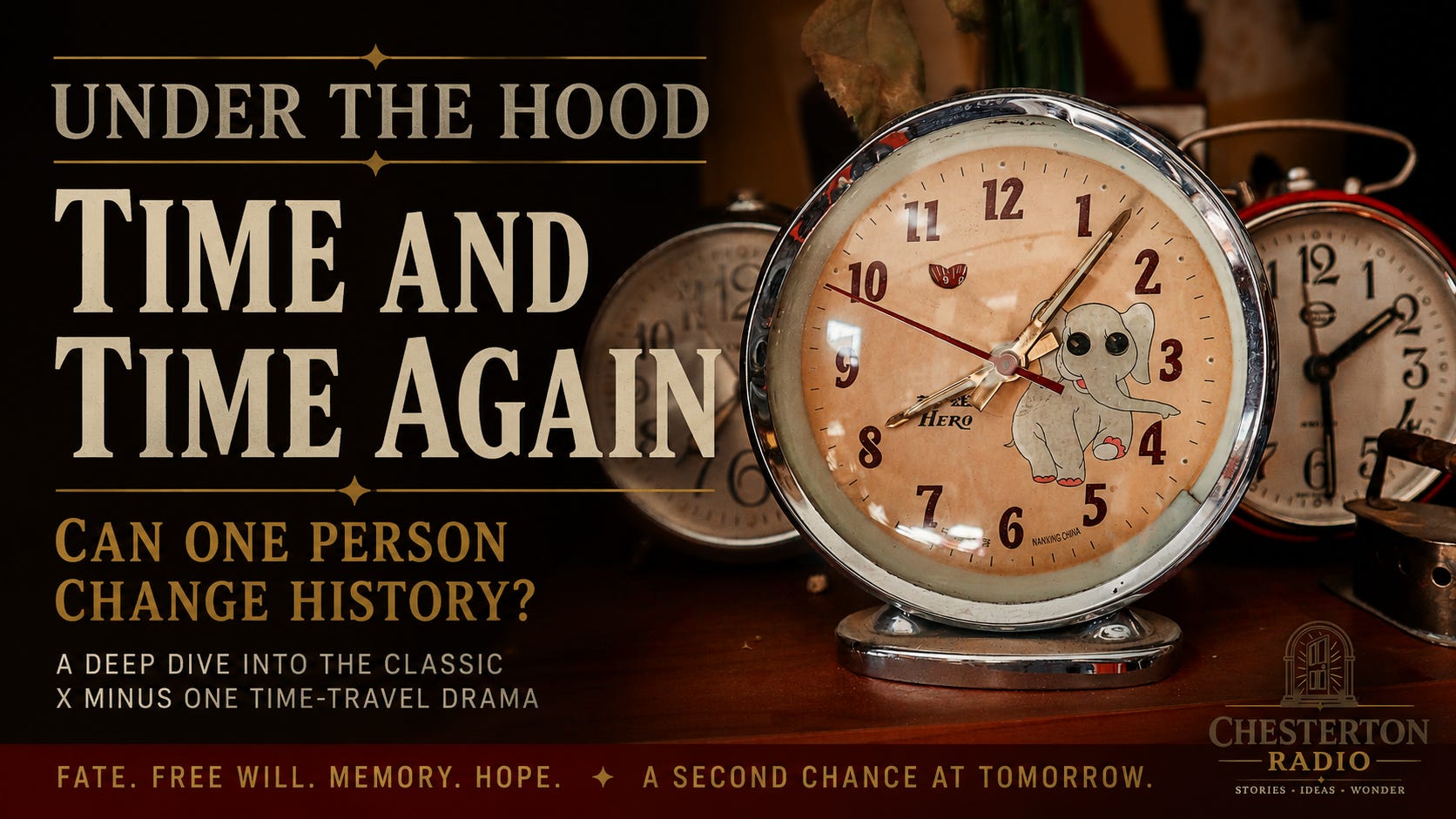
⚠️ SPOILER WARNING: This episode contains major spoilers for the X Minus One classic “Time and Time Again.” We strongly recommend listening to the original radio drama first, then returning for this discussion.
What if you were given a second chance—not tomorrow, but decades earlier? What if you could return to your childhood carrying every memory of a future filled with war, loss, and regret? Could one ordinary person change history?
In this episode of Under the Hood, broadcasting from the Little Station on Commercial Street in Atchison, Kansas, we take a deep dive into H. Beam Piper’s remarkable science fiction tale, adapted for the legendary X Minus One series.
Together we’ll explore:
Why Time and Time Again remains one of the finest time-travel stories ever broadcast.
The Cold War anxieties that shaped its creation.
The moral burden of knowing the future.
Fate versus free will—and whether history can truly be changed.
Connections to H.G. Wells, Charles Dickens, Boethius, St. Augustine, and G.K. Chesterton.
The unforgettable performances, sound design, and craftsmanship that make this episode a masterpiece of old-time radio.
More than a story about time travel, this is a meditation on hope, responsibility, and the power of ordinary choices. As Chesterton often reminded us, civilization is preserved not by extraordinary people doing extraordinary things, but by ordinary people faithfully doing what is right.
So pull up a chair, pour yourself a cup of coffee, and join us as we go Under the Hood of one of radio’s greatest science fiction classics.
🎙️ Listen to the original X Minus One episode first, then come back and join the conversation.
If you enjoy thoughtful explorations of classic radio, literature, philosophy, history, and faith, please consider becoming a supporter of Chesterton Radio.
Step inside Chesterton Radio World:
📻 Live Stream:
https://live.chestertonradio.com
✍️ Substack:
❤️ Support the station and help preserve the golden age of storytelling.
Because the best stories don’t just entertain us—they help us understand ourselves, our past, and the future we’re building today.


