

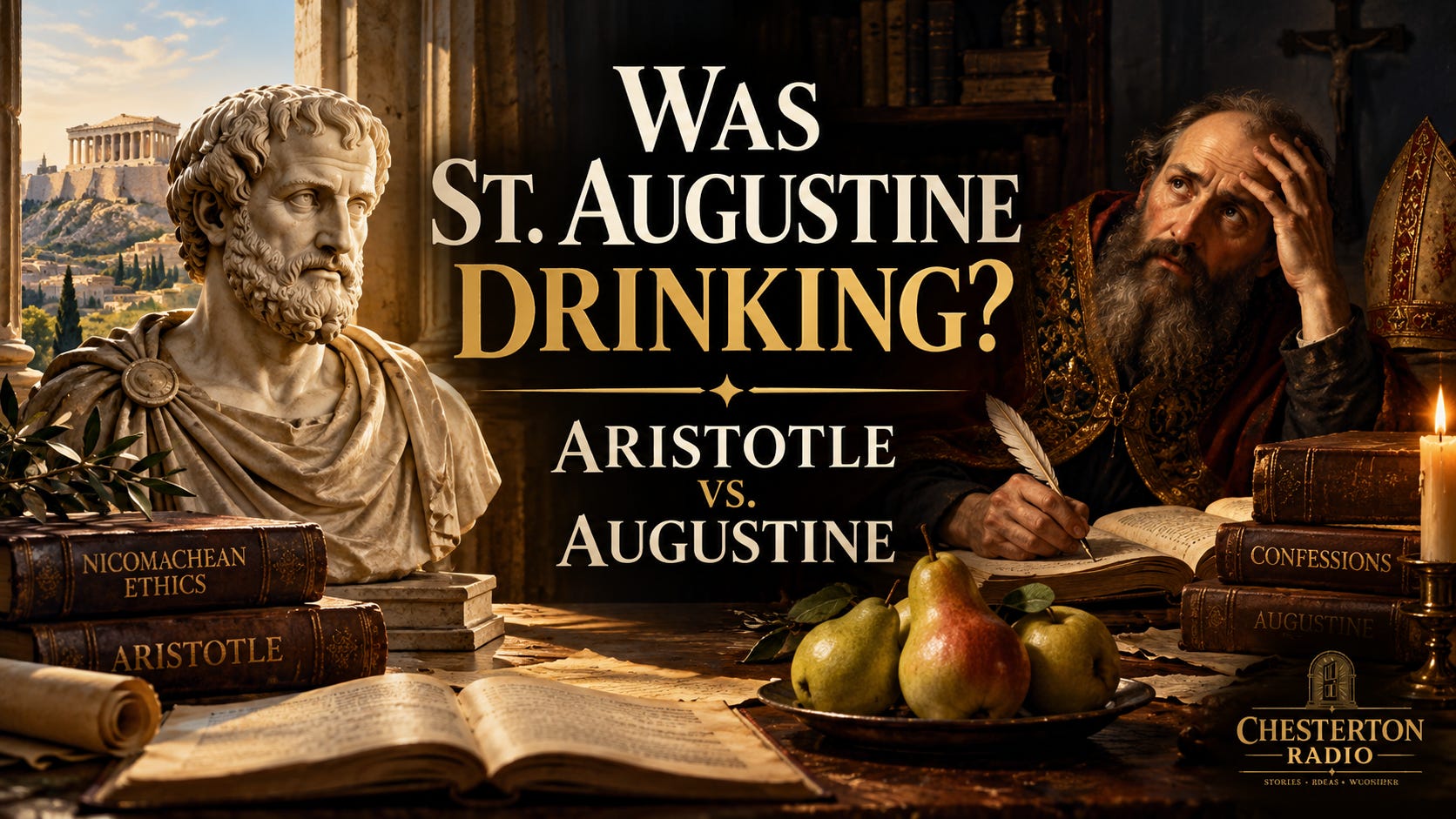
Aristotle tells us how to become good: practice virtue, form good habits, develop character, and learn to desire what is worthy.
Then St. Augustine arrives.
He steals pears he doesn’t even want. He agonizes over desire. He discovers that knowing the right thing doesn’t necessarily make us do it. He searches his own memory, argues with himself about his own will, and eventually asks a seemingly impossible question: Does the present moment even exist?
No wonder a modern college student might read the two and conclude: Aristotle makes sense. Augustine must have been drinking.
But what if the strangest parts of Augustine are actually the most perceptive?
In this Chesterton Radio Deep Dive, we put Aristotle’s Nicomachean Ethics beside Augustine’s Confessions and explore two very different approaches to happiness, virtue, desire, free will, self-control, friendship, sin, grace—and the maddening difficulty of being human.
We also revisit St. Augustine’s remarkable life through the classic Ave Maria Hour radio dramatization and follow the intellectual road from ancient Greece through Augustine and eventually to Thomas Aquinas.
Aristotle asks: How does a human being become good?
Augustine asks: Why can’t I make myself do the good I already know I should do?
Maybe Aristotle explains how we train human beings.
And Augustine explains what it feels like to actually be one.


