

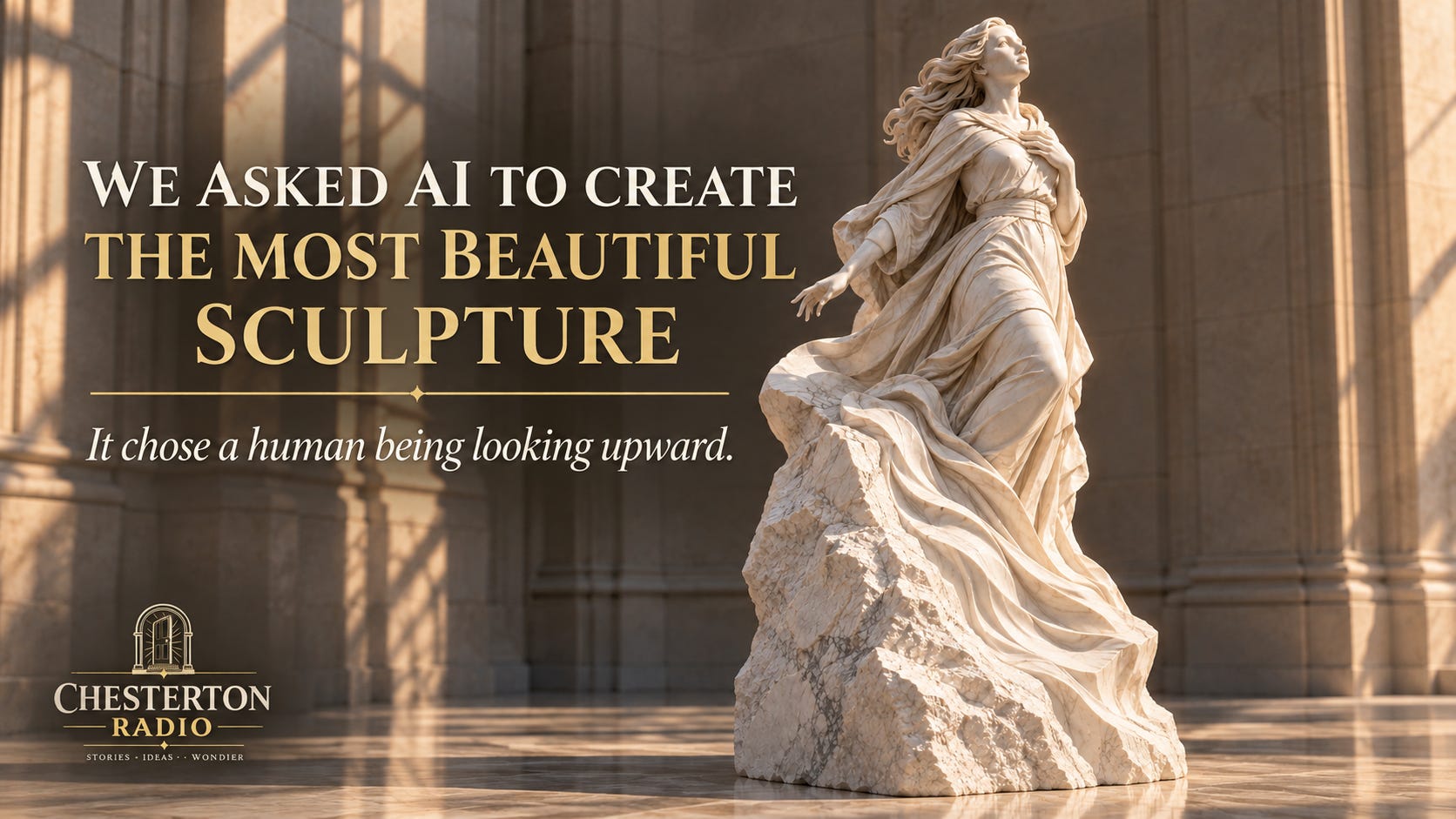
Can artificial intelligence create something beautiful?
Not merely something attractive. Not something that resembles art. And not another impossible AI-generated image in which marble floats, folds through itself, or quietly ignores the laws of physics.
Something that could actually exist.
Something that could be carved from marble, placed in a museum, and encountered as a physical object.
That question grew out of our recent exploration of ROBOTOR, the robotic stone-carving technology that uses digital geometry and robotic subtractive machining to turn blocks of stone into extraordinarily complex forms.
But ROBOTOR raises an important distinction.
A machine can manufacture a sculpture without necessarily conceiving the sculpture.
The artistic idea can still begin with a human being. An artist creates the form. Digital geometry describes it. The robotic system removes the material required to realize it.
Technologically, that is remarkable.
But someone upstream has already answered the most important artistic question:
What should exist?
So we decided to move artificial intelligence upstream too.
Instead of asking whether a robot could carve a beautiful sculpture, we asked whether AI could conceive one.
And then we asked the deliberately unreasonable question:
What is the most beautiful sculpture an artificial intelligence can conceive?
Beauty Is Not Enough
There was an engineering problem almost immediately.
Artificial intelligence can easily generate an image that looks like an extraordinary marble sculpture.
But looking like a sculpture and being a sculpture are very different things.
An image generator does not necessarily care whether a milling spindle can reach a surface. It can invent undercuts that cannot be machined, stone so thin that it would fracture, inaccessible cavities, unsupported marble floating in space, or geometry that looks magnificent from the camera’s viewpoint and makes no sense whatsoever from behind.
That distinction mattered because this experiment began with ROBOTOR.
We were not really asking:
Can AI make a beautiful picture of a sculpture?
We were asking something harder:
Can AI conceive a beautiful sculpture that could plausibly become a physical object?
So we gave imagination an unusual companion.
Engineering.
Beauty remained the objective, but physical reality became part of the assignment.
The sculpture would have to come from one continuous block of Carrara marble. It would need believable structural paths through the stone. Its major surfaces would need to be accessible to multi-axis cutting tools.
No impossible enclosed cavities. No inaccessible deep pockets. No absurd reverse undercuts. No marble membranes a few millimeters thick pretending gravity doesn’t exist. No delicate ribbons or strands of stone that would snap long before anyone wheeled the sculpture into a gallery.
And the design had to be something that could at least plausibly be developed into coherent three-dimensional geometry, then a CAD model, then machining toolpaths.
There is an important distinction here.
The image you are about to see is not a production-ready model.
Turning it into an actual sculpture would require substantial work: developing rigorous three-dimensional geometry, checking robotic reach and tool access, analyzing fragile sections, selecting and fixturing the marble, generating and verifying toolpaths, machining, and almost certainly some degree of human finishing.
The experiment is not proof that we can press a button and have ROBOTOR make this sculpture tomorrow.
It is an attempt to ask AI to imagine beauty while respecting the fact that beauty must eventually submit to matter.
Our rule was simple:
Manufacturability constrains the artwork; it does not define the artwork.
We weren’t trying to create the most difficult object a robot could carve.
We were still looking for beauty.
One More Constraint
We added one other requirement.
Because this sculpture was intended for Chesterton Radio, YouTube, Substack and social media, the human figure would be fully and gracefully clothed.
That turned out to be less of a restriction than we expected.
Beauty would have to come from the face and hands, gesture and posture, proportion and movement, marble and light.
And from drapery.
The drapery became particularly interesting because the artistic requirement and the engineering requirement began helping each other.
Broad folds of marble can create movement without requiring fragile ribbons of stone. A garment can subtly connect an arm or another projecting form back into the main marble mass. What looks like flowing fabric can also provide structural continuity.
The engineering constraint became part of the sculpture’s visual language.
And this was the answer.
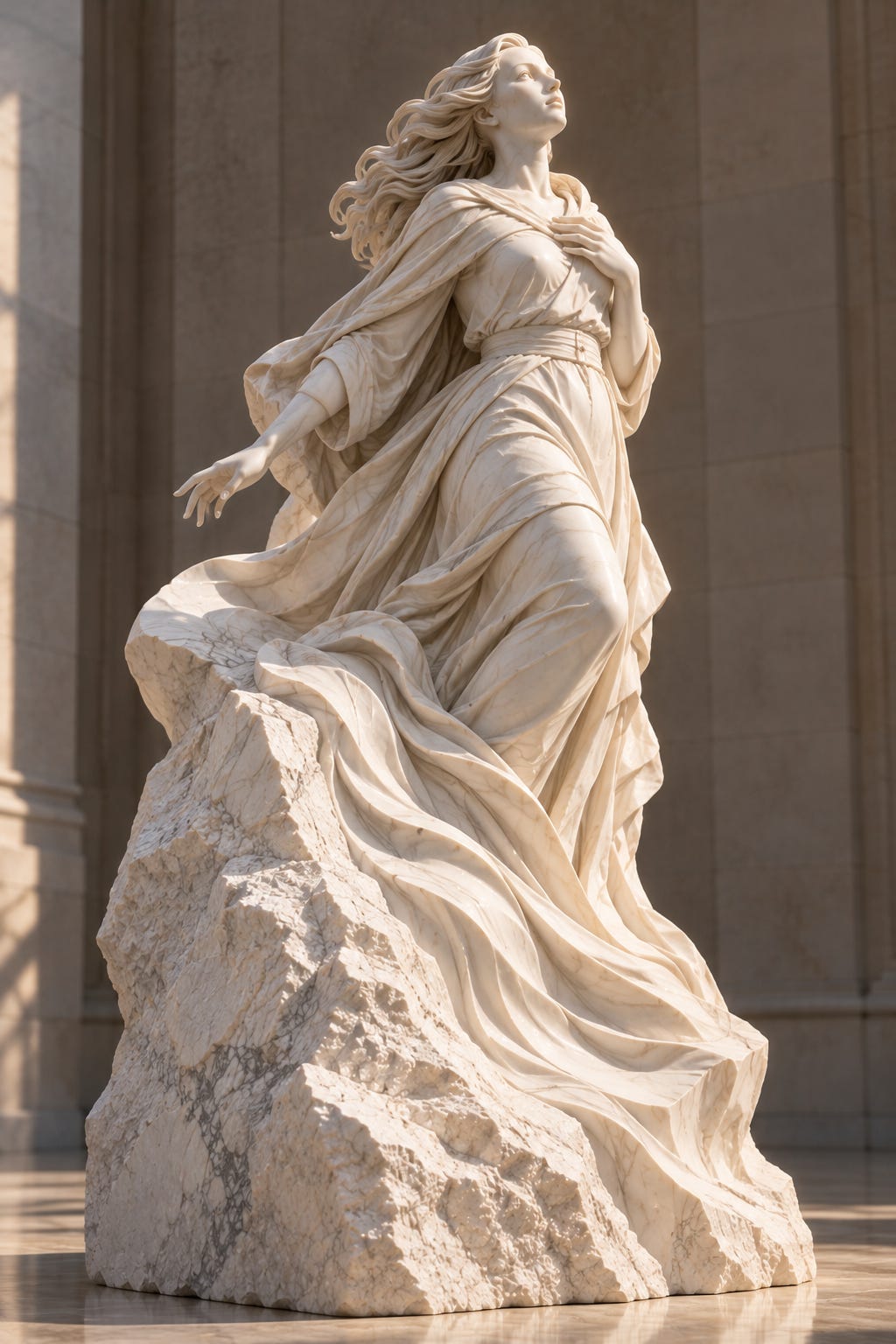
Look at it for a moment.
Forget artificial intelligence.
Forget ROBOTOR.
Forget prompts, algorithms, CAD models and cutting tools.
There is only one question that matters first.
Is it beautiful?
You don’t have to agree with us.
In fact, the experiment becomes more interesting if you make that judgment before knowing what you are supposed to think.
What Did the Machine Choose?
The more interesting question may not be whether the sculpture is beautiful.
It may be:
Why does it look like this?
The AI had considerable freedom.
It could have chosen geometry.
It could have chosen an animal or a tree.
It could have created some astonishing abstract mathematical form that no traditional sculptor would have imagined.
It could have made something alien.
It could have made something futuristic.
It could have filled the marble with holes, spirals and elaborate surfaces merely to demonstrate the capabilities of a multi-axis robotic system.
It could have given us something recognizably digital.
It did none of those things.
It chose a human being.
That is worth lingering over.
When we asked artificial intelligence to represent beauty, it returned to the human form.
But it did something more.
It didn’t simply give us a woman standing on a marble pedestal.
It gave us a human being apparently emerging from the stone itself.
At the bottom is mass.
The marble is heavy and rough.
As the eye travels upward, the material begins to resolve into deliberate form. Rough stone becomes flowing geometry. Geometry becomes drapery. Drapery reveals the human figure. The surfaces become increasingly refined until we arrive at the face and hands.
And then there is the gaze.
The entire sculpture can almost be read as a sequence:
stone → form → garment → person → face → gaze
There is another movement as well.
Gravity pulls downward.
The sculpture moves upward.
And at the top of that movement is a face.
She Is Looking Upward
This may be the strangest decision the AI made.
The woman is not looking at us.
She is not looking at herself.
She is not looking toward another person.
She is looking upward.
Toward what?
There is nothing there.
No object explains the gaze. No narrative tells us what she has seen.
Yet we instinctively begin supplying words.
Hope.
Wonder.
Longing.
Gratitude.
Aspiration.
Perhaps even transcendence.
Why?
The Old Idea Inside the New Machine
There is nothing historically unprecedented about a figure emerging from marble.
Sculptors have explored the relationship between raw stone and completed form for centuries. Michelangelo inevitably comes to mind, particularly his unfinished figures, where the tension between untouched marble and human form can make it seem as though the person is struggling to emerge from the block.
Our AI did not invent that tradition.
That matters.
Artificial intelligence has inherited an enormous visual culture created by human beings.
Classical proportion. Renaissance humanism. Baroque movement. Carrara marble. Flowing drapery. Idealized human figures. Light and shadow. The contrast between finished and unfinished stone.
And, perhaps most significantly here, the long association between looking upward and looking beyond oneself.
AI did not arrive at beauty in a cultural vacuum.
Which makes the question harder rather than easier.
Did AI Create Beauty—or Recognize Its Pattern?
We tend to collapse several very different ideas into one.
There is recognizing beauty.
There is generating beauty.
There is understanding beauty.
And there is loving beauty.
They may not be the same thing.
Artificial intelligence can discover relationships among proportion, symmetry and asymmetry, faces, gestures, materials, movement, light and the aesthetic judgments human beings have made about them.
It can become extraordinarily capable of recombining those relationships into something we have never seen before.
We shouldn’t dismiss that achievement simply because computation is involved.
If you looked at the sculpture and found it beautiful, that response is real.
But another question remains.
Does the machine know why it is beautiful?
Does it understand what an upward gaze means?
Does it know what longing feels like?
Does it know hope?
Can it experience wonder?
Those questions can quickly lead into enormous debates about machine consciousness. We don’t need to settle them here.
We only need to look again at the sculpture.
Something Important Is Missing
There is no halo.
No cross.
No angel.
No church.
No inscription.
No supernatural object.
No glowing orb hovering conveniently above the woman’s head to tell us that something spiritual is happening.
We deliberately denied the AI those shortcuts.
And yet the sculpture can feel almost religious.
Why?
The block below is matter.
The figure emerging from it becomes increasingly ordered.
The human person is the most refined part of the stone.
The composition rises.
The face turns upward.
Light reaches it.
And the figure seems to desire something outside herself.
Which raises perhaps the most interesting question in the experiment:
Who supplied that meaning?
Did the artificial intelligence put transcendence into the sculpture?
Or did it arrange visual forms that centuries of human beings have associated with transcendence?
And when we see those forms, do we provide the transcendence?
There may not be an easy way to separate the two.
A Chestertonian Question
Chesterton is useful here precisely because this isn’t really a question about technology.
It is a question about reduction.
We can explain mechanisms without necessarily exhausting meaning.
A machine may discover the proportions people tend to find beautiful. It may learn which arrangements of light and shadow create particular emotional responses. It may discover that an uplifted face suggests aspiration and that rough stone resolving into human form suggests emergence.
Eventually it might become better than most of us at reproducing those relationships.
But knowing the mechanism by which something produces wonder is not obviously the same thing as wondering.
And that takes us far beyond the machine that started this discussion.
ROBOTOR asks:
Can a machine carve?
Artificial intelligence asks:
Can a machine conceive?
The sculpture asks something harder:
Is conception enough to make an artist?
Where Is the Artist?
Imagine actually making this object.
The chain might look something like this:
human question → AI concept → 3D interpretation → CAD/STEP model → CAM/toolpaths → ROBOTOR → marble sculpture
Where, exactly, is the artist?
Is it the person who posed the question and established the constraints?
Is it the AI that proposed the form?
Is it the human who looked through possible results and decided, That one?
Is it the sculptor or CAD specialist who must translate a two-dimensional conception into coherent three-dimensional geometry?
What about the engineer who changes a beautiful curve because the marble won’t survive it?
The CAM programmer?
The person performing the final hand finishing?
The robot?
As an engineering question, part of this is familiar.
We don’t ordinarily give a CNC machining center authorship credit for an engineered component because its cutter physically removed the metal.
The machine executed a process.
ROBOTOR physically removing marble therefore doesn’t automatically make ROBOTOR the artist.
But something changes when artificial intelligence begins making decisions about the form itself.
The boundary becomes less comfortable.
But Human Artists Inherit Things Too
There is an obvious objection.
AI didn’t invent any of this.
It learned from us.
Its idea of beauty is assembled from human art.
That is substantially true.
But no human artist creates from nothing either.
Artists inherit language and technique. They inherit materials and tools. Teachers and traditions. Philosophy and religion. Memories and previous artworks.
They inherit the human body.
They inherit nature.
Michelangelo inherited a world.
Bernini inherited a world.
Every artist inherits a world.
So influence alone cannot answer the question.
The harder question is:
What transforms inheritance into creation?
Novelty?
Selection?
Intention?
Consciousness?
Experience?
Suffering?
Love?
The desire to communicate something to another person?
At that point we may finally have reached a question that no improvement in image resolution can answer.
The Gallery Test
Imagine that we continue the experiment.
The concept is developed into rigorous three-dimensional geometry. Sculptors and engineers subtly modify it wherever necessary while trying to preserve the original artistic idea.
A suitable block of Carrara marble is selected.
It enters a robotic carving cell.
Large tools begin removing stone.
The rough mass gradually disappears.
Smaller tools follow.
Drapery emerges.
Then hands.
Then a face.
Human finishing completes whatever the robotic process leaves unfinished.
Eventually the sculpture is transported to a gallery.
There is no explanatory plaque.
A woman enters the room.
She stops.
She looks.
Perhaps she finds the sculpture beautiful.
Perhaps something about the face moves her.
Perhaps she sees hope.
Perhaps she sees a human being emerging from matter and reaching toward something beyond it.
And only afterward does someone tell her:
No human artist originally conceived this sculpture. Artificial intelligence did.
Does the sculpture suddenly become less beautiful?
Was her first response false?
Does learning the origin change the object?
Does it change its meaning?
Does authorship matter to beauty?
Or does authorship matter to something different from beauty?
I don’t think our experiment answers those questions.
It makes them harder.
And perhaps that is more useful.
We gave artificial intelligence considerable freedom.
We asked it what the most beautiful sculpture it could conceive might look like.
We required only that its imagination submit to some of the realities of marble, machining, structural integrity and modesty.
It could have given us almost anything.
It did not give us a computer.
It did not give us a robot.
It did not give us an equation.
It did not give us an abstract monument to intelligence.
It gave us a human being.
Perhaps the strangest thing about our experiment was not that artificial intelligence could produce something beautiful.
It was what the intelligence chose when we asked it what beauty looked like.
It chose us.
A human face. A human figure. A person rising out of stone and looking toward something above herself.
The machine may not know what she is looking for.
But we do.