

Every so often, a listener says something that explains what you are trying to do better than you have managed to explain it yourself.
That happened this week.
A listener named ColReid had found one of our Deep Dives, a conversation about The Lady from Alfaqueque, the forgotten comedy by John Fletcher that eventually found its way to the BBC’s Saturday Night Theatre.
At first, things did not look promising.
“This was not what I expected and, in these days of America trumped, and when I heard two American voices, I very nearly switched off.”
We smiled at that.
But thankfully, ColReid didn’t switch off.
The comment continued:
“I often struggle when reading or listening to books. I have difficulty in remembering who is who amongst the characters. But now I have already enjoyed this book thanks to this fascinating and absorbing method of book explanation.”
And suddenly, there it was.
A remarkably good explanation of something we have been trying to build at Chesterton Radio.
There Is a Difference Between Preserving Something and Opening It
For years, Chesterton Radio has been a place where people could discover wonderful things from radio’s past.
That isn’t changing.
There are thousands of hours of extraordinary drama, comedy, mystery and storytelling sitting in the great radio archives of the twentieth century. Some are famous. Many aren’t.
But simply making an old program available isn’t always enough.
Sometimes there are fifteen characters whose names you can’t keep straight.
Sometimes the historical setting assumes things an audience in 2026 no longer knows.
Sometimes the opening ten minutes seem impossibly slow.
Sometimes the title sounds uninteresting.
Sometimes it’s a 400-year-old play by someone named John Fletcher.
And sometimes you simply need somebody to say:
Wait. Before you leave, let me tell you why this is interesting.
That’s what we’re discovering the Deep Dives can do.
The Common Room
Perhaps that’s also why The Common Room has begun to feel like the right name for an important part of the new Chesterton Radio.
Imagine that we’ve just listened to something together.
The program ends.
But instead of everybody putting on their coats and going home, a few of us remain behind.
Someone pours another cup of coffee.
And somebody asks:
“So…what did you think?”
That’s where things get interesting.
Who wrote this?
Why did the BBC choose it?
Who were these actors?
Why does this character behave that way?
What was happening in Britain when this was broadcast?
Why did that scene work so beautifully?
And perhaps most importantly:
Why should anybody still care about this story today?
That conversation doesn’t diminish the original work.
It sends us back to it with better ears.
A Door, Not a Substitute
When we replied to ColReid, we wrote:
“This is exactly what we hope these conversations can do—not replace the book, but open a door into it.”
I’ve been thinking about that sentence ever since.
Because perhaps that’s a pretty good description of what Chesterton Radio is becoming.
We aren’t interested in replacing books with summaries.
We aren’t interested in replacing great radio plays with commentary about radio plays.
And we certainly aren’t interested in replacing the extraordinary writers, actors, producers and broadcasters whose work fills the Chesterton Radio library.
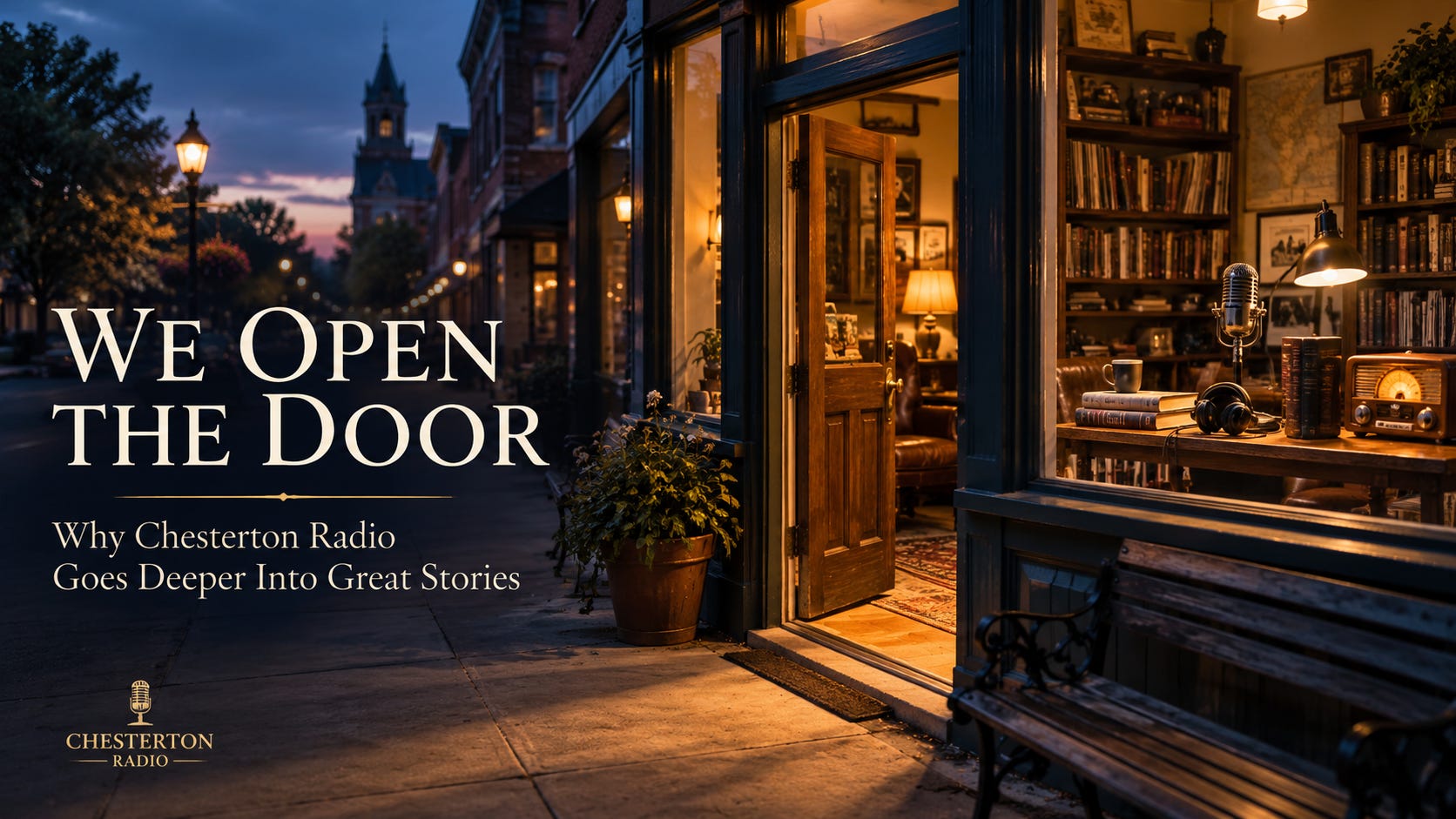
We want to open doors.
A door into a forgotten BBC play.
A door into Dickens.
A door into Father Brown.
A door into Sherlock Holmes.
A door into a piece of history you never knew was interesting.
A door into an old radio program you might otherwise have switched off after five minutes.
And increasingly, a door into new stories being created here as well.
The Little Station Is Changing
If you’ve been with Chesterton Radio for a long time, you’ve probably noticed something happening.
The classic programs are still here.
They always will be part of this place.
But around them, something else is growing.
DAYBREAK in the morning.
The Common Room in the afternoon.
Deep Dives into remarkable broadcasts, books, people and moments in history.
New mysteries and serialized stories.
New conversations.
New voices.
And the occasional expedition down a rabbit hole none of us expected to enter.
Perhaps Chesterton Radio isn’t simply an archive anymore.
It’s becoming a place.
A slightly eccentric little radio station where old stories and new ones live beside each other—and where, after the program ends, somebody leaves the light on in the Common Room.
Come On In
There was one final sentence in ColReid’s comment:
“Thank You. ❤️”
No.
Thank you.
Because comments like this help us understand what we’re building.
There are extraordinary stories sitting behind closed doors everywhere.
Some are 400 years old.
Some have been sitting on forgotten BBC tapes for sixty years.
Some haven’t been written yet.
Our job isn’t to replace what’s behind those doors.
It’s simply to find the key, turn on the light, and say:
Come on in. I think you’re going to like this.
— Chesterton Radio
The Little Station on Commercial Street