

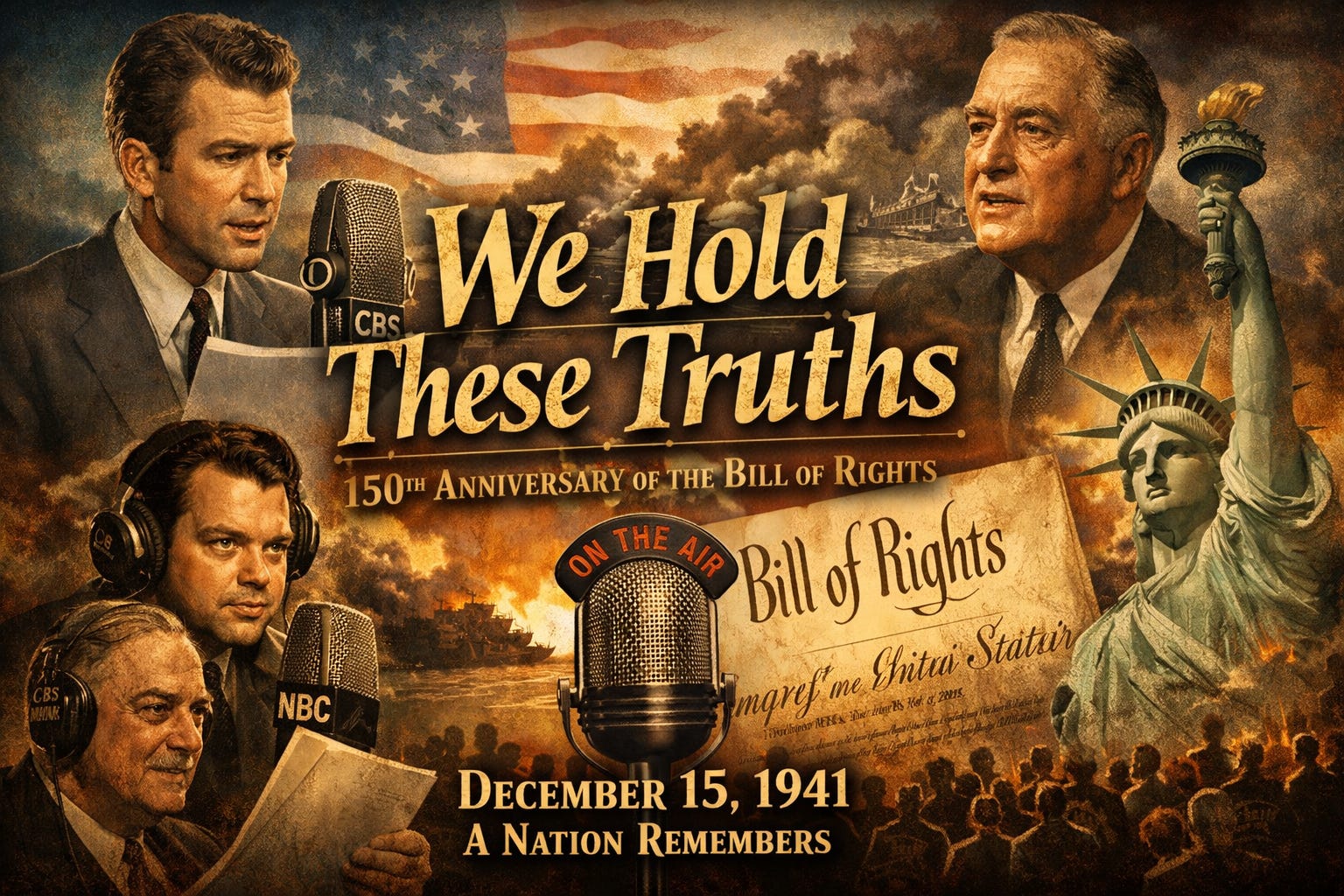
On December 15, 1791, the American Republic fastened its doors not against its enemies, but against itself. It wrote into law ten glorious limitations—chains upon power, rather than chains upon men. One hundred and fifty years later, in the darkest week of 1941, those chains were tested.
Eight days after the Attack on Pearl Harbor, when fear might have excused silence and war might have postponed ceremony, a voice went out across the nation: Proceed.
The result was one of the most extraordinary broadcasts in the history of radio: We Hold These Truths, written and produced by Norman Corwin and aired live on December 15, 1941. It was the first dramatic program to be carried simultaneously on all four major networks—CBS, NBC Red, NBC Blue, and Mutual—and an estimated 63 million Americans listened. Nearly half the nation gathered around their radios, not for diversion, but for definition.
Because what Corwin offered was not entertainment. It was a reminder.
A Bill Written Against Kings
The broadcast commemorated the 150th anniversary of the ratification of the United States Bill of Rights—those first ten amendments that form the moral skeleton of the Republic.
Corwin did not present them as museum pieces. He presented them as living promises.
Through dramatized episodes, poetry, music, and oratory, the program walked listeners through the freedoms Americans often assume without noticing: speech without permission, worship without coercion, trial by jury, protection from arbitrary arrest. These were not abstract doctrines but human realities. In Corwin’s hands, the Bill of Rights was not a parchment in Washington; it was a conversation in a kitchen, a protest in a square, a conscience refusing to kneel.
The cast was a remarkable assembly of voices—Jimmy Stewart, Orson Welles, Lionel Barrymore—each lending his craft not to celebrity, but to citizenship. The program culminated in a brief address from President Franklin D. Roosevelt himself, reminding Americans that liberty is not an inheritance automatically renewed, but a trust consciously defended.
And that reminder came precisely when liberty was under global assault.
Why It Mattered More After Pearl Harbor
The program had been commissioned under the auspices of the U.S. Office of Education long before December 7. But when Japanese planes struck Pearl Harbor, Corwin understandably asked whether the broadcast should be canceled.
The reply wired back to him was simple and thunderous:
“The President thinks it’s more important now than ever to proceed with the program.”
That single decision transformed a commemorative program into a national act of moral defiance.
In wartime, governments often ask citizens to surrender freedoms temporarily. Corwin’s broadcast asked them to remember why those freedoms exist at all. The Bill of Rights was not something to be suspended in crisis; it was the reason the crisis mattered.
The enemies abroad were totalitarian states that denied speech, conscience, and due process. The response of the United States was not merely military mobilization—but a public recitation of its own limitations. In effect, America declared: We fight because we refuse to become what we oppose.
Radio as Civic Art
For Chesterton Radio listeners, this broadcast is a reminder of what the Golden Age of Radio could be at its best.
Radio was not merely a vehicle for mystery dramas and comedies (though we cherish those). It could also be a pulpit of the air, a theatre of ideas, a national town square. Corwin understood that sound alone could create a republic of listeners—millions united not by spectacle, but by shared reflection.
The program is lyrical without being sentimental. Patriotic without being strident. Earnest without being naïve. It recognizes that rights are not self-executing; they require vigilance. It insists that liberty is not preserved by shouting slogans, but by respecting limits—even when those limits restrain ourselves.
It is, in its way, profoundly Chestertonian.
For G.K. Chesterton often reminded his readers that the real romance of democracy is not in shouting against tyrants, but in trusting ordinary men with dignity. The Bill of Rights assumes that the common citizen can think, speak, assemble, and worship without supervision. That is a daring belief. It is almost theological.
Listening in 1941—and Listening Now
Imagine the scene: families gathered around living-room radios in December 1941. Sons were enlisting. Newspapers were filled with casualty reports. The world seemed to tilt toward chaos.
And into that anxiety came voices declaring that America’s strength lay not in vengeance, but in restraint; not in conquest, but in conscience.
Today, the program speaks again—but into a different kind of noise. We live in an age of constant commentary and very little contemplation. Rights are invoked frequently, but seldom studied. The First Amendment is cited, but rarely read.
To hear We Hold These Truths is to be slowed down. To be reminded. To ask whether we cherish liberty merely as a convenience—or as a conviction.
Listen on Chesterton Radio
We are honored to share this historic broadcast on Chesterton Radio:
Listen here:
http://billofrights.chestertonRadio.com
As always, Chesterton Radio is listener-supported. We revive these works not because they are profitable, but because they are permanent. Because they remind us that drama can dignify, and that entertainment can ennoble.
In 1941, nearly half the nation paused to hear a meditation on the limits of government and the liberties of man.
It would not be the worst thing if we paused again.
Chesterton Radio
Stories that stir the mind.
Drama that feeds the soul.
Liberty remembered aloud.