

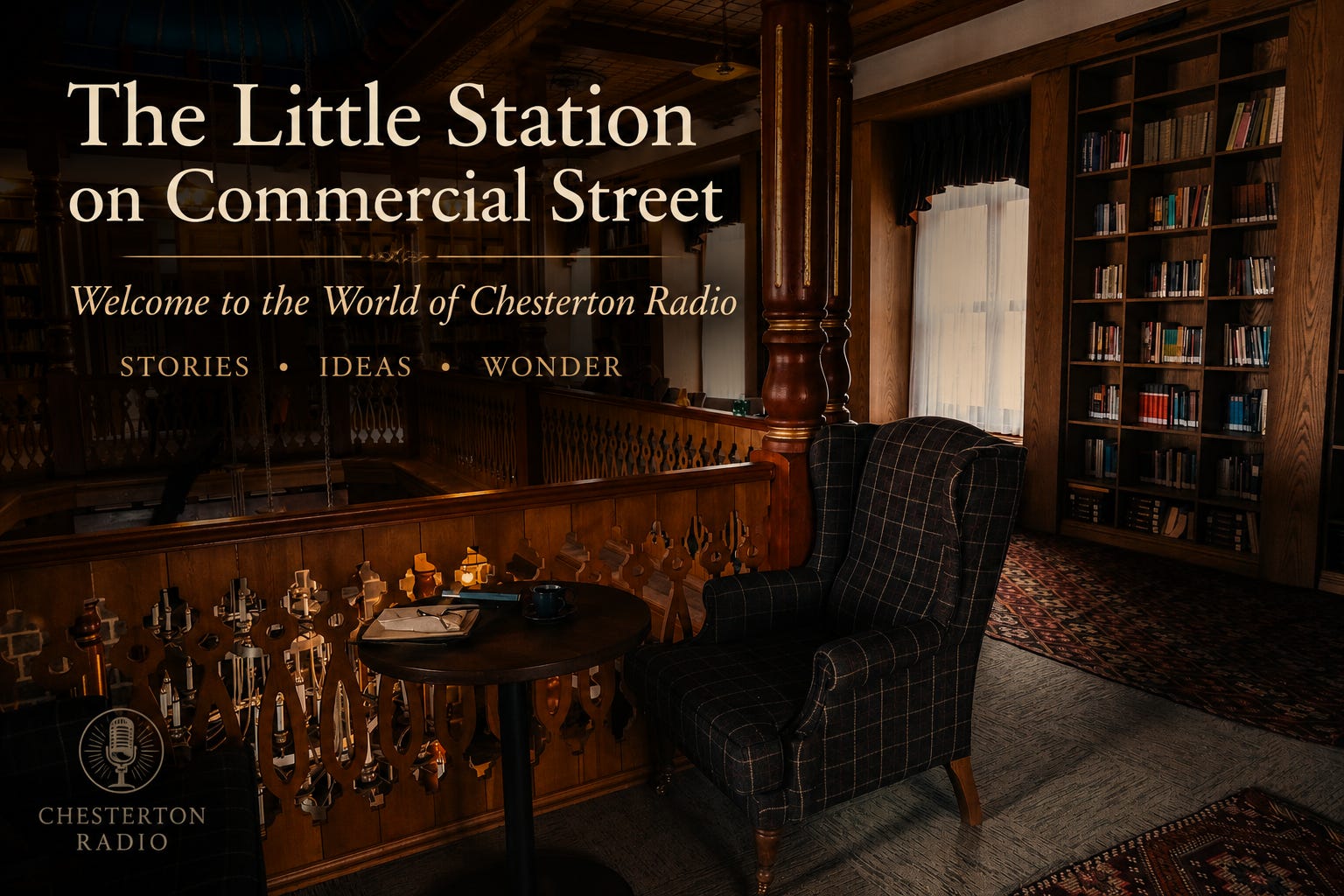
There is a small brick building on Commercial Street in Atchison, Kansas.
You might walk past it if you were in a hurry.
The storefront is modest. The sign is not especially large. No flashing lights compete for your attention. There are no loudspeakers urging you inside.
But if you happen to pause on the sidewalk—perhaps because evening has settled gently over the town—you may notice something.
A warm lamp burns in the front window.
Not brightly.
Just brightly enough to suggest that someone is still awake.
The light falls across a stack of books resting on a wooden table near the entrance. Beside them sits an old cathedral radio whose polished walnut cabinet has long since lost its showroom shine. It bears the quiet marks of years spent in living rooms where families once gathered after supper, waiting for music, news, mystery, comedy, or simply the familiar comfort of a trusted voice.
The front door stands slightly open.
Not because someone forgot to close it.
Because it was meant to be open.
If you step inside, the first thing you notice is not what you see.
It is what you hear.
Somewhere farther down the hallway, music is playing.
Not loudly enough to interrupt your thoughts.
Only loudly enough to remind you that someone, somewhere in the building, thought this particular piece deserved another hearing.
It may be a string quartet.
It may be a big band.
It may be a hymn that has outlived every fashion intended to replace it.
Whatever it is, it belongs here.
The hallway smells faintly of coffee.
Fresh coffee.
Not the hurried coffee poured into paper cups between meetings, but the sort brewed because conversation has a habit of lasting longer than expected.
The wooden floor has acquired the gentle creak that old floors earn honestly. Every step seems less like a complaint than a greeting, as though the building wishes to acknowledge each visitor in its own quiet way.
On one wall hangs a row of photographs.
Broadcasters leaning over ribbon microphones.
Writers surrounded by books.
Families gathered around living-room radios.
A black-and-white picture of Main Street after fresh snow.
Children listening with astonishing seriousness to stories they would later remember for the rest of their lives.
None of the photographs are labeled.
They do not need to be.
They are reminders that before broadcasting became an industry, it was often a neighbor speaking to neighbors.
At the end of the hallway, a soft amber light glows above a studio door.
ON AIR.
The words are simple enough, but they carry an unusual promise.
Someone is speaking.
Someone is listening.
Somewhere beyond these walls, perhaps hundreds or perhaps thousands of miles away, another person has invited this room into his kitchen, her workshop, a quiet office, the cab of a truck crossing the plains, or a comfortable chair beside a lamp before bedtime.
Radio has always possessed that curious gift.
It makes strangers feel less like strangers.
Open the studio door, and the room reveals itself gradually.
Books first.
Always the books.
They occupy nearly every wall, climbing from floor to ceiling in shelves that appear to have surrendered long ago to their inevitable purpose. History leans comfortably beside poetry. Mysteries share shelf space with theology. Dickens nods politely toward Austen. A weathered collection of Shakespeare keeps company with detective stories, biographies, old engineering manuals, travel journals, and volumes whose faded bindings suggest that many thoughtful hands have turned their pages over many decades.
No one here seems particularly concerned about arranging books by color.
They are arranged instead by affection.
Near the window stands a broad wooden desk.
On it rests an open notebook filled with penciled observations, quotations copied from favorite authors, tomorrow’s ideas waiting patiently beside today’s unfinished thoughts.
A fountain pen lies uncapped.
Someone intends to return.
Beside the notebook sits a coffee mug whose contents have long since cooled, forgotten during the pursuit of a particularly satisfying sentence.
In another corner of the room, vintage microphones stand beside modern recording equipment.
Vacuum tubes glow softly inside restored radios while quiet computer screens prepare tomorrow’s broadcast.
There is no conflict here between old and new.
The newest tools are employed in the service of very old conversations.
Technology is welcome.
Fashion is optional.
The purpose has not changed.
Outside the studio windows, evening settles over Atchison.
The lights along Commercial Street begin to appear one by one.
Somewhere, a train whistle carries faintly across the river valley.
Inside, another page is turned.
Another recording begins.
Another story finds its voice.
If you stayed long enough, you would discover that the station keeps unusual company.
One afternoon, you might overhear a discussion of a forgotten novel that somehow speaks directly to the present moment.
Later that evening, an old-time radio mystery drifts through the speakers as naturally as though it had first aired yesterday.
Tomorrow morning begins with prayer.
Tomorrow afternoon with history.
Tomorrow evening perhaps with a conversation about a play, a poem, a hymn, or an idea that deserves another hearing.
Nothing here is chosen merely because it is new.
Nothing is preserved merely because it is old.
The measure is simpler than that.
Does it still have something true to say?
That question has a way of rearranging an entire library.
Visitors occasionally ask whether Chesterton Radio is really a radio station.
The answer depends upon what one means by “really.”
If a radio station is only a transmitter, a tower, a license, and a schedule, then perhaps we are using the word rather freely.
But if a radio station is a place where voices are welcomed, stories are shared, friendships are formed, ideas are explored, prayers are offered, laughter is heard, and ordinary evenings become quietly memorable, then we believe the description fits rather well.
Every place has a heartbeat.
Some are measured in traffic.
Some in commerce.
Some in noise.
This little station measures time differently.
In chapters read.
In conversations continued.
In mysteries solved.
In hymns remembered.
In cups of coffee refilled.
In listeners who arrive intending to stay for ten minutes and discover, almost by accident, that an hour has quietly passed.
Perhaps that is why the front door remains open.
Not because everyone enters.
But because everyone is welcome.
There will be time, in the pages that follow, to explain why this little station bears the name of a great English writer, why we continue to believe radio has an important future, why stories still matter, why old books continue to surprise us, and why thoughtful conversation remains one of the greatest forms of hospitality ever invented.
There will be time to walk through every room of this curious place.
To meet the programs.
To meet the people.
To understand the mission.
To look behind the microphone.
To imagine what may yet be built.
But before any of that, it is enough simply to stand for a moment in the doorway.
Listen to the music drifting down the hall.
Notice the warm lamp in the window.
Breathe in the aroma of fresh coffee.
Watch the ON AIR light glow above the studio door.
And realize that somewhere, on a quiet street in Atchison, there is a little station where the conversation is already underway.
We’ve been expecting you.
Part Two
Why Chesterton?
Every house is built upon something.
Some are built upon stone.
Some upon timber.
Some upon memory.
Chesterton Radio is built upon an idea.
Not an idea that can be reduced to a slogan or summarized in a sentence, but one that reveals itself slowly, much as an old friendship does. It is the conviction that the world is more astonishing than we usually notice, and that one of the greatest privileges of a human life is learning to notice it again.
That conviction found one of its happiest champions in G. K. Chesterton.
It is tempting to begin with dates, books, debates, and biographies. Historians rightly concern themselves with such things. Libraries are filled with them, and we are grateful they exist.
But a visitor who walks through the front door of our little station is not first interested in chronology.
The better question is this:
What kind of spirit would make someone build a radio station in his honor?
The answer begins with wonder.
Wonder is not the same thing as surprise.
Surprise happens when something unexpected interrupts the ordinary.
Wonder happens when we discover that the ordinary was extraordinary all along.
A sunrise has occurred every morning for as long as anyone can remember. It is therefore easy to forget that it remains one of the most astonishing events any of us will ever witness.
A child does not make that mistake.
Neither, remarkably, did Chesterton.
He possessed the rare ability to look upon familiar things with fresh eyes. A fence, a loaf of bread, a lamp burning in a window, the laughter of friends around a dinner table—these were not merely commonplace objects. They were invitations to gratitude.
Perhaps that is what modern life most often steals from us.
Not our possessions.
Not our opportunities.
Our capacity to be surprised by blessings we have received so many times that we no longer recognize them as gifts.
Radio, at its best, quietly restores that habit.
When someone shares a poem that deserves another hearing, a hymn that has comforted generations, or a forgotten story that still speaks with unexpected clarity, we are reminded that not everything valuable must be invented anew.
Sometimes it must simply be remembered.
That is one reason our shelves are filled with old books.
Not because we imagine the past to have been perfect.
It certainly was not.
Every age has produced both wisdom and folly, generosity and selfishness, courage and fear.
Yet every age also leaves behind companions worth meeting.
Authors who still have something true to say.
Playwrights who still understand the human heart.
Broadcasters whose voices still sound strangely familiar, though decades have passed since they first stepped before a microphone.
To ignore them simply because they are old would be rather like refusing advice from a wise grandfather because his shoes are unfashionable.
Chesterton would probably have smiled at such a notion.
He delighted in paradox—not because contradiction amused him, but because truth often arrives wearing unexpected clothing.
Strength may appear as gentleness.
Humility may prove wiser than ambition.
A child may ask better questions than an expert.
The smallest act of kindness may outweigh the grandest speech.
The shortest prayer may reach farther than the longest argument.
The world is filled with such paradoxes.
Modern culture often encourages us to choose between reason and imagination, between faith and curiosity, between tradition and creativity.
Chesterton insisted we need not make such impoverishing choices.
Reason is strengthened by imagination.
Faith welcomes honest questions.
Tradition provides fertile soil from which fresh creativity can grow.
At Chesterton Radio, we have found this to be true again and again.
A discussion of a century-old novel sheds unexpected light on today’s headlines.
An old detective story reveals enduring truths about justice and mercy.
A hymn written generations ago comforts someone listening alone in the early hours of the morning.
A prayer spoken quietly in Atchison reaches ears in places we may never visit.
The conversation continues because truth has never required novelty in order to remain alive.
Nor does joy.
Joy is another of those words easily mistaken for something smaller than it is.
Happiness often depends upon circumstances.
Joy possesses deeper roots.
It can laugh in difficult times.
It can sing before dawn.
It can pour another cup of coffee for a weary traveler.
It can find beauty where others notice only inconvenience.
This station hopes to be a place where such joy is cultivated—not through forced optimism, but through gratitude.
Gratitude changes the scale by which we measure a day.
Instead of asking whether today was exciting, it asks whether today was meaningful.
Instead of asking whether we consumed enough, it asks whether we appreciated enough.
That is a quieter question.
It is also a better one.
We believe conversation flourishes in such an atmosphere.
Not every discussion must become a debate.
Not every disagreement requires a victory.
Sometimes the finest conversations end not with complete agreement but with mutual respect and a shared desire to keep thinking together.
The old radio studios we admire understood this.
So did many neighborhood libraries.
So did front porches, parish halls, bookstores, and kitchen tables.
They were places where ideas could be explored without hurry.
Where stories unfolded at their proper pace.
Where silence itself occasionally became part of the conversation.
Perhaps that is why our studio keeps a lamp burning in the window.
It is not merely decorative.
It reminds us that hospitality begins long before anyone crosses the threshold.
Someone is expected.
Someone is welcome.
Someone may be searching for a place where questions are not feared, where books are still opened with anticipation, where stories are told with care, and where faith and imagination are permitted to sit together without embarrassment.
If so, we hope they find their way here.
The name above the door points toward one remarkable English writer.
The spirit within the building belongs to something much older.
It belongs to every teacher who ever awakened curiosity.
Every parent who read aloud one more chapter before bedtime.
Every librarian who placed exactly the right book into waiting hands.
Every broadcaster who believed listeners deserved their very best.
Every storyteller who understood that truth often travels farther when carried by beauty.
Those are the people whose company we hope to keep.
They remind us that civilization is not preserved only by great institutions or famous names.
It is preserved, quietly and faithfully, whenever ordinary people gather to tell good stories, ask worthwhile questions, offer sincere prayers, and leave one another a little more hopeful than when they arrived.
That is the tradition we inherited.
It is also the tradition we hope, in our own modest way, to continue.
And if the little station on Commercial Street bears the name of Chesterton, it is because every broadcast aspires to echo one simple conviction:
The world is still filled with wonder.
The next task is not to manufacture it.
The next task is simply to notice it.
Part Three
Why Radio Still Matters
There is a curious thing about radio.
You cannot hold it in your hand.
Not really.
You can hold the receiver, of course. You can admire the polished walnut cabinet of a cathedral radio or the brushed aluminum face of a well-loved tabletop set. You can turn the dial and watch the pointer glide slowly across familiar frequencies.
But the thing itself—the conversation, the music, the story—is always just beyond your grasp.
It exists only for a moment.
Then it becomes memory.
Perhaps that is why radio has always felt less like a machine than a companion.
Long before podcasts could be downloaded with a touch or entire libraries of music carried in a pocket, people welcomed voices into their homes.
Morning began with a weather report.
Afternoon brought music while supper was prepared.
Evening belonged to comedians, detectives, orchestras, and adventures that unfolded one scene at a time.
Families did not gather around a screen.
They gathered around an idea.
Someone had a story to tell.
Someone else was willing to listen.
That simple exchange has never gone out of fashion.
Only the machinery has changed.
The remarkable thing about radio is not that it speaks.
Books speak as well.
Films speak.
The theatre has always spoken.
What makes radio different is that it leaves room.
It asks something of the listener.
A novel invites the imagination through words.
A motion picture supplies nearly every image.
Radio stands somewhere beautifully between the two.
It offers voices.
Music.
Silence.
A closing door.
Footsteps in the snow.
The distant whistle of a train.
Then it quietly asks your imagination to complete the world.
No two listeners ever hear exactly the same broadcast.
When a storyteller describes an old English inn, each listener furnishes different wooden beams, different windows, different gardens.
When an announcer speaks of rain falling across the Kansas prairie, every listener remembers a different storm.
The story belongs partly to the broadcaster.
But it also belongs to the one listening.
That partnership is one of radio’s greatest gifts.
It trusts the imagination.
Perhaps that is why radio so often accompanies ordinary work.
People listen while driving across long highways.
While repairing a fence.
Preparing supper.
Walking through the neighborhood after sunset.
Folding laundry.
Working in a workshop.
Watching snow fall outside the kitchen window.
Radio understands that life is not interrupted by stories.
Life is accompanied by them.
Some of our happiest memories have arrived with a voice quietly present in the background.
There is something wonderfully humble about that.
Radio rarely demands your complete attention.
Instead, it becomes a companion to whatever honest work your hands have found to do.
That companionship has shaped generations.
Many people still remember the voices they grew up with.
Not because those voices shouted the loudest.
Quite the opposite.
They spoke with familiarity.
They arrived every evening at nearly the same hour.
They became welcome guests who never overstayed their visit.
One of the tragedies of modern media is not that we have too many choices.
It is that we often have too little companionship.
We consume information constantly.
Yet genuine conversation has become strangely scarce.
Everything competes for attention.
Very little invites contemplation.
Radio has always preferred contemplation.
Even its silences matter.
A thoughtful pause before the next sentence.
The faint crackle of an old recording.
Music allowed to finish before another voice begins.
These moments remind us that conversation need not fear quiet.
Indeed, quiet often gives conversation its meaning.
At Chesterton Radio, we hope never to lose that lesson.
Some broadcasts begin with prayer.
Others begin with laughter.
Some open a forgotten novel.
Others revisit a classic radio drama whose actors have long since taken their final bows.
Still others introduce original stories written not because the old stories have failed us, but because good stories have a habit of inspiring new ones.
All belong to the same conversation.
Our microphones are newer than those used by broadcasters of the 1940s.
Our editing software would seem miraculous to producers who once cut magnetic tape with razor blades.
Episodes travel across fiber-optic cables instead of shortwave frequencies.
Listeners may discover them through a phone resting in a shirt pocket rather than a glowing Philco beside the fireplace.
None of those changes alter the essential mystery.
One person speaks.
Another listens.
A friendship quietly begins.
Technology has always changed.
Human beings have not.
We still long for voices we trust.
We still remember stories that helped us through difficult seasons.
We still find unexpected comfort in hearing someone say, “Good evening,” with sincerity.
We still enjoy sitting quietly while another person tells us something worth hearing.
Perhaps that explains why podcasts have flourished in an age that supposedly abandoned radio.
People did not stop wanting thoughtful voices.
They simply found new ways to hear them.
The best podcasts are not descendants of social media.
They are descendants of radio.
They inherit its patience.
Its intimacy.
Its ability to accompany rather than interrupt.
Its confidence that an hour spent listening together is never wasted.
Chesterton Radio gladly belongs to that family tree.
We admire the great broadcasters of the past not because they lived in a golden age that can never return, but because they understood something permanently true.
A microphone can become a bridge.
Across miles.
Across generations.
Even across time itself.
When we listen to an old broadcast, we do more than preserve history.
We discover that certain voices never entirely disappear.
The concerns they discussed remain familiar.
The laughter still sounds genuine.
The music still lifts the heart.
The questions remain worth asking.
History ceases to be a museum.
It becomes a conversation.
That is one reason we continue to celebrate old-time radio.
Not from nostalgia.
Nostalgia imagines the past was better simply because it is gone.
We are after something quite different.
We believe the past still has companions worth introducing to the present.
A detective from 1948.
A playwright from centuries ago.
A hymn written before electricity.
A philosopher whose questions remain unfinished.
A mystery whose ending still surprises.
These are not relics.
They are neighbors.
The little station on Commercial Street tries to make introductions.
Sometimes between a modern listener and an old friend they have not yet met.
Sometimes between two generations listening together.
Sometimes between faith and imagination.
Sometimes between history and hope.
And sometimes simply between one lonely evening and a familiar voice saying,
“Come in.
Stay awhile.
Tonight, we have a story to share.”
Perhaps that is why the ON AIR light continues to glow above the studio door.
Not because broadcasting has become easier.
Because listening remains one of the most generous things a human being can do.
Every conversation begins with someone willing to speak.
Every friendship begins with someone willing to listen.
Radio has always understood that.
We hope it always will.
And so, each morning and every evening, the little station on Commercial Street does what neighborhood stations have quietly done for generations.
It turns on the microphone.
It opens the door.
It sends another voice out into the world.
Trusting that somewhere, perhaps farther away than we will ever know, someone has just settled into a comfortable chair, poured another cup of coffee, and is ready to listen.
That is where every broadcast truly begins.
Part Four
Our Mission
Sooner or later, nearly every visitor asks the same question.
“So what is Chesterton Radio?”
It is a fair question.
The answer, however, is a little longer than most people expect.
We could describe it as a podcast network.
That would not be wrong.
We could call it an online radio station.
That would also be true.
We could say that it is a collection of articles, original stories, old-time radio programs, literary conversations, daily reflections, and live broadcasts.
All of those descriptions would be accurate.
None of them would be complete.
A map is not the same thing as a country.
A table of contents is not the same thing as a book.
And a list of programs cannot fully explain the life of a place.
The easiest way to understand Chesterton Radio is not by asking what it produces.
It is by asking what kind of home it hopes to become.
Every generation inherits two responsibilities.
The first is to create something worth passing on.
The second is to recognize what has already been entrusted to us.
Modern life often celebrates the first while forgetting the second.
We admire innovation, and rightly so.
New discoveries have relieved suffering, expanded knowledge, and connected people across oceans.
We are grateful for every honest advancement.
But every generation also inherits treasures that cannot be improved merely by making them newer.
A beloved hymn.
A faithful prayer.
A well-told mystery.
A poem learned by heart.
A conversation that stretches long into the evening because no one is in a hurry to leave.
Civilizations are held together not only by invention, but by remembrance.
We believe there are many voices worth carrying forward.
Not because they belong to the past.
Because they continue to speak to the present.
Chesterton Radio exists to keep those conversations alive.
Not as a museum.
Museums preserve things behind glass.
Visitors admire them, then quietly move on.
We hope for something different.
A library where books are still opened.
A theater where stories are still performed.
A studio where microphones remain warm.
A front porch where neighbors still linger after sunset.
A parish hall where difficult questions are welcomed.
A kitchen table where another chair is always available.
The image changes.
The spirit remains the same.
Hospitality.
That word deserves more attention than it usually receives.
Hospitality is not merely serving a meal.
It is making room.
Making room for another person’s story.
Another person’s questions.
Another person’s laughter.
Another person’s silence.
Good broadcasters understand this instinctively.
So do good teachers.
Good pastors.
Good librarians.
Good parents.
They know that learning rarely begins with information.
It begins with welcome.
We hope every broadcast begins there.
Someone arrives carrying a question.
Perhaps they are looking for a mystery that still surprises.
Perhaps they miss the voices of old-time radio.
Perhaps they have grown weary of outrage disguised as conversation.
Perhaps they simply want a peaceful hour before bedtime.
Whatever brings them through the door, we hope they discover something increasingly uncommon:
a place where attention is considered a form of kindness.
Attention to words.
Attention to history.
Attention to beauty.
Attention to one another.
There is an old temptation in every age to believe that faster automatically means better.
Faster news.
Faster opinions.
Faster entertainment.
Faster reactions.
Speed has its place.
But wisdom generally walks.
Chesterton Radio has no desire to compete in a race toward greater noise.
Instead, we hope to become a place where people recover the forgotten pleasure of lingering.
Lingering over a chapter.
Lingering over an idea.
Lingering over a hymn.
Lingering over a conversation that deserves another five minutes.
There is something quietly revolutionary about refusing to hurry.
The best friendships are never rushed.
Neither are the best books.
Or the best prayers.
Or the best stories.
They unfold.
One page.
One sentence.
One conversation at a time.
That rhythm shapes everything we create.
It shapes our Morning Prayer, where Scripture is not merely quoted but contemplated.
It shapes our literary conversations, where a classic novel is treated not as homework but as a companion.
It shapes our original fiction, where mysteries are allowed to breathe and characters are given room to become neighbors rather than puzzles.
Even our music follows this instinct.
Music has always done more than fill silence.
It prepares the heart to listen.
A familiar melody can open a door that argument never could.
That is why you’ll often hear music drifting through the halls of our little station before a single word is spoken.
It reminds us that beauty often arrives before explanation.
Another question occasionally follows.
“Who is this station for?”
We have thought about that often.
It is for anyone who believes that conversation is worth preserving.
For the reader who still marks favorite passages in the margin of a book.
For the teacher who hopes one student will discover a lifelong love of history.
For the parent reading aloud after the dishes have been washed.
For the retiree who remembers gathering around a family radio.
For the college student discovering Chesterton or Dickens for the first time.
For the night-shift worker who appreciates a familiar voice during quiet hours.
For the engineer who enjoys solving practical problems but still keeps a volume of poetry within reach.
For the child who asks impossible questions.
For the grandparent who still knows wonderful stories.
For anyone who suspects that wisdom and delight belong together.
In truth, Chesterton Radio is less interested in age than in appetite.
Not the appetite for novelty.
The appetite for truth.
For goodness.
For beauty.
For stories that enlarge the soul.
For conversations that continue long after the broadcast has ended.
If there is a single phrase that quietly guides our work, it is this:
Leave people more hopeful than you found them.
Not because hope ignores difficulty.
Hope looks directly at difficulty and still chooses to light another lamp.
Hope records another episode.
Hope writes another chapter.
Hope believes someone, somewhere, needs to hear this story today.
That conviction has carried radio through wars, depressions, celebrations, and lonely evenings.
It continues to carry us now.
Chesterton Radio does not aspire to become the loudest voice on the internet.
There are already enough loud voices.
We would rather become one of the trusted ones.
The kind people return to after a difficult day.
The kind they recommend to a friend with the simple words,
“I think you’ll enjoy spending some time there.”
If that happens, then something remarkable has occurred.
A broadcast has become a friendship.
A station has become a neighborhood.
A collection of programs has become a home.
And perhaps that has been our mission from the beginning.
Not merely to produce content.
But to build a place.
A place where old stories remain young.
Where new stories are written with gratitude for those that came before.
Where faith and imagination are welcomed to the same table.
Where history is treated as conversation rather than nostalgia.
Where books are opened.
Where music is heard.
Where microphones are switched on each morning with quiet anticipation.
Where the front door remains open.
And where, no matter how far you have traveled to arrive here, you are greeted with the comforting feeling that someone has been expecting you all along.
Because in the end, every good radio station does far more than transmit sound.
It reminds us that we were never meant to make the journey alone.
Part Five
The Chesterton Radio World
By now you have probably noticed something unusual about our little station.
There are more doors than you first expected.
At first glance, it appears to be a single radio studio—a welcoming room with books, microphones, coffee, and conversation.
Stay a little longer, however, and you begin to discover that the building is much larger than it first appeared.
One hallway leads to another.
One room opens into the next.
A conversation overheard in passing becomes the beginning of tomorrow’s story.
A mystery mentioned one evening returns weeks later in another form.
The music drifting through the corridor belongs to a program you have not yet discovered.
Chesterton Radio is less like a single broadcast than a house with many rooms.
You need not visit every room on your first visit.
Most people don’t.
Instead, they wander.
They find a comfortable chair.
They listen at one doorway.
Then another.
Before long, they begin to know their way around.
Let us show you a few of the rooms.
The Morning Room
Every good house has a room that welcomes the day.
Ours begins with prayer.
Morning Prayer is never intended to hurry anyone toward breakfast or the next appointment.
It is an invitation to begin the day with perspective.
Scripture is read slowly.
Ideas are explored thoughtfully.
History, literature, philosophy, and ordinary experience are welcomed into the conversation—not as distractions from faith, but as reminders that faith has always spoken to the whole of life.
Morning Prayer is less like receiving instructions and more like opening the curtains.
The world remains the same.
Yet somehow everything is seen more clearly.
Many listeners have told us that this has quietly become part of their daily rhythm.
We are grateful whenever that happens.
The Library
Just beyond the studio lies our largest room.
The library.
Not merely shelves of books, though there are certainly enough of those.
This is where our Deep Dive conversations begin.
Some evenings we spend time with a classic novel.
Other days we revisit an old radio drama, a speech, a film, a hymn, or a forgotten essay that deserves another hearing.
Our purpose is not to review these works.
Reviews end conversations.
We hope to begin them.
A good book should not simply be summarized.
It should become a companion.
The same is true of great plays, memorable broadcasts, and enduring ideas.
When we linger over them together, we often discover that they have been waiting patiently for us all along.
Father Brown’s Corner
Every library has one chair that seems especially suited to mysteries.
This is where Father Brown usually sits.
Not only the beloved stories written generations ago, but new mysteries written in the same spirit.
We admire Father Brown because he reminds us that solving crimes begins with understanding people.
His greatest tool is not deduction.
It is compassion.
His mysteries are never merely puzzles.
They are explorations of conscience, forgiveness, pride, humility, and grace.
Those themes remain as fresh today as when readers first encountered the quiet little priest who understood that every human heart is capable of both great goodness and great error.
Writing new Father Brown stories is our way of continuing a conversation rather than merely preserving a memory.
The Merry Paradox
Farther down the hall is an inn that somehow fits inside a radio station.
No one seems entirely surprised by this.
The Merry Paradox is one of those places literature occasionally permits.
An inn where remarkable people from different centuries may find themselves sharing supper.
Where conversations cross generations.
Where history is less interested in chronology than companionship.
The Merry Paradox reminds us that ideas rarely become interesting until someone begins to speak them aloud.
There, philosophers, saints, writers, inventors, explorers, and ordinary travelers discover that friendship often begins where certainty ends.
The Story Room
Across the hallway another door stands open.
Inside are stories still being written.
Some are mysteries.
Some are adventures.
Some are quiet tales of ordinary people discovering extraordinary grace in ordinary circumstances.
Here live the Tall Girl stories.
The Little Station on Commercial Street.
New novels.
Unexpected characters.
Old themes finding fresh voices.
We believe every generation deserves original stories worthy of standing respectfully beside the classics.
Not replacing them.
Joining them.
The Listening Room
This room has very comfortable chairs.
It also has wonderfully old speakers.
Here, the lights are kept deliberately low.
Classic radio dramas fill the room once again.
Comedy.
Adventure.
Mystery.
Drama.
Music.
Programs whose original audiences have long since grown silent now find entirely new listeners.
Some arrive out of nostalgia.
Many stay because they discover something unexpected.
Craftsmanship.
Excellent writing.
Remarkable acting.
Stories that trusted listeners enough to engage their imaginations.
Old-time radio is not simply history.
It remains one of storytelling’s finest teachers.
The Music Room
There are times when words become unnecessary.
Music has always understood what prose occasionally struggles to express.
Throughout the station, music appears naturally.
Sometimes it prepares the heart.
Sometimes it provides rest between conversations.
Sometimes it simply reminds us that beauty requires no explanation.
Whether sacred hymns, orchestral works, jazz, big bands, folk music, or familiar melodies from another generation, every selection is chosen with the same question we ask of every book:
Does it still have something true to say?
History Hall
One hallway seems lined entirely with doors leading into different centuries.
Here we meet statesmen, explorers, inventors, missionaries, soldiers, artists, and ordinary people whose quiet faithfulness shaped the world more than they ever imagined.
History here is never presented as a parade of dates.
It is a gathering of neighbors.
The past becomes less distant when we begin listening instead of merely memorizing.
Saturday Night Theatre
Every station ought to have one evening when the lights burn a little later than usual.
Saturday Night Theatre is that evening.
Curtains rise.
Actors take the stage.
Mysteries unfold.
Comedy interrupts solemnity.
Applause echoes through imaginary auditoriums.
It is a weekly reminder that stories are meant not only to be read, but experienced together.
The Open Door
Then there is one room that never really closes.
Its lights remain on.
Its coffee is warm.
Its music drifts softly into the night.
This is The Open Door.
Our continuous live stream.
People arrive from different countries.
Different time zones.
Different seasons of life.
Some stay five minutes.
Others remain for hours.
There is no pressure.
No schedule demanding complete attention.
Only the quiet assurance that somewhere, someone has left the lights on.
Rooms Still Unfinished
Perhaps our favorite rooms are those still under construction.
Blueprints cover one table.
Ideas wait patiently inside notebooks.
New documentary series.
Original novels.
Interviews.
Children’s stories.
Historic recreations.
Live broadcasts from Atchison.
Conversations we have not yet imagined.
The building continues to grow.
Not because we seek endless expansion.
But because good houses are never truly finished.
Every family eventually adds another bookshelf.
Another chair.
Another photograph on the wall.
Another story worth telling.
So it is here.
If you return often enough, you will notice small changes.
A new room opened.
A fresh coat of paint.
Another shelf filled with books.
Another familiar voice joining the conversation.
Yet somehow the station always remains unmistakably itself.
The same lamp still burns in the front window.
The same music still drifts down the hallway.
The same ON AIR light glows above the studio door.
The same invitation waits for every visitor.
Come in.
Wander where your curiosity leads you.
Stay as long as you like.
There is no wrong place to begin.
Every room eventually leads back to the same hallway, where stories, ideas, faith, history, music, friendship, and wonder quietly meet one another beneath the roof of a little station on Commercial Street.
And if you listen carefully as you leave this part of the building, you may begin to hear something else.
Not another program.
Not another voice.
Footsteps.
Other visitors are arriving.
Some are old friends.
Some are here for the very first time.
Each carries a story of their own.
Perhaps it is time we introduced you to them.
Part Six
The People
Every place has its architecture.
Stone.
Wood.
Brick.
Glass.
But those materials alone never make a home.
A library without readers is only a building.
A church without a congregation is only a room.
A theater without an audience is only an empty stage waiting in the dark.
The same is true of a radio station.
Microphones do not make broadcasts.
Transmitters do not create conversations.
Even the finest stories are incomplete until someone listens.
The true architecture of Chesterton Radio has never been brick or bookshelves.
It has always been people.
Not gathered in one place.
Scattered across towns and cities, farms and suburbs, apartments and country roads, connected by something less visible than geography.
A shared affection.
A shared curiosity.
A shared conviction that thoughtful conversation is still worth making time for.
It is one of the quiet miracles of broadcasting.
The people listening to the same program may never meet one another.
Yet they become neighbors of a kind.
Some listen while the sun rises.
Others long after midnight.
Some are beginning their day.
Others are ending it.
A nurse driving home after an overnight shift.
A farmer checking cattle before breakfast.
A teacher preparing tomorrow’s lesson.
A retiree settling into a favorite chair beside the window.
A college student discovering an author no one ever assigned in class.
A truck driver crossing the plains beneath a sky so large that even silence seems to have room to breathe.
A young parent rocking a restless child back to sleep.
An engineer with grease still on his hands from a long afternoon in the workshop.
A widow who has grown accustomed to the company of familiar voices.
None of them knows the others.
Yet for a little while they are listening together.
There is something deeply hopeful about that.
Modern life often gives us the impression that community requires proximity.
Chesterton Radio has gently suggested another possibility.
Community begins with attention.
Whenever two people give their attention to the same story, they are no longer entirely strangers.
Stories have always done that.
Long before there were microphones or printed books, people gathered around fires.
One voice spoke.
Many listened.
Children leaned closer.
Older faces smiled because they already knew the ending.
The youngest heard it for the first time.
Generations met around a common story.
Not much has changed.
The fire has become a microphone.
The circle has become much larger.
The human heart remains remarkably familiar.
One of the great privileges of this work is discovering how widely those circles now extend.
Every message reminds us that the little station on Commercial Street has windows opening in unexpected places.
Sometimes a listener writes from a farmhouse where the nearest neighbor is measured in miles rather than streets.
Sometimes from a crowded city apartment overlooking lights that never seem to go out.
Sometimes from a military base.
Sometimes from a monastery.
Sometimes from a retirement community.
Sometimes from a university dormitory.
Sometimes from a quiet house where the radio has become a faithful evening companion after years of shared listening with someone who is no longer there.
Each letter arrives with its own geography.
Each carries the same unmistakable tone.
“I thought I was listening alone.”
Perhaps that is one of broadcasting’s oldest secrets.
No one really listens alone.
There are always others hearing the same hymn.
The same mystery.
The same chapter.
The same prayer.
The same laughter.
The same long pause before a meaningful sentence.
We imagine the station as a place because it helps us remember this truth.
When you listen to Chesterton Radio, we hope you never feel like a customer.
Or an audience.
Or a statistic hidden inside a chart.
We hope you feel like a guest.
Guests are welcomed by name.
They are offered coffee before they think to ask.
Someone notices when they return.
Someone remembers which stories they enjoyed.
Someone saves them a comfortable chair.
Hospitality has always been more personal than efficiency.
Perhaps that is why we have never tried to imagine the “average listener.”
There probably isn’t one.
Instead, we think about individuals.
The grandfather introducing his grandchildren to old-time radio.
The teenager discovering that classic literature can actually be delightful.
The homeschooling family searching for stories that nourish both imagination and character.
The book club looking for a deeper conversation after finishing a novel.
The parish discussion group exploring faith through literature.
The traveler crossing unfamiliar highways with familiar voices for company.
The insomniac grateful that somewhere, somehow, another human being has left the lights on.
Every one of them changes the station.
Not because they alter the schedule.
Because they remind us why schedules exist in the first place.
Programs are made for people.
Never the other way around.
That simple truth quietly shapes everything we do.
When we prepare Morning Prayer, we imagine someone beginning a difficult day.
When we record a Father Brown mystery, we picture someone smiling as they settle into an evening chair.
When we explore a great novel, we think of someone opening that book for the first time.
When music drifts through The Open Door, we remember that companionship sometimes arrives without needing many words.
These are not imaginary listeners.
They are our neighbors.
One of the happiest discoveries has been realizing how generous those neighbors can be with one another.
A listener recommends a favorite book.
Another remembers a forgotten radio program.
Someone shares a family story inspired by a broadcast.
Another offers encouragement after a difficult week.
The conversation slowly grows.
Not because everyone agrees.
No worthwhile conversation ever does.
But because everyone has entered with goodwill.
That word deserves rescuing.
Goodwill.
It has become unfashionable in some corners of public life.
Arguments often begin with suspicion.
Chesterton Radio hopes to begin with charity instead.
Not the charity that ignores disagreement.
The charity that assumes another person is worth listening to before deciding whether they are right.
That habit transforms conversations.
It also transforms communities.
The station itself has learned as much from its listeners as its listeners have learned from the station.
Someone recommends a forgotten author.
Another suggests an overlooked hymn.
A question leads to a new documentary.
A conversation becomes an original story.
The relationship is wonderfully reciprocal.
The microphone speaks.
The listeners answer.
The station grows wiser.
Perhaps this explains why we rarely think of ourselves as broadcasters standing on one side of a conversation.
We prefer to imagine ourselves sitting at the same table.
Some happen to have microphones nearby.
Others have comfortable chairs.
Both are equally necessary.
The conversation belongs to everyone gathered around it.
If you could somehow visit the station late one evening after the final recording had been completed, you might notice something curious.
The building feels far from empty.
The books remain on their shelves.
The coffee cups wait to be washed.
The ON AIR light has been switched off.
Yet the place still seems inhabited.
Not by ghosts.
By gratitude.
Every broadcast leaves behind the quiet awareness that somewhere, beyond the walls of this little studio, another friendship has begun.
Another family has listened together.
Another reader has discovered a favorite author.
Another lonely evening has become a little less lonely.
These things are impossible to measure.
They are also the only measurements that finally matter.
Perhaps that is why we continue to imagine Chesterton Radio as a neighborhood rather than a platform.
Neighborhoods are not built by algorithms.
They are built by familiar faces.
By remembered names.
By open doors.
By people who wave from the porch.
By those who notice when someone has been absent.
By those who are genuinely glad when they return.
That is the kind of place we hope this little station may always become.
Not larger for its own sake.
Not louder.
Simply richer in friendship.
Because every good radio station eventually discovers the same truth.
Its greatest programs are not the ones it broadcasts.
Its greatest achievement is the community that quietly gathers around them.
And once you begin to know the people who frequent this little station on Commercial Street, you begin to understand something even more surprising.
The stories they love have, over time, begun to shape them.
Perhaps that is where our journey should lead next.
Part Seven
Why We Still Tell Stories
If you spend enough evenings at the little station on Commercial Street, you eventually notice something curious.
The conversations almost always become stories.
Someone begins by asking a question.
Another remembers a book.
Someone else recalls a line from an old radio drama.
Before long, the room is filled with characters who have been dead for centuries and others who have not yet been imagined.
No one seems to find this unusual.
Stories have always had a way of introducing people who would otherwise never meet.
A shepherd and a king.
A detective and a thief.
A child and a giant.
A sailor and a whale.
A priest and a murderer.
A farmer and a philosopher.
A widow and a stranger.
A king and a carpenter.
History gives us the facts of their lives.
Stories allow us to walk beside them.
This has always puzzled those who believe stories are somehow less serious than arguments.
The opposite is often true.
Arguments may persuade the mind.
Stories have an uncanny ability to persuade the whole person.
Long after we have forgotten the outline of a lecture, we remember the widow who gave her last coin.
We remember the boy who stood before the giant.
We remember the old man who refused to surrender hope.
We remember the detective who solved a mystery by understanding a human heart rather than simply collecting evidence.
A good story does not merely tell us what is true.
It allows us to recognize truth when we meet it again.
Perhaps that is why every civilization has been built upon stories.
Children learn them before they can explain them.
Adults return to them after discovering that explanations alone are not enough.
Entire cultures carry their memories inside tales passed from one generation to the next.
Some are written.
Some are sung.
Some are whispered beside hospital beds.
Some are told around campfires.
Some are heard through the warm speaker cloth of an old radio.
The medium changes.
The need does not.
We are storytelling creatures.
Long before we become economists, engineers, lawyers, teachers, mechanics, nurses, or broadcasters, we begin by asking someone to tell us another story.
The request never really disappears.
It simply grows older with us.
There is a temptation in every generation to believe that stories exist primarily for escape.
Certainly they can provide welcome rest from heavy days.
There is no shame in that.
But the finest stories have always done something far more remarkable.
They prepare us to return.
After reading a great novel, the world somehow looks different.
Not because the streets have changed.
Because we have.
We begin to notice the lonely neighbor.
The overlooked kindness.
The dangerous pride hidden beneath polished manners.
The courage quietly practiced by ordinary people whose names will never appear in history books.
Stories sharpen our sight.
That is one reason we continue to return to Father Brown.
At first glance, he seems an unlikely hero.
He possesses no extraordinary physical strength.
He commands no great fortune.
He carries no impressive title.
He rarely astonishes anyone by appearing clever.
Indeed, many of those who first meet him underestimate him entirely.
That is precisely the point.
Father Brown sees what others overlook because he has learned to love the people standing before him.
His mysteries are solved not by superiority but by sympathy.
He understands temptation because he understands humanity.
He knows that every sinner is also someone’s son or daughter.
Every criminal was once an innocent child.
Every proud heart longs, however secretly, to be forgiven.
Such insights cannot be reduced to detective techniques.
They arise from charity.
Perhaps that explains why Father Brown has remained such enduring company.
He reminds us that the greatest mysteries are never simply about crimes.
They are about conscience.
Mercy.
Pride.
Repentance.
Justice.
Hope.
These subjects never become outdated because the human heart never becomes outdated.
The clothes change.
The technologies change.
The headlines change.
The heart remains astonishingly familiar.
That conviction has encouraged us not only to revisit beloved stories but to write new ones.
Some have asked whether original stories can stand beside the classics.
We think they must.
Not because they will surpass them.
But because every classic was once an original story told for the first time.
Imagine if every generation had concluded that all worthwhile stories had already been written.
There would be no Dickens.
No Austen.
No Tolkien.
No Lewis.
No Chesterton.
Every tradition remains alive because someone loves it enough to continue creating within it.
That is our hope.
When we write a new Father Brown mystery, we are not attempting to imitate another author’s genius.
We are joining a conversation begun long before we arrived.
When we create an original series like The Merry Paradox, we hope to provide another room in the great house of literature where thoughtful people may gather.
When we tell the adventures of the Tall Girl or imagine life inside the little station itself, we are asking old questions with fresh voices.
What is courage?
What is friendship?
What makes a person truly good?
Can mercy overcome justice?
Can laughter coexist with holiness?
Can ordinary lives become extraordinary through faithfulness rather than fame?
These questions deserve more than essays.
They deserve stories.
One of the quiet pleasures of broadcasting is discovering how naturally stories belong beside conversation.
A thoughtful discussion of a novel often leads someone to read it.
Reading the novel inspires another conversation.
That conversation inspires an original story.
The original story sends someone back to the classic that inspired it.
The circle continues.
This is how living traditions grow.
Not by replacing the old.
Not by worshipping the old.
By allowing the old and the new to greet one another with mutual respect.
Some evenings, after recording has finished, the studio grows wonderfully quiet.
The microphones rest.
The music fades.
A manuscript remains open on the desk.
Perhaps only one paragraph was completed that afternoon.
Perhaps an entire chapter.
Either way, tomorrow another page will be written.
That work has its own rhythm.
Stories rarely arrive all at once.
They appear gradually, like dawn across the Kansas prairie.
One sentence suggests another.
One character begins speaking unexpectedly.
A mystery reveals its first clue.
An ending quietly waits, patient enough to let the beginning find its proper course.
Writing teaches humility in this way.
Stories refuse to be hurried.
Nor should they.
We have often wondered whether the greatest gift stories offer is not excitement, but companionship.
A favorite novel waits patiently on a shelf for years without complaint.
A beloved radio drama remains ready to perform whenever someone presses “play.”
Characters who first greeted readers generations ago still offer wisdom to those meeting them today.
There are friendships in literature every bit as real as those formed across kitchen tables.
Many readers know exactly what we mean.
Certain books seem less like possessions than old friends.
One does not outgrow them.
One grows into them.
We hope Chesterton Radio may become that kind of companion.
A place where listeners discover not merely programs but lifelong friends disguised as stories.
Some written a century ago.
Some written yesterday.
Some still waiting quietly in notebooks upon the studio desk.
The lamp in the window continues to burn because there is always another tale waiting to be told.
Not every story will become a classic.
Not every chapter will be remembered.
That has never been the point.
The point is to tell the truth as beautifully and honestly as we know how.
To leave the listener with a little more courage.
A little more gratitude.
A little more wonder.
If that happens, the story has done its work.
And tomorrow, somewhere in the station, another blank page will be waiting.
A microphone will be switched on.
Coffee will be poured.
A familiar chair will be pulled a little closer to the desk.
The first sentence will be written.
And another conversation, disguised as a story, will quietly begin.
For stories, like friendships, are never truly finished.
They are simply handed from one heart to another.
And that may be the oldest broadcast of all.
Part Eight
Behind the Microphone
Every now and then, someone asks a question that makes us smile.
“What does a typical day at Chesterton Radio look like?”
We usually laugh gently before answering.
Not because the question is difficult.
Because there is no such thing as a typical day.
Every morning begins in roughly the same place.
Every evening ends somewhere entirely unexpected.
That seems to be the nature of creative work.
If you were to arrive at the station early, before the first recording begins, you would find it unusually quiet.
The lights come on one by one.
The coffee is started.
The day’s notebook is opened.
Somewhere outside, Commercial Street is waking to its own familiar rhythms. Shops prepare to open. Delivery trucks make their rounds. A train may sound its whistle somewhere beyond the river.
Inside the studio, another sort of journey is about to begin.
The first task is almost never writing.
It is listening.
Listening to Scripture.
Listening to a chapter of a novel.
Listening to an old broadcast.
Listening to a question that has lingered since yesterday.
Listening to an idea that arrived unexpectedly while washing dishes or walking down the sidewalk.
We have learned that good broadcasts begin long before anyone speaks into a microphone.
They begin with attention.
Attention is becoming one of the rarest forms of generosity.
The modern world encourages constant reaction.
It rewards immediate opinions.
It often mistakes speed for wisdom.
The station tries to practice another habit entirely.
Before we ask, “What shall we say today?”
We ask,
“What is worth listening to today?”
Sometimes the answer is found in an old book whose pages have yellowed with age.
Sometimes in a line of Scripture that has been read a hundred times before but suddenly reveals something entirely new.
Sometimes in a listener’s thoughtful note.
Sometimes in a forgotten radio drama.
Sometimes in history.
Sometimes in the quiet events of an ordinary Tuesday.
Once the day’s conversation begins to take shape, the studio gradually becomes busier.
Books migrate from shelves to the desk.
Several volumes may lie open at once.
Margins fill with notes.
Quotations are copied by hand.
Ideas are rearranged.
One question leads naturally to another.
The process resembles less the construction of a speech than the setting of a dinner table.
Every guest deserves careful preparation.
Every chair should be thoughtfully placed.
Every conversation deserves room to unfold.
Only after this quiet work comes the writing.
There is something wonderfully humbling about beginning with a blank page.
No matter how many stories have already been written, the next sentence must still be earned.
Sometimes it arrives immediately.
Sometimes it hides for an hour.
There are mornings when an entire page seems to write itself.
There are afternoons when a single paragraph quietly refuses to cooperate until evening.
Writing has little patience for pride.
It rewards perseverance instead.
Once the words begin to settle into their proper places, another craft enters the room.
Speaking.
People often assume that recording is simply reading aloud.
It is not.
Reading tells us what the words say.
Speaking asks whether they have begun to live.
The microphone is remarkably honest.
It notices hurried thoughts.
It notices uncertainty.
It notices insincerity.
It also notices delight.
Curiosity.
Wonder.
Gratitude.
The listener may never see the studio, but they can often hear the difference between words that have merely been written and words that have first been believed.
That is why we try never to rush a recording.
If a sentence deserves another reading, it receives one.
If a pause makes room for reflection, the pause remains.
Radio has always known that silence is part of the conversation.
When the recording is finished, another stage begins.
Editing.
This, too, is an act of hospitality.
Good editing is almost invisible.
Its purpose is not to impress.
Its purpose is to remove whatever stands between the listener and the story.
An unnecessary phrase disappears.
A pause becomes slightly shorter.
Background music enters quietly and leaves just as quietly.
The finished episode should feel effortless.
The effort belongs behind the scenes.
While the audio is taking shape, another conversation is happening elsewhere in the building.
Images are being imagined.
Not because every story requires illustration, but because every doorway deserves a welcoming light.
A photograph.
A landscape.
An old microphone.
A quiet street.
A lamp glowing through a window at dusk.
The visual language of Chesterton Radio has slowly become another way of telling stories.
We have discovered that people often encounter an image before they hear a word.
The picture becomes an invitation.
The broadcast becomes the visit.
Then comes publishing.
This is the moment when the little station quietly opens its doors for the day.
An article appears.
A podcast begins streaming.
A listener in another country presses play.
Someone discovers an old mystery.
Another begins Morning Prayer.
Another shares an episode with a friend.
The conversation leaves the studio and enters homes we may never see.
There is something deeply moving about that.
No broadcaster truly knows where every signal travels.
Perhaps radio has always contained an element of faith.
One speaks faithfully.
The rest is entrusted to providence.
Modern technology has transformed many parts of this process.
The tools upon our desk would have astonished broadcasters from the 1940s.
Editing that once required razor blades and magnetic tape now happens with remarkable precision.
Research that once demanded weeks among library shelves can begin in moments.
Artificial intelligence can help organize information, suggest connections, and assist in developing conversations that might otherwise remain hidden.
Among these newer companions is NotebookLM, a tool we have come to appreciate not because it replaces thoughtful work, but because it extends thoughtful conversation.
It allows us to gather books, articles, broadcasts, and historical sources around a common table.
Patterns emerge.
Questions deepen.
Unexpected connections appear.
The result is not shorter thinking.
It is often longer, richer, and more generous thinking.
Technology, when used wisely, becomes another steward of memory.
It helps us carry forward conversations that deserve to continue.
Yet for all these modern tools, the heart of the station remains remarkably unchanged.
A person sits before a microphone.
A story is told.
Another person listens.
Everything else is simply furniture.
Some evenings, after the final episode has been published and the last notes have been filed away, the station grows quiet once again.
The ON AIR light is switched off.
Books are returned to their shelves.
Coffee cups are gathered.
The notebook is closed—though usually with another idea scribbled hurriedly across the final page before the lights go out.
There is satisfaction in such endings.
Not because every task has been completed.
Creative work is never entirely finished.
There is always another story waiting.
Another book to open.
Another mystery to solve.
Another hymn to remember.
Another conversation that deserves tomorrow’s microphone.
As we lock the front door for the evening, we sometimes glance back through the studio window.
The lamp still burns softly.
The old radio rests quietly upon its shelf.
The microphones wait patiently.
Tomorrow they will speak again.
Not because there is pressure to produce something new.
But because there is always something true worth sharing.
People occasionally imagine broadcasting as performance.
We have come to think of it differently.
It is stewardship.
The careful tending of ideas, stories, music, memory, and friendship.
Receiving them with gratitude.
Caring for them faithfully.
Passing them along, a little brighter than we found them.
If that work is done well, the listener never notices the machinery.
They remember only the conversation.
And in the end, that is exactly as it should be.
Because every broadcast begins behind the microphone.
But its true destination has always been the human heart.
And hearts, unlike studios, cannot be built by technology alone.
They are built by trust, one conversation at a time.
Part Nine
Listener Supported
There is a small brass plaque near the entrance to the little station on Commercial Street.
It is not especially polished.
Most visitors walk past it the first time they come through the door.
If they pause to read it, they find only a few simple words:
“This station was built by those who believed thoughtful conversation was worth preserving.”
No names.
No titles.
No list of accomplishments.
Just gratitude.
It seems fitting.
For every place that hopes to endure eventually discovers the same truth.
Buildings are not sustained by bricks alone.
Libraries are not sustained by books alone.
Churches are not sustained by stone alone.
And radio stations are not sustained by microphones alone.
They are sustained by people who quietly decide that such places should continue to exist.
Long before there were sponsorships, subscriptions, crowdfunding campaigns, or membership programs, there were patrons.
The word has acquired an unfortunate reputation in recent years, as though it described someone standing at a distance, writing checks for abstract causes.
Historically, it meant something far warmer.
A patron was a steward.
Someone who helped keep the workshop open.
Someone who made it possible for a composer to finish another symphony.
A printer to publish another book.
A schoolmaster to teach another class.
A parish to ring its bells.
A craftsman to continue practicing a trade that benefited the whole community.
The work belonged to everyone.
Some contributed through labor.
Others through encouragement.
Others through resources.
Each made the work possible.
Chesterton Radio has always understood itself in that older tradition.
The stories may be spoken by a single voice.
The station itself is built by many hands.
There is a tendency in our time to measure success by scale.
How many subscribers?
How many views?
How many downloads?
How many followers?
Those questions are not entirely unimportant.
They tell us whether a signal is reaching anyone at all.
But they tell us remarkably little about whether the signal matters.
A single thoughtful letter has often meant more to us than an impressive chart.
A message from a listener who rediscovered the joy of reading.
A family who began listening together during evening meals.
Someone who found companionship during a lonely season.
A teacher who shared an episode with students.
A grandfather introducing grandchildren to old-time radio.
These things rarely become headlines.
Yet they are precisely why the station exists.
Perhaps that explains why we have never thought of listener support primarily in financial terms.
Support begins much earlier.
Someone listens carefully.
Someone recommends an episode to a friend.
Someone leaves a thoughtful comment.
Someone shares a favorite book.
Someone suggests a forgotten radio drama.
Someone prays for the work.
Someone simply returns tomorrow.
Every one of these is a form of stewardship.
Every one quietly tends the fire.
Eventually, of course, every real place also has practical needs.
Lights remain on because someone pays the electric bill.
Coffee appears because someone remembered to bring it.
Books require shelves.
Microphones eventually wear out.
Computers become obsolete.
Websites need hosting.
Podcasts require storage.
Broadcasts travel across networks maintained by people we will probably never meet.
Even the little station on Commercial Street, imagined though it may be in some ways, occupies very real space in the everyday world.
Stories require time.
Research requires patience.
Writing asks for long, uninterrupted afternoons.
Recording often continues long after sunset.
Editing is careful work.
Publishing is faithful work.
None of these things happen accidentally.
Nor should they.
Craftsmanship has always required both devotion and provision.
There is no embarrassment in acknowledging that.
Indeed, one of the oldest lessons of civilization is that beautiful things survive because ordinary people quietly choose to preserve them.
The great cathedrals were not built by kings alone.
They were built by generations.
Libraries grew because readers believed books mattered.
Neighborhood theaters survived because audiences returned week after week.
Local radio stations remained on the air because communities welcomed them into their homes.
Chesterton Radio hopes to belong to that same tradition.
Independent.
Listener supported.
Free to spend an hour discussing a century-old novel if that novel still speaks with wisdom.
Free to produce an original Father Brown mystery because good stories continue to nourish the imagination.
Free to begin each morning with prayer.
Free to devote an evening to a forgotten radio drama simply because it deserves another audience.
Freedom is one of the quiet gifts that listener support protects.
It allows the station to ask not,
“What will attract the largest crowd today?”
But,
“What is most worth sharing today?”
Those are not always the same question.
We have discovered that trust grows slowly.
Much like an old oak tree.
Year after year.
Conversation after conversation.
Story after story.
A listener who arrives for an old-time radio mystery may stay for Morning Prayer.
Someone who begins with literature may discover history.
Someone who comes searching for Father Brown may unexpectedly find a community.
That kind of growth cannot be hurried.
Nor should it be.
A garden does not apologize for growing one season at a time.
Neither does a neighborhood.
The same is true of a radio station.
We often think of our supporters in a particular way.
Not as customers.
Not as donors.
Certainly not as transactions.
We think of them as the keepers of the lamp.
Every evening, just before dusk, someone lights the lamp that glows in the front window of our imaginary station.
It is a small act.
Most people passing along Commercial Street hardly notice it.
Yet travelers who have been walking for a long while often do.
From a distance, they see a warm light.
Someone is still awake.
Someone is still welcoming visitors.
Someone has kept the door open.
That lamp burns because many people have quietly decided it should never go dark.
Some contribute ideas.
Some contribute time.
Some contribute encouragement.
Some contribute resources.
All contribute hope.
Together they say something wonderfully simple:
“This place matters.”
No one owns Chesterton Radio in the ordinary sense.
It belongs, instead, to the conversation itself.
To everyone who believes that thoughtful broadcasting still has a place in the modern world.
To everyone who values stories that nourish rather than merely distract.
To everyone who understands that beauty, truth, and goodness remain worthy companions.
To everyone who has ever found unexpected comfort in hearing a familiar voice begin,
“Good evening.”
Or,
“Good morning.”
Or simply,
“Welcome.”
That is why gratitude occupies such an important place within these walls.
Not gratitude as politeness.
Gratitude as memory.
Every broadcast carries traces of countless kindnesses.
Every episode reflects the encouragement of listeners we may never meet in person.
Every story has been shaped by conversations extending far beyond the studio.
The station has become what it is because many people believed it should exist.
Some have listened from the beginning.
Others arrived only yesterday.
Each has added another log to the fire.
Another chair around the table.
Another book upon the shelf.
Another reason to switch on the microphone tomorrow morning.
When future generations someday ask how a small station on Commercial Street managed to endure in an age of constant distraction, we hope the answer will not begin with technology.
Nor marketing.
Nor algorithms.
We hope it will begin with something much older.
A community of thoughtful people decided that stories still mattered.
That books still mattered.
That conversation still mattered.
That prayer still mattered.
That hospitality still mattered.
And because they believed those things were worth preserving, they quietly kept the lamp burning.
The light in the window has never been especially bright.
It was never meant to outshine the city.
It exists for another purpose entirely.
To help one more traveler find the door.
To remind one more listener that somewhere, on a quiet street in Atchison, a conversation is still waiting.
And that there will always be a chair by the fire.
A fresh cup of coffee.
Another story.
Another hymn.
Another mystery.
Another morning.
Because ordinary people, with extraordinary generosity, chose to keep the little station on Commercial Street on the air.
Part Ten
Looking Ahead
Every old house contains at least one room that has not yet been finished.
The walls are framed.
A workbench stands in the corner.
Blueprints are rolled neatly across a table.
There are sketches tucked into notebooks, measurements penciled into margins, and ideas that have not yet decided exactly what they wish to become.
Visitors sometimes apologize for wandering into such places.
We always tell them the same thing.
“You’ve arrived at exactly the right time.”
There is a special kind of hope found in unfinished rooms.
They remind us that the story is still being written.
Chesterton Radio is very much like that.
If you walk through the station today, you will find many familiar rooms already filled with conversation. Morning Prayer begins with the quiet rhythm of Scripture and reflection. Deep Dive podcasts invite listeners to linger over books, plays, films, and ideas. Father Brown continues to solve mysteries with humility and compassion. The Open Door welcomes travelers at every hour.
Yet even as these familiar voices continue, new ones are patiently waiting just beyond the next doorway.
The future of Chesterton Radio is not built upon expansion for its own sake.
It is built upon deeper hospitality.
We do not dream of becoming a place where there is always more to consume.
We hope to become a place where there is always more to discover.
That distinction matters.
A library does not become richer because it contains more shelves.
It becomes richer because the books upon those shelves continue to change lives.
So it is with a radio station.
Our hope is not simply to publish more episodes.
Our hope is to create programs that listeners return to years later and say,
“I needed that conversation.”
Some of those conversations have already begun taking shape.
There are notebooks filled with original Father Brown mysteries whose first clues have only recently been discovered.
Characters who have quietly introduced themselves but are still waiting for their stories to unfold.
Mysteries that explore mercy more than malice, redemption more than revenge, and the surprising grace hidden inside ordinary lives.
Each new story is written with profound respect for the tradition that inspired it.
Not to imitate the past, but to continue the conversation.
Elsewhere in the station, another notebook remains permanently open.
Its pages are devoted to original novels.
Some are literary mysteries.
Some are adventures.
Some are gentle comedies.
Some are stories that seem to wander quite naturally between history, imagination, and faith.
The Merry Paradox continues to welcome remarkable guests from different centuries.
The Little Station on Commercial Street has more doors waiting to be opened.
Entirely new worlds are quietly taking shape, one chapter at a time.
We hope these stories will become trusted companions, not only for today’s listeners but for readers many years from now.
There are also conversations we have not yet had.
We hope to sit with historians whose enthusiasm makes forgotten centuries feel wonderfully alive.
With teachers who have spent a lifetime helping students fall in love with great books.
With craftsmen who remind us that excellence is still learned one careful step at a time.
With pastors, musicians, writers, engineers, librarians, artists, parents, and neighbors whose ordinary faithfulness deserves a wider audience.
Some interviews will preserve memories.
Others will begin entirely new friendships.
Both are worth recording.
History, too, has many unopened doors.
Chesterton Radio hopes to continue exploring the lives of remarkable men and women whose courage, imagination, and quiet perseverance shaped the world in ways that are still unfolding.
Not as museum exhibits.
As fellow travelers.
We hope to revisit classic speeches, forgotten broadcasts, historic journeys, enduring books, and pivotal moments—not merely to remember them, but to ask what they still have to teach us.
The past is never truly silent if someone is willing to listen carefully.
The same is true of literature.
There remain thousands of books waiting patiently upon their shelves.
Some famous.
Some nearly forgotten.
Some written only yesterday.
Many deserve another hearing.
Our Deep Dive conversations will continue opening those volumes one page at a time, not rushing toward conclusions but enjoying the companionship that thoughtful reading has always offered.
One of our favorite dreams involves leaving the studio from time to time.
The little station on Commercial Street should occasionally step out onto Commercial Street itself.
We imagine broadcasting from community events in Atchison, where conversations can take place beneath open skies instead of studio ceilings.
Perhaps listeners will hear the sounds of the town itself—church bells, passing trains, footsteps along brick sidewalks, distant laughter during festivals, music drifting through the summer evening.
Broadcasting has always connected places.
Perhaps it should occasionally allow listeners to visit them as well.
We hope to tell more stories rooted in Atchison without ever becoming limited by geography.
The local and the universal have always been close friends.
The more honestly a place loves its own home, the more warmly it often welcomes visitors from everywhere else.
Children, too, deserve stories that respect their intelligence.
We hope to create original tales that families will enjoy reading aloud together.
Stories that encourage courage without sentimentality.
Humor without cruelty.
Adventure without cynicism.
Wonder without embarrassment.
The sort of stories grandparents happily recommend because they wish someone had written them years ago.
Morning Prayer will continue to grow, not through greater complexity but through deeper simplicity.
There is always another passage of Scripture.
Another hymn.
Another reflection.
Another opportunity to begin the day with gratitude instead of hurry.
Our prayer is that these mornings become gentle companions to countless households around the world.
The Open Door will remain exactly what its name suggests.
A place where the lights stay on.
Where music continues after midnight.
Where old broadcasts find new audiences.
Where someone finishing a difficult day may discover that another conversation is already waiting.
Not every visitor will stay long.
They need not.
Even a brief visit can remind us that we belong to a larger community than we sometimes imagine.
Perhaps the greatest hope for the future has nothing to do with programs at all.
It concerns people.
We hope more listeners will become fellow travelers.
Not merely consumers of broadcasts.
Participants in conversations.
Readers who recommend books to one another.
Families who rediscover the joy of reading aloud.
Teachers who introduce students to forgotten authors.
Parents who tell stories before bedtime.
Friends who send an episode with the simple note,
“I thought of you.”
If Chesterton Radio succeeds in anything, we hope it succeeds there.
Helping thoughtful people discover one another.
The future, after all, is never built only by institutions.
It is built by friendships.
By conversations that continue.
By traditions lovingly passed from one generation to the next.
By ordinary people quietly deciding that beauty is worth preserving.
That stories are worth telling.
That books are worth reading.
That music is worth hearing.
That prayer is worth offering.
That hospitality is worth practicing.
Every morning when we unlock the studio door, we are reminded that tomorrow has always been one of God’s favorite words.
Tomorrow another page may be written.
Tomorrow another listener may arrive.
Tomorrow another friendship may begin.
Tomorrow another child may discover a story that stays for a lifetime.
Tomorrow another lonely evening may become less lonely because somewhere a familiar voice begins to speak.
The future remains unwritten.
That is not something to fear.
It is one of the Creator’s greatest gifts.
Blank pages are promises.
Unopened doors are invitations.
Unfinished rooms are acts of hope.
And if, many years from now, someone walks along Commercial Street after sunset and notices the familiar lamp still glowing in the station window, we hope they will smile.
Not because nothing has changed.
Much will have changed.
New stories will have filled the shelves.
New voices will have joined the conversation.
New listeners will have found their way through the front door.
The microphones will almost certainly look different.
The technology will surely have advanced beyond anything we now imagine.
But one thing, we pray, will remain exactly the same.
Inside that little station, someone will still be pouring coffee.
Someone will still be opening a well-loved book.
Someone will still be switching on the ON AIR light.
Someone will still be saying,
“Good evening.
Come in.
We’ve been expecting you.”
Because the future we hope to build is not measured in years.
It is measured in welcomes.
And there is always room for one more.
Part Eleven
Come In. Stay Awhile.
By now, you know your way around.
The hallway is no longer unfamiliar.
You know where the library is.
You know which room holds the old radios.
You know where Father Brown likes to sit.
You know that music sometimes drifts through the building before anyone speaks.
You know that the coffee is usually fresh.
And you know that, somewhere beyond the studio door, the little red ON AIR light still glows.
It is a curious thing.
When you first arrived, this station existed only in words.
Brick by imagined brick.
Shelf by imagined shelf.
Conversation by conversation.
Now, perhaps, it feels a little more familiar.
Not because we have described every room.
We have not.
Many remain unexplored.
Some have not yet been built.
Others are still waiting quietly for the right story to arrive.
That is as it should be.
A living place is never entirely finished.
There are always more books to shelve.
More chairs to pull around the table.
More windows through which evening light may fall.
More listeners who have not yet found the front door.
Every real neighborhood grows this way.
Not all at once.
One family.
One friendship.
One conversation at a time.
The little station on Commercial Street hopes to grow in much the same manner.
Slowly enough that people are known.
Patiently enough that stories have time to unfold.
Faithfully enough that those who return after many years still recognize the place they first came to love.
There is an old temptation to believe that permanence comes from resisting change.
We have never thought that quite true.
The old oak remains the same tree because it continues to grow.
The river remains the same river because its waters continue to flow.
A conversation remains alive because someone is always willing to ask the next honest question.
So it is with Chesterton Radio.
We hope new stories will always find a home here.
New writers.
New listeners.
New ideas.
New friendships.
We hope children who discover the station today will someday introduce it to their own children.
We hope books now waiting quietly on distant shelves will eventually make their way onto our studio desk.
We hope forgotten broadcasts will find grateful new audiences.
We hope the conversations continue long after we ourselves have become part of history.
If that sounds ambitious, perhaps it is.
But every library was once only a few books.
Every cathedral began with a single stone.
Every neighborhood began with one family deciding to build a home.
Every great conversation began with someone saying,
“Sit down.”
There is another lesson old radio teaches remarkably well.
Every broadcast eventually comes to an end.
The orchestra plays one final measure.
The announcer thanks the audience.
The microphone is switched off.
Silence returns.
Yet something curious happens after the room grows quiet.
The story continues.
Not in the studio.
In the listener.
A child spends the next afternoon pretending to be a detective.
A husband and wife continue discussing a novel over supper.
A hymn returns unexpectedly while washing dishes.
A line from Scripture comes to mind during a difficult meeting.
A lonely evening somehow feels less lonely.
Good broadcasting has never ended with the final sentence.
It begins there.
We have often hoped Chesterton Radio might become that kind of companion.
Not a destination that people visit once.
A place they quietly carry with them.
A familiar voice on a long drive.
A chapter before bedtime.
A thoughtful conversation while walking beneath autumn trees.
A hymn remembered during an ordinary Tuesday afternoon.
A reminder that the world is still more beautiful than headlines sometimes suggest.
If that happens, then the little station has fulfilled its purpose.
Not by becoming indispensable.
Only truth deserves that distinction.
But by becoming dependable.
Like a favorite library.
Like an old parish church whose doors remain open.
Like a neighborhood bookstore.
Like a front porch where the light is always left on.
Dependability has become an underrated virtue.
We admire brilliance.
We celebrate novelty.
We reward speed.
Yet most of the people who quietly change the world possess another quality entirely.
They simply keep showing up.
The teacher who prepares another lesson.
The pastor who writes another sermon.
The librarian who recommends another book.
The parent who reads another chapter.
The musician who practices another hour.
The broadcaster who switches on the microphone once more.
Civilization is often preserved through such wonderfully ordinary faithfulness.
Chesterton Radio hopes to practice that same quiet habit.
Not because every broadcast will be extraordinary.
Most days are not.
Most lives are not.
Yet grace has always preferred ordinary places.
A stable.
A fishing boat.
A carpenter’s bench.
A village road.
A shared meal.
A cup of coffee.
A conversation between friends.
Perhaps that is why we chose to imagine this station not in a great capital city, but on a modest street in Atchison.
Places like this remind us that the center of the world is often wherever people choose to love their neighbors well.
As this article comes to its close, we find ourselves standing once again near the front door where our journey began.
Outside, the evening has settled comfortably over Commercial Street.
The shop windows across the way have grown dark.
A gentle breeze stirs the leaves of the trees.
Somewhere in the distance, a train announces its passing with the familiar whistle that has echoed through this river town for generations.
Inside the station, the last program of the evening has just ended.
Books remain open on the desk.
Tomorrow’s notes wait patiently beneath a fountain pen.
An old radio rests quietly upon its shelf.
The coffee pot is nearly empty.
Someone reaches toward the studio switch and the red ON AIR light finally grows dark.
For a moment, the building is perfectly still.
Then another lamp catches your eye.
The one in the front window.
It has not been turned off.
It never is.
It is left burning for the same reason front porch lights have always been left burning.
Not to illuminate the whole street.
Only to help someone find the door.
Perhaps tomorrow another traveler will notice it while passing by.
Perhaps they will hear music drifting softly through the hallway.
Perhaps curiosity will overcome hesitation.
Perhaps they will step inside.
If they do, we hope they will discover what you have discovered.
Not merely a podcast.
Not merely a radio station.
Not merely a collection of books, stories, prayers, and conversations.
But a home for people who still believe that wonder is worth pursuing.
That beauty is worth preserving.
That friendship is worth cultivating.
That faith is worth living.
That stories still shape souls.
That thoughtful conversation remains one of the finest forms of hospitality ever offered.
And that somewhere, on a quiet street in Atchison, Kansas, there is a little station where the lights are still on, the books are still open, the coffee is warm, the next story is already waiting...
...and there will always be an empty chair with your name on it.
Come in.
Stay awhile.
Postscript
If this little station on Commercial Street feels like a place you would enjoy visiting again, we would be honored to welcome you back.
Chesterton Radio is more than a single podcast or article. It is a growing collection of stories, conversations, prayers, mysteries, music, and timeless ideas, gathered together in the hope that they might encourage wonder, deepen gratitude, and remind us that thoughtful conversation still has a place in our lives.
You can continue the journey wherever you prefer to listen:
Read our articles, original stories, and Deep Dive podcasts on Chesterton Radio on Substack.
Listen live, twenty-four hours a day, at The Open Door Live Stream.
Watch our broadcasts and special features on Chesterton Radio on YouTube.
Join our live community and extended programming on Chesterton Radio on Rumble.
Listen wherever you enjoy podcasts, including Apple Podcasts.
Help keep the lamp burning through listener support at Buy Me a Coffee.
Every visit, every conversation, every shared episode, every thoughtful comment, and every act of support helps keep this little station alive.
Thank you for stopping by.
The lamp is still in the window.
The coffee is still warm.
The books are still open.
The music is still playing.
And somewhere, just beyond the studio door, another story is about to begin.
We’ll save you a seat.