

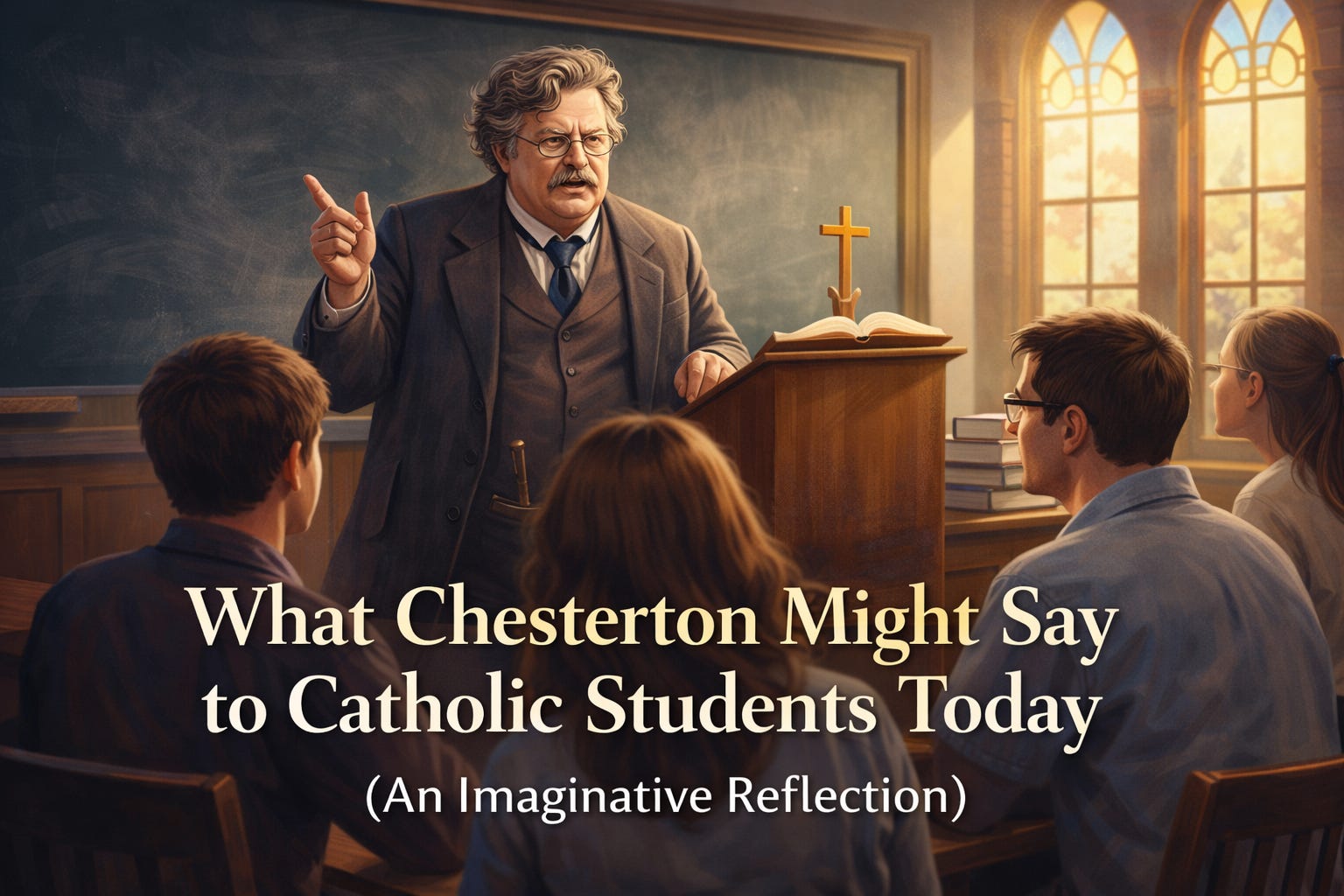
My dear young friends,
I am told that you live in an age of extraordinary freedom. You may read almost anything, believe almost nothing, and question everything except the value of questioning itself. You are encouraged to be original, provided your originality resembles everyone else’s. You are urged to think for yourselves, provided you arrive at the approved conclusions.
In short, you live in a very modern world.
You have chosen—whether by conviction, convenience, or coincidence—to attend a Catholic university. This already places you in a small but significant minority: people who still believe that the adjective before a noun might actually mean something.
But I must warn you at once that you will be tempted to misunderstand what that adjective is for.
A Catholic university is not Catholic because it has a chapel, any more than a man is married because he owns a wedding ring. It is not Catholic because it offers Mass, nor because it allows religion to be discussed during office hours. It is Catholic—or it is nothing—because it believes that truth is not an invention of the mind but a discovery of the soul.
You will be told, very often and very earnestly, that your task is to “keep an open mind.” This is good advice, provided you remember that an open mind, like an open mouth, is meant to close on something solid eventually. Minds that remain permanently open tend to fill up with flies.
You will encounter professors who are brilliant, kind, skeptical, bored, passionate, ironic, and occasionally all at once. Some will challenge your faith honestly, which is a compliment. Some will dismiss it casually, which is an evasion. Do not confuse the two. A man who wrestles with your beliefs respects them. A man who yawns at them has already decided he does not need to think.
You may hear it said that faith is a private matter, best kept safely out of serious intellectual life. This is a curious claim, since faith is precisely what answers the most serious questions anyone can ask: Why is there something rather than nothing? Why should I be good? Why should truth matter when it hurts?
If your education never asks these questions, then it has spared you discomfort at the price of meaning.
You may also be told that the Church is afraid of questions. This is one of those things that sound clever until one remembers that the Church invented the university, preserved Aristotle, baptized reason, and spent centuries arguing with herself precisely because she believed truth could survive the argument.
The Church is not afraid of questions. She is afraid of answers that pretend not to exist.
What you must resist most strongly is not disbelief, but drift. Drift is the great enemy of the modern student. Drift convinces you that convictions are childish, that commitment is naïve, and that floating indefinitely between options is the same thing as wisdom.
It is not.
A Catholic education is not meant to make you comfortable. It is meant to make you capable. Capable of seeing the world whole. Capable of loving truth without conditions. Capable of disagreeing without despair and believing without embarrassment.
You are not at a Catholic university in order to hide from the modern world. You are there in order to face it—with a mind sharpened by reason, a heart strengthened by faith, and a soul sturdy enough to stand upright when fashions fall over.
Do not ask whether your university is sufficiently Catholic to protect you from doubt. Ask whether you are sufficiently Catholic to survive certainty.
For the world does not need more graduates who can explain everything and believe nothing. It needs men and women who know what they believe, why they believe it, and are cheerful enough to defend it without shouting.
The future of Catholic education does not finally belong to presidents, committees, or statements by lakes. It belongs to students who discover that faith is not a cage but a key—and who have the courage to use it.
Yours,
A Friend Who Thinks Orthodoxy Is the Most Daring Adventure of All