

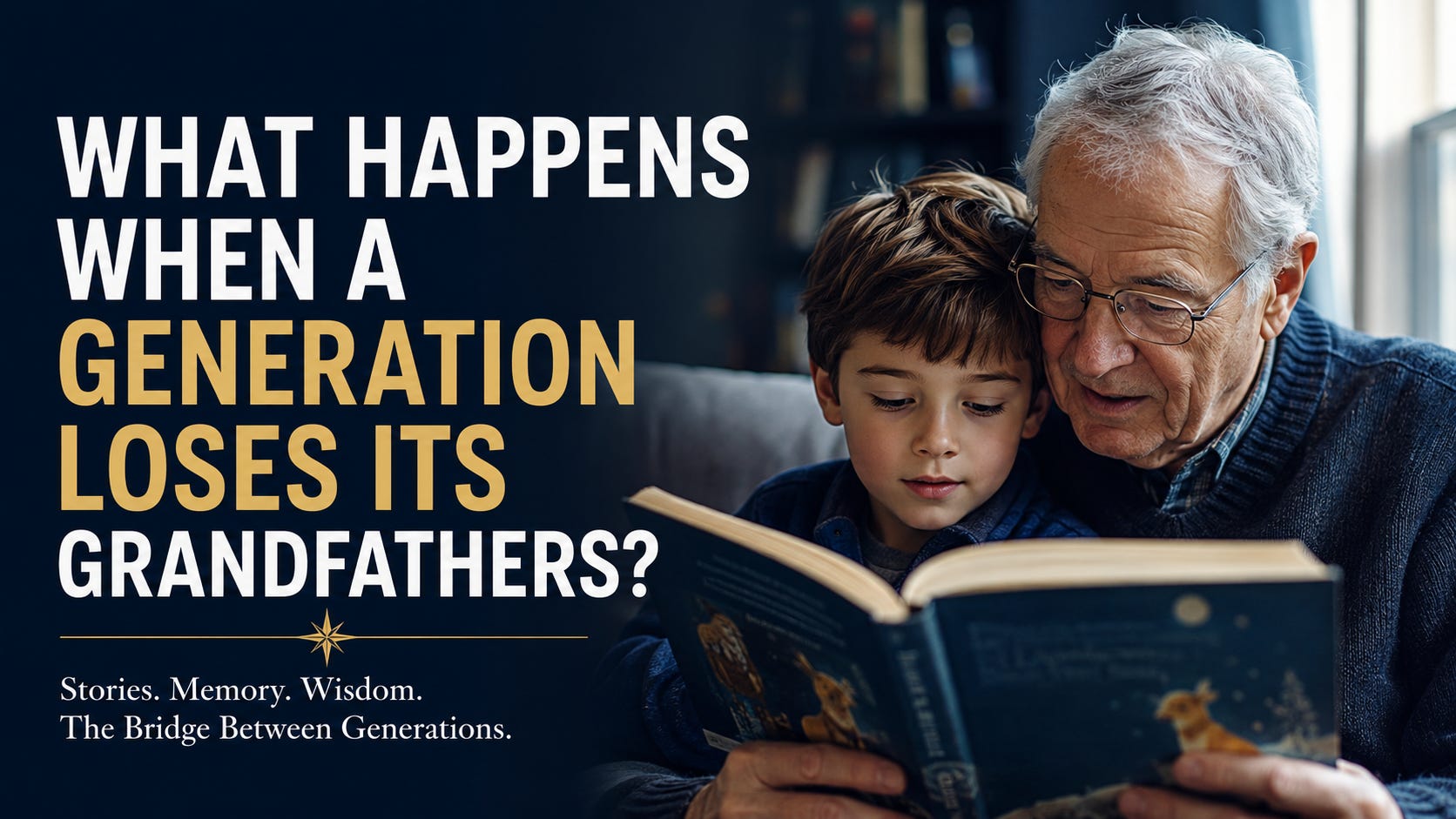
There are many things one expects to hear on a college radio station.
Music, certainly. Sports. News. Political arguments. Interviews. The endless sounds of a generation trying to discover itself.
What one does not expect to hear is an old priest reading Winnie-the-Pooh.
Yet for many years, listeners tuning in to WSND-FM at the University of Notre Dame could hear precisely that. The voice belonged to Fr. Robert Griffin, C.S.C., one of the most beloved figures in the history of the university. His program, The Children’s Hour, became a quiet institution. Week after week, listeners gathered around their radios to hear stories that seemed, at least on the surface, intended for children.
The remarkable thing was that many of those listeners were not children at all.
They were college students.
Young men and women preparing for careers, marriages, graduate schools, military service, and all the responsibilities of adulthood would pause long enough to listen to stories they might have first encountered decades earlier. Others were alumni scattered across the country. Some were parents. Some were grandparents themselves. Yet the audience endured.
At first glance, this seems almost impossible to explain.
Why would adults willingly return to stories written for children?
Why would an old priest devote precious airtime to bears, rabbits, donkeys, and adventures in the Hundred Acre Wood when the modern world offered an endless supply of supposedly more important subjects?
The answer, I suspect, is that the stories themselves were never the entire point.
The stories were a vehicle.
What listeners were really receiving was something much rarer.
They were receiving the gift of an elder.
That gift is becoming increasingly uncommon.
For all our technological sophistication, for all our ability to communicate instantly across continents, modern life has quietly severed many of the ordinary connections that once joined generations together. We are more connected than ever and yet strangely detached from the people who came before us. We have access to information in quantities unimaginable to our ancestors, but often find ourselves starved for wisdom.
Perhaps nowhere is this more evident than in the gradual disappearance of the grandfather as a cultural figure.
Not the biological grandfather.
The grandfather as an institution.
The grandfather as storyteller.
The grandfather as keeper of family memory.
The grandfather as the old man who knows where everyone came from and why certain things matter.
The grandfather as the living bridge between past and future.
For most of human history, such figures were not exceptional. They were everywhere.
Children grew up surrounded by older relatives. Grandparents lived nearby or under the same roof. Families gathered regularly. Stories passed naturally from one generation to the next. A child learned who he was not by consulting a genealogy website but by sitting at a table and listening.
History was personal.
Memory had a face.
Wisdom had a voice.
An old man could point to a field and explain how it looked fifty years earlier. He could describe hardships that younger people knew only from books. He could tell stories about family members long buried in churchyards but still vividly alive in memory.
The past was never truly past because someone was still there to remember it.
The modern world has changed this arrangement in ways both obvious and subtle.
Families scatter across states and continents in pursuit of education and opportunity. Careers demand mobility. Retirement often means moving away from the communities where children and grandchildren remain. Entire generations may communicate primarily through photographs and text messages. Grandparents are still loved, but they are frequently distant. Their role becomes occasional rather than daily.
No one planned this outcome.
No one sat down and decided that children should grow up without regular contact with older generations.
Yet the result has been much the same.
Many children today know remarkably little about the lives of their grandparents. They know even less about their great-grandparents. Family stories that would once have been passed naturally from person to person simply disappear. A grandfather dies, and with him vanish hundreds of stories that were never written down because no one imagined they would be lost.
The tragedy is not merely historical.
It is human.
Children need old people.
Not because old people are always right. They are not.
Not because age automatically produces wisdom. It does not.
But because age offers perspective.
An old man has survived disappointments that a young person fears will be fatal. He has witnessed crises that once seemed world-ending but eventually passed. He knows from experience that life contains seasons. He understands that joy and sorrow rarely remain forever.
Such knowledge cannot be downloaded.
It must be lived.
And when it is shared, it is usually shared through stories.
That is why storytellers have always occupied a place of honor in healthy civilizations.
Long before formal education became widespread, cultures transmitted their values through stories. The stories taught courage, loyalty, sacrifice, gratitude, humility, and hope. They preserved memory. They provided identity. They connected children to something larger than themselves.
Every culture understood this.
The stories changed. The principle did not.
In many families, grandparents became the primary custodians of those stories.
Some told tales of wars.
Some spoke of immigration and hardship.
Some described farms, factories, neighborhoods, and communities that no longer existed.
Others simply read books aloud.
Yet even the simplest story often carried something larger than its plot.
It carried presence.
And presence is one of the most precious gifts an elder can offer.
This may explain why The Children’s Hour occupied such a unique place in the lives of its listeners.
Fr. Griffin was not merely reading stories.
He was creating a space increasingly absent from modern life.
A space where the purpose was not efficiency.
A space where no one was trying to sell anything.
A space where the listener was invited to slow down long enough to wonder.
In a culture obsessed with acceleration, that invitation becomes almost revolutionary.
The older one becomes, the more valuable such moments appear.
Young people often assume adulthood consists primarily of gaining freedom. In time they discover that adulthood also involves accumulating responsibilities. Careers, mortgages, obligations, deadlines, and anxieties begin to crowd out simpler pleasures. The world grows louder. The pace grows faster.
Then one evening an old priest sits down at a microphone and begins reading a story.
For a few moments, the noise recedes.
The listener is reminded of something that modern life often struggles to preserve: the ability to delight in ordinary things.
This was, incidentally, one of the central themes of G.K. Chesterton’s work.
Chesterton spent much of his life arguing that the world remains astonishing, not because it is extraordinary but because it is familiar. The sun rises every morning, and we cease to notice the miracle. Children notice it because they have not yet learned to be bored. Adults often miss it because familiarity has dulled their sense of wonder.
Chesterton believed that civilization depends upon recovering that wonder.
Not occasionally.
Habitually.
The child sees the world as magical.
The mature adult learns to see it as magical again.
Between those two points lies much of human life.
Grandfathers often help us make that journey.
They have lived long enough to understand how fragile ordinary blessings truly are. They know how quickly youth passes. They know how suddenly a familiar voice can disappear forever. They know that many of the things we take for granted become precious only after they are gone.
Because they know this, they often become guardians of wonder.
A grandfather points out things that younger people overlook.
He teaches patience.
He teaches gratitude.
He teaches continuity.
Most importantly, he teaches that life did not begin with us.
We inherit a world already rich with stories, sacrifices, traditions, and loves.
We are not self-created.
We are heirs.
Chesterton once described tradition as the democracy of the dead. The phrase remains famous because it captures a profound truth. The people who came before us still have something to say. Their experiences matter. Their wisdom matters. Their mistakes matter.
The modern world often behaves as though the newest opinion must be the best one.
Grandfathers quietly disagree.
Their lives testify to a different reality.
They remind us that human nature has not changed nearly as much as we imagine. The hopes, fears, ambitions, and sorrows that occupy us today occupied previous generations as well. We are not as unique as we think.
This realization is strangely comforting.
It means we are not alone.
It means others have walked similar roads.
It means wisdom is available if we are willing to listen.
Perhaps that is the real significance of The Children’s Hour.
The program was never simply about children’s literature.
It was about preserving a conversation between generations.
It was about creating a place where wonder still mattered.
It was about reminding listeners that stories are not luxuries but necessities.
And it was about demonstrating that even in an age of satellites, smartphones, artificial intelligence, and endless digital distraction, people still hunger for the voice of an elder telling a story.
That hunger remains.
The popularity of memoirs, podcasts, oral histories, and long-form conversations suggests that it has never disappeared. We continue searching for guides. We continue looking for wisdom. We continue seeking voices capable of placing our lives within a larger story.
The question is whether we still know where to find them.
For a generation that increasingly grows up without daily contact with grandparents, that search may become more difficult.
And that brings us back to the question.
What happens when a generation loses its grandfathers?
The answer is not that it loses old men.
Every generation has old men.
The answer is that it loses memory.
It loses continuity.
It loses stories.
It loses perspective.
It loses wonder.
Most of all, it loses the living reminder that wisdom is not merely accumulated knowledge but knowledge tempered by time, suffering, gratitude, and love.
A civilization can survive many losses.
It can recover from economic hardship, political turmoil, and cultural confusion.
But when it ceases to pass wisdom from one generation to the next, it begins to forget itself.
And a people who forget themselves eventually forget where they are going.
That is why an old priest reading children’s stories on a college radio station mattered.
It was never only about Pooh Bear.
It was about inheritance.
It was about memory.
It was about keeping alive the conversation between generations.
And in a world that increasingly seems determined to silence that conversation, it may have been one of the most important broadcasts on the air.The Age of Grandfathers
To understand what we have lost, we must first remember what once existed.
This is not as easy as it sounds.
Modern people possess a remarkable talent for assuming that the way things are now is the way they have always been. We look at our own arrangements and quietly imagine them to be permanent features of human existence. The rhythms of contemporary life seem so natural that it becomes difficult to imagine alternatives.
Yet if a man from a thousand years ago, or even a hundred years ago, were suddenly transported into the modern world, many of our assumptions would strike him as profoundly strange.
One of the strangest would be the separation of generations.
For most of human history, young and old lived together.
Not occasionally.
Not during holidays.
Not through scheduled video calls.
Together.
Children grew up surrounded by adults of different ages. They saw grandparents every day. They heard their voices at meals. They worked beside them. They attended church with them. They listened to the same stories, observed the same customs, and participated in the same community life.
The arrangement was not ideal. No human arrangement ever is. Families quarreled. Generations disagreed. Old people could be stubborn. Young people could be foolish.
Yet something important occurred simply because the generations occupied the same physical space.
Wisdom became visible.
A child did not learn merely from formal instruction. He learned by observation.
He watched his grandfather repair a broken gate.
He listened as his grandmother spoke with neighbors.
He observed how older people responded to disappointment, illness, success, failure, and loss.
Life itself became a classroom.
The lessons were often unspoken.
Indeed, the most important lessons usually were.
A grandfather rarely sat down and announced that he was about to teach perseverance. He simply persevered.
He did not deliver a lecture on responsibility. He demonstrated responsibility.
He did not define courage. He exhibited courage.
The child absorbed these lessons almost by accident.
Such transmission is difficult to quantify, which is perhaps why modern societies frequently underestimate its importance.
We are accustomed to measuring educational outcomes. We can count test scores, degrees, certifications, and credentials. We can calculate graduation rates and professional achievements.
What we cannot easily measure is the influence of a grandfather sitting quietly at the edge of a room.
Yet that influence may shape a human being more profoundly than many formal educational experiences.
The historian and philosopher often study civilizations through their institutions. They examine governments, armies, economies, and legal systems. These things certainly matter. They help explain how societies function.
But civilizations are not ultimately preserved by institutions.
They are preserved by habits.
And habits are transmitted through relationships.
A constitution may define a nation’s laws.
A grandfather helps define its character.
Consider how much knowledge previous generations carried that never appeared in books.
There was practical knowledge.
How to repair tools.
How to grow food.
How to build a fence.
How to navigate by landmarks.
How to recognize changing weather.
How to care for animals.
How to preserve food for winter.
Much of this knowledge was transmitted directly from one generation to another. The lessons occurred not in classrooms but in workshops, barns, kitchens, and fields.
Yet practical skills represented only part of the inheritance.
Equally important was moral knowledge.
Children learned how adults behaved.
They learned what was considered honorable.
They learned what was considered shameful.
They learned how promises were kept.
They learned how conflicts were resolved.
They learned how marriages endured.
They learned how communities survived.
These lessons were rarely written down because they seemed too obvious to require explanation.
Everyone knew them.
Or at least everyone was expected to know them.
The expectation existed because older generations remained close enough to teach them.
Today we often attempt to replace such formation with information.
When social problems arise, we produce more content. More books. More videos. More podcasts. More courses. More training programs.
These efforts may be valuable.
Yet they frequently overlook an uncomfortable truth.
People learn character primarily from people.
Not from content.
A young man becomes responsible because he observes responsibility embodied in another person.
A young woman learns perseverance because she witnesses perseverance practiced by someone she admires.
The deepest lessons of life are usually caught rather than taught.
That reality explains why the figure of the grandfather appears so consistently throughout history, literature, and folklore.
He is not merely an elderly relative.
He represents continuity.
The grandfather stands at the intersection of memory and experience. He remembers things that younger generations never witnessed. He carries stories that would otherwise disappear. He provides context for events that seem unprecedented to younger eyes.
Every generation believes it faces challenges unlike any before.
Sometimes it does.
More often it faces ancient problems wearing modern clothing.
The grandfather knows this.
He has seen enough life to recognize recurring patterns.
He knows that economic booms eventually cool. He knows that political passions eventually fade. He knows that cultural fashions come and go. He knows that human beings remain remarkably consistent despite the changing scenery.
This perspective acts as a stabilizing force.
It prevents panic.
It encourages patience.
It reminds younger people that history is longer than headlines.
In this sense, grandparents functioned as a civilization’s memory banks long before digital storage existed.
Every family possessed archives.
Not paper archives.
Human archives.
The stories lived in people.
A grandfather could explain how the family arrived in a particular town. He could describe hardships overcome by previous generations. He could recount sacrifices made by parents, grandparents, and great-grandparents whose names might otherwise vanish from memory.
Children learned that they belonged to something larger than themselves.
This awareness carried profound consequences.
A person who knows his story possesses a stronger sense of identity.
He understands that his life forms part of a larger narrative.
His existence does not begin at birth.
His story began long before he arrived.
Likewise, it will continue after he departs.
Such knowledge encourages humility.
It also encourages gratitude.
Modern culture often emphasizes individual achievement. We celebrate self-made success stories. We admire people who appear to have created themselves through talent and determination.
Yet the phrase “self-made man” would have sounded peculiar to most previous generations.
No one considered himself self-made.
Every achievement rested upon foundations built by others.
Parents sacrificed.
Teachers instructed.
Neighbors helped.
Communities supported.
Grandparents remembered.
The older one becomes, the more obvious this truth appears.
Very little of lasting value is accomplished alone.
The illusion of radical independence fades with experience.
What remains is an awareness of indebtedness.
Perhaps this is why old people often become more grateful than young people.
Not universally, of course. Human nature remains complicated.
Yet many elderly men and women develop a heightened appreciation for ordinary blessings. They understand how fragile those blessings truly are.
The house once filled with children grows quiet.
Friends pass away.
Parents are gone.
Careers end.
The familiar world changes.
And through these changes comes a realization that much of what seemed permanent was actually temporary.
The realization can produce bitterness.
More often, it produces wisdom.
A grandfather who has lived through loss understands the value of presence.
He knows that relationships matter more than possessions.
He knows that conversations matter more than schedules.
He knows that time cannot be recovered.
This wisdom often appears in simple forms.
A willingness to sit and listen.
An ability to tell stories.
Patience with children.
Tolerance for imperfection.
An appreciation for ordinary pleasures.
These qualities rarely attract attention.
Yet they help sustain civilizations.
Civilizations require people who remember what matters.
Without them, societies become increasingly vulnerable to amnesia.
And amnesia is dangerous.
A society that forgets its history becomes vulnerable to every fashionable idea.
A society that forgets its ancestors becomes uncertain of its identity.
A society that forgets its stories eventually loses its purpose.
This is why the disappearance of grandfathers as cultural figures matters so profoundly.
The issue is not nostalgia.
Nostalgia can be misleading. Every era contains flaws. The past was not paradise. Families experienced conflict, injustice, hardship, and failure just as they do today.
The argument is not that previous generations were perfect.
The argument is that previous generations understood something we are in danger of forgetting.
Human beings require connections across time.
Children need relationships with older people.
Young adults need mentors who possess experience rather than merely expertise.
Communities need individuals capable of remembering where they came from.
Civilizations need custodians of memory.
For centuries, grandfathers helped fulfill that role.
They were not always famous.
Most never held public office.
Many lived and died without leaving written records.
Yet they performed one of the most important tasks in human society.
They carried the stories.
They remembered the names.
They preserved the lessons.
They connected generations.
And because they did, children inherited more than possessions.
They inherited a sense of belonging.
The question before us is whether modern society can continue to transmit that inheritance after weakening many of the institutions that once made it possible.
For if grandfathers once served as the living bridge between generations, what happens when that bridge begins to disappear?
The answer lies not only in changing family structures, but in the growing loneliness, uncertainty, and fragmentation that characterize so much of contemporary life.
And it is to that loss that we must now turn.
The Vanishing Grandfather
The disappearance of grandfathers did not happen all at once.
There was no public announcement. No legislation. No national debate. No moment when families gathered around dinner tables and decided that older generations would no longer occupy a central place in the lives of the young.
Like many significant cultural changes, it occurred gradually enough to escape notice.
A generation moved away for work.
A family relocated for opportunity.
A retirement community opened in a warmer climate.
A child became accustomed to seeing grandparents a few times each year instead of every week.
Each individual decision seemed reasonable.
Most of them were.
Yet over time, thousands of reasonable decisions produced an unexpected result.
The generations drifted apart.
The modern world was built upon mobility.
For much of history, people spent their entire lives within a relatively small geographic area. A man often lived where he was born. His children frequently settled nearby. Families remained connected not because they were unusually virtuous but because distance made separation difficult.
The Industrial Revolution began changing that pattern.
The twentieth century accelerated it.
The twenty-first century transformed it completely.
Today a young graduate may attend college in one state, begin a career in another, marry someone from a third, and raise children in a fourth. Such mobility offers genuine advantages. It expands opportunity. It allows talent to flourish. It exposes people to new ideas and experiences.
Yet every gain carries a cost.
The cost of mobility is often continuity.
A child whose grandparents live a thousand miles away cannot experience the same daily relationship that previous generations considered normal. Love remains. Affection remains. Family remains.
Presence does not.
And presence is not easily replaced.
Technology helps, but only to a point.
Video calls are wonderful things. They allow grandparents to see grandchildren grow. They allow families to maintain relationships across great distances. They provide connections that previous generations could scarcely imagine.
Yet a video call cannot fully replicate a shared afternoon.
It cannot replace sitting together on a porch.
It cannot reproduce the experience of helping a grandfather repair something in a garage.
It cannot imitate a spontaneous conversation during a long car ride.
The digital world allows us to communicate.
It does not always allow us to inhabit the same space.
This distinction matters more than we often realize.
Human beings learn through proximity.
Children learn through observation.
Many of the most important lessons in life occur not during planned interactions but during ordinary moments.
A child notices how his grandfather treats strangers.
He notices how he responds to disappointment.
He notices whether he keeps promises.
He notices whether he listens carefully.
He notices whether he complains constantly or remains grateful.
These observations accumulate over years.
They form character almost invisibly.
Such formation becomes difficult when relationships are compressed into occasional visits and carefully scheduled conversations.
Yet geography alone does not explain the vanishing grandfather.
Another force has been at work.
Modern culture increasingly organizes itself around age segregation.
Children spend most of their time with children.
Teenagers spend most of their time with teenagers.
College students spend most of their time with college students.
Adults spend most of their time with adults in similar stages of life.
Older people often spend much of their time with other older people.
This arrangement appears normal because it is familiar.
Historically, it is unusual.
For most of human history, daily life involved constant interaction among multiple generations.
Children watched adults work.
Young people participated in community life alongside elders.
The old remained integrated into the social fabric rather than separated from it.
Age segregation has produced certain efficiencies.
It has also reduced opportunities for intergenerational learning.
A young person can now progress through much of life while having surprisingly little meaningful contact with elderly people outside immediate family members.
The consequences are profound.
When generations cease interacting regularly, they begin misunderstanding one another.
The young perceive the old as irrelevant.
The old perceive the young as reckless.
Each group loses the ability to understand the experiences of the other.
Mutual sympathy declines.
Isolation increases.
The bridge weakens.
At the same time, something else has changed.
Our culture has become increasingly uncomfortable with aging itself.
Previous generations often viewed old age as a stage of life associated with authority and wisdom. The elderly occupied positions of respect because they possessed experience. Their opinions carried weight not because they were always correct but because they had witnessed more of life.
Modern society often sends a different message.
Youth is celebrated.
Youth is marketed.
Youth is idealized.
Entire industries exist to conceal the evidence of aging.
Advertisements rarely suggest that growing old is desirable.
Instead, they imply that growing old is a problem requiring correction.
The message is subtle but persistent.
Stay young.
Look young.
Think young.
Act young.
Remain young as long as possible.
Lost in this pursuit is an important question.
What if old age possesses gifts that youth cannot provide?
What if the purpose of life is not merely to remain young but to become wise?
What if aging is not a defect but a vocation?
The grandfather represents precisely this possibility.
He stands as evidence that human life contains seasons, each with its own purpose and dignity.
Youth excels at energy.
Middle age often excels at productivity.
Old age can excel at perspective.
A healthy society needs all three.
When old age loses its place of honor, the entire culture becomes less balanced.
The symptoms appear everywhere.
We increasingly seek guidance from celebrities rather than elders.
We consume endless streams of information while struggling to find wisdom.
We know more facts than previous generations and often possess less confidence about how to live.
This confusion should not surprise us.
Information and wisdom are not the same thing.
Information answers questions.
Wisdom helps determine which questions matter.
Information can be gathered quickly.
Wisdom generally requires time.
Information accumulates.
Wisdom matures.
The grandfather traditionally served as one of society’s primary repositories of that wisdom.
His authority did not come from credentials.
It came from experience.
He had survived mistakes.
He had endured losses.
He had learned which ambitions were worth pursuing and which were not.
His counsel carried weight because it had been tested against reality.
The modern world often struggles to create substitutes for this role.
We hire consultants.
We seek coaches.
We attend seminars.
We read self-help books.
Some of these resources are valuable.
Yet their popularity may reveal a deeper hunger.
People are searching for guidance once supplied more naturally through relationships.
They are searching for wisdom.
They are searching for perspective.
They are searching, in a sense, for grandfathers.
This search becomes particularly visible during periods of uncertainty.
When societies experience rapid change, people instinctively look backward as well as forward. They seek voices capable of explaining how previous generations navigated disruption and turmoil.
The desire is not merely intellectual.
It is deeply human.
We want reassurance that others have faced difficult times and endured.
We want proof that confusion is survivable.
We want to hear stories that place our own struggles within a larger narrative.
This is precisely what grandparents have traditionally provided.
Their lives remind younger generations that history did not begin yesterday.
They have witnessed economic downturns, cultural upheavals, political conflicts, personal disappointments, and unexpected recoveries.
They know from experience that despair is often premature.
Such knowledge cannot eliminate suffering.
It can, however, provide hope.
Hope may be one of the most important gifts an elder offers.
Not naïve optimism.
Not wishful thinking.
Hope grounded in memory.
Hope rooted in experience.
Hope born from having seen difficult seasons pass before.
A generation deprived of such voices becomes more vulnerable to anxiety.
Every challenge appears unprecedented.
Every crisis feels permanent.
Every setback seems catastrophic.
Without memory, perspective becomes difficult.
Without perspective, fear grows.
Perhaps this helps explain why so many people today describe themselves as lonely despite unprecedented levels of connectivity.
Loneliness is not merely the absence of contact.
It is often the absence of rootedness.
A person may communicate with hundreds of people and still feel disconnected from any larger story.
Grandfathers once helped provide that story.
They reminded children where they came from.
They connected families to their history.
They transformed isolated individuals into members of a continuing narrative.
As those connections weaken, many people experience a vague but persistent sense of dislocation.
They know something is missing.
They simply struggle to name it.
And yet the loss is not irreversible.
Human beings possess a remarkable capacity to recover forgotten things.
Traditions can be renewed.
Relationships can be rebuilt.
Stories can be retold.
The first step, however, is recognizing what has been lost.
Only then can we understand why an old priest reading children’s stories on a college radio station touched so many lives.
For The Children’s Hour was not merely preserving literature.
It was preserving a role.
In a culture increasingly uncertain about what to do with its elders, Fr. Robert Griffin quietly demonstrated what elders are for.
They are keepers of stories.
They are custodians of memory.
They are guardians of wonder.
And they remind us that every generation stands upon the shoulders of those who came before.
The question, then, is not simply what happens when a generation loses its grandfathers.
The deeper question is whether a generation can learn to become grandfathers again.
Fr. Robert Griffin and the Ministry of Storytelling
If the grandfather is a keeper of memory, then storytellers are his natural allies.
Stories have always accomplished what arguments often cannot. An argument may convince a person that something is true. A story helps him understand why the truth matters. An argument appeals to the mind. A story appeals to the whole person. It engages memory, imagination, affection, and experience all at once.
This is why human beings have carried stories across generations for thousands of years.
Long before there were universities, there were storytellers.
Long before there were textbooks, there were storytellers.
Long before there were podcasts, radio stations, newspapers, and publishing houses, there were storytellers.
Around fires, around dinner tables, on porches, in workshops, in monasteries, and in village squares, stories were passed from one generation to the next. Through them people learned who they were. Through them they discovered what their communities valued. Through them they encountered heroes, villains, saints, fools, and ordinary men and women trying to live decent lives.
The storyteller was never merely entertaining his audience.
He was forming it.
That truth was understood instinctively by previous generations. It is understood less clearly today.
Modern culture often treats stories as a form of diversion. We consume them in enormous quantities. Movies, television programs, streaming services, podcasts, audiobooks, social media videos, and video games fill countless hours of our lives. Yet because stories are so abundant, we sometimes forget how powerful they really are.
Stories shape the imagination.
And the imagination eventually shapes the world.
Before a society changes its laws, it changes its imagination.
Before a civilization adopts new values, it tells new stories.
Before people alter the way they live, they alter the way they see.
For this reason, the storyteller occupies a position of tremendous influence, whether he recognizes it or not.
Fr. Robert Griffin understood this, though perhaps not in the way modern media personalities understand influence.
He was not building a brand.
He was not chasing ratings.
He was not trying to dominate a news cycle or create viral content.
He was doing something both simpler and more profound.
He was reading stories.
The simplicity of that statement almost conceals its significance.
An old priest sitting before a microphone and reading children’s literature does not sound like a revolutionary act. Yet viewed against the backdrop of modern life, it begins to look surprisingly radical.
The contemporary world excels at speed.
Everything arrives instantly.
News appears the moment events occur. Messages travel around the globe in seconds. Entertainment is available on demand. Entire libraries fit inside a device carried in a pocket.
Speed has brought undeniable benefits.
Yet it has also altered our relationship with attention.
The ability to sit quietly and listen to a story has become increasingly rare.
Listening requires patience.
Listening requires stillness.
Listening requires surrendering, for a time, the illusion that we must constantly be doing something else.
Children once learned these habits naturally.
Someone read to them.
A parent.
A teacher.
A grandparent.
An older sibling.
The child listened because there was little alternative.
More importantly, the child listened because another human being was giving him a gift.
The gift was not merely the story itself.
The gift was attention.
The storyteller was saying, in effect, “This is worth sharing with you.”
There is something deeply personal about being read to.
Even adults understand this instinctively.
One can read Shakespeare silently. One can read Dickens silently. One can read Chesterton silently.
Yet hearing those words spoken aloud creates a different experience altogether.
The voice matters.
The pauses matter.
The personality of the reader matters.
The story becomes a shared event rather than a solitary activity.
In this respect, The Children’s Hour resembled an older world more than a modern one.
Radio itself occupies an interesting place in cultural history. Unlike television, it requires participation from the imagination. The listener must complete the picture. Characters exist primarily in the mind. Scenes unfold internally. The audience becomes a collaborator in the act of creation.
This may help explain why radio often produces such powerful memories.
People remember not merely what they heard but where they heard it.
A voice becomes associated with a room, a season of life, a particular period of growth or struggle.
Years later, hearing that voice again can summon entire worlds from memory.
The effect is almost sacramental.
An ordinary sound carries something larger than itself.
Fr. Griffin’s listeners were not simply consuming content.
They were entering a relationship.
Not a personal friendship, certainly. Most never met him. Yet they knew his voice. They knew his rhythms. They knew that at a certain hour, somewhere on campus, a priest would sit before a microphone and invite them into a story.
Such consistency creates trust.
Trust creates affection.
Affection creates community.
This is one reason why so many beloved broadcasters occupy a place in memory that seems disproportionate to the mechanics of their profession. People remember them not merely because they were talented but because they accompanied them through life.
A familiar voice can become a companion.
Fr. Griffin’s voice became precisely that for many listeners.
And what he offered them was something increasingly scarce.
He offered gentleness.
The modern world is not especially gentle.
It is loud.
It is competitive.
It rewards outrage.
It encourages performance.
It constantly demands attention.
The gentle voice often struggles to compete.
Yet history suggests that gentle voices frequently outlast louder ones.
The loud voice captures the moment.
The gentle voice captures the heart.
A grandfather understands this instinctively.
Grandfathers rarely command attention through force. Their influence operates differently. They attract listeners through affection, patience, and presence. Their authority emerges not from volume but from trust.
The same was true of many great storytellers.
Consider how often beloved children’s authors write not from a position of superiority but from a position of companionship. They do not lecture children. They accompany them. They enter the world of wonder alongside them.
This quality appears repeatedly in the stories Fr. Griffin chose to share.
A. A. Milne understood it.
So did Kenneth Grahame.
So did C. S. Lewis.
So did countless storytellers whose works continue to endure long after more fashionable literature has faded.
They respected the imagination.
They understood that wonder is not childish.
It is foundational.
The loss of wonder represents one of the great spiritual dangers of adulthood.
Children naturally find the world astonishing. Adults often become accustomed to it. Familiarity breeds indifference. Routine dulls perception. The miraculous becomes ordinary simply because it occurs every day.
Chesterton spent much of his career fighting this tendency.
He believed that modern people suffered not from excessive wonder but from insufficient wonder. They had ceased to notice the extraordinary nature of ordinary things. They treated existence itself as commonplace.
The cure, he suggested, was gratitude.
Not gratitude for rare events.
Gratitude for common ones.
The sunrise.
Friendship.
Food.
Family.
Laughter.
Home.
Stories.
The storyteller performs an important role in this recovery of gratitude.
He helps us notice what we have overlooked.
A child listening to Winnie-the-Pooh notices friendship.
An adult listening years later notices friendship differently.
The same story reveals new truths because the listener has changed.
Good stories age with us.
Great stories grow with us.
That may be why adults return to children’s literature throughout their lives.
The stories often contain more wisdom than we recognized as children.
As children, we enjoy the adventure.
As adults, we understand the meaning.
As older adults, we often discover both at once.
This process mirrors the work of grandparents.
The grandparent does not simply provide information.
He helps younger people see familiar things in a new light.
He points out significance hidden within ordinary experiences.
He teaches that the commonplace is often the most precious.
A family dinner.
A walk through a neighborhood.
A bedtime story.
A conversation on a porch.
These moments seem small while they are happening.
Years later they often become the memories people cherish most.
Fr. Griffin understood this truth because he understood something fundamental about human beings.
We are not sustained by information alone.
We are sustained by meaning.
And meaning is most often carried through stories.
That is why a radio program devoted to children’s literature could become so beloved.
It was never merely about books.
It was about preserving a way of seeing.
It was about protecting wonder from cynicism.
It was about reminding listeners that imagination is not an escape from reality but a deeper entrance into it.
Most of all, it was about offering a generation what every generation needs.
A wise voice.
A patient voice.
A trustworthy voice.
A voice that reminds us that the world remains larger, stranger, and more beautiful than we often remember.
In other words, a grandfatherly voice.
And perhaps that is why so many listeners returned week after week.
They were not simply listening to stories.
They were listening for wisdom hidden inside them.
They were listening for memory.
They were listening for wonder.
And, whether they realized it or not, they were listening for home.
Chesterton’s Answer: Recovering the Grandfather Spirit
Every serious question eventually becomes a practical one.
It is one thing to identify a loss. It is another thing entirely to respond to it.
If grandfathers have become less visible in modern life, what are we supposed to do about it?
If families are more scattered than they once were, if communities are less rooted, if generations interact less frequently, if stories are no longer passed naturally from old voices to young ears, what remains?
The temptation is to answer such questions with programs, initiatives, and strategies.
Modern society is very good at creating programs.
When we discover a problem, we establish a committee.
When we identify a need, we create a system.
When we observe a deficiency, we design a solution.
Sometimes these efforts succeed.
Often they help.
Yet there are certain human realities that cannot be restored through administration alone.
Friendship cannot be manufactured.
Trust cannot be mandated.
Belonging cannot be automated.
And wisdom cannot be mass-produced.
The things we have been discussing throughout this essay belong to that category.
The grandfather is not a policy.
He is a relationship.
The storyteller is not an institution.
He is a person.
The transmission of memory does not occur primarily through systems.
It occurs through love.
That is why the recovery of what has been lost must begin not with structures but with people.
And this is where Chesterton becomes surprisingly relevant.
G.K. Chesterton spent much of his life confronting a mistake that remains common today. He believed modern people were constantly searching for elaborate solutions to problems that often required simpler answers. They traveled to distant places looking for treasures that already existed in their own homes. They sought novelty when what they truly needed was appreciation.
One of Chesterton’s recurring themes was that ordinary things are not ordinary at all.
They only appear ordinary because we encounter them every day.
The family dinner seems ordinary until it disappears.
The neighborhood seems ordinary until we leave it.
The familiar voice seems ordinary until it falls silent.
The grandfather seems ordinary until his chair sits empty.
Then suddenly we discover that the things we overlooked were among the greatest gifts we possessed.
Chesterton believed that gratitude begins with recognizing this reality.
Not gratitude as a vague feeling.
Gratitude as a way of seeing.
A way of looking at the world that recognizes gifts where others see only routines.
The grandfather spirit begins here.
Not with age.
Not with retirement.
Not even with grandchildren.
It begins with gratitude.
A grandfather, at his best, is someone who has learned to value things that younger people often ignore.
He understands the importance of presence because he has witnessed absence.
He values conversation because he has experienced silence.
He treasures family because he has attended funerals.
He appreciates ordinary days because he knows how quickly extraordinary days become memories.
This wisdom is available to all of us.
Indeed, it must be available to all of us.
For many people reading these words are not grandfathers.
Some are too young.
Some have no children.
Some never knew their own grandparents.
Some live far from family.
Some carry wounds and losses that make such relationships difficult.
If the future depends solely upon biological grandfathers, then many people would be excluded from the conversation.
Fortunately, that is not how wisdom works.
The grandfather spirit is larger than genealogy.
Every civilization has depended upon men and women willing to serve as bridges between generations.
Teachers have done it.
Coaches have done it.
Priests have done it.
Neighbors have done it.
Authors have done it.
Mentors have done it.
Storytellers have done it.
Fr. Robert Griffin did it.
What made such people valuable was not their age alone.
It was their willingness to give away what they had received.
They understood that wisdom becomes meaningful only when it is shared.
A story locked inside a memory eventually dies.
A story told becomes an inheritance.
This realization points toward a hopeful possibility.
Perhaps the question is not merely whether modern society has lost its grandfathers.
Perhaps the question is whether modern society is willing to become grandfatherly again.
The distinction matters.
For if the problem were purely demographic, there would be little we could do. We cannot instantly recreate the social arrangements of previous centuries. We cannot reverse every economic, technological, and cultural force that has shaped contemporary life.
But we can recover certain habits.
We can tell stories.
We can listen to older people.
We can preserve family memories.
We can create opportunities for generations to spend time together.
We can resist the tendency to isolate ourselves within age groups and ideological tribes.
We can choose presence over distraction.
These choices may seem small.
Most important things begin small.
A grandfather rarely changes the world through dramatic gestures.
He changes it through accumulated moments.
A conversation.
A story.
A walk.
A lesson.
A memory.
One generation passes something to the next.
Then the next generation does the same.
Civilization advances not through leaps but through handoffs.
The baton is passed.
The story continues.
Chesterton understood this profoundly.
His famous description of tradition as the democracy of the dead was not an argument against progress. It was an argument against arrogance. He believed that every generation should contribute something new. He simply insisted that no generation should imagine itself wise enough to ignore everyone who came before.
The grandfather embodies this principle.
He represents continuity without stagnation.
Memory without nostalgia.
Wisdom without cynicism.
Hope without naivety.
At his best, he reminds younger generations that they are neither the first people to face difficulties nor the last.
Others have struggled.
Others have persevered.
Others have built families, communities, schools, churches, businesses, and nations under circumstances no less challenging than our own.
The knowledge does not eliminate hardship.
It places hardship in context.
And context is one of the greatest gifts wisdom can offer.
Perhaps this is why so many people continue to seek out stories.
The appetite remains as strong as ever.
Podcasts flourish.
Memoirs flourish.
Oral histories flourish.
People spend hours listening to conversations between thoughtful individuals.
Why?
Because beneath all our technology, we remain profoundly human.
We still long to hear a trusted voice explain the world.
We still seek guides.
We still hunger for meaning.
We still want to know where we came from and where we are going.
In short, we still want grandfathers.
Not necessarily old men in rocking chairs.
Something deeper.
We want the perspective they represent.
We want the continuity they provide.
We want the reassurance that our lives belong to a larger story.
The remarkable thing is that such reassurance remains available.
The conversation between generations has not ended.
It merely requires participants willing to continue it.
Every time a parent tells a child about a grandparent, the conversation continues.
Every time a teacher shares a story worth remembering, the conversation continues.
Every time an older person takes the time to listen to someone younger, the conversation continues.
Every time a family gathers and remembers together, the conversation continues.
Every time a storyteller sits before a microphone and reads a story, the conversation continues.
That was the quiet genius of The Children’s Hour.
It was never simply a radio program.
It was an act of cultural preservation.
Week after week, Fr. Robert Griffin demonstrated something the modern world desperately needs to remember.
Human beings do not live by information alone.
We live by stories.
We live by memory.
We live by wonder.
Most of all, we live by inheritance.
And inheritance requires someone willing to pass it on.
Which brings us back to the question with which we began.
What happens when a generation loses its grandfathers?
The answer is not that it loses old men.
It loses storytellers.
It loses memory.
It loses continuity.
It loses perspective.
It loses a sense of belonging to something older and larger than itself.
Yet that loss need not be permanent.
The grandfather spirit can be recovered wherever people choose gratitude over cynicism, memory over amnesia, presence over distraction, and stories over noise.
It can be recovered wherever one generation decides that the next generation is worth investing in.
It can be recovered wherever someone takes the time to sit down, open a book, and begin reading aloud.
For in the end, civilization survives not because information is preserved in databases or libraries, important though those things may be.
Civilization survives because human beings pass wisdom to one another.
One story at a time.
One conversation at a time.
One generation at a time.
And perhaps that is why an old priest reading children’s stories on a college radio station still matters.
He was doing more than reading.
He was keeping the conversation alive.
And if we are wise, we will do the same.
Postscript: Keeping the Conversation Alive
One of the quiet lessons of Fr. Robert Griffin’s Children’s Hour is that stories are never really about the people who tell them.
They are about the people who receive them.
Somewhere, years ago, a student at Notre Dame turned on a radio and listened to a story. Perhaps he was studying for an exam. Perhaps she was wondering what life would look like after graduation. Perhaps neither realized that decades later they would still remember the voice, the stories, and the sense of wonder those broadcasts inspired.
That is how inheritance works.
We rarely recognize its importance while it is happening.
Only later do we discover that a story, a conversation, a book, a teacher, a parent, or a grandfather quietly shaped the way we see the world.
At Chesterton Radio, we believe those conversations are worth preserving.
Whether through old-time radio dramas, classic literature, BBC productions, Catholic thought, Notre Dame memories, the writings of G.K. Chesterton, or stories like this one, our goal remains the same: to keep alive the conversation between generations.
The modern world offers no shortage of information.
What it often lacks is memory.
What it often lacks is wonder.
What it often lacks is the reassuring voice that reminds us we belong to a story larger than ourselves.
If this essay resonated with you, consider sharing it with a parent, a grandparent, a child, a former teacher, or a friend whose life has been shaped by the wisdom of those who came before. The most important stories survive because someone passes them along.
And if you would like to help keep these conversations alive, consider subscribing to Chesterton Radio on Substack, sharing our work with others, or supporting the project as a paid subscriber. Your support helps us continue exploring the books, broadcasts, ideas, and memories that connect generations across time.
After all, every generation inherits a treasury it did not create.
The question is whether we will preserve it.
The answer begins the same way it always has.
With a story.
And someone willing to tell it.
— Chesterton Radio
Broadcasting from Atchison, Kansas, where the conversation continues.