

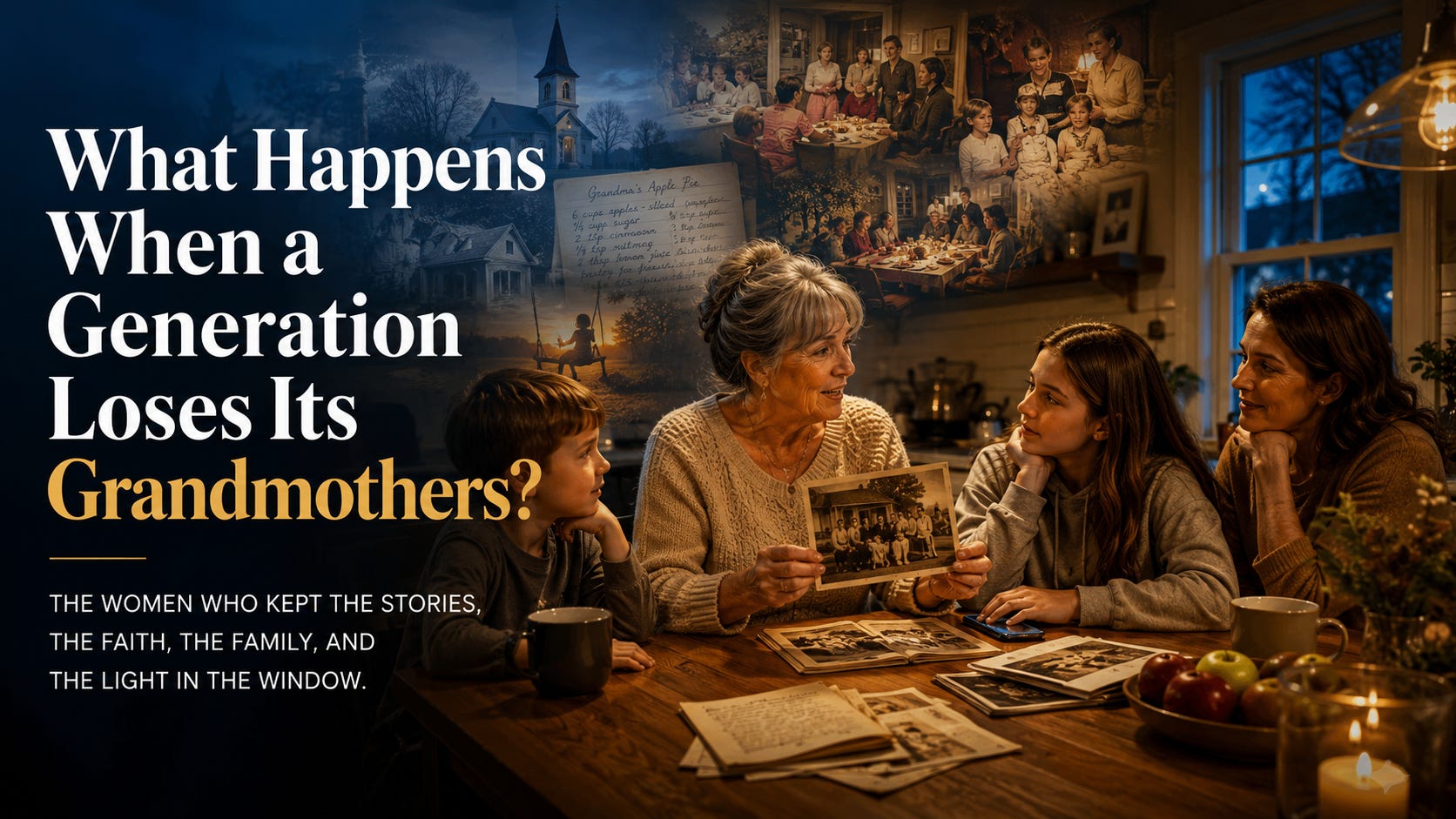
There is a peculiar kind of grief that arrives long before a funeral.
It begins quietly. A recipe can no longer be found. A family story is told incorrectly. A holiday feels strangely empty. A child asks a question about someone who died years ago, and no one in the room knows the answer. The old photographs remain, but the names attached to the faces begin to fade. A house is sold. A favorite chair disappears. A voice once heard every Sunday becomes difficult to remember.
The loss does not happen all at once. It happens in fragments.
A generation wakes up one morning and discovers that the women who held everything together are gone.
We speak often about grandfathers. We remember the men who taught us to fish, build things, fix engines, and tell stories. We celebrate their wisdom and their sacrifices. Yet there is another loss, quieter and perhaps even more profound, that modern society seldom discusses. What happens when a generation loses its grandmothers?
The question is more important than it first appears. For grandmothers have rarely been merely elderly relatives. Throughout most of human history they occupied a role that modern civilization barely understands. They were historians without diplomas. Teachers without classrooms. Theologians without titles. Economists without spreadsheets. Diplomats without offices. They preserved not merely information but culture itself.
Civilizations are not transmitted primarily through governments, universities, corporations, or media companies. They are transmitted through families. More specifically, they are transmitted through ordinary conversations repeated across generations. A nation survives because someone teaches a child how to pray, how to behave at a table, how to welcome a guest, how to mourn the dead, how to celebrate a feast day, how to endure disappointment, and how to laugh at misfortune.
For centuries grandmothers stood at the center of this work.
Their authority rarely appeared dramatic. They seldom commanded armies or signed legislation. Few statues were erected in their honor. Yet they exercised a form of influence that kings would have envied. They shaped the habits, memories, loyalties, and imaginations of children. Through countless small acts repeated over decades, they formed the moral atmosphere in which entire families lived.
This is why the disappearance of grandmothers is not merely a demographic event. It is a cultural event.
Many people today live hundreds or even thousands of miles from extended family. Careers require mobility. Housing costs scatter relatives across states and countries. Elderly parents often live independently until declining health forces them into assisted living facilities. Family gatherings become occasional rather than habitual. Children may know their grandparents through video calls more often than through shared afternoons.
Technology allows communication, but it does not always permit presence.
A child can see a grandmother’s face on a screen and still never learn how she kneads bread. He can hear her voice through a speaker and still never absorb the countless lessons hidden inside ordinary daily life. There are forms of knowledge that cannot be downloaded. They must be witnessed.
The old world understood this instinctively.
For most of history multiple generations frequently lived under one roof or within walking distance of one another. Grandparents did not occupy a separate category called “visiting relatives.” They were simply part of life. They sat at tables, watched children, corrected behavior, settled disputes, and repeated stories. Their presence was woven into the fabric of everyday existence.
The modern world has gained many things through mobility and technology. It has increased opportunities, expanded horizons, and connected distant places. Yet every gain carries a cost. One of those costs has been the weakening of intergenerational bonds. Many children now grow up surrounded by peers, teachers, coaches, influencers, and screens but spend comparatively little time with elderly family members.
The result is not merely loneliness among the elderly. It is a form of cultural amnesia among the young.
G.K. Chesterton once described tradition as the “democracy of the dead.” He argued that previous generations deserve a voice in the decisions of the living. The phrase is famous because it captures something deeply true. Human beings are not self-created. We inherit languages, customs, beliefs, and institutions that existed before our birth. To ignore the wisdom of previous generations is not enlightenment. It is arrogance.
Grandmothers often served as the most practical representatives of this democracy.
They were living links to people whom children would never meet. They remembered grandparents, great-grandparents, aunts, uncles, cousins, neighborhoods, churches, schools, and events that had disappeared before the next generation arrived. Through them, the dead remained participants in family life.
Without such links, history begins to shrink.
Ask many young adults today about their great-grandparents and they may know almost nothing. The names are uncertain. The occupations are forgotten. The stories have vanished. Entire lifetimes disappear in the span of two or three generations.
Yet there was a time when family memory extended much further. Grandmothers carried these memories naturally. They remembered births, weddings, migrations, hardships, illnesses, wars, and reconciliations. They preserved details that no official archive would ever record. They knew who possessed courage. They knew who overcame tragedy. They knew which uncle was generous, which cousin was funny, which ancestor crossed an ocean with little more than hope.
Their stories transformed history from abstraction into inheritance.
The significance of this role becomes clearer when we consider what children actually need.
Modern education excels at conveying information. Children learn mathematics, science, literature, and history. They acquire technical skills and intellectual knowledge. Yet information alone cannot answer the most important questions of life.
How should one endure suffering?
How does one forgive?
What does loyalty require?
How should one care for aging parents?
What makes a marriage last?
How does one maintain hope during difficult years?
These questions are rarely answered in textbooks.
Instead they are answered through observation. Children learn by watching people who have lived long enough to encounter joy and disappointment, success and failure, love and grief. Grandmothers possess a unique credibility because their wisdom is usually earned rather than theoretical. Their lessons arise from lived experience.
A grandmother rarely says, “Here is my philosophy of perseverance.”
Instead she tells a story about surviving difficult years. She describes ration books during wartime. She recalls caring for sick relatives. She explains how a family managed during lean seasons. She remembers moments when prayer seemed impossible and moments when it proved essential.
The lesson is absorbed almost by accident.
That is often how the deepest forms of wisdom are transmitted.
Children sitting in kitchens seldom realize they are receiving an education. They think they are hearing stories. They think they are helping bake cookies. They think they are listening to old memories.
Only decades later do they understand that they were being formed.
The kitchen itself deserves consideration.
There are few places more important in human civilization than the family kitchen. Economists seldom discuss it. Historians frequently overlook it. Yet generations have been shaped there.
Around kitchen tables children learned manners. Families reconciled after arguments. Holidays were prepared. Guests were welcomed. News was discussed. Traditions were passed from one generation to the next.
Grandmothers often stood at the center of these spaces.
Their recipes were not merely methods of preparing food. They were vessels of memory. Every dish carried stories. Every holiday meal connected the present to the past. Every handwritten recipe card represented knowledge accumulated through decades.
When a grandmother dies, her recipes sometimes disappear.
The loss may seem small compared to larger tragedies. Yet the disappearance of a recipe often symbolizes something much larger. It represents the loss of a living connection between generations.
Food nourishes the body. Memory nourishes the soul.
Grandmothers frequently provided both.
Perhaps this is why so many people, even many years after bereavement, remember the kitchens of their grandmothers more vividly than almost anything else. They remember the smell of bread. The sound of dishes. The afternoon sunlight through curtains. The conversations that drifted between practical matters and profound truths.
Those memories endure because they were never really about food.
They were about home.
And home, in its deepest sense, is not a building. It is the experience of belonging.
Grandmothers were often the guardians of that experience.
A child who entered a grandmother’s house usually knew what to expect. There would be affection. There would be stories. There would be familiar objects. There would be continuity in a world that increasingly felt unstable.
That stability mattered more than anyone realized.
For children grow best not merely through freedom but through rootedness. They need places that remain constant while everything else changes. They need adults whose affection does not fluctuate with trends, achievements, or social status.
Grandmothers often embodied that permanence.
And perhaps that is why their absence leaves such a profound emptiness. When they disappear, something more than an individual life is lost. A source of continuity vanishes. A bridge between generations collapses. A library burns. A hearth grows cold.
The tragedy is not simply that grandmothers die. Mortality has always been part of the human story.
The tragedy is that many modern families no longer realize what they possessed until it is gone.
Only afterward do they discover how much wisdom, memory, faith, humor, resilience, and love had been quietly sustaining them all along.
The Women Who Taught Us How to Live
One of the peculiar habits of the modern world is that it tends to value what can be measured and overlook what cannot. We count economic output, educational attainment, productivity, efficiency, and growth. We compile statistics for nearly everything. Yet some of the most important influences in human life leave no obvious data behind. They appear nowhere on balance sheets and generate no quarterly reports. Their effects become visible only years later, when a child grows into an adult and begins to face the same challenges that previous generations once faced.
The influence of grandmothers belongs to this category.
They were rarely celebrated as architects of civilization, yet civilization itself depended upon the virtues they transmitted. They taught lessons that could not easily be reduced to formulas because they were not teaching information. They were teaching ways of being. They were showing children how to inhabit the world.
This distinction matters. Knowledge tells us what things are. Wisdom tells us what to do with them.
A society can possess extraordinary knowledge and still lack wisdom. It can build powerful technologies while forgetting how to form strong families. It can send messages across oceans in seconds while losing the ability to conduct meaningful conversations across a dinner table. It can accumulate information endlessly while becoming uncertain about how to live.
Grandmothers traditionally stood against this tendency. They represented a form of knowledge that was inseparable from experience. They understood that the most important lessons are not learned through lectures but through participation. Children absorb them by watching adults respond to everyday situations.
When a guest arrived unexpectedly, the grandmother found room at the table.
When a neighbor experienced hardship, the grandmother organized help.
When family members quarreled, the grandmother sought reconciliation.
When a holiday approached, the grandmother preserved traditions that connected the present generation to those who had gone before.
None of these actions appeared remarkable in isolation. Yet together they formed a vision of life. They taught children what kind of people they should become.
Hospitality offers a particularly revealing example.
Modern culture often treats hospitality as a form of entertainment. It is associated with elaborate meals, carefully designed homes, and social events planned weeks in advance. Historically, however, hospitality was something far simpler and far more profound. It meant making room for another person. It meant creating a space where strangers became guests and guests became friends.
Grandmothers excelled at this art.
Many people can remember arriving at a grandmother’s home and being welcomed almost before they crossed the threshold. There was rarely any concern about whether the house was perfect. There was food available even when none had been planned. There was always an extra chair somewhere. There was a sense that people mattered more than schedules.
Children raised around such examples absorbed an important lesson without realizing it. They learned that human beings are not interruptions. They are the purpose.
This lesson grows increasingly rare in an age dominated by calendars, notifications, and endless distractions. We often organize our lives around efficiency, and efficiency seldom leaves much room for unexpected visitors. Yet communities are built through precisely those moments that efficiency regards as inconvenient.
Grandmothers understood this instinctively because they belonged to generations that viewed relationships differently. Their lives were not necessarily easier. In many cases they were significantly harder. They faced economic uncertainty, wars, illnesses, and responsibilities that modern people would find exhausting. Yet they frequently maintained a capacity for generosity that seems almost miraculous in retrospect.
Perhaps this was because they understood scarcity better than abundance.
People who have endured difficult times often possess a clearer understanding of what truly matters. They know how quickly circumstances can change. They know that possessions can disappear. They know that health can fail. They know that life itself is fragile.
As a result, they tend to value people more deeply.
Grandmothers often carried this perspective into family life. Their priorities reflected hard-earned wisdom. They worried less about appearances and more about character. They cared less about status and more about integrity. They understood that a person’s reputation is ultimately less important than his soul.
This moral clarity became especially evident in the way they corrected children.
The modern world frequently confuses love with approval. It assumes that caring for someone means affirming every choice he makes. Previous generations generally viewed the matter differently. They believed that genuine love sometimes required correction. A child who behaved badly was not ignored. He was guided.
Grandmothers possessed a remarkable ability to perform this task with firmness and affection simultaneously.
They could communicate disappointment without withdrawing love. They could correct behavior without humiliating the child. They could insist upon standards while preserving dignity.
This balance is extraordinarily difficult to achieve. Many adults struggle with it. Yet countless grandmothers practiced it daily.
Children who experienced such guidance learned something essential about moral responsibility. They discovered that actions have consequences. They learned that kindness matters. They learned that honesty matters. They learned that promises should be kept. They learned that selfishness harms relationships. They learned that respect is not merely a social convention but a recognition of human dignity.
These lessons rarely arrived as formal instructions. They emerged through thousands of interactions accumulated over years.
A grandmother reminding a child to write a thank-you note was teaching gratitude.
A grandmother insisting that guests be greeted properly was teaching respect.
A grandmother encouraging reconciliation after an argument was teaching forgiveness.
The individual moments seemed small. The cumulative effect was enormous.
Faith often followed a similar pattern.
Many people trace their earliest religious memories not to theologians, clergy, or formal instruction but to grandmothers. They remember prayers before meals. They remember bedtime devotions. They remember church attendance that seemed as natural as breathing. They remember hearing biblical stories told not as ancient myths but as living realities.
What made these experiences powerful was their ordinary nature.
Grandmothers frequently communicated faith through habit rather than argument. They did not necessarily engage in sophisticated apologetics. They simply lived as though God existed.
They prayed because prayer was necessary.
They attended worship because worship mattered.
They expressed gratitude because blessings were real.
They trusted providence because they had spent decades depending upon it.
Children notice such things.
They may not understand theology, but they understand authenticity. They recognize whether beliefs genuinely shape a person’s life. A grandmother who prays during moments of uncertainty teaches something far more convincing than a hundred abstract lectures about faith.
This influence extends beyond religion itself. It shapes how children understand reality.
Modern culture often encourages the belief that human beings are self-sufficient. Success is attributed primarily to personal effort. Dependence is regarded as weakness. Vulnerability is treated as a problem to be overcome.
Grandmothers frequently offered a different vision.
They understood dependence because they had lived it. They knew what it meant to rely upon family, neighbors, friends, and God. They recognized that human beings flourish through relationships rather than independence alone.
This understanding fostered humility.
Humility is one of the least appreciated virtues in contemporary society. It receives little public celebration because it does not attract attention. Yet humility lies at the heart of wisdom. A person who recognizes his limitations remains teachable. A person who acknowledges dependence becomes grateful. A person who understands his own imperfections becomes more merciful toward others.
Grandmothers often modeled this virtue naturally.
Their lives taught children that strength and humility are not opposites. In fact, they frequently coexist. The strongest people are often those who no longer feel compelled to prove their strength.
This truth became increasingly apparent as grandmothers aged.
In youth, people often strive to establish themselves. They pursue careers, raise families, and build reputations. Their attention focuses on achievement. By the time they become grandparents, many have acquired a broader perspective. They begin to understand which victories mattered and which did not. They become less interested in impressing others and more interested in serving them.
This transformation creates a unique form of wisdom.
Grandmothers have lived long enough to witness trends come and go. They have seen public anxieties that once seemed overwhelming eventually fade into obscurity. They have observed technological revolutions, political conflicts, economic upheavals, and cultural changes. Through it all they have learned that human nature remains remarkably constant.
People still need love.
People still need forgiveness.
People still need purpose.
People still need hope.
The passing fashions of one generation rarely alter these deeper realities.
This perspective explains why conversations with grandmothers often felt strangely reassuring. They possessed a long view of life. Problems that appeared catastrophic to younger people sometimes seemed manageable to them. Not because they lacked compassion, but because experience had taught them resilience.
They knew that difficult seasons eventually end.
They knew that heartbreak can heal.
They knew that families can recover from conflict.
They knew that joy often returns when least expected.
In a culture increasingly dominated by immediacy, this long perspective is invaluable. Modern life encourages constant urgency. Every controversy feels existential. Every setback feels permanent. Every disappointment demands immediate resolution.
Grandmothers often served as living reminders that life is larger than the present moment.
They taught patience.
They taught endurance.
They taught hope.
Most importantly, they taught these things not through theories but through example.
And that may be their greatest legacy. Civilization is not sustained primarily by ideas written in books, important though those ideas may be. Civilization is sustained by people who embody virtues and transmit them to others. It survives because ordinary men and women demonstrate how life ought to be lived.
For generations, grandmothers fulfilled this role quietly and faithfully. They shaped character. They formed consciences. They nurtured faith. They cultivated gratitude. They preserved traditions. They created homes where children learned what it meant to belong.
The tragedy of losing them is not simply that beloved individuals pass away. The deeper tragedy is that we often fail to recognize how much of our moral inheritance came through their hands.
Only when they are gone do we begin to understand how many of the things we cherish were first taught by women who never sought recognition, never demanded applause, and never imagined that history would overlook them.
Yet history, whether it acknowledges them or not, was shaped by them all the same.
The Grandmother’s Kitchen: Where Memory Lived
If historians from some distant century wished to understand the true character of a civilization, they would learn surprisingly little by studying its political speeches alone. They would gain only a partial understanding from its laws, its military campaigns, or even its great works of literature. To discover how people actually lived, what they valued, what they celebrated, and what they hoped to pass on to their children, they would need to look somewhere much smaller and far more ordinary.
They would need to enter the kitchen.
For much of human history, the kitchen was not merely a room devoted to preparing food. It was the beating heart of the household. It was where family members gathered at the beginning and end of the day. It was where stories were exchanged, news was shared, disagreements were settled, and traditions were preserved. Long before social media connected distant acquaintances, kitchens connected generations.
And at the center of many of those kitchens stood a grandmother.
The image is so familiar that it almost risks becoming a cliché. Yet clichés often begin as truths repeated so frequently that people cease to notice them. There is a reason so many memories of grandmothers lead inevitably back to kitchens. It is because the kitchen was one of the primary places where their influence became visible.
A child might not remember every conversation he had with his grandmother. He may not remember every piece of advice she offered. He may not recall specific dates or details from family gatherings decades earlier. Yet he often remembers the kitchen with astonishing clarity.
He remembers the smell.
He remembers the sounds.
He remembers the light coming through the window.
He remembers a particular table, a favorite chair, a worn recipe book, a cookie tin, a tea kettle, a pie cooling on the counter, or a pot simmering on the stove.
The memory survives because it is attached not merely to information but to experience.
Human beings are creatures of memory, and memory is rarely organized like a filing cabinet. We do not store our lives as lists of facts. We store them as moments. We remember places. We remember scents. We remember feelings. We remember the atmosphere surrounding events.
The grandmother’s kitchen provided an atmosphere unlike any other.
There was a sense of permanence about it.
Children grow up in a world that changes constantly. Schools change. Friends move away. Interests shift. Neighborhoods evolve. Families experience triumphs and setbacks. Yet many children knew that when they arrived at their grandmother’s home, certain things would remain the same.
The same dishes occupied the same cupboards.
The same photographs rested on the same shelves.
The same recipes appeared at the same holidays.
The same stories emerged during the same family gatherings.
This continuity provided something increasingly rare in modern life: stability.
Stability is not glamorous. It seldom attracts attention. Yet it forms the foundation upon which healthy lives are built. Human beings need places that remain recognizable while everything else changes. They need reminders that not every part of life is subject to reinvention.
Grandmothers often provided that reassurance.
Through habits repeated over decades, they created environments that felt dependable. Children entering those spaces experienced something deeper than comfort. They experienced belonging.
This sense of belonging is closely connected to memory.
One of the most remarkable things about food is its ability to transport us across time. A single taste can resurrect decades-old experiences with extraordinary vividness. A particular pie, soup, bread, or holiday dish can summon forgotten conversations, long-gone relatives, and vanished homes.
Scientists can explain part of this phenomenon through biology. The senses of taste and smell possess powerful connections to memory. Yet the emotional significance goes beyond neuroscience.
Food carries stories.
A recipe is never merely a recipe.
It is a record of countless meals, celebrations, hardships, and acts of love. It represents decisions made by previous generations. It reflects regional traditions, cultural influences, economic realities, and family preferences. A grandmother preparing a familiar dish was often preserving far more than a method of cooking.
She was preserving history.
Many family recipes arrived through complicated journeys. Some crossed oceans with immigrants. Others survived economic depressions, wars, and migrations. Some evolved through necessity. Ingredients changed. Techniques adapted. Yet the recipe endured.
A grandmother frequently served as the guardian of this inheritance.
Sometimes the recipe existed only in her memory.
This fact has become almost legendary within many families. After a grandmother dies, relatives suddenly realize that her famous dish was never written down. Everyone assumed the recipe existed somewhere. Everyone assumed there would be time to ask. Everyone assumed the knowledge would somehow survive automatically.
Then it vanishes.
Children and grandchildren spend years attempting to recreate flavors they remember from childhood. They search through cookbooks. They compare notes. They experiment endlessly.
Often they come close.
Rarely do they succeed completely.
What disappeared was not merely a recipe. It was a relationship. The missing ingredient was not hidden in a cupboard. It existed in the grandmother herself.
This illustrates a larger truth about tradition.
Modern society often assumes that traditions are self-sustaining. We imagine that customs continue automatically from one generation to the next. In reality, traditions survive because specific people choose to preserve them.
Someone must prepare the holiday meal.
Someone must organize the gathering.
Someone must remember which decorations belong where.
Someone must know the stories attached to particular objects.
Someone must ensure that children understand why certain rituals matter.
Grandmothers frequently carried these responsibilities with little recognition.
Many families discover the extent of this work only after it ceases.
A holiday that once seemed effortless suddenly becomes difficult to organize. Traditions that appeared permanent begin to fade. Family members disagree about details no one previously questioned because the person who always knew the answers is no longer present.
The experience can feel surprisingly disorienting.
What disappears is not merely a set of activities. It is a center of gravity.
For countless families, grandmothers functioned as the people around whom gatherings naturally formed. They maintained relationships between relatives who might otherwise lose contact. They remembered birthdays. They sent cards. They made phone calls. They organized reunions. They ensured that cousins remained connected and that family bonds survived geographical distance.
The kitchen often served as the physical expression of this role.
Meals possess a unique ability to bring people together because eating is one of the few activities every human being must perform. Around a table, differences become less important. Generations mingle naturally. Conversations emerge organically. Stories are repeated and expanded.
Children listen.
Teenagers pretend not to listen while absorbing more than anyone realizes.
Adults rediscover parts of their own history.
The elderly remember people and places that would otherwise be forgotten.
The result is something far greater than dinner.
It is cultural transmission.
The modern world possesses many tools for sharing information. We have databases, cloud storage, social media, and digital archives. Yet these technologies cannot fully replace the experience of sitting around a table with people who know one another.
Information and inheritance are not the same thing.
Inheritance involves relationship.
A grandmother telling a family story while preparing a meal accomplishes something that no online archive can replicate. The story arrives wrapped in context. It carries emotion, humor, wisdom, and personal connection. The listener does not merely learn what happened. He learns why it mattered.
This distinction becomes increasingly important as society grows more fragmented.
We live in an age of unprecedented connectivity and growing isolation. People communicate constantly yet often struggle to feel genuinely known. Families can share photographs instantly while rarely gathering in person. Knowledge travels faster than ever before, yet wisdom often seems more elusive.
The grandmother’s kitchen offered an antidote to this fragmentation.
It reminded people that life is fundamentally relational.
The meal mattered because people shared it.
The recipe mattered because someone taught it.
The story mattered because someone remembered it.
The tradition mattered because someone loved it enough to preserve it.
These lessons are not obsolete. If anything, they have become more necessary.
Children still need roots.
Families still need rituals.
Communities still need gathering places.
Human beings still hunger for belonging.
The grandmother’s kitchen met these needs in ways that modern institutions frequently struggle to replicate.
Perhaps this is why memories of such places remain so powerful long after the houses themselves are sold, renovated, or demolished. The physical structures may disappear, but the meaning attached to them survives.
People remember the kitchen not because it was perfect.
Many were small. Many were outdated. Many contained worn furniture and aging appliances. Some would appear unremarkable to outside observers.
Yet they were transformed by the love practiced within them.
A humble kitchen filled with generosity becomes more memorable than a palace devoid of affection.
Grandmothers understood this instinctively. They rarely worried about creating impressive experiences. They focused instead on creating welcoming ones. They knew that people remember how a place made them feel far longer than they remember how it looked.
And so the kitchen became something far greater than a room.
It became an archive.
It became a classroom.
It became a sanctuary.
It became a place where children learned who they were and where they came from.
Most importantly, it became a place where love took visible form.
Long after the meals are finished and the dishes are washed, that is what remains. Not the recipes themselves, though they matter. Not the furniture, though it may be cherished. Not even the house.
What remains is the memory of being welcomed.
What remains is the memory of belonging.
What remains is the memory of a grandmother standing at the center of a home, quietly teaching an entire family what it meant to gather, to remember, and to love.
The Last Storytellers
Every family possesses two histories.
There is the official history, the version that can be found in documents, photographs, certificates, census records, newspaper clippings, military service files, and gravestones. This history provides names, dates, locations, and facts. It tells us when people were born, where they lived, whom they married, and when they died. It creates a framework upon which the story of a family can be constructed.
Then there is the other history.
This history rarely appears in official records. It exists primarily in memory. It consists of the stories that explain who people really were. It contains the details that never make their way into archives. It preserves the moments that families laugh about for generations, the acts of courage that become legends, the hardships that shaped character, and the quirks that made individuals unforgettable.
This second history is often far more important than the first.
A birth certificate can tell us when a great-grandfather entered the world. It cannot tell us why everyone loved him.
A marriage license can confirm that two people were united. It cannot explain how they remained faithful through forty or fifty years of difficulty and change.
A military record can describe where someone served. It cannot reveal what he feared, what he sacrificed, or what he carried home afterward.
Facts matter. But facts alone do not create identity.
Stories do.
For generations, grandmothers served as the primary custodians of these stories.
They remembered things that no one else remembered. They retained details that seemed insignificant until the moment they became priceless. They preserved not merely information but meaning. They understood how events connected to one another. They knew which stories needed to be repeated and which lessons needed to be passed on.
Many families never fully appreciated this role while it was being performed.
The storytelling seemed so natural that it became almost invisible. Children would sit at kitchen tables, on porches, in living rooms, or beside holiday dinners while grandmothers spoke about people they had never met. At the time, the stories often seemed ordinary. Sometimes they were heard so frequently that younger listeners could nearly recite them from memory.
Then the years passed.
The grandmother died.
And suddenly no one remained who could tell the story correctly.
It is one of the strangest experiences in human life to discover that a piece of history has vanished forever. A person asks a question about an ancestor and realizes that the last individual who knew the answer is gone. A photograph appears, and no one can identify everyone in the image. A family heirloom surfaces from a closet, and nobody remembers how it came into the family.
The silence that follows is not merely informational.
It is personal.
A thread connecting the present to the past has been broken.
Modern society often assumes that information is permanent because so much of it is digitally stored. We live surrounded by databases, photographs, videos, and searchable records. Yet we sometimes forget that the most valuable knowledge is not always recorded.
The most important stories frequently exist only in conversation.
A grandmother might know why a family moved from one town to another eighty years earlier. She might remember the circumstances surrounding a marriage, a business failure, a reconciliation, or an act of generosity that altered the course of several lives. She might understand the hidden reasons behind decisions that appear mysterious to later generations.
Without her, those events become disconnected facts.
The story loses its soul.
This loss extends far beyond genealogy.
Human beings understand themselves through narrative. We make sense of our lives by placing them within larger stories. We want to know where we came from, who influenced us, what sacrifices made our lives possible, and what values we inherited.
Grandmothers frequently provided these answers.
Through their storytelling, children learned that they belonged to something larger than themselves. They discovered that their lives did not begin with their own birth. They were part of a chain extending backward through generations.
This realization carries profound significance.
Modern culture often encourages radical individualism. People are taught to think of themselves as self-created. Identity becomes a personal project rather than an inheritance. The past is viewed as something optional, something that can be discarded if it proves inconvenient.
Yet human beings instinctively hunger for roots.
We want to know who we are.
We want to know where we belong.
We want to know the stories that shaped us.
Grandmothers satisfied this hunger by functioning as living bridges between generations.
When they told stories, they were doing more than entertaining children. They were constructing identity. They were helping young people understand that they belonged to a family with a history, a community with traditions, and a world that existed long before they arrived.
The stories themselves often seemed deceptively simple.
A grandmother might describe walking to school through deep snow.
She might recall ration books during wartime.
She might talk about a father who worked impossible hours, a mother who stretched every dollar, a brother who enlisted, or a sister who sacrificed dreams so others could succeed.
The stories rarely sounded heroic when she told them.
That was part of their power.
Grandmothers often narrated extraordinary lives as though they were ordinary. They spoke of hardships with humility and perseverance rather than self-congratulation. They described sacrifices matter-of-factly because sacrifice had been expected.
Children listening to such stories absorbed lessons that no motivational speaker could effectively communicate.
They learned resilience.
They learned gratitude.
They learned perspective.
They learned that previous generations endured challenges that seemed overwhelming and yet somehow continued.
This perspective becomes increasingly valuable in every age.
Each generation encounters its own difficulties and tends to believe those difficulties are unprecedented. Political conflicts, economic uncertainty, cultural upheaval, and personal struggles often feel uniquely severe while they are being experienced.
Grandmothers frequently reminded younger people that history is longer than the present crisis.
They had witnessed previous storms.
They remembered earlier fears.
They knew that societies survive more than they imagine.
Their stories provided context.
Context is one of the first casualties of modern life.
The twenty-four-hour news cycle encourages constant urgency. Social media rewards outrage and immediacy. Every event is presented as though it represents a turning point in human history. The result is a culture that often struggles to maintain perspective.
Grandmothers quietly resisted this tendency.
They knew that history unfolds across decades rather than days. They understood that today’s crisis often becomes tomorrow’s memory. They recognized patterns invisible to younger people because they had already lived through similar moments.
In this sense, storytelling became an act of wisdom.
It reminded listeners that life is larger than the present moment.
Yet grandmothers preserved more than family stories. They often carried the memory of entire communities.
Before digital archives became commonplace, local history survived largely through conversation. Grandmothers remembered neighborhoods as they once were. They knew where old businesses had stood. They remembered churches, schools, festivals, customs, and events that had disappeared from public memory.
They could describe streets before highways altered them.
They could identify families who had lived in particular houses for generations.
They could explain why certain traditions existed and how communities had changed.
Through them, places retained depth.
Without such storytellers, communities risk becoming collections of buildings disconnected from their own history.
The same pattern appears in matters of faith.
Many people’s earliest religious memories are inseparable from stories told by grandmothers. Biblical narratives, saints’ lives, family testimonies, answered prayers, and accounts of divine providence were often transmitted not through formal instruction but through storytelling.
A grandmother speaking about God’s faithfulness during difficult years communicates something different from a textbook discussion of theology.
She is not describing an abstract principle.
She is describing reality as she experienced it.
This distinction matters.
Faith survives not merely because doctrines are taught but because stories are shared. Human beings need examples. They need witnesses. They need to hear how belief shaped actual lives.
Grandmothers frequently served as those witnesses.
They connected eternal truths to ordinary experiences.
They showed how faith endured through grief, uncertainty, disappointment, and joy.
In doing so, they preserved spiritual memory as well as family memory.
Perhaps this is why the loss of grandmothers often feels like the loss of an entire world.
When a storyteller dies, something irreplaceable disappears.
Books can preserve words.
Photographs can preserve images.
Recordings can preserve voices.
But no technology can fully preserve the living experience of sitting with someone who remembers.
A storyteller does more than repeat information. She responds to questions. She adapts details. She senses what listeners need to hear. She emphasizes certain moments and gently omits others. She breathes life into events that would otherwise remain distant.
The stories live because the storyteller lives.
When she is gone, the stories become more fragile.
Some survive.
Many fade.
A few disappear forever.
And yet the influence of these storytellers does not vanish entirely.
The stories they told continue to shape the people who heard them. Children become adults carrying memories they scarcely realize they possess. Family narratives become part of personal identity. Lessons learned through stories influence decisions decades later.
The storyteller may be gone, but the story continues.
Perhaps that is the deepest significance of grandmothers. They remind us that human beings are not isolated individuals drifting through history alone. We are participants in an ongoing narrative that began long before our birth and will continue after our death.
Grandmothers understood this instinctively.
They knew that every generation inherits stories and then becomes responsible for passing them on.
For a time, they carried that responsibility for us.
They kept the memories alive.
They preserved the names.
They guarded the lessons.
They connected the living to the dead.
They stood between forgetting and remembrance.
And in an age that increasingly forgets where it came from, their role may have been more important than we ever realized.
Why Children Need Old People
One of the quiet peculiarities of modern life is that we have become remarkably successful at separating generations from one another.
Children spend most of their days with people their own age. Schools are organized by age. Activities are organized by age. Sports are organized by age. Entertainment is increasingly tailored to specific age groups. Even many neighborhoods, communities, and housing developments have become more segregated by stage of life than previous generations would have considered normal.
The arrangement appears sensible at first glance. Children learn alongside peers. Adults work with adults. Retirees live among retirees. Every group receives environments designed around its particular needs and interests.
Yet something important may be lost in the process.
Human beings were not originally meant to live this way.
For most of history, daily life naturally mixed generations together. Children encountered infants, parents, grandparents, great-grandparents, aunts, uncles, neighbors, and elderly members of the community as a normal part of existence. They learned not only from people their own age but from people at every stage of life.
A child growing up in such an environment received a broader education than any formal institution could provide.
He learned what adulthood looked like.
He learned what aging looked like.
He learned that life unfolds in seasons.
Most importantly, he learned that every season possesses dignity.
This lesson has become increasingly difficult to teach in a culture that often celebrates youth while quietly marginalizing age.
Modern society devotes enormous resources to helping people appear younger. Entire industries exist to conceal the visible signs of aging. Popular culture frequently portrays youth as the pinnacle of human existence and old age as an unfortunate decline. The message may not always be explicit, but it is pervasive.
To grow older is often presented as something to resist rather than something to embrace.
Children absorb these assumptions.
If they rarely interact with elderly people, they may come to view old age primarily through stereotypes. They encounter aging not as a normal stage of human life but as an abstract concept associated with weakness, irrelevance, or decline.
The consequences extend far beyond attitudes toward the elderly.
When children lose meaningful relationships with older generations, they also lose access to a unique form of wisdom.
This wisdom is difficult to describe because it differs fundamentally from information.
Information can be transmitted through books, videos, schools, and technology. Wisdom is often transmitted through relationships. It emerges from observing how someone has lived. It reveals itself gradually through conversations, habits, decisions, and perspectives accumulated over decades.
Grandmothers and grandfathers possess something that younger people cannot acquire quickly: experience.
There is no shortcut around this reality.
A person who has lived through seventy or eighty years has encountered joys and sorrows that younger generations can only imagine. He has experienced success and disappointment. He has witnessed cultural changes, economic cycles, political movements, technological revolutions, and personal tragedies. He has watched dreams flourish and fail.
The knowledge acquired through such experiences is not theoretical.
It has been tested.
Children benefit enormously from proximity to people who possess this kind of knowledge.
The benefit is not always obvious while it is occurring. A child sitting beside a grandmother during an afternoon visit may appear to be doing very little. They might talk about ordinary things. They might bake cookies, play cards, look through photographs, or simply sit together.
From a purely utilitarian perspective, nothing significant seems to be happening.
Yet something profoundly important is taking place.
The child is learning what a human life looks like when viewed as a whole.
This perspective is increasingly rare.
Modern culture tends to focus on immediate achievement. Young people are encouraged to think constantly about the next step: the next grade, the next activity, the next accomplishment, the next opportunity. Life becomes a series of milestones pursued one after another.
There is value in ambition. There is value in striving. Yet there is also danger.
When people focus exclusively on the next achievement, they can lose sight of the larger purpose toward which achievement should be directed.
Older people often help restore that perspective.
A grandmother has already traveled much of the road that a child is beginning. She knows which ambitions proved meaningful and which turned out to be distractions. She understands how quickly years pass. She recognizes that some things matter enormously while others matter very little.
This perspective cannot be manufactured.
It must be lived.
Children who spend time with grandparents gain access to it naturally.
They discover that life is not merely a race but a journey.
They learn that character matters more than reputation.
They learn that relationships matter more than status.
They learn that happiness and fulfillment are not identical.
They learn that some of the most important things in life cannot be purchased.
These lessons become particularly important during moments of difficulty.
Every child eventually encounters disappointment. Dreams fail. Friendships end. Plans collapse. Illness arrives. Loss becomes unavoidable. At such moments, young people need more than encouragement. They need examples.
They need to know that suffering can be endured.
Grandmothers often provide precisely this reassurance.
Not because they are immune to hardship but because they have already endured it.
A child who knows his grandmother survived difficult years begins to understand that difficulty is not the end of the story. He learns that pain and hope can coexist. He learns that resilience is possible.
The lesson may never be stated directly.
It is communicated through presence.
The grandmother becomes living evidence that human beings are stronger than they imagine.
There is another reason children need old people, one that is perhaps even more important.
Older people help children understand that they belong to a larger human story.
Young children naturally view the world through the lens of the present moment. This is not a flaw. It is simply part of childhood. Their experience of time is limited. A year feels enormous. A decade feels unimaginable.
Grandparents expand this horizon.
Through stories and memories, they reveal a world that existed before the child was born. They describe people, events, customs, and experiences from different eras. They connect the child to a past that would otherwise remain inaccessible.
This connection creates continuity.
A child begins to see himself not as an isolated individual but as part of a family narrative stretching across generations.
This understanding provides stability.
Human beings need roots.
Without roots, identity becomes fragile.
People become vulnerable to the illusion that they must invent themselves entirely from scratch. Every decision feels overwhelming because there is no larger framework within which to place it.
Grandparents offer that framework.
They remind children that they come from somewhere.
They belong to someone.
They inherit not only genetic traits but stories, values, traditions, and responsibilities.
The importance of this inheritance becomes especially clear when it is absent.
Many modern societies are experiencing an epidemic of loneliness. Despite unprecedented connectivity, people frequently report feeling isolated, disconnected, and uncertain about where they belong. Communities weaken. Institutions lose trust. Relationships become more transient.
In such an environment, intergenerational bonds become even more valuable.
Grandparents provide a form of belonging that is difficult to replicate elsewhere.
Their affection is usually rooted not in achievement but in relationship. A grandmother does not love a grandchild because he is successful. She loves him because he is hers.
This distinction is enormously important.
Much of modern life is conditional. Performance is evaluated. Results are measured. Success earns rewards.
Children need at least some relationships that operate according to a different logic.
They need people who delight in their existence rather than their accomplishments.
Grandmothers often embody this kind of love.
The security it provides allows children to grow with confidence. They know there is at least one place where they are welcomed simply because they belong.
Civilizations depend upon such relationships more than they realize.
The health of a society cannot be measured solely by economic growth, technological innovation, or political stability. It must also be measured by the quality of relationships between generations.
A civilization that isolates its elderly loses access to memory.
A civilization that isolates its children loses access to wonder.
The healthiest communities bring these two groups together.
The young provide energy, curiosity, imagination, and hope.
The old provide perspective, wisdom, memory, and patience.
Each possesses something the other needs.
When they are separated, both suffer.
When they are united, both flourish.
Grandmothers have historically occupied a special place within this relationship. They often served as translators between generations. They understood the concerns of children because they had once been children themselves. They understood the concerns of adults because they had raised families. They understood the concerns of the elderly because they were experiencing old age firsthand.
As a result, they helped families remain connected.
They reminded everyone that the generations were not competitors.
They were partners.
They belonged to one another.
This truth may be more important today than at any point in recent memory.
For modern society often treats age groups as separate worlds with separate interests and separate priorities. Yet human flourishing has always depended upon relationships that cross generational boundaries.
Children need old people.
Not merely as caretakers.
Not merely as occasional visitors.
Not merely as beloved relatives.
They need them as witnesses.
They need them as storytellers.
They need them as examples.
They need them as living reminders that life is larger than the present moment and richer than the culture around them sometimes suggests.
And perhaps old people need children for many of the same reasons.
For just as children learn hope from the elderly, the elderly often rediscover wonder through children.
One generation remembers where the story has been.
The other imagines where the story might go.
Between them stands the possibility of wisdom.
For countless families, grandmothers helped create that possibility.
They sat at the intersection of memory and hope.
They connected yesterday to tomorrow.
They helped the young understand the old and the old understand the young.
And in doing so, they performed a service not merely to their families but to civilization itself.
The Vanishing Hearth
Every generation inherits certain things so naturally that it rarely stops to consider them. Customs, relationships, routines, and assumptions become part of the background of life. They seem permanent because they have always existed within living memory. Most people do not wake up each morning wondering whether the sun will rise. In much the same way, previous generations often assumed that families would remain connected, that grandparents would know their grandchildren, and that the wisdom of the old would naturally find its way into the lives of the young.
Then, gradually, the world changes.
The change is seldom dramatic enough to attract immediate attention. It does not arrive in the form of a single law, invention, or social movement. Rather, it unfolds through countless small decisions made over many decades. People move for work. Families become geographically dispersed. Communities become more transient. Technology alters communication. Economic pressures reshape daily life. New opportunities emerge. New expectations arise.
Each individual change appears reasonable.
Together, they transform society.
One of the casualties of this transformation has been the hearth.
The word itself sounds old-fashioned now. Many people associate it with fireplaces, historic homes, or scenes from another century. Yet the hearth represented something much larger than a physical object. It symbolized the center of family life. It was the place where generations gathered, stories were exchanged, meals were shared, and relationships were strengthened.
The hearth was never really about fire.
It was about presence.
Human beings need places where they encounter one another not as customers, coworkers, students, or users but as family. They need environments in which conversation unfolds naturally, where stories can be repeated without urgency, and where belonging is assumed rather than negotiated.
For centuries, grandmothers often stood near the center of these spaces.
Not because they exercised formal authority, but because they represented continuity. They connected family members to one another. They preserved traditions. They maintained relationships that might otherwise have faded. They created homes that functioned as gathering places.
Many modern families still experience some version of this reality. Yet it has become increasingly fragile.
Consider the simple matter of geography.
For most of human history, people tended to remain relatively close to where they were born. Extended families often lived within walking distance or a short journey of one another. Grandparents, parents, children, cousins, and neighbors occupied the same social world. Interactions occurred naturally because proximity made them unavoidable.
Today, mobility is often celebrated as a virtue.
Young adults leave home for universities hundreds or thousands of miles away. Careers require relocation. Economic opportunities pull families toward distant cities. Retirement moves older generations to entirely different regions. It is now common for grandparents and grandchildren to live in separate states or even separate countries.
No one intends harm through these decisions.
Most are motivated by legitimate goals and responsibilities.
Yet distance changes relationships.
A grandmother who once might have seen her grandchildren several times each week may now see them only during holidays. The countless ordinary interactions that build intimacy disappear. Shared experiences become occasional rather than habitual.
The difference is profound.
Relationships are formed less by major events than by accumulated moments.
A child does not become close to a grandmother solely through Christmas gatherings. Closeness develops through ordinary afternoons, casual conversations, routine visits, and shared experiences that appear insignificant while they are happening.
When distance removes these opportunities, something essential becomes harder to sustain.
Technology attempts to bridge the gap.
Video calls allow grandparents to see grandchildren across great distances. Photographs can be shared instantly. Messages travel faster than ever before. Families remain connected in ways previous generations could scarcely imagine.
These developments are genuine blessings.
Yet they possess limitations.
A video call can transmit an image.
It cannot fully transmit presence.
A photograph can preserve a moment.
It cannot create a shared experience.
Technology can supplement relationships. It struggles to replace them.
The distinction matters because human beings are embodied creatures. We learn through physical presence. We absorb lessons through observation. We build trust through proximity. Some forms of connection simply cannot be digitized.
A grandmother teaching a child to bake, garden, sew, pray, repair something, or tell a story communicates more than information. She communicates habits, attitudes, rhythms, and values. The lesson occurs not merely through words but through participation.
Screens can show the process.
They cannot fully recreate it.
Another factor contributing to the vanishing hearth is the increasing fragmentation of time itself.
Previous generations were busy. The romantic notion that life was once leisurely is largely a myth. Families worked hard, often under conditions that modern people would find exhausting. Yet many forms of busyness were integrated into family life. Work, home, community, and relationships often occupied overlapping spaces.
Modern busyness is different.
Activities are increasingly specialized and scheduled. Calendars become crowded with obligations. Children move from school to sports to lessons to events. Adults juggle careers, commutes, appointments, and responsibilities. Every hour acquires a destination.
The result is a culture of perpetual motion.
Even when families are physically together, they are often mentally elsewhere. Attention becomes fragmented. Conversations become abbreviated. Shared time competes with countless distractions.
Grandmothers once occupied a unique position within family life because they often represented a different rhythm.
They had time.
Or at least they appeared to.
Children could sit with them without an agenda. Conversations could wander. Stories could unfold gradually. Silence was permitted. The relationship itself was considered worthwhile.
In a society increasingly dominated by efficiency, such interactions can begin to feel almost revolutionary.
Efficiency is a useful tool.
It is a terrible philosophy of life.
Human relationships flourish through abundance rather than optimization. Friendships, marriages, and family bonds require time that cannot always be justified according to measurable outcomes. The most meaningful conversations are often the least planned. The most memorable moments are often the least productive.
Grandmothers understood this long before anyone wrote books about it.
Their lives testified to a simple truth: people are not projects.
They are persons.
And persons require presence.
The changing structure of elder care has also altered the relationship between generations.
There are circumstances in which professional care becomes necessary and even lifesaving. Many families face difficult realities involving health, safety, and medical needs. Compassion demands that these realities be acknowledged honestly.
Yet broader cultural patterns deserve examination as well.
Modern society has increasingly moved aging out of view.
Previous generations often encountered elderly relatives daily. Children witnessed the entire arc of human life, including its final chapters. Aging was visible because older people remained woven into family and community life.
Today, many elderly individuals spend their final years separated from younger generations.
Again, the reasons are often understandable.
Yet the consequences are significant.
Children lose opportunities to learn from elders.
Elders lose opportunities to influence children.
Both become poorer.
A society that separates the old from the young gradually loses the ability to understand either group properly.
The young begin to see old age as unfamiliar territory.
The old begin to feel forgotten.
Neither perception is healthy.
Perhaps the most powerful competitor to the hearth, however, is not distance, busyness, or even institutional separation.
It is distraction.
For the first time in history, entire generations carry devices capable of occupying nearly every idle moment. Waiting rooms, family gatherings, dinner tables, living rooms, and even bedrooms now compete with an endless stream of entertainment, information, and stimulation.
The technology itself is not the enemy.
The challenge lies in what it replaces.
Every hour spent scrolling is an hour unavailable for conversation.
Every interruption fragments attention.
Every distraction competes with memory.
The grandmother’s stories once occupied a central place because there were fewer alternatives. Families listened because listening was part of life.
Today, stories compete against an infinite supply of content.
The competition is not always fair.
A grandmother telling a story cannot match the stimulation of professionally produced entertainment designed by teams of experts to capture attention. Yet what she offers possesses a value that no algorithm can replicate.
She offers herself.
She offers memory.
She offers relationship.
She offers belonging.
The tragedy is that these gifts are often recognized fully only after they are gone.
A family may spend years assuming there will always be another holiday, another visit, another conversation, another opportunity to ask questions. Then suddenly there is not.
The chair remains empty.
The recipes remain unfinished.
The stories remain untold.
And people begin to realize that what disappeared was not merely an individual but an entire way of life.
The hearth vanishes not because anyone deliberately destroys it.
It vanishes because it is neglected.
It fades when relationships are postponed, when conversations are delayed, when presence is replaced by convenience, and when families forget that some things cannot be recovered once lost.
Yet this story need not end in despair.
For the hearth is not ultimately a place.
It is a practice.
It is created whenever people choose presence over distraction, conversation over isolation, memory over forgetfulness, and relationship over convenience.
Grandmothers understood this instinctively.
They knew that homes are built not only from wood and stone but from attention, affection, and time.
They knew that families survive because someone gathers them.
They knew that traditions endure because someone remembers them.
They knew that love requires presence.
And perhaps the most important question facing modern families is not whether the old hearth can be restored exactly as it once existed.
History rarely moves backward.
The better question is whether we still possess the wisdom to build new hearths before the last memories of the old ones disappear.
For if the grandmother’s role teaches us anything, it is that families do not remain connected automatically. They remain connected because someone decides that connection matters enough to protect.
For generations, grandmothers made that decision.
The challenge now belongs to us.
The Democracy of the Dead
One of the most famous observations ever made by G.K. Chesterton is also one of the most misunderstood. He described tradition as “the democracy of the dead.” The phrase has endured because it captures a truth that modern societies struggle to remember. Democracy, properly understood, is not merely the right of people living today to have a voice. It is the recognition that wisdom is not distributed exclusively among the fashionable, the powerful, or the currently living. Tradition extends a vote to those who came before us. It refuses to assume that the present generation is automatically wiser than every generation that preceded it.
Chesterton was not arguing that the past should rule the present. He was arguing that the past deserves to be heard.
The distinction matters.
Every civilization exists in a conversation between generations. The living inherit a world they did not create. They receive languages they did not invent, institutions they did not establish, customs they did not originate, and moral principles they did not discover entirely on their own. The present is always indebted to the past, whether it acknowledges the debt or not.
Yet modern culture often behaves as though history began yesterday.
There is a subtle temptation in every age to regard ourselves as uniquely enlightened. We assume that because we possess advanced technologies, greater scientific knowledge, and unprecedented access to information, we must therefore understand human life better than our ancestors did. We imagine that progress in one area automatically implies progress in all others.
History suggests otherwise.
Human beings remain remarkably consistent across centuries. The technologies change. The clothing changes. The politics change. The circumstances change. But the fundamental questions remain the same.
How should we live?
What do we owe one another?
What is worth sacrificing for?
How should we respond to suffering?
What gives life meaning?
No innovation has eliminated these questions.
Every generation must answer them anew.
The wisdom of previous generations becomes valuable precisely because they wrestled with the same realities. Their circumstances differed, but their humanity did not.
This is where grandmothers enter the story.
For all the discussions of tradition, culture, and historical continuity, the actual work of preserving these things rarely occurs through abstract theories. It happens through people. Someone must remember. Someone must repeat the stories. Someone must teach the customs. Someone must explain why certain practices matter and why certain values should be preserved.
In countless families, grandmothers performed this work.
They were the practical custodians of Chesterton’s democracy of the dead.
Without using philosophical language, they ensured that previous generations retained a voice in the lives of the young. They preserved memories that would otherwise disappear. They maintained traditions that might otherwise be abandoned. They carried forward lessons learned through sacrifice, hardship, and experience.
A grandmother telling a child about his great-grandfather is doing more than recounting family history.
She is allowing the dead to participate in the present.
She is ensuring that a life which ended years earlier continues to exert influence.
She is extending a vote.
The process appears almost invisible while it is happening.
A story told around a table does not feel like an act of cultural preservation. A holiday tradition does not seem like a defense against historical amnesia. A recipe passed from one generation to another hardly resembles a philosophical argument.
Yet these ordinary actions often accomplish more than grand declarations ever could.
Civilizations survive through habits long before they survive through theories.
The reason traditions matter is not because they are old. Age alone proves nothing. Bad traditions exist alongside good ones. Every generation must exercise judgment. The true value of tradition lies elsewhere.
Tradition functions as accumulated experience.
It allows people to benefit from lessons learned before they were born.
Imagine a traveler attempting to cross a wilderness. One option is to ignore every map created by previous explorers and begin entirely from scratch. Another option is to study the routes, warnings, and discoveries left by those who traveled before him. He remains free to choose his own path, but he does so with greater wisdom because he benefits from inherited knowledge.
This is how healthy traditions operate.
They do not imprison the living.
They guide them.
Grandmothers frequently understood this at an intuitive level.
They knew that children need roots before they can grow branches. They understood that identity emerges not merely from personal choices but from belonging to a story larger than oneself. They recognized that young people require a sense of continuity if they are to navigate change successfully.
The transmission of faith offers a particularly powerful example.
For centuries, religious belief has been preserved not only through churches, synagogues, temples, and formal institutions but through families. Parents and grandparents served as the first witnesses to faith. They demonstrated how belief functioned in ordinary life. They prayed. They worshipped. They expressed gratitude. They sought forgiveness. They endured suffering.
The lessons reached children not as abstract doctrines but as lived realities.
Grandmothers often played a central role in this process.
Many people can remember a grandmother’s Bible resting on a table, its pages worn from use. They remember hearing prayers before meals or at bedtime. They remember conversations about providence, gratitude, forgiveness, and hope. They remember seeing faith embodied rather than merely discussed.
Whether one shares those beliefs or not, the cultural significance remains undeniable.
Grandmothers acted as carriers of spiritual memory.
They connected younger generations to truths that had sustained previous generations.
They provided continuity in a world increasingly characterized by disruption.
This continuity extended beyond religion.
Grandmothers often preserved family values that would have been difficult to communicate through formal instruction alone. They modeled hospitality. They demonstrated perseverance. They practiced generosity. They maintained relationships. They forgave offenses. They cared for neighbors. They remained loyal during difficult times.
These actions transmitted moral knowledge.
Children observing them learned not simply what people said they believed but what those beliefs looked like in practice.
In this sense, grandmothers served as interpreters of tradition.
Traditions survive only when they remain connected to human experience. Customs become meaningless if people forget why they exist. Rituals become empty if their purpose disappears. Values become slogans if they are never embodied.
Grandmothers helped prevent this disconnection.
They linked principles to stories.
They linked stories to people.
They linked people to places.
They linked the past to the present.
The result was a form of cultural continuity that felt natural rather than forced.
Modern society often underestimates the importance of this continuity because it places such high value on novelty. New ideas attract attention. New technologies generate excitement. New trends promise improvement. Innovation is frequently treated as an unquestioned good.
Innovation certainly has its place.
Yet every civilization must balance innovation with memory.
A society that never changes becomes stagnant.
A society that never remembers becomes rootless.
The challenge is maintaining both.
Grandmothers often represented that balance better than anyone realized.
Contrary to stereotype, they were not merely defenders of the past. Most adapted continuously throughout their lives. They witnessed extraordinary changes in technology, culture, transportation, communication, medicine, and politics. They adjusted to realities their own grandparents could scarcely have imagined.
Yet while embracing necessary changes, they often retained an awareness of what should not change.
Human dignity should not change.
Love should not change.
Faithfulness should not change.
Honesty should not change.
Compassion should not change.
Responsibility should not change.
These convictions provided stability amid transformation.
This stability becomes increasingly valuable in periods of rapid change.
The faster a society changes, the more people need anchors.
Without anchors, individuals become vulnerable to confusion and anxiety. Every new trend demands attention. Every cultural shift creates uncertainty. Every generation risks losing confidence in its own inheritance.
Grandmothers frequently served as living anchors.
Their presence reminded families that not everything important was new. Some truths had already been tested by time. Some values had already proven their worth. Some lessons had already been learned at great cost.
Their lives offered evidence.
They had seen what worked.
They had seen what failed.
They had watched ideas rise and fall.
They had witnessed promises kept and promises broken.
This experience gave weight to their wisdom.
Perhaps this is why their absence often feels so profound.
When a grandmother dies, the loss extends beyond personal affection, though that alone is significant. Families often lose one of their primary connections to previous generations. They lose a living repository of stories, traditions, memories, and values. They lose someone who could explain not merely what happened but why it mattered.
The democracy of the dead becomes quieter.
The voices of earlier generations grow fainter.
The conversation between past and present becomes more difficult to sustain.
And yet the influence of grandmothers does not disappear entirely.
The stories they told continue to echo.
The traditions they preserved continue to shape family life.
The values they embodied continue to influence decisions.
The love they offered continues to be remembered.
In this way, they accomplish something remarkable.
Even after death, they continue to participate in the lives of those they loved.
Their voices remain present in memory.
Their lessons remain present in character.
Their examples remain present in conduct.
They continue, in Chesterton’s phrase, to have a vote.
Perhaps that is the deepest meaning of the democracy of the dead. It is not merely a theory about tradition. It is a recognition that human lives possess a significance extending beyond their years. People shape the future through the values, stories, and examples they leave behind.
Grandmothers understood this, even if they never expressed it philosophically.
They spent their lives preserving what they had inherited and passing it forward.
They acted as stewards rather than owners.
They received gifts from previous generations and entrusted them to the next.
For a time, they carried the memory of the family.
Then they placed that responsibility into our hands.
The question is whether we are willing to carry it.
What We Owe the Grandmothers
There is a temptation, when writing about grandmothers, to drift into nostalgia.
The temptation is understandable. Nostalgia is one of the most natural human responses to loss. We remember beloved people, familiar places, and happier times. We revisit old photographs. We replay conversations in our minds. We imagine what we would say if we could sit with those people once more. Memory softens certain edges and sharpens certain details until the past begins to glow with a warmth that the present sometimes seems unable to match.
Yet nostalgia, by itself, is not enough.
The purpose of remembering grandmothers is not merely to feel sentimental about them. It is to understand what they contributed and to ask what responsibility that contribution places upon us. Memory becomes truly meaningful only when it influences how we live.
This is the question that eventually emerges from every reflection on inheritance.
What do we owe those who came before us?
The modern world often speaks the language of rights. We discuss what we deserve, what we are entitled to, and what others owe us. These conversations are important, but they can become incomplete if they are not balanced by another question.
What do we owe?
What do we owe our parents?
What do we owe our children?
What do we owe our communities?
What do we owe the generations that sacrificed so we could inherit the lives we now enjoy?
Grandmothers belong at the center of this question because they spent so much of their lives giving without expecting recognition.
The older one becomes, the more remarkable this fact appears.
Children often assume that family traditions simply exist. Holiday meals appear on tables. Birthday cards arrive. Family gatherings happen. Stories are told. Relationships are maintained. The invisible labor required to make these things possible remains hidden.
Only adulthood reveals the truth.
Someone organized those gatherings.
Someone remembered those birthdays.
Someone made the phone calls.
Someone sent the letters.
Someone preserved the recipes.
Someone kept track of relatives.
Someone made sure people remained connected.
In many families, that someone was a grandmother.
Her work rarely appeared dramatic. It did not attract headlines. It generated no public acclaim. Yet it represented a form of service without which families gradually drift apart.
This service becomes visible only when it stops.
A grandmother dies, and suddenly the annual gathering no longer occurs. Relatives who once saw one another regularly begin losing touch. Family stories fade. Traditions become uncertain. Relationships weaken.
People wonder what happened.
The answer is often surprisingly simple.
The person who held the threads together is gone.
For years, perhaps decades, she performed work that no one fully noticed because she performed it so well.
This realization should produce gratitude.
Gratitude is one of the most neglected virtues of modern life.
We live in a culture that constantly directs attention toward what is missing. Advertising thrives by encouraging dissatisfaction. Politics often flourishes by amplifying grievances. Social media rewards outrage more readily than appreciation. The result is a society that frequently struggles to recognize gifts while they are still present.
Grandmothers invite a different response.
They remind us that much of what is best in life arrives not as an entitlement but as a gift.
No one earns a grandmother’s stories.
No one purchases a grandmother’s affection.
No one deserves the years of quiet sacrifice through which families are sustained.
These things are received.
And what is received should inspire gratitude.
Yet gratitude alone is insufficient.
If grandmothers spent their lives preserving and transmitting an inheritance, then receiving that inheritance carries responsibilities.
The first responsibility is remembrance.
Human beings possess a remarkable capacity for forgetting.
Entire lives can disappear within a few generations if no effort is made to preserve memory. Names fade. Stories vanish. Photographs become anonymous. Family history dissolves into fragments.
This process is not inevitable.
Memory requires intention.
Families can tell stories.
They can label photographs.
They can record interviews.
They can preserve letters.
They can share traditions.
They can teach children where they came from.
None of these actions eliminate loss, but they push back against forgetting.
And forgetting is the great enemy of gratitude.
The second responsibility is presence.
One of the recurring themes throughout this essay has been the importance of relationships between generations. If modern society has weakened these relationships, then recovering them requires more than admiration for the past. It requires action in the present.
Children need grandparents.
Grandparents need grandchildren.
Families need opportunities to gather.
Conversations need time to unfold.
Stories need listeners.
Relationships need attention.
These needs have not disappeared simply because technology has changed.
If anything, they have become more urgent.
The challenge facing modern families is not whether they can replicate the exact conditions of previous generations. They cannot. The world has changed. Geography, careers, technology, and social structures create realities that earlier generations never faced.
The challenge is whether they can preserve the underlying principles.
Can families still prioritize presence?
Can they still make room for conversations that are not efficient but are meaningful?
Can they still create spaces where multiple generations share life together?
Can they still resist the forces pulling them toward fragmentation?
These questions matter because inheritance is not automatic.
Every generation must choose whether to pass forward what it has received.
This brings us to the deepest responsibility of all.
We owe grandmothers not merely remembrance but continuation.
The traditions they preserved must eventually be preserved by someone else.
The stories they told must eventually be told by someone else.
The hospitality they practiced must eventually be practiced by someone else.
The faith they embodied must eventually be embodied by someone else.
The kindness they demonstrated must eventually be demonstrated by someone else.
The work does not end with them.
It passes to us.
This reality can feel intimidating.
Most people do not feel qualified to become custodians of family memory. They assume someone else will do it. They imagine that another relative knows the stories better, remembers the details more accurately, or possesses greater wisdom.
Yet this is exactly how traditions disappear.
Everyone waits for someone else.
The truth is simpler.
The responsibility belongs to whoever is willing to accept it.
Perhaps that means becoming the person who organizes family gatherings.
Perhaps it means recording stories before they are lost.
Perhaps it means teaching children recipes that once came from a grandmother’s kitchen.
Perhaps it means making sure younger generations know the names and sacrifices of those who came before them.
Perhaps it simply means creating a home where people feel welcomed.
The specific actions will differ from family to family.
The principle remains the same.
Inheritance becomes meaningful only when it is passed forward.
Grandmothers understood this better than most.
They knew they were part of a chain extending across generations. They inherited traditions from people who came before them. They added their own experiences, wisdom, and love. Then they entrusted the result to those who followed.
There is something profoundly hopeful about this process.
Modern culture often emphasizes disruption. We hear constantly about change, innovation, and reinvention. These things have their place. Yet human beings also need continuity. They need evidence that some things endure.
Grandmothers provided that evidence.
They reminded us that love can endure.
They reminded us that faith can endure.
They reminded us that families can endure.
They reminded us that stories can endure.
They reminded us that goodness can survive from one generation to the next.
In a world increasingly obsessed with what is new, they quietly testified to the value of what is lasting.
Perhaps that is why their absence feels so significant.
They represented something that cannot be mass-produced, digitized, automated, or outsourced.
They represented continuity.
They represented memory.
They represented home.
And when they departed, they left behind a challenge as well as a gift.
The gift was everything they gave.
The challenge is what we will do with it.
For the measure of our gratitude will not ultimately be found in the tears we shed at their funerals or the fondness with which we remember them years later.
The measure of our gratitude will be found in whether their legacy continues.
Will the stories still be told?
Will the family still gather?
Will the traditions still matter?
Will the children still know where they came from?
Will there still be a place where people feel they belong?
These are the questions that determine whether an inheritance survives.
Grandmothers answered them with their lives.
Now it is our turn.
The Light in the Window
There is an old temptation in every age to believe that the things which matter most will somehow take care of themselves.
We assume there will always be another conversation.
We assume there will always be another holiday.
We assume there will always be another opportunity to ask the questions we have not yet asked.
We assume there will always be time.
Then one day we discover that there is not.
A chair sits empty at Thanksgiving.
A familiar voice is absent from Christmas dinner.
A birthday arrives without a phone call that had arrived every year for decades.
A recipe exists, but the hands that taught it are gone.
A photograph remains, but the person who could explain it has passed beyond our reach.
And suddenly we understand something that had been true all along.
The most valuable things in life were never guaranteed.
They were gifts.
Much of this essay has been about grandmothers, but beneath that subject lies something even larger. It is about memory. It is about continuity. It is about the fragile and beautiful ways human beings pass life from one generation to another.
Civilizations are often described in terms of governments, economies, armies, technologies, and institutions. These things certainly matter. They shape history in visible ways. They rise and fall. They leave monuments, records, and statistics.
Yet beneath every civilization lies something less visible and perhaps more important.
There are families.
There are kitchens.
There are stories.
There are prayers whispered beside beds.
There are recipes written in fading handwriting.
There are conversations that take place after dinner.
There are old photographs brought out during holidays.
There are children listening while elderly people remember.
These humble moments rarely appear in history books.
Yet they are the foundation upon which everything else rests.
A civilization survives because someone teaches the next generation what is worth loving.
It survives because someone teaches gratitude.
It survives because someone teaches courage.
It survives because someone teaches loyalty, hospitality, patience, forgiveness, and hope.
The transmission of these virtues does not happen primarily through institutions.
It happens through people.
And for countless families, grandmothers were among the most important of those people.
They performed a task so fundamental that it often escaped notice. They kept human life human.
In an age increasingly fascinated by speed, they taught patience.
In an age increasingly fascinated by novelty, they taught continuity.
In an age increasingly fascinated by achievement, they taught relationship.
In an age increasingly fascinated by individualism, they taught belonging.
They reminded us that life is not merely about becoming someone. It is also about being connected to someone.
A grandmother understood instinctively what many modern philosophies forget.
A human being is not an isolated project.
A human being is a member of a family, a participant in a community, an inheritor of a history, and a steward of a future.
We belong to one another.
That simple truth may be one of the most endangered ideas in contemporary society.
Modern life often encourages mobility over rootedness, convenience over commitment, and efficiency over presence. We become skilled at managing information while struggling to sustain relationships. We communicate constantly while sometimes feeling increasingly alone.
The result is a peculiar form of poverty.
Not material poverty.
Relational poverty.
People possess more devices and fewer conversations.
More contacts and fewer confidants.
More entertainment and fewer shared memories.
More information and less wisdom.
Grandmothers stood as quiet resistance to this trend.
They represented an older understanding of what constitutes a good life.
A good life was not measured primarily by wealth.
It was measured by relationships.
A good life was not measured primarily by status.
It was measured by character.
A good life was not measured primarily by productivity.
It was measured by faithfulness.
This wisdom was rarely delivered through lectures. It emerged through example.
Children watched grandmothers care for spouses, siblings, neighbors, friends, and grandchildren.
They watched them remain loyal through difficult years.
They watched them endure losses that might have broken others.
They watched them continue showing up.
Again and again.
Year after year.
Decade after decade.
Such faithfulness is one of the least celebrated virtues in modern culture because it lacks drama. It unfolds slowly. It attracts little attention. It cannot be condensed into a headline or transformed into a viral trend.
Yet civilization depends upon it.
Families survive because someone remains faithful.
Communities survive because someone remains faithful.
Traditions survive because someone remains faithful.
Grandmothers often carried this responsibility quietly and without complaint.
Perhaps that is why their legacy feels larger than their public recognition.
They rarely occupied positions of prominence. Many never held public office. Few appeared on television. Most never wrote books or delivered speeches. Their names will never be known beyond the circles of people who loved them.
Yet their influence extends further than they ever imagined.
The child they comforted becomes a parent.
The story they told becomes part of family memory.
The values they modeled become habits.
The kindness they offered becomes an example.
The faith they lived becomes a witness.
The love they gave continues moving outward through generations they will never meet.
This is one of the great mysteries of human life.
The most influential people are not always the most famous.
Indeed, they are often the least famous.
History tends to celebrate those who shape nations.
Life depends upon those who shape families.
And families are where civilizations begin.
Chesterton understood this. He understood that the ordinary things are never truly ordinary. He understood that a family meal can matter more than a political speech, that a story told to a child can outlast an empire, and that the most important battles are often fought not in public squares but in private homes.
Grandmothers embodied this truth.
They stood near the center of countless homes, doing work that appeared small and was in fact enormous.
They kept the stories.
They kept the traditions.
They kept the memories.
They kept the faith.
They kept the family connected.
They kept the light in the window.
That image may be the most fitting way to understand their role.
For generations, a light in the window meant something.
It meant someone was home.
It meant there was a place to return to.
It meant that beyond the darkness, beyond the storms, beyond the long road, there was welcome.
There was warmth.
There was belonging.
Many people can still remember such a light.
Perhaps it shone from a farmhouse on a winter evening.
Perhaps it glowed from a small-town kitchen after sunset.
Perhaps it illuminated a city apartment where generations gathered around a table.
The details differ.
The meaning remains.
The light represented a person.
A grandmother.
Someone who remembered your name before you arrived.
Someone who saved your favorite seat.
Someone who asked about your life and genuinely wanted the answer.
Someone who knew where you came from.
Someone who reminded you, simply by existing, that you belonged.
The tragedy is not merely that such people eventually leave us.
The tragedy would be if we forgot what they taught us.
The challenge before us is not to preserve the past unchanged. No generation has ever accomplished that. The challenge is to preserve the things that made the past worth remembering.
To preserve the stories.
To preserve the relationships.
To preserve the gatherings.
To preserve the faith.
To preserve the hospitality.
To preserve the memory that human beings need one another.
If we can do that, then the light has not truly gone out.
It has simply been passed from one window to another.
And perhaps that is the final gift grandmothers leave behind.
Not merely memories.
Not merely traditions.
Not merely stories.
But a responsibility.
The responsibility to become for others what they once were for us.
To keep the light burning.
To keep the door open.
To keep the family connected.
To keep the story alive.
For someday, sooner than we imagine, another generation will look back and ask what kind of ancestors we became.
And the answer will depend largely upon whether we were willing to carry forward the inheritance entrusted to us by the women who spent their lives quietly teaching us how to belong.
Postscript: While the Light Is Still On
One of the quiet blessings of writing an essay like this is that it reminds us that not every story belongs entirely to the past.
It is easy, after reflecting on grandmothers, memory, tradition, and loss, to become overwhelmed by a sense of finality. We think of those who have already departed. We remember voices we can no longer hear and conversations we can no longer have. We revisit old photographs and realize that entire worlds have vanished beyond our reach.
There is sadness in that realization, and there should be.
Love without grief is impossible because grief is simply love that has lost its earthly object. The reason we mourn grandmothers is because they mattered. The reason their absence hurts is because their presence once brought comfort. Every empty chair at a family gathering is evidence that someone occupied it so faithfully that the space still remembers.
Yet there is another truth that deserves equal attention.
For many readers, the story is not over.
Somewhere tonight, a grandmother is sitting in a living room with a book in her lap. Somewhere she is washing dishes after dinner. Somewhere she is organizing family photographs, tending a garden, writing a birthday card, preparing a Sunday meal, saying her evening prayers, or wondering why the grandchildren have not called recently.
Somewhere, the light is still on.
That fact should change the way we read everything that came before.
The purpose of remembering grandmothers is not merely to honor those who have gone before us. It is also to recognize the gifts that remain available while there is still time to receive them.
Ask the questions.
Ask them now.
Ask about the photographs.
Ask about childhood.
Ask about the people whose names are written on the backs of old pictures.
Ask about the war years.
Ask about the courtship.
Ask about the first house.
Ask about the hardest year.
Ask about the happiest year.
Ask what they believed.
Ask what frightened them.
Ask what gave them courage.
Ask what they wish they had known when they were young.
One of the most common regrets expressed by adults is not that they asked too many questions of their grandparents. It is that they asked too few.
They assumed there would be more time.
Most of us do.
Human beings are strangely optimistic about tomorrow. We postpone conversations because we imagine opportunities will always remain available. We tell ourselves we will visit next month, make the call next week, record the story another day.
Then life intervenes.
The opportunity passes.
The story disappears.
The question remains unanswered forever.
The great tragedy is not that memory is fragile. Memory has always been fragile. The tragedy is that we often recognize its value only after it has become irreplaceable.
But there is good news hidden within this realization.
The stories do not need to vanish.
Not yet.
We live in an age where preserving memories has never been easier. A simple recording on a phone can capture a voice that future generations may treasure. A conversation around a kitchen table can preserve family history that might otherwise disappear. A notebook can become an archive. A photograph can become the beginning of a story rather than the end of one.
The tools matter less than the attention.
What is required is not sophisticated technology.
It is curiosity.
It is presence.
It is the willingness to sit and listen.
Listening may be one of the greatest gifts we can offer another human being.
To listen sincerely is to communicate that a life matters. It is to say that experiences are worth preserving, that memories deserve attention, and that wisdom has value. Grandmothers spent years listening to children tell stories that wandered in every direction imaginable. Perhaps one of the most fitting ways to honor them is to return the favor.
Listen while you can.
Listen carefully.
Listen without looking at a screen.
Listen without rushing toward the next appointment.
Listen as though the story matters.
Because it does.
And if the grandmother in your life is already gone, there is still work to be done.
Tell her stories.
Tell them to your children.
Tell them to your grandchildren.
Tell them to friends who never had the chance to know her.
Keep the memories moving.
The remarkable thing about stories is that they remain alive only when they are shared. A story locked away eventually fades. A story retold becomes part of someone else’s inheritance.
In this way, grandmothers continue to shape the future long after their earthly lives have ended.
Their influence survives in recipes prepared by younger hands.
It survives in traditions maintained by new generations.
It survives in prayers repeated by children who never met the person who first prayed them.
It survives in acts of kindness inspired by examples remembered decades later.
It survives because love has a peculiar habit of multiplying.
That multiplication may be one of the greatest forms of hope available to us.
We live during a time when many people worry about the future. Communities feel fragmented. Families often feel scattered. Loneliness has become widespread. Institutions struggle. Traditions weaken. The forces pulling people apart frequently seem stronger than the forces drawing them together.
Yet every grandmother’s life offers a quiet rebuttal to despair.
For what did she spend her years doing?
She gathered people.
She remembered people.
She fed people.
She encouraged people.
She forgave people.
She prayed for people.
She loved people.
Not in theory.
In practice.
Day after day.
Year after year.
The work was rarely dramatic.
It was simply faithful.
And faithfulness, accumulated over a lifetime, possesses extraordinary power.
The world changes because of such people.
Families survive because of such people.
Civilizations endure because of such people.
At Chesterton Radio, we spend much of our time preserving voices from the past. We listen to old broadcasts. We revisit forgotten stories. We explore writers, actors, thinkers, and storytellers whose work still speaks across the decades. There is something profoundly human about this desire. We do not want the good things to disappear. We want to carry them forward.
In many ways, that is what this essay has been about.
Not merely grandmothers.
Not merely family.
But inheritance.
The beautiful, fragile, sacred task of receiving something valuable and refusing to let it be lost.
Chesterton once argued that tradition means giving a vote to the most obscure of all classes: our ancestors. Grandmothers understood this instinctively. They spent their lives ensuring that those voices remained audible. They stood between remembrance and forgetting. They kept the conversation alive.
Now the responsibility belongs to us.
And perhaps that responsibility is not as complicated as we imagine.
Perhaps it begins with a phone call.
Perhaps it begins with a visit.
Perhaps it begins with pulling out an old photograph and asking a simple question.
Perhaps it begins with sitting at a table and listening.
For somewhere, even now, a grandmother is waiting to tell a story.
And somewhere else, a family carries stories that deserve to be told again.
The light is still on in more windows than we realize.
Let us be grateful for that.
Let us not hurry past it.
And let us remember, while there is still time, that some of the greatest treasures we will ever inherit are not hidden in vaults, archives, or museums.
They are waiting for us across a kitchen table.