

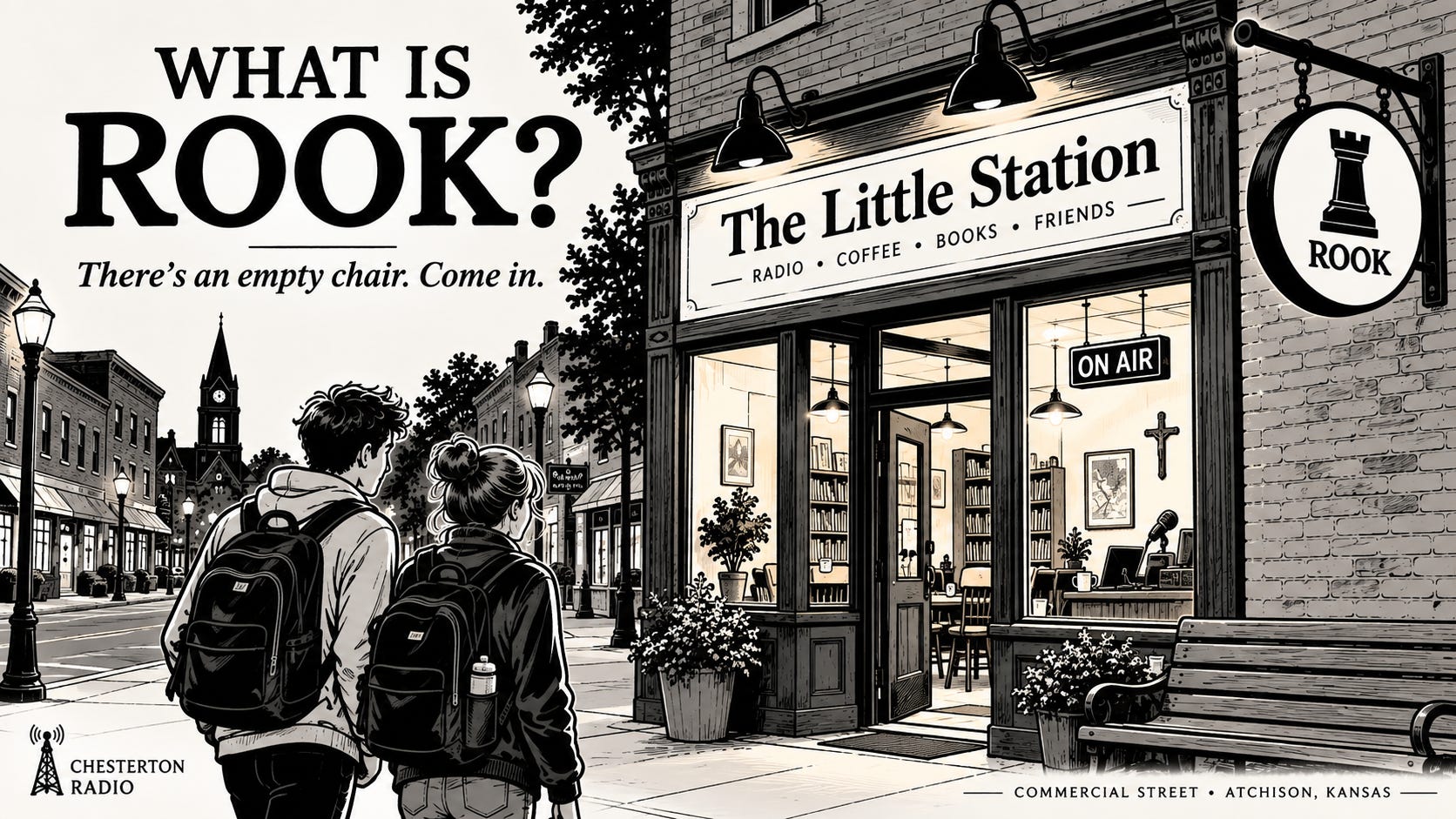
There is a little radio station on Commercial Street in Atchison, Kansas.
There is coffee inside.
Old books.
A radio that is almost always playing.
And every so often, a college student wanders through the door.
That is where ROOK begins.
A comic about the years between
ROOK follows a group of college students through that peculiar stretch of life when you are old enough to make enormous decisions—and young enough to have absolutely no idea how enormous they are.
What will I do?
Where will I live?
Who will I marry?
What am I actually good at?
What does God want me to do?
And, considerably more urgently:
Is this assignment due tonight?
That’s the world of ROOK.
There are football games and dance rehearsals. Goalkeepers and engineers. Professors and roommates. Coffee, bad ideas, good friends and occasional moments of unexpected wisdom.
Most of the time, the characters are simply trying to get through the week.
Which is usually when something interesting happens.
Meet the Little Station
At the center of ROOK is a tiny radio station known simply as the Little Station.
It is part radio studio, part coffee shop, part reading room and part refuge.
It is the sort of place where you can come in intending to stay five minutes and discover an hour later that you’re discussing God, marriage, football, engineering, Chesterton—or why nobody warned you that adulthood involved this much paperwork.
The Little Station owes something to an old idea from Father Robert Griffin of Notre Dame.
He imagined Darby’s Place: a place of hospitality, stories, conversation and friendship.
ROOK’s Little Station lives somewhere in that tradition.
Campus is where life happens.
The Little Station is where the characters sometimes figure out what happened.
Why a comic strip?
Because six little black-and-white boxes can do something wonderful.
They force you to notice small things.
A look.
An empty chair.
A goalkeeper still wearing her gloves.
A dancer carrying her shoes.
A cup of coffee between two people who don’t quite know what to say.
ROOK deliberately borrows the visual language of the old newspaper comic strip. Black ink. White page. Minimal scenery. A few characters. Usually six panels.
No cinematic universe required.
You should be able to discover ROOK today without knowing anything that happened yesterday.
But if you stay awhile, you’ll begin recognizing the people.
And perhaps recognizing yourself.
Is it a Catholic comic?
ROOK lives in a Catholic world.
That means faith isn’t added to the story as a lesson at the end.
It’s simply there.
These characters go to Mass. They wrestle with vocation. They encounter Scripture. They make mistakes. They forgive each other—sometimes. They wonder what God is doing with their lives.
But ROOK isn’t interested in turning its characters into little sermon-delivery machines.
Sometimes the Catholic message is explicit.
Sometimes it is simply this:
Sit down. There’s room for you at the table.
On Sundays, the strip becomes Sunday ROOK, taking its inspiration from the Gospel of the day.
The rule is still the same:
Story first.
Why ROOK?
Because there is something extraordinary about ordinary life.
G.K. Chesterton understood that.
The pub matters.
The meal matters.
The joke matters.
The friend sitting across the table matters.
And a perfectly ordinary Tuesday afternoon may turn out, years later, to have been one of the most important afternoons of your life.
College is filled with moments like that.
Someone is arriving.
Someone is graduating.
Someone is falling in love.
Someone is changing majors.
Someone just won the game.
Someone just lost it.
Someone thinks they know exactly where they’re going.
Someone else has no idea.
And tomorrow morning they all have class.
That is the world ROOK inhabits.
So, what is ROOK?
It’s a comic strip.
It’s a little college town.
It’s a group of friends.
It’s football and dancing and engineering and coffee and faith and all the ridiculous conversations that happen along the way.
And somewhere on Commercial Street, the light is still on at the Little Station.
The radio is playing.
Someone has put on another pot of coffee.
And there’s an empty chair.
Come in.