

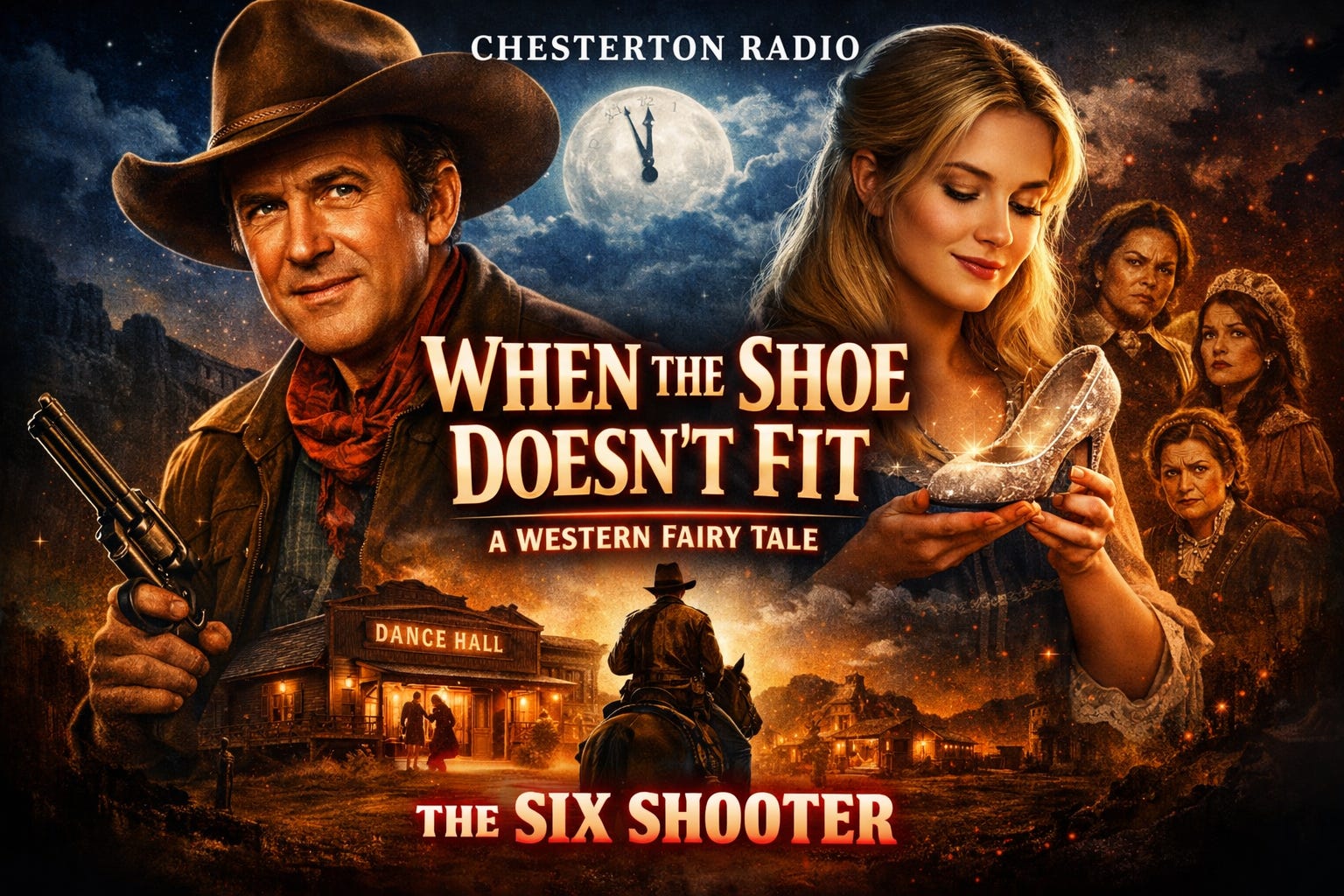
There are many ways to retell a fairy tale. One may place it in a castle, or in a forest, or in the polite drawing rooms of civilization. But only a genius would think to retell it on horseback.
In the June 17, 1954 episode of The Six Shooter, titled “When the Shoe Doesn’t Fit,” the wandering cowboy Britt Ponset — played with unmistakable warmth and wit by Jimmy Stewart — rides into a frontier town and stumbles upon what is, unmistakably, Cinderella.
But this is not a tale of glass slippers and pumpkin coaches. It is a story of square dances and dusty streets. Of a shy young woman burdened by a cruel stepmother and grasping stepsisters. Of a social event that promises escape. And of a midnight deadline that may change everything.
It is, in short, a fairy tale disguised as a Western.
A Cowboy in the Kingdom of the Ordinary
Britt Ponset is no fairy godmother. He carries no wand — only a quiet moral clarity and a six-shooter. Yet like all true heroes of fairy stories, he wanders without belonging anywhere, and thus belongs everywhere.
When he encounters Cindy Lou Ames — the episode’s frontier Cinderella — he sees what others do not: dignity beneath humiliation. Hope beneath drudgery. A princess hidden in plain sight.
The town prepares for a dance — its rustic equivalent of the royal ball. Cindy Lou dreams of attending. But the tyranny of domestic pettiness stands in her way. And here the episode does something marvelous: it treats cruelty not as melodrama, but as something small, mean, and tragically common.
Fairy tales endure because they exaggerate truths we recognize. The wicked stepmother is merely the magnification of everyday envy. The glass slipper is the symbol of identity — that mysterious, fragile thing that fits only one soul.
And Britt Ponset, wandering philosopher of the plains, becomes the unlikely agent of grace.
Why Fairy Tales Refuse to Die
The modern mind often treats fairy tales as sentimental relics — sugar-coated fantasies for children. But this episode quietly argues the opposite.
Fairy tales endure because they speak of justice.
They endure because they insist that hidden goodness will be revealed.
They endure because they proclaim that humiliation is not destiny.
In the dusty West of The Six Shooter, there are no castles. Yet there are still balls. There are still tyrants. There are still lost slippers.
And there is still midnight.
The brilliance of this episode lies in how naturally it translates the archetype. The shoe that “doesn’t fit” is not merely footwear. It is the misalignment between who we are and who we are told to be. The wrong life. The wrong place. The wrong judgment.
Fairy tales whisper: You are not what they say you are.
The Western as Myth
It is no accident that the Western lends itself so well to fairy tale. The frontier is already mythic territory. It is a land of moral absolutes and wandering knights disguised as cowboys.
In many ways, Britt Ponset is closer to a knight-errant than a hired gun. He intervenes not for money, nor glory, but because something inside him refuses injustice.
That is the true fairy element — not magic, but moral courage.
When the clock strikes midnight and truth is revealed, the transformation is not supernatural. It is human. And that may be more miraculous.
A Word on Jimmy Stewart
Jimmy Stewart brings to Britt Ponset the same gentle decency he brought to countless roles on screen. His voice carries hesitation and kindness in equal measure. He does not thunder justice; he suggests it.
And in that suggestion lies the entire charm of the episode.
A lesser actor might have turned this into parody. Stewart makes it feel inevitable — as though Cinderella had always lived on the American frontier and we simply had not noticed.
Why This Episode Belongs on Chesterton Radio
At Chesterton Radio, we often say that the Golden Age of Radio preserved something modern entertainment frequently forgets: wonder.
When the Shoe Doesn’t Fit is not merely a Western episode. It is a reminder that fairy tales are not fragile antiques. They are living forms. They can ride a horse. They can wear boots. They can survive dust.
And perhaps that is the most Chestertonian idea of all — that the old stories are not old at all, but eternally young.
Listen Now
🎧 You can hear the full episode here on our YouTube channel:
Settle in. Pour something warm. Let the hoofbeats begin.
And if you believe — as we do — that stories like this deserve to survive without interruption, consider joining our Listener’s Club on Substack. Chesterton Radio is listener-supported, independent, and devoted to keeping the theatre of the mind alive.
Because sometimes, when the shoe doesn’t fit…
…it is the world that needs adjusting.
Chesterton Radio
Stories that stir the mind. Drama that feeds the soul.