

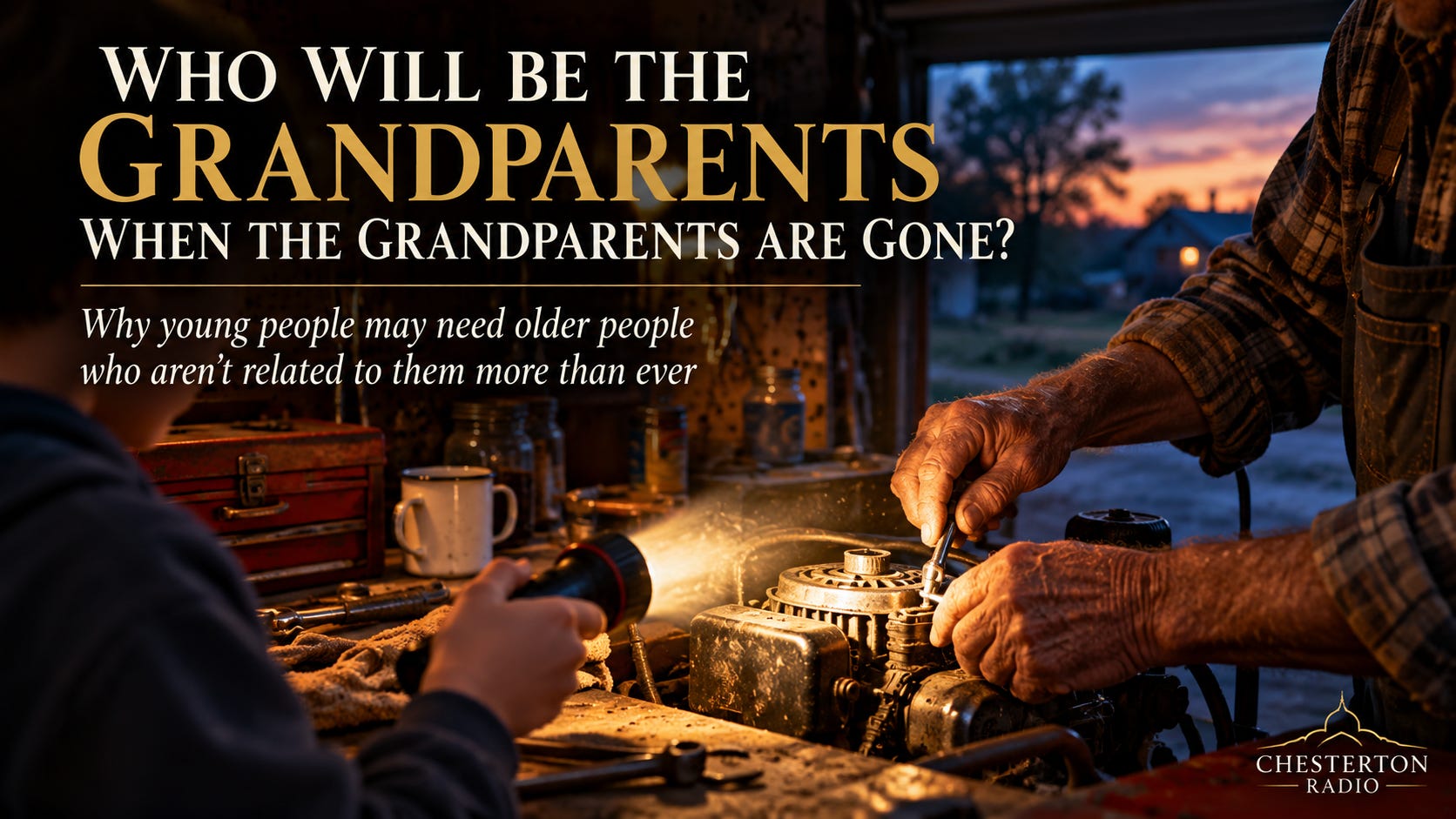
There was once a particular job given to children in garages.
You held the flashlight.
This sounded simple enough until you attempted it. Apparently there were a remarkable number of ways to hold a flashlight incorrectly.
“Right there.”
You moved it.
“No. Where it was.”
You moved it back.
“Hold it still.”
The man under the car might have been your father or grandfather. He might have been the neighbor from two houses down, your uncle, the fellow who ran the repair shop, or somebody who had known your family since before you were born.
He was doing something mysterious with a wrench in a place you couldn’t quite see.
You were helping.
At least technically.
What you didn’t know was that something else was happening.
You were watching how an older person confronted a problem.
A bolt wouldn’t move. He didn’t declare the automobile defective and order another one. He tried a longer wrench.
That didn’t work.
He sprayed something on it.
He waited.
He tried again.
Perhaps he said something unsuitable for publication.
Then he laughed.
There was no curriculum. Nobody called it mentoring. No one developed learning objectives or handed you a certificate when it was over.
You were simply there.
Years later, you may remember almost nothing about the repair. But you remember the garage. You remember the tools. You remember the voice saying, “Don’t force it.”
And eventually you discover that he wasn’t only talking about the bolt.
That is one of the peculiar things about older people.
Sometimes it takes half a lifetime to understand what they were teaching you.
And the person teaching you did not necessarily have to be your grandfather.
The People Who Remembered Before You Did
Grandparents occupy a strange position in a child’s life.
Parents know your beginning.
Grandparents know what came before it.
They remember your mother when she was eight.
They know your father once had hair.
They know which stories he would prefer were not told at Thanksgiving, which is usually why they tell them.
They remember houses that no longer exist and people whose names survive only because somebody still speaks them aloud. They remember the first car, the terrible job, the uncle nobody talks about, the Christmas when there wasn’t much money, the recipe nobody ever wrote down correctly.
A grandparent stretches a child’s timeline backward.
Without them, history can seem like something that happened to strangers.
With them, history has a kitchen table.
This is part of what grandparents have traditionally given children: not merely affection, presents or emergency babysitting, but continuity.
They are evidence that the world existed before you arrived.
That is more important than it sounds.
A fourteen-year-old can easily believe that the catastrophe occurring this afternoon is unprecedented in human history. A grandfather has an unfair advantage in such situations. He has already survived fourteen.
The girl who thinks one humiliation will define her forever may benefit from knowing someone who barely remembers his own humiliations from 1968.
The young man convinced that his career must be perfectly planned at twenty-two might profit from meeting somebody who has had four careers, been fired twice, moved six times and somehow ended up all right.
This is not because older people are automatically wise.
They aren’t.
Age can produce wisdom, but it can also produce an elderly fool.
There have always been cantankerous grandfathers, impossible grandmothers, bad advice, old grudges and family dinners that lasted approximately three hours longer than civilization could reasonably sustain.
Age itself confers neither goodness nor good judgment.
But it does confer one thing that cannot be acquired any other way.
Lived time.
You cannot read your way into having been seventy.
You cannot download forty years of marriage.
You cannot watch a tutorial called “What It Feels Like to Bury Your Parents.”
Some things can only be known by having remained alive long enough to know them.
And once upon a time, younger people encountered people who possessed that knowledge almost automatically.
Increasingly, they don’t.
A World Sorted by Age
Consider how efficiently we now sort human beings according to the year they were born.
A five-year-old spends his day with five-year-olds.
A fourteen-year-old spends his day with fourteen-year-olds.
College students may live, eat, study and socialize almost entirely among people separated from them by only a few years.
Young professionals find other young professionals.
Parents of small children find other parents of small children.
Retirement communities gather retirees.
None of this is sinister. Much of it is convenient, enjoyable and perfectly sensible.
But taken together, it creates an odd result.
People can live in the same town and inhabit completely different worlds.
A nineteen-year-old and a seventy-nine-year-old might shop at the same grocery store, drive the same streets and complain about the same weather without ever having a conversation longer than “Excuse me.”
We speak frequently about diversity, but age may be one of the dimensions along which ordinary life has become remarkably homogeneous.
The young know the young.
The old know the old.
And each generation becomes slightly mysterious to the other.
The young begin to imagine that old people were somehow born old.
The old begin to suspect that civilization ended shortly after the young learned to use smartphones.
Neither is helped by the distance.
Something is lost when generations cease to know one another as individual people rather than demographic categories.
And the loss runs in both directions.
What the Young Lose
A young person surrounded almost entirely by other young people receives a distorted picture of life.
This is not because young people are deficient. It is because they are young.
Everything is happening for the first time.
First love.
First heartbreak.
First real failure.
First job.
First firing.
First child.
First serious illness.
First encounter with death.
These experiences deserve to be taken seriously. But they also benefit enormously from the presence of someone for whom they are not first experiences.
An older person can provide scale.
Not answers, necessarily.
Scale.
There is a difference.
Sometimes a twenty-year-old doesn’t need somebody to solve the problem. He needs somebody who can demonstrate, merely by sitting across the table, that human beings have survived problems before.
Older people can also provide something increasingly scarce: relationships that exist outside the machinery of peer approval.
Your grandfather probably did not care whether you were popular.
Your grandmother was unlikely to be impressed by your follower count.
The older mechanic teaching you to change brake pads may have had absolutely no interest in your personal brand.
There is freedom in that.
A healthy relationship with an older adult gives a young person somewhere to stand outside the relentless judgment of people his own age.
It also exposes him to another way of measuring a life.
At twenty, five years seems enormous.
At seventy, five years is what happened while you were looking for the screwdriver.
The presence of old people quietly teaches that life has seasons.
There will be years when you are strong and years when you aren’t. Years when you are needed every hour of the day and years when the telephone doesn’t ring enough. There will be beginnings that feel like endings and endings that turn out to be beginnings.
Young people can be told these things.
It is different to know someone who embodies them.
What the Old Lose
But this is only half the story.
We often talk about older people as though their principal social task is to receive assistance.
How do we care for them?
How do we keep them safe?
How do we provide transportation, medical care, housing and companionship?
These are good questions.
But there is another question that may matter almost as much:
Who still needs them?
There is a profound difference between being cared for and being needed.
Modern societies have become extraordinarily good at retirement in one sense. We have created an entire stage of life in which people may live twenty or thirty years after leaving full-time employment.
That is a tremendous achievement.
But it creates a peculiar problem.
A person can spend forty-five years becoming useful and then, on a Friday afternoon, receive a cake, a watch and the cultural message:
Thank you very much.
We no longer require you.
The engineer who has solved problems since 1974 suddenly has nobody asking him how he would solve this one.
The teacher who guided thousands of children is no longer expected in a classroom.
The machinist who can hear when a bearing is wrong walks past a generation that has never touched a lathe.
The grandmother who cooked for eight people every Sunday now eats alone because everyone is busy.
We sometimes speak as if the great problem of old age is that older people need too much from the rest of us.
Perhaps another problem is that we need too little from them.
Research into intergenerational programs is still developing, and the studies vary considerably in design and quality. But systematic reviews repeatedly find promising benefits when younger and older people actually spend meaningful time together: improved social connection, better attitudes across generations, a stronger sense of inclusion, and in some studies improvements in well-being. A recent review of programs involving young adults and people over 65 found positive outcomes for both generations in most of the studies examined.
That shouldn’t be terribly surprising.
Human beings like to be useful.
An older person who teaches a child to make bread isn’t merely filling the child’s afternoon.
She is making bread again for someone who wants to know how.
The distinction matters.
Somebody Else’s Grandfather
This brings us to an overlooked possibility.
Not everybody has grandparents.
Some have died.
Some live a thousand miles away.
Some families are estranged.
Some grandparents are ill.
Some were never capable of being the grandparents anyone needed.
And some young people have loving grandparents whom they see twice a year because modern families can scatter across a continent with remarkable efficiency.
Family cannot simply be replaced.
We should not pretend otherwise.
A grandfather is a grandfather.
But one of the great human capacities is our ability to form relationships that extend beyond blood.
Sometimes an older person quietly becomes important in a young person’s life without either of them deciding that this is what is happening.
It might be the retired teacher who continues asking how school is going.
The neighbor who knows how to fix lawn mowers.
The older couple who discover that a college student can’t get home for Thanksgiving and add another chair to the table.
The professor who treats an uncertain nineteen-year-old’s ideas as though they might actually be worth hearing.
The coach who keeps answering the telephone long after the uniform has been put away.
The retired engineer who looks at a student’s contraption, studies it for a moment and says:
“All right. Show me what you’ve got.”
Nobody fills out an application to become an honorary grandfather.
Nobody announces that the relationship has begun.
One day, twenty years later, you realize that is what it was.
Research has specifically examined programs that bring unrelated older adults and children together. The results are encouraging, although researchers rightly caution that the evidence is not uniform and that not every organized program produces the same benefits.
But perhaps the most important word there is not program.
It is together.
Holding the Flashlight
Some of the strongest relationships between generations form when nobody is trying particularly hard to form a relationship.
They are doing something else.
This may be one reason formal efforts at “mentoring” sometimes feel awkward. Two people are placed across a table and instructed to have a meaningful relationship.
Human beings do not always work that way.
Give them a broken lawn mower.
Now we have possibilities.
Put an older carpenter and a teenager in front of a crooked cabinet.
Ask a retired engineer to help a group of students build something that stubbornly refuses to work.
Put a grandmother and a twelve-year-old in a kitchen with flour, butter and a recipe containing the deeply unhelpful instruction “until it looks right.”
Let people garden together.
Restore something.
Coach something.
Sing something.
Run a radio station.
Build scenery.
Serve meals.
Repair bicycles.
Make music.
Conversation has a curious habit of appearing when conversation is not the official purpose of the meeting.
There is less pressure when both people are looking at the same broken object instead of directly at one another.
The hands stay busy.
Silence is permitted.
Then someone says something.
A story follows.
The young person asks a question.
The older person gives an answer, perhaps too long an answer.
Another question comes.
And somewhere between the stripped screw and the missing socket, a human inheritance changes hands.
A boy may learn more about becoming a man while holding a flashlight than during an hour officially devoted to “life skills.”
Not because anyone planned it.
Because he was there.
What Cannot Be Downloaded
There is an obvious objection.
Young people today don’t need an old man to show them how to repair a lawn mower.
They have YouTube.
And that is true.
It is also wonderful.
A person with curiosity and an internet connection has access to an astonishing storehouse of human knowledge. You can learn woodworking, calculus, welding, piano, plumbing, gardening, cooking and engine repair without leaving your house.
An AI can explain why the engine won’t start.
A video can show exactly where the hidden fastener is located.
This is progress.
But information and inheritance are not quite the same thing.
YouTube can show you how to rebuild an engine.
It cannot remember your father when he was twenty-three.
A database can preserve your grandmother’s recipe.
It cannot tell you why she always made it on the first cold Sunday in November.
An AI can explain how to use a hand plane.
It cannot place an old one in your hands and say, “Your grandfather taught me with this.”
Information answers the question:
How is this done?
Inheritance answers another:
Who taught you?
That question leads backward through human beings.
Someone showed me.
And someone showed him.
And somebody showed her.
This is how enormous portions of civilization traveled through history without ever becoming content.
Not uploaded.
Not archived.
Given.
The Longer Memory
This may be the deepest thing older people offer the young.
They extend memory beyond the boundaries of one’s own life.
Every generation is tempted to believe it invented both virtue and catastrophe.
Older people complicate the story.
They remember when today’s shocking new problem had another name.
They also remember problems that genuinely were solved.
They know that fashions reverse, institutions change, neighborhoods rise and fall, careers wander, children grow up, grief alters shape and astonishingly important controversies can become astonishingly unimportant.
Again, this does not make every old person’s opinion correct.
Sometimes the young person is right.
Sometimes the old way really was worse.
Sometimes a tradition deserves to disappear.
The purpose of intergenerational friendship is not to make the young obedient to the old.
Nor is it to make the old imitate the young.
It is to give both generations a larger world.
Young people bring energy, questions, irreverence, possibility and the useful habit of asking why something must be done the way it has always been done.
Older people bring memory, proportion, experience and the equally useful habit of remembering why it was done that way in the first place.
Occasionally the answer will be, “No good reason.”
Everyone benefits.
Creating Places Where It Can Happen
We do not need a government department to assign everyone a grandfather.
Nor should every ordinary human relationship become a program with a logo.
What we need are places where generations can encounter one another while doing real things.
Schools can invite experienced people back into workshops and classrooms.
Colleges can connect students with retired professionals who still want difficult problems to think about.
Libraries can teach skills instead of merely hosting events.
Community theaters need people backstage as much as onstage.
Volunteer organizations can deliberately mix ages rather than unconsciously sorting them.
Churches can do more than place young people in one room and older people in another.
Neighborhoods can rediscover the radical social technology known as asking someone for help.
Families can add a chair.
That may be enough.
The goal is not to manufacture intimacy.
It is to create the conditions in which intimacy becomes possible.
There are probably thousands of older people sitting in houses full of tools, recipes, books, stories and experience who have quietly concluded that nobody particularly wants what they know.
There are probably thousands of younger people a few streets away trying to learn things entirely by themselves.
Perhaps they should meet.
The research gives us reason to think such contact can be good for both sides. Reviews of intergenerational engagement have found benefits ranging from social inclusion and reduced ageism to stronger relationships and well-being, while also warning that the evidence varies and that meaningful activity matters.
But there is a less scientific way of putting it.
People need people who are not exactly like themselves.
The young need people who remember.
The old need people to whom remembering is useful.
When the Grandparents Are Gone
Eventually, of course, the grandparents are gone.
That has always been part of the arrangement.
Perhaps that is why the question in the title is slightly wrong.
The question is not really who will replace them.
Nobody will.
The better question is whether the things grandparents once carried must disappear with them.
The patience.
The stories.
The skills.
The family jokes.
The standards.
The recipes.
The willingness to spend an entire Saturday fixing something that could probably be replaced for seventy-nine dollars.
The conviction that a younger person is worth teaching even when teaching him takes twice as long as doing the job yourself.
Those things can travel.
But only if someone carries them.
So imagine the garage again.
Many years have passed.
The boy who once held the flashlight is no longer a boy.
His knees hurt when he gets down on the concrete now.
He owns tools whose names he once didn’t know.
There is something broken on the workbench.
Beside him stands someone younger.
Maybe a grandson.
Maybe not.
The younger person watches for a while.
“How do you know how to do this?”
The older man stops.
It is an interesting question.
He has not thought about the answer in years.
Someone showed him.
Maybe his father.
Maybe his grandfather.
Maybe somebody else’s grandfather.
Maybe simply an older man who once decided that a younger person was worth his time.
He hands over the flashlight.
“Here,” he says. “Hold this.”
The beam immediately points in the wrong direction.
“No. Right there.”
It moves.
“Where it was.”
The light comes back.
“That’s it. Hold it still.”
And so the work continues.
Perhaps that is how these things have always survived.
Not because every grandfather lived forever. Not because every family remained together. Not because every lesson was carefully written down.
They survived because sooner or later, someone handed the flashlight to somebody younger.
And stayed long enough to show him where to point it.
A Note from Chesterton Radio
Chesterton Radio is a little station devoted to stories, ideas, drama, conversation and the things worth carrying forward.
If this essay made you remember someone who once took the time to teach you—or made you wonder whether you might become that person for somebody else—please consider becoming a paid subscriber.
Your subscription helps us keep creating original essays, stories, audio programs and broadcasts for people who still believe that some things are worth passing on.
And if someone came to mind while you were reading this, send it to them.
Sometimes remembering is the beginning of handing something on.
Sources & Further Reading
Savino, De Luca, Nocentini & Menesini — “Intergenerational interventions and their impact on active aging: A systematic review.” International Psychogeriatrics (2026). Review of 26 studies involving young and older adults, finding generally positive outcomes for social inclusion, community cohesion, mental health and attitudes toward aging, while noting variation among programs.
PubMed: Intergenerational interventions and their impact on active aging
Krzeczkowska et al. — “A systematic review of the impacts of intergenerational engagement on older adults’ cognitive, social, and health outcomes.” Ageing Research Reviews (2021). Finds promising effects, particularly in social outcomes, while emphasizing limitations in the existing evidence.
PubMed: Impacts of intergenerational engagement
Peters et al. — “Intergenerational Programmes bringing together community dwelling non-familial older adults and children: A Systematic Review.” Archives of Gerontology and Geriatrics (2021). Particularly relevant to relationships between children and older adults who are not relatives; the authors find promising results but caution against overstating the evidence.
PubMed: Non-familial intergenerational programs
Zhong et al. — “Intergenerational communities: A systematic literature review of intergenerational interactions and older adults’ health-related outcomes.” Social Science & Medicine (2020). Examines non-family intergenerational interactions and their relationship to social, psychological and health outcomes among older adults.
PubMed: Intergenerational communities review
Pew Research Center — “Aging well: How income and health shape older Americans’ lives.” Includes recent data on older Americans’ contact with adult children, grandchildren, extended family and friends.
Pew Research Center: Aging Well