

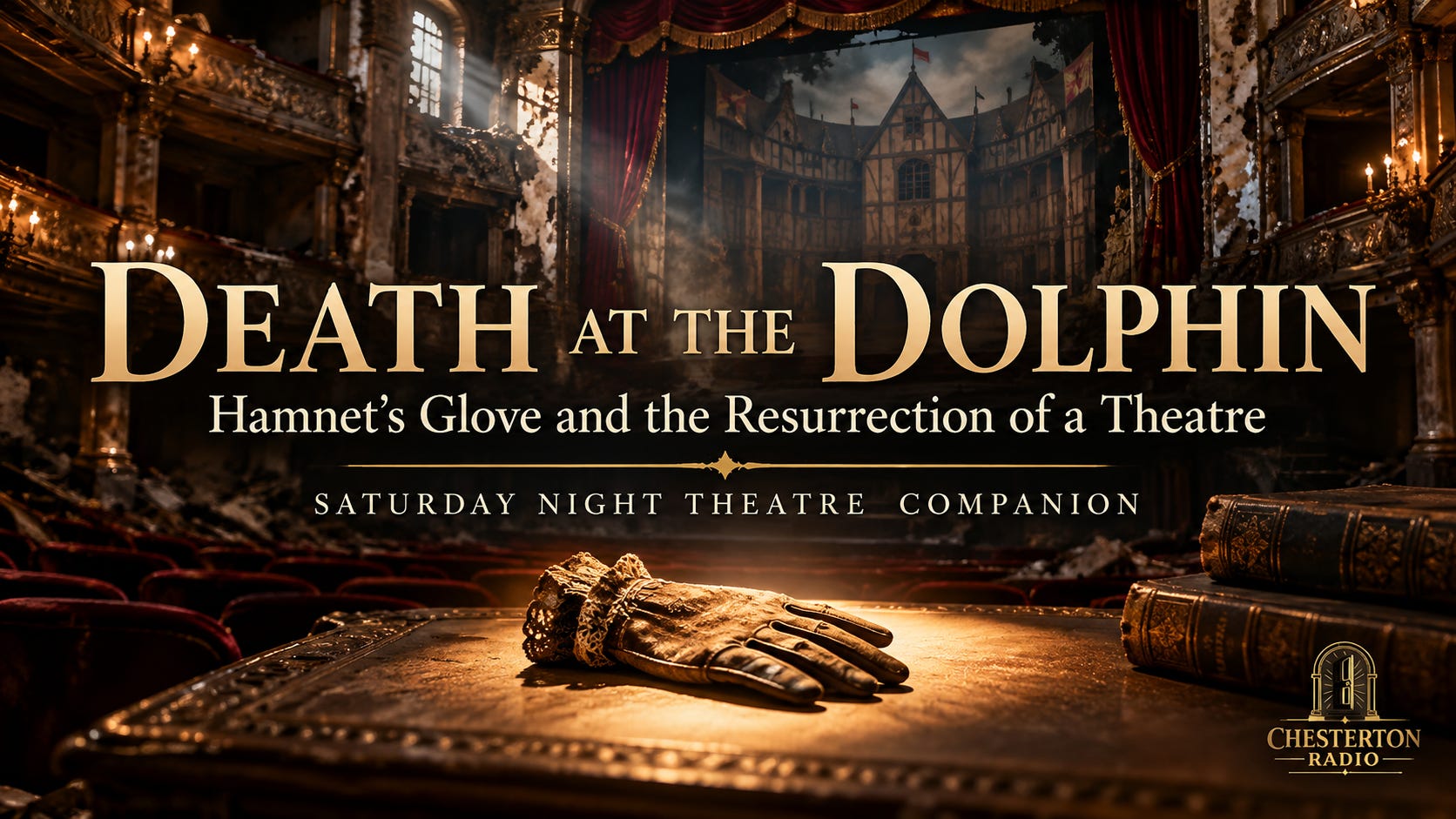
A ruined London theatre. A mysterious benefactor. A playwright with a vision. And a small glove said to have belonged to Hamnet Shakespeare, the only son of William Shakespeare.
In Ngaio Marsh’s Death at the Dolphin, these unlikely pieces come together in one of her richest Roderick Alleyn mysteries—a story in which murder inhabits the strange borderland between theatre and reality, performance and truth, the living and the dead.
In this edition of Listen with Gilbert: The Saturday Night Theatre Companion, we go behind the BBC radio production to explore the remarkable world surrounding the mystery.
We look at Ngaio Marsh’s own deep involvement with the theatre; the possible real-world inspirations behind the ruined Dolphin; postwar London and the restoration of old theatres; the brief and haunting life of Hamnet Shakespeare; and why Marsh’s imaginary Shakespearean glove becomes much more than an antique theatrical curiosity.
There is also a wonderfully Chestertonian question hiding at the center of the story:
Why do ordinary material things become extraordinary when they have been touched by someone we love or remember?
A glove is only leather.
A wedding ring is only metal.
An old theatre is only brick, timber and plaster.
And yet we know they can become something more.
Perhaps the Dolphin itself is a kind of relic. Peregrine Jay does not simply preserve an obsolete building—he restores it to the purpose for which it was made. And when Inspector Roderick Alleyn enters the story, he performs another sort of restoration: taking fragments, appearances and lies and putting them back into their proper order.
We’ll also consider why this intensely theatrical mystery works so beautifully on radio, where the Dolphin must be rebuilt once again—not with bricks and scenery, but with voices, footsteps, music, silence and the imagination of the listener.
About the Saturday Night Theatre Companion
The Saturday Night Theatre Companion is a Listen with Gilbert series from Chesterton Radio exploring the remarkable dramas once heard on BBC Radio’s legendary Saturday Night Theatre.
Rather than simply replaying the programmes, we go behind them—into the authors, actors, history, literature, theatrical traditions and forgotten stories that make these broadcasts worth hearing again.
Think of it as the programme you listen to before or after the play: part listening guide, part cultural history, and part expedition into the enormous lost library of radio drama.
Keep Chesterton Radio on the air
Chesterton Radio is listener-supported. If you enjoy these deep dives, our original productions, classic radio discoveries, Daybreak, ROOK, Morning Prayer and the growing Chesterton Radio library, please consider becoming a paid subscriber or supporting the project through Buy Me a Coffee, Patreon, or the Chesterton Radio Mercantile.
Every subscription and contribution helps us preserve, rediscover and create radio worth listening to.
And when the podcast ends, the radio doesn’t.
The Open Door is Chesterton Radio’s continuous live stream—a place to discover classic drama, comedy, literature, music and new Chesterton Radio productions throughout the day and night.
Come through the Open Door and listen awhile.
Because an old radio recording is rather like the Dolphin Theatre itself.
The actors may be gone.
The studio may be gone.
The original broadcast vanished into the air decades ago.
But press Play—
and the theatre lives again.


