

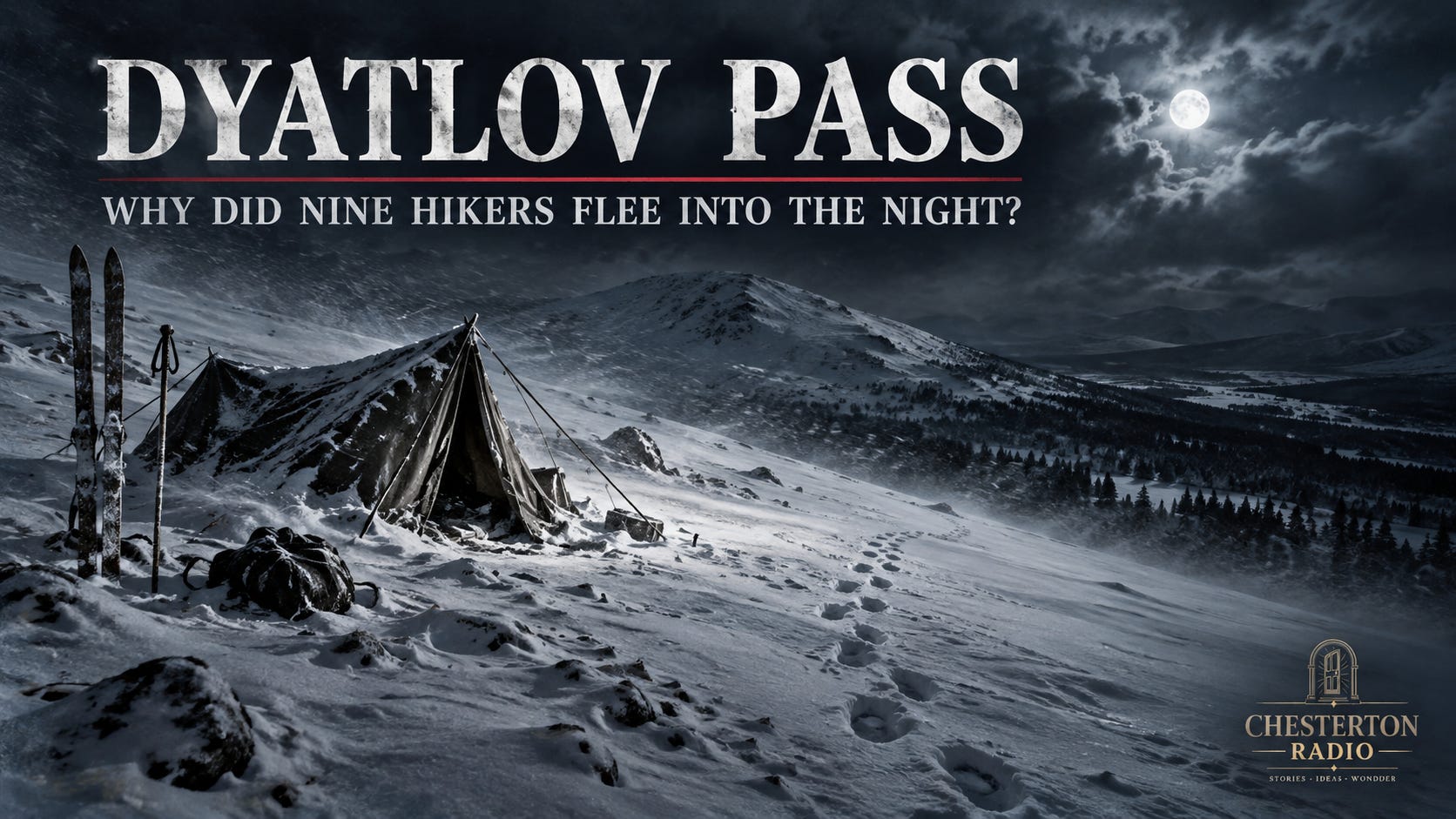
In February 1959, nine experienced hikers disappeared into the frozen wilderness of the Soviet Union’s Ural Mountains.
Weeks later, searchers found their tent abandoned on a remote mountainside.
Their boots were still inside.
Their winter clothing was still inside.
And a trail of footprints led away from the tent—into the darkness and bitter cold.
What could make experienced mountaineers leave their only shelter in the middle of a winter night?
The deaths at Dyatlov Pass became one of the twentieth century’s most enduring mysteries. Over the decades came theories of secret Soviet weapons, strange lights, radiation, murder, military experiments, infrasound, avalanches—and explanations stranger still.
But what does the evidence actually say?
In this Chesterton Radio Deep Dive, we return to the hikers’ photographs and diaries, the original investigation, the strange circumstances in which their bodies were discovered, and the modern scientific attempts to reconstruct what happened on that mountain.
Along the way, we encounter a deeper mystery.
Why, when confronted by something we cannot explain, are we so eager to invent something extraordinary?
And if science can explain what happened at Dyatlov Pass, does that really make the story any less mysterious?
G. K. Chesterton understood that reason and mystery are not enemies. Reason can sweep away the imaginary monsters—and sometimes reveal that reality itself is stranger, more frightening, and more wonderful than the legends we created to explain it.
Nine young people walked into the mountains.
Their footprints still tell part of the story.
This is Dyatlov Pass.


