

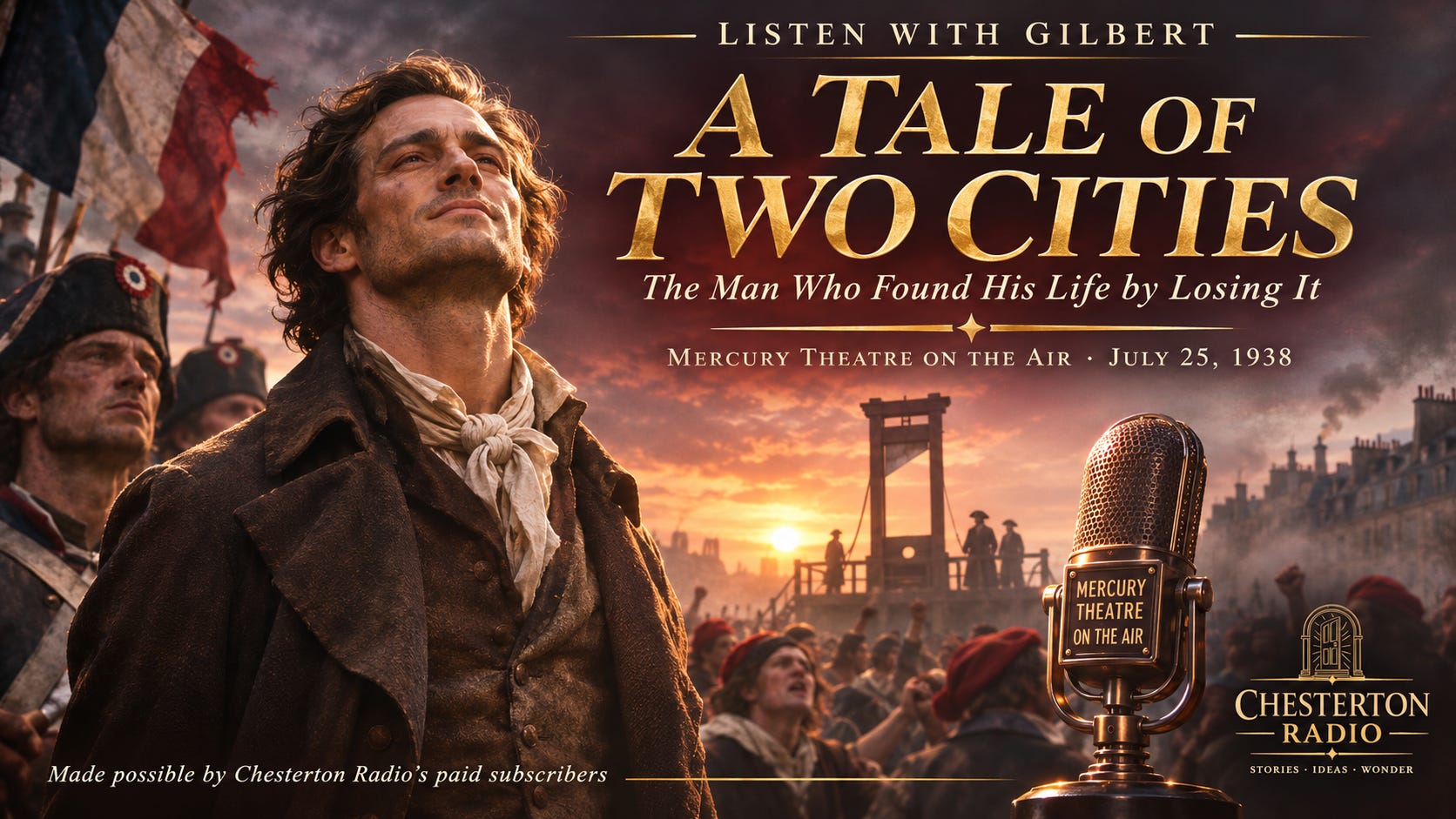
What if the greatest act of heroism in a revolution had nothing to do with overthrowing a government—and everything to do with saving another human being?
On July 25, 1938, Orson Welles and his Mercury Theatre on the Air brought Charles Dickens’s A Tale of Two Cities to American radio. Against the violence of the French Revolution, Dickens tells a story of love, revenge, broken lives, and the extraordinary possibility of redemption.
And at its heart stands Sydney Carton, one of literature’s most unforgettable characters.
Welcome back to Listen with Gilbert, from the Little Station on Commercial Street in Atchison, Kansas.
We’re working our way through the legendary Mercury Theatre broadcasts in their original order. After Dracula and Treasure Island, our third installment brings us to Dickens—and to a story that speaks directly to G. K. Chesterton’s understanding of courage, human dignity, and the paradox of sacrifice.
In this episode, we explore Welles’s remarkable performances, the artistry of radio drama, the terrible contradictions of revolution, and Chesterton’s own fascinating criticism of A Tale of Two Cities.
Can a man who has wasted his life discover its true value in a single extraordinary act? And is the greatest revolution sometimes the one that takes place in the human heart?
Join us for another journey into the golden age of radio, where great stories still have something important to tell us.
Listen with Gilbert — The Chesterton Radio Listening Guide.
This episode is made possible by Chesterton Radio’s paid subscribers. Their generous support keeps the Little Station on Commercial Street broadcasting and makes original programs like Listen with Gilbert possible. Become a paid subscriber at ChestertonRadio.com.
Listen to the original Mercury Theatre broadcast: A Tale of Two Cities — July 25, 1938


