

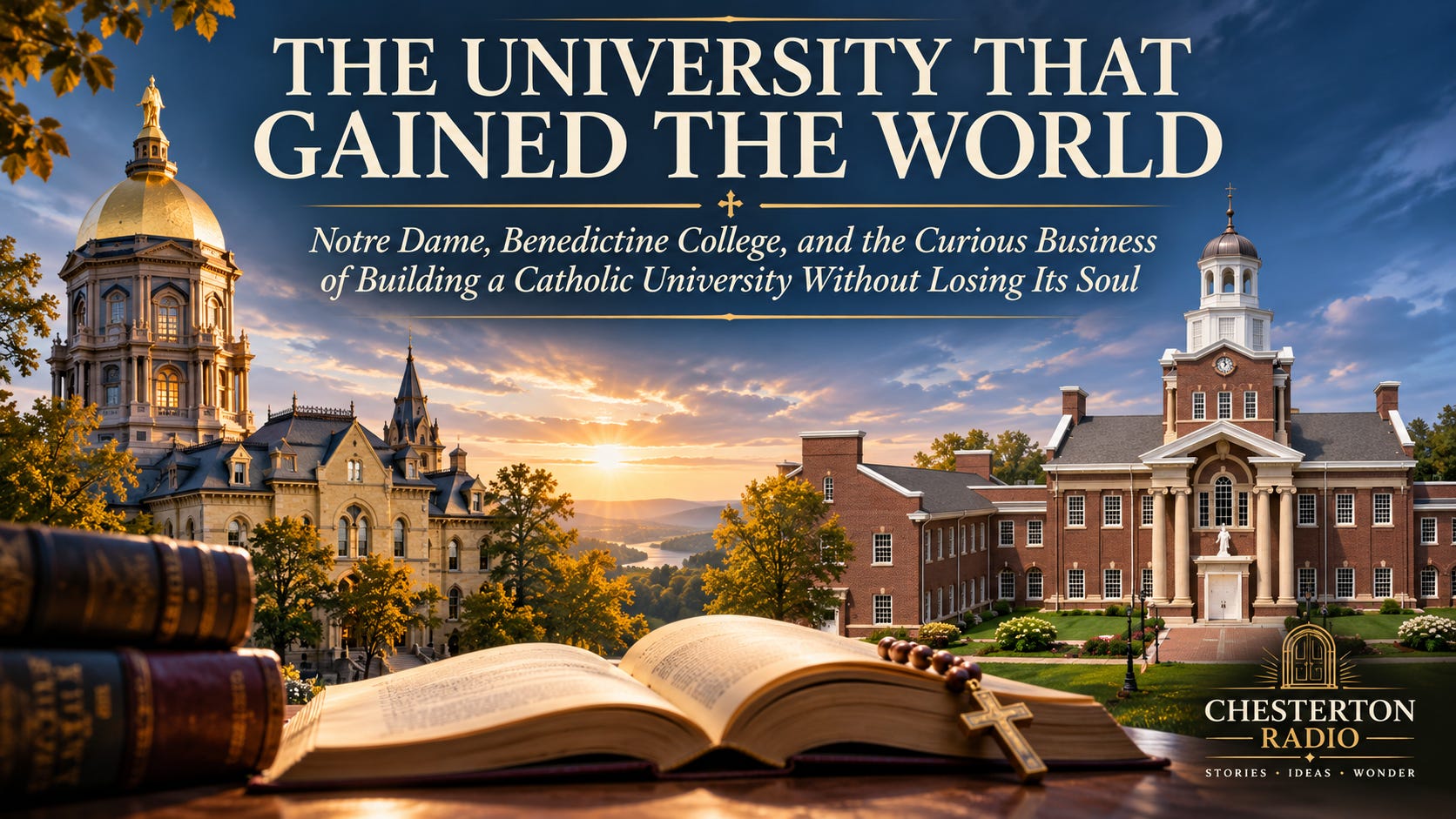
There are many ways to measure the greatness of a university. We can count its students, its professors, its buildings, its research grants, its athletic championships, and, with particular enthusiasm, its money.
Modern universities have become remarkably good at counting these things. They employ people to count them, other people to explain why the numbers ought to be larger, and still others to persuade generous alumni to make them so.
There is nothing wrong with this arrangement. Professors must be paid, buildings maintained, students educated, and bills settled. Even the most faithful Catholic university cannot operate indefinitely on good intentions and holy water.
But there is one thing considerably harder to count.
It is the reason the university was founded in the first place.
I have thought about that distinction often since my two daughters chose Benedictine College instead of the University of Notre Dame, my alma mater.
Both attended Chesterton Academy, where Catholicism was not simply a subject taught in religion class. Their education integrated faith with literature, philosophy, history, mathematics, science, and the ordinary business of learning how to think. The Catholic intellectual tradition was not an extracurricular activity. It was the foundation on which the school understood education itself.
Both were Notre Dame legacies. We believed they would have been competitive applicants.
But neither chose to pursue admission.
It was not that Notre Dame lacked impressive academic programs, accomplished professors, beautiful buildings, or a distinguished reputation. It had all those things, and considerably more.
Their concern was something less easily entered into a college-ranking formula.
They believed attending Notre Dame might represent a step backward in the Catholic formation they had received. Their concerns extended beyond campus ministry or the availability of Mass. They involved the classroom, the assumptions of campus life, and whether they would find themselves surrounded by a community that understood their faith as something more than a private preference.
They worried about belonging. They did not want to spend four years feeling like strangers in a place that ought to have felt like home.
They chose Benedictine College in Atchison, Kansas.
I do not offer their decision as a scientific survey of Catholic higher education. Two students cannot speak for a generation, and their perceptions cannot establish the full character of a university.
But their decision raises a question worth asking.
What happens when a Catholic university acquires nearly everything a university could desire, yet some Catholic families no longer regard it as their natural educational home?
And what happens when another Catholic college attracts precisely those families but must still find the resources to preserve that education for the next generation?
Those questions lead us from the college chapel to the investment office, from the classroom to the boardroom, and eventually to the rather uncomfortable matter of what universities believe they are building.
The Great Catholic Endowment Divide
At the end of fiscal 2025, Notre Dame reported an endowment of approximately $20.09 billion.
Benedictine College’s reported endowment was approximately $68.33 million.
These figures come from Notre Dame’s audited annual report and the FY2025 NACUBO-Commonfund endowment reporting data.
The difference is enormous, although the comparison is not particularly enlightening by itself. A large research university necessarily operates on a different scale from a small Catholic college.
A more useful comparison divides the endowment by the number of students served.
Using fiscal 2025 endowment values and student headcounts for the 2024–25 academic year produces the following approximate figures:
Notre DameBenedictineFY2025 endowment$20.09 billion$68.33 million2024–25 students13,0422,615Endowment per student$1.54 million$26,100
Sources: Notre Dame FY2025 Annual Report; FY2025 NACUBO-Commonfund endowment data; Kansas Independent College Association 2026 Factbook. Student figures are headcounts, not full-time-equivalent enrollment. Endowment per student measures relative institutional resources, not an amount freely available to spend on each student.
Notre Dame possesses approximately 59 times as much endowment per student.
The calculation is imperfect. Endowments contain donor restrictions, academic and athletic programs differ, and institutions vary in their research obligations and graduate enrollment. Yet none of those qualifications makes the underlying disparity disappear.
Notre Dame has financial choices that Benedictine simply does not possess.
A large endowment can provide scholarships, support distinguished faculty, finance academic programs, protect against economic shocks, and allow leaders to make decisions that might otherwise be dictated by immediate tuition revenue.
Consider a hypothetical $50 million addition to a permanent endowment.
With an illustrative annual distribution rate of 4.5%, it could provide $2.25 million in annual support—equivalent to 150 scholarships of $15,000 each.
Of course, investment returns fluctuate. Inflation erodes purchasing power. Administrative costs matter. And donors frequently restrict the purposes for which distributions may be used.
But the principle is sound.
An endowment is an arrangement by which one generation provides for people it will never meet.
The donor gives today. The institution invests. Future students receive some portion of the resulting support. The principal, properly managed, continues working for generations still unborn.
It is a profoundly conservative idea in the best sense of the word.
Indeed, there is something distinctly Catholic about it. Our faith, our universities, our libraries, and much of our civilization are inheritances from people whose names we will never know.
They built something they would not live to enjoy.
We are supposed to do likewise.
The difficulty begins when the preservation of the institution becomes detached from the preservation of its purpose.
An endowment can make a university remarkably capable of doing whatever it chooses.
It cannot tell the university what it ought to choose.
For that, we must turn from finance to history.
Notre Dame and the Price of Independence
Notre Dame did not become wealthy by accident.
Father Theodore Hesburgh, who served as president from 1952 until 1987, transformed an already important Catholic university into a major American research institution.
According to Notre Dame’s account of his presidency, the university’s endowment grew from approximately $9 million in 1952 to $350 million in 1987. Its annual operating budget increased from $9.7 million to $176.6 million, while research funding rose from $735,000 to $15 million.
These are nominal figures, not inflation-adjusted comparisons. Nevertheless, they document extraordinary expansion.
Hesburgh recruited faculty, broadened research, cultivated donors, developed the campus, and elevated Notre Dame’s academic reputation.
His achievements deserve recognition. The fact that some Catholics disagree with decisions made during his presidency does not erase the accomplishment of creating an institution with the resources to compete academically on a national and eventually global stage.
But an important question remains.
What happened to Notre Dame’s understanding of its Catholic identity as its institutional ambitions expanded?
In 1967, the Congregation of Holy Cross transferred Notre Dame’s general governance authority to a new structure involving a Board of Trustees and a Board of Fellows, bringing substantially greater lay participation into its governing arrangements.
The transition is sometimes described as the moment Notre Dame separated itself from the Church.
That is too simple.
The Board of Fellows still includes six Holy Cross clerical members and six lay members. Its stated responsibilities include ensuring that Notre Dame retains its essential Catholic character.
Nor does the historical record support the claim that lay governance first made federal research money available to Notre Dame.
A particularly revealing document in the university archives reports approximately $1.92 million in research grants and fellowships during 1960, principally from government agencies.
The listed sources included the Atomic Energy Commission, the National Science Foundation, the National Institutes of Health, and branches of the armed forces.
The university was receiving federal research support years before the governance transition.
The same 1961 archival release describes an $18 million fundraising campaign whose largest objective was an $8 million library project.
There is a rather useful historical irony here.
Notre Dame was raising substantial sums, receiving government research grants, and building an ambitious library before the celebrated restructuring.
The notion that Catholic universities had to choose between religious governance and participating in the modern financial and academic world is more complicated than is sometimes supposed.
But 1967 remains a turning point.
That summer, Catholic university leaders gathered at Notre Dame’s Land O’Lakes property in Wisconsin and produced a statement that became one of the most disputed documents in modern Catholic higher education.
The Land O’Lakes Statement argued that Catholic universities required genuine institutional autonomy and academic freedom. It also envisioned Catholicism as a meaningful and active presence within university intellectual life.
Those propositions have been in uneasy conversation ever since.
Supporters believed that Catholic universities required sufficient independence to pursue scholarship credibly and participate fully in the intellectual life of their time.
Critics feared that independence from ecclesiastical oversight would gradually become independence from Catholic intellectual and moral commitments.
Neither concern is trivial.
An academic institution must be free to investigate difficult questions, challenge assumptions, and follow evidence.
But a Catholic university also claims that truth possesses a unity that cannot simply be dissolved by departmental boundaries or governing-board resolutions.
The question is not whether a university should possess freedom.
It is what that freedom is for.
In an earlier Chesterton Radio essay, A Friendly Word to Catholic University Presidents at the Notre Dame Land O’Lakes Conference, I explored this tension through an imaginary address in the spirit of G. K. Chesterton.
The central concern was whether institutional autonomy, properly understood as a means of pursuing truth, might eventually become an end in itself.
There is a difference between a university’s freedom to pursue its founding mission and its freedom to forget it.
Notre Dame’s defenders, however, have an important argument.
Former president Father John Jenkins, in his fiftieth-anniversary reflection on Land O’Lakes, argued that the statement’s authors envisioned an academically excellent university in which Catholic theology, worship, intellectual life, and service remained mutually reinforcing.
He also acknowledged that the document failed to develop a sufficiently positive account of the university’s relationship with ecclesiastical authority.
That is a serious distinction. It allows us to criticize the limitations of Land O’Lakes without assuming that everyone who supported it intended to secularize Catholic education.
Notre Dame continues to maintain an extensive Catholic life: liturgy, campus ministry, theology, Catholic scholarship, residence-hall religious communities, and Holy Cross leadership.
Those things are real.
So are the controversies that have influenced how some Catholic families regard the university.
In 2009, Notre Dame invited President Barack Obama to deliver its commencement address and awarded him an honorary degree.
For many Catholics, the decision created a conflict between the university’s claim to Catholic witness and Obama’s positions on abortion and embryonic stem cell research.
Father Jenkins argued that inviting a sitting president to campus was an opportunity for dialogue, not an endorsement of every policy he supported. He explicitly reaffirmed Notre Dame’s opposition to Obama’s positions on those life issues.
His contemporary statement deserves to be read alongside the criticism.
Other debates concerning campus culture, sexuality, pastoral inclusion, and fidelity to Catholic moral teaching have also shaped perceptions of the university.
Respect for the dignity of every person is itself a Catholic obligation. The contested questions concern how institutional policies, public decisions, and academic commitments should reflect the Church’s teaching.
The existence of controversy does not establish that Notre Dame has ceased to be Catholic.
It does establish that Catholic identity cannot be measured solely by a charter, a chapel, a mission statement, or the number of priests serving on a board.
It is encountered in classrooms, residence halls, faculty appointments, intellectual assumptions, campus culture, and the judgments made when Catholic commitments and other institutional ambitions appear to conflict.
And this brings us to an uncomfortable contrast.
Notre Dame has become one of America’s wealthiest universities.
What has that wealth made possible?
What Money Can—and Cannot—Buy
In fiscal 2025, Notre Dame distributed approximately $655 million from its endowment.
According to its annual report, 41% of endowment distributions supported scholarships and fellowships, 24% academic programs, 17% faculty chairs, 13% general operations, 4% athletics, and 1% other purposes.
The university awarded approximately $452 million in scholarships and fellowships that year, with $250 million directly supported by endowment distributions.
Those figures make one accusation impossible to sustain: that Notre Dame has accumulated billions while doing nothing useful with the money.
It has invested heavily in education and access.
Notre Dame’s financial resources support need-blind undergraduate admissions and the commitment to meet demonstrated financial need. They allow the university to recruit talented faculty, maintain academic programs, conduct research, and make decisions that might be impossible for an institution dependent almost entirely on current-year tuition.
For this, Notre Dame deserves credit.
Benedictine and other mission-focused Catholic colleges should study its financial stewardship carefully, even where they differ with its academic culture or institutional priorities.
The goal is not to copy Notre Dame in every respect.
It is to understand the extraordinary freedom that permanent resources can provide.
But there is a danger in treating financial freedom as self-justifying.
A university might possess the means to provide almost any education imaginable. That achievement would not settle the question of which education it ought to provide.
It is possible to be very rich and still have remarkably little idea what one’s riches are for.
To be fair, Notre Dame’s wealth is not an unrestricted bank balance. Its audited statements show substantial donor restrictions and university-designated endowment funds. Gifts intended for scholarships or professorships cannot simply be redirected to another purpose whenever leadership changes its mind.
Even a wealthy university must live within financial and legal constraints.
In fact, Notre Dame’s 2025 annual report describes spending restraint and a more cautious approach to new construction amid changes in its economic environment.
The university’s endowment provides choices.
It does not remove the responsibility to choose wisely.
That responsibility is no less important at a smaller Catholic college.
The Curious Business of Tuition
Another peculiarity of American higher education deserves attention.
Colleges publish tuition prices that many students will never actually pay.
For the 2026–27 academic year, Notre Dame lists undergraduate tuition of $69,280. Benedictine lists $38,200, before applicable mandatory fees, housing, meals, and other costs.
Neither figure tells a family what it will necessarily pay.
Students receive grants, institutional aid, merit awards, need-based assistance, and other forms of support. Some are funded by permanent endowments. Others are principally discounts against tuition revenue the college would otherwise seek to collect.
The National Association of College and University Business Officers reported that participating private nonprofit institutions estimated an average tuition discount rate of 57.1% for first-time, full-time students in 2025–26, and 51.3% for all undergraduates.
Those are national survey averages, not the actual discount rates at Notre Dame or Benedictine.
Still, they expose something curious about the economics of higher education.
A college may raise its published tuition and celebrate an increase in enrollment while collecting less inflation-adjusted net tuition revenue per student than it did the year before.
Indeed, NACUBO’s 2026 report found that average net tuition and fee revenue per student fell in real terms between 2023–24 and 2024–25 among participating institutions.
There is nothing inherently improper about tuition discounting. It may help families afford an education that would otherwise be beyond their reach.
But it complicates the university’s financial picture.
A scholarship financed by endowment income does not have the same long-term financial implications as an additional institutional discount financed from current operating resources.
Nor should net price—the estimated cost after certain kinds of aid—be confused with tuition discount rate.
One measures an amount students may pay under a particular definition. The other describes a relationship between gross tuition charges and institutional grants.
The difference matters to parents trying to choose a college.
It matters even more to trustees trying to keep one solvent.
For a tuition-dependent institution, more students do not necessarily mean a healthier balance sheet.
If additional enrollment produces insufficient revenue to cover educational costs and contribute toward fixed obligations, a larger entering class can disguise financial weakness.
The arithmetic is not particularly romantic.
But neither is insolvency.
Catholic colleges have a special reason to take this seriously.
Families who have already invested heavily in Catholic elementary and secondary education frequently arrive at the college admissions process having made considerable sacrifices for their children’s formation.
If a Catholic university regards those families as central to its mission, affordability must be more than an attractive paragraph in an admissions brochure.
It must be supported by a sustainable financial strategy.
An endowment cannot answer every question about affordability.
But permanent scholarship resources can help prevent the cost of providing a distinctive Catholic education from falling almost entirely upon each successive generation of parents.
A Catholic university should not become a treasure that everyone is encouraged to admire and increasingly few can afford to obtain.
Benedictine and the Business of Building
It would be easy to turn this story into a simple morality play.
Notre Dame is rich but controversial. Benedictine is faithful but financially constrained. The obvious prescription would then be for Notre Dame to recover its Catholic identity and Benedictine to discover the virtues of an endowment.
There is one difficulty with this account.
Benedictine has already discovered the virtues of an endowment.
Its published strategic plan, Transforming Culture in America, identifies building permanent endowment resources capable of reducing tuition dependency as an institutional priority.
The plan also addresses endowed scholarships, faculty development, academic programs, alumni engagement, institutional financial health, and the college’s distinctive Catholic mission.
Its leadership is not simply stumbling from one construction project to the next.
Indeed, the accounting and advisory firm Forvis Mazars included Benedictine in its 2025 higher-education outlook as a case study in financial discipline, consistent leadership, and mission-focused institutional growth.
The report described the college’s use of financial benchmarks, including retention, staffing productivity, net tuition revenue, discounting, operating margins, liquidity, and debt service.
This does not mean that every decision Benedictine makes is correct.
Even the most sophisticated collection of financial ratios is not a sacrament of infallibility.
But it does mean that criticism ought to begin with the actual evidence rather than a presumption that no financial planning exists.
The college’s tax filings also demonstrate growth.
Its IRS Form 990 reports net assets of approximately $89.5 million in fiscal 2020 and approximately $183 million in fiscal 2025.
Over the same period, reported annual revenue grew from about $89 million to $148.2 million, while expenses increased from approximately $86.4 million to $119.3 million.
Those numbers suggest a substantial strengthening of the overall financial position.
But they require care.
Form 990 revenue includes contributions and investment-related activity. It is not equivalent to recurring operating revenue. Net assets include resources that may be restricted, tied up in facilities, or unavailable for immediate spending.
A growing balance sheet is encouraging.
It does not establish the amount of unrestricted cash available to pay next year’s expenses.
Nor does a new building necessarily strengthen an institution’s permanent financial independence, even when the building was made possible by generous donors.
A building may be paid for.
Its maintenance will not be.
This distinction becomes particularly interesting when we examine Benedictine’s two most ambitious recent initiatives.
A library, a monument, and a bill for electricity
In September 2026, Benedictine dedicated its new Moritz Library in D’Aniello Hall.
The Independence Hall-inspired building includes expanded study space, classrooms, academic offices, and spaces intended to express the college’s commitment to scholarship and civic formation.
At the dedication, President Stephen Minnis described it as a kind of trophy building—a visible turning point in the college’s development.
His remarks argued that the library made Benedictine’s academic and civic commitments visible in the architecture of the campus.
This is not a foolish argument.
Catholics, of all people, should understand that buildings can express ideas. For centuries, churches, monasteries, libraries, and universities have embodied convictions in stone, timber, and glass.
Beauty is not a dispensable ornament of Catholic intellectual life.
Nor is a library merely a warehouse for books.
It is an announcement that learning deserves a permanent home.
But even beautiful announcements have operating expenses.
A building must be cleaned, heated, insured, maintained, repaired, and eventually renovated. Additional space may improve educational quality, but it may also increase the institution’s fixed costs.
So the relevant questions are not whether the building is beautiful or whether its donors were generous.
They are whether the project advances the mission, whether its financing is sound, and whether the college can maintain it without weakening other essential commitments.
What is the full cost of ownership? How much of the project was funded by restricted gifts? What continuing expenses will it create? What measures will demonstrate its contribution to scholarship, student life, recruitment, or retention?
The publicly available information reviewed for this essay does not provide a complete independently verified project-cost and operating forecast.
That means we cannot responsibly pronounce the library either a financial mistake or an unqualified success.
But the questions belong in the conversation.
It is possible to build a magnificent monument to learning while neglecting the financial arrangements needed to keep the lights on.
It is equally possible to build a magnificent library precisely because a sound financial strategy and generous donors have made one feasible.
The evidence must tell us which.
The medical school: a larger ambition
The proposed Benedictine College School of Osteopathic Medicine is a still more consequential undertaking.
In September 2026, the college received Candidate Status from the Commission on Osteopathic College Accreditation. It also reported more than $50 million in philanthropic support and plans for a medical education facility exceeding 110,000 square feet.
Benedictine has applied for the next accreditation stage and hopes to welcome its first class in 2028, subject to the necessary approvals.
This remains a proposed medical school, not an operating one.
Its ambition is understandable.
Medicine touches questions of life and death, suffering and dignity, conscience and the responsibilities of science toward the human person.
A medical school where Catholic moral formation is taken seriously could make a substantial contribution, particularly if it serves rural communities and develops physicians committed to treating patients as persons rather than collections of symptoms.
Benedictine has explicitly connected the project with its mission and its strategic commitment to science, healthcare, and Catholic bioethics.
In an earlier Chesterton Radio examination of the medical-school proposal, we considered the accreditation milestones and the larger philosophical question of what medicine is for.
The question here is financial.
A medical school is not simply another department with additional classrooms.
It requires laboratories, specialized faculty, administrators, clinical training relationships, accreditation compliance, and substantial investment before its first students can graduate.
Benedictine’s published materials also refer to a $50 million accreditation-related escrow requirement.
That should not be confused automatically with the $50 million-plus in philanthropic support reported for the project.
A pledge is not the same thing as cash received. A donor-restricted gift is not a contribution that may be redirected at will. Escrowed money is not necessarily money permanently spent, and it is not the same as a general unrestricted endowment.
These distinctions make a simple accusation—that the college should have put all the medical-school money into endowment instead—financially unsound.
Donors may well have supported the medical school precisely because they wanted a medical school.
But the broader opportunity-cost question remains.
What will it cost to develop and operate the program through the first graduating class? What happens if accreditation takes longer than expected, enrollment develops more slowly, or faculty and clinical costs exceed estimates? How will the new program affect the college’s debt, liquidity, management capacity, and undergraduate mission?
What financial results would constitute success, and over what period?
It is possible that the medical school will prove a remarkable investment in both Benedictine’s Catholic mission and its financial future.
It is also possible that the undertaking will impose new costs and risks that will require sustained support from elsewhere in the institution.
Publicly available information does not yet establish which result is more likely.
The college deserves credit for the progress it has made.
Its trustees also carry the responsibility of ensuring that ambition and resources remain in sensible proportion.
One may have an excellent reason to build a cathedral.
That is not an argument for forgetting the roof.
The Catholic Identity Dividend
There is another possibility that deserves considerably more attention from Catholic college leaders.
What if Catholic identity is not merely an institutional obligation to be financed?
What if it is also one of the institution’s most important advantages?
The growing network of classical Catholic schools offers an opportunity to investigate that question.
The Chesterton Schools Network reported 62 member schools in February 2025. Other classical Catholic high schools operate outside the network, while Catholic elementary and secondary education more broadly continues to serve a substantial national population.
According to the National Catholic Educational Association, approximately 1.67 million students attended Catholic schools in 2025–26.
The entire Catholic school population is not the classical Catholic movement. Nor does the growth of a particular school network establish that its graduates will attend any particular college.
But a plausible educational relationship is already visible.
Students who have spent four years studying literature, philosophy, history, theology, and the liberal arts within a coherent Catholic framework may reasonably prefer a college where that framework continues.
Benedictine already cultivates such relationships.
It offers a dedicated visit experience for Chesterton Academy families, and the Chesterton Schools Network has published accounts of graduates continuing their education at Benedictine.
This is not a hypothetical recruitment channel.
It exists.
The question is how much it matters financially.
Do classical Catholic high school graduates apply in greater numbers? Are they more likely to enroll when admitted? Do they remain through graduation? Are their families more likely to become involved in recruiting future students or supporting the college?
Does their educational background reduce the amount of aid necessary to attract them—or does the financial burden of Catholic schooling make institutional scholarships particularly important?
These are questions to be answered with cohort-level data, not with attractive anecdotes.
But there is a compelling possibility.
A college that offers essentially the same educational experience as dozens of competing institutions must persuade families to choose it through some combination of price, prestige, convenience, programs, and amenities.
A college offering a distinctive education that families actively seek may possess a different sort of advantage.
Its identity may contribute to its enrollment strength.
In our earlier Chesterton Radio episode, Where Should a Catholic Student Go?, we explored the search for colleges that continue Catholic intellectual and spiritual formation.
The financial counterpart to that question is just as important.
If families are choosing colleges precisely because of Catholic identity, preserving that identity is not something separate from preserving the institution’s future.
It may be one of the ways the institution secures that future.
Catholic identity should never be reduced to a marketing slogan.
But there is no rule requiring a genuine educational virtue to be economically useless.
The Coming Enrollment Test
The next generation of college students will not arrive under the same demographic conditions as the last.
The Western Interstate Commission for Higher Education projected that the number of American high school graduates would peak at approximately 3.9 million in 2025 before declining to roughly 3.4 million by 2041.
That is a projected decline of about 13%.
The change will be uneven. Some regions will experience substantial contraction while others remain comparatively stable.
Nor can one assume that a decline in high school graduates translates directly into an identical decline in college enrollment. Participation rates, recruiting geography, institutional reputation, and new educational programs also matter.
Still, the economic challenge is substantial.
A college with fewer students does not automatically have fewer buildings to maintain or fewer academic programs to support.
An underfilled classroom still requires heating. Faculty salaries do not conveniently decline by the same percentage as an entering class.
As pressure increases, institutions may become more aggressive with tuition discounts, athletic recruitment, program expansion, and marketing.
Some initiatives will improve their financial condition.
Others may produce little more than additional complexity.
A strong endowment helps an institution endure uncertainty.
A distinctive mission gives students a reason to choose it.
A disciplined operating model connects those advantages with sustainable educational outcomes.
For Benedictine, national recruitment provides opportunities beyond the Kansas student population. Its 2024–25 enrollment was predominantly from outside Kansas.
But recruiting across the country is not the same as possessing permanent immunity from demographic change.
It requires continued success in attracting, retaining, and graduating students.
The most valuable measure is not simply how many students enroll.
It is whether the college can educate them well, preserve its mission, and sustain the financial resources necessary to do so again next year.
And the year after that.
And after the people currently running the institution have retired.
Who Guards the Inheritance?
There is an interesting complication in the comparison between Notre Dame and Benedictine.
In January 2026, the Benedictine Sisters of Mount St. Scholastica announced that they would discontinue active sponsorship of Benedictine College and withdraw from the governing responsibilities associated with that sponsorship.
The Sisters helped establish the institution whose later merger with St. Benedict’s College produced Benedictine College in 1971.
Their January 23 statement described the decision as the result of discernment about their changing community and ministries.
They also affirmed their continuing affection for the college and their intention to remain involved through hospitality, relationships, and collaboration.
Benedictine College and St. Benedict’s Abbey responded with gratitude for the Sisters’ historic contributions.
The decision should not be interpreted as evidence that Benedictine is abandoning Catholic education.
Nor is it equivalent to Notre Dame’s 1967 governance transformation. The arrangements and circumstances are different.
But the parallel is worth examining.
Both institutions have experienced changes in the formal relationships between their religious founders and their contemporary governance.
That raises a question which cannot be resolved simply by examining the investment portfolio.
Who is responsible for preserving a Catholic college’s identity when its founding religious communities change their institutional roles?
It would be comforting to say that the answer is the president.
But presidents retire.
It would be equally comforting to say that the answer is the board.
But trustees change.
Faculty members arrive and depart. Donors die. Students graduate. Religious communities themselves experience changes in membership and the demands placed upon them.
A mission that survives only because particular people happen to believe in it today has not yet been adequately protected for tomorrow.
Institutional governance must therefore make the mission durable.
That may involve governing documents, trustee responsibilities, faculty formation, academic expectations, relationships with the Church, and deliberate succession planning.
None of this requires the assumption that lay governance is inherently hostile to Catholic identity.
Competent and committed lay Catholics can be exceptional stewards of Catholic institutions.
Nor does religious governance automatically guarantee fidelity or sound administration.
The crucial question is what the governance system actually protects.
Would a future board recognize mission drift before it had become accepted custom?
Could the institution preserve its academic character through changes in leadership?
Would its financial priorities still make sense if a major donor, president, or fundraising campaign disappeared?
These are questions of stewardship, not nostalgia.
An inheritance does not belong exclusively to those who happen to possess it at the moment.
It is held in trust.
The Wrong Mountains
In business management, the Entrepreneurial Operating System uses a discipline known as quarterly Rocks.
Leadership teams identify a limited number of priorities to complete within roughly ninety days. Each Rock has an accountable owner and a measurable result.
The idea is simple: an organization should not confuse activity with achievement.
A university is not an ordinary commercial enterprise. Its purpose cannot be reduced to profit, and the formation of a human being does not fit neatly into a quarterly performance report.
But the principle is useful.
Are we concentrating our resources on the things that matter most?
Or are we merely becoming more efficient at completing the things that happen to be in front of us?
Visible achievements are naturally attractive.
A new library can be photographed.
A medical school can be announced.
A fundraising campaign can be celebrated.
A new academic program can appear in a brochure.
Endowment growth is less dramatic. So is student retention. So is the steady development of faculty, the strengthening of alumni relationships, or the patient work of passing an institution’s Catholic intellectual tradition from one generation of professors to the next.
Yet these less visible efforts may determine whether a college remains capable of fulfilling its mission decades from now.
For a Catholic college, the most important long-term objectives might include preserving the real purchasing power of its endowment, reducing excessive tuition dependence, improving affordability, strengthening retention, expanding genuine alumni participation, and ensuring that major capital projects contribute sustainably to its mission.
Those objectives can be translated into quarterly work.
A finance team might be assigned to develop a five-year analysis of inflation-adjusted endowment per student.
An admissions team might examine yield and retention among graduates of Catholic and classical schools.
Advancement might establish a measurable program connecting alumni classes and regional communities, much as Notre Dame has long done through its alumni networks.
A board committee might require a fully reconciled financial model for a major academic expansion, including downside scenarios and long-term operating obligations.
Another might define how Catholic intellectual and spiritual formation will be evaluated across the institution.
These are not recommendations that Benedictine—or Notre Dame—adopt an entirely new management system. Both institutions have existing governance and planning processes.
They are examples of how long-term objectives can be connected to concrete responsibilities.
The important distinction is between building something and accomplishing what that building was intended to accomplish.
A library is a project.
Strengthening scholarship and the intellectual life of the college is an outcome.
A medical school is a program.
Developing excellent physicians, advancing Catholic medical ethics, and creating a sustainable academic enterprise are outcomes.
A fundraising campaign is an activity.
Increasing permanent financial independence is an outcome.
An alumni magazine is a communication tool.
Building lifelong relationships that strengthen the institution across generations is an outcome.
One can complete every project on schedule and still fail at the larger purpose.
There is something peculiarly modern about our ability to organize the means to an end while growing less certain what the end is.
We become experts in productivity without first settling the question of what ought to be produced.
We build dashboards to monitor progress, but sometimes forget to ask whether we are traveling in the right direction.
A university may become remarkably efficient at moving mountains.
It remains possible that they are the wrong mountains.
What Will Our Grandchildren Inherit?
I return, finally, to my daughters.
Their decision to attend Benedictine was not a verdict on Notre Dame’s investment performance or the quality of its laboratories.
They were choosing the environment in which they wanted to spend four formative years of their lives.
They wanted an education that would continue what they had begun at Chesterton Academy.
That decision illustrates something no financial table can fully capture.
The worth of a Catholic university cannot be reduced to the resources it possesses.
It lies in the education those resources make possible, the truths the institution believes worth pursuing, and the people it hopes its students will become.
But the reverse is equally important.
A college cannot preserve that education for future generations merely by proclaiming its importance.
It must pay its professors, maintain its buildings, provide scholarships, develop its endowment, manage risk, and govern itself competently.
Notre Dame has demonstrated the extraordinary possibilities of permanent financial resources.
Benedictine has demonstrated the appeal of a distinctive Catholic educational identity to families seeking continuity in intellectual and spiritual formation.
Neither institution is beyond criticism. Neither is without achievements worth studying.
Their most important lesson may be that financial stewardship and fidelity to mission are not opposing virtues.
They belong together.
A Catholic university does not exist merely to become wealthy.
Nor does it exist to remain small, underfunded, and perpetually vulnerable in order to prove its religious sincerity.
It exists to pursue truth and form human beings within a particular intellectual and spiritual tradition—and to do so with sufficient prudence that future generations may receive the same opportunity.
The buildings will need renovation. The investments will fluctuate. The presidents and trustees will change.
And eventually our grandchildren will decide which institutions deserve their trust.
When they do, they will care very little how many fundraising campaigns we celebrated or how many ribbon-cuttings we attended.
They will want to know what we preserved for them.
The first responsibility of a Catholic university is not merely to survive.
It is to ensure that what survives remains worth preserving.
Research and methodology
Financial figures are based on the most recent publicly verifiable sources reviewed through November 18, 2026. Endowment balances are reported market values, not unrestricted cash. The per-student comparison divides FY2025 reported endowments by 2024–25 enrollment headcounts. Because the institutions differ substantially in academic programs, graduate enrollment, and research activity, the resulting comparison is an indicator of scale rather than a comprehensive measure of educational spending capacity.
Benedictine’s IRS Form 990 revenue includes gifts and investment activity and must not be interpreted as recurring operating surplus. Endowment-distribution examples are hypothetical. The complete audited lifecycle costs of Moritz Library and the full financial forecast for the proposed medical school were not independently verified. This essay makes no claim to possess internal Benedictine budgets, donor agreements, or trustee deliberations.
Principal sources
Chesterton Radio exists to explore the questions that matter long after the day’s headlines have disappeared—faith, education, literature, history, and the permanent things.
If you value independent Catholic commentary, original programs, and the continuing work of the Little Station on Commercial Street, consider becoming a paid subscriber.
Your support helps us keep these conversations going.

🎙️ Where Should a Catholic Student Go? The Newman Guide, Land O’Lakes, and the Fight for the Soul of Catholic Education

A simple question is quietly haunting Catholic families across the country:
