

A little station with a wide world
A radio station ought to have a little mystery about it.
You switch it on, hear a voice, perhaps catch the middle of a detective story or a piece of music you haven’t heard in forty years, and decide to stay awhile. You weren’t necessarily looking for that program. That’s part of the pleasure.
Chesterton Radio is built around that experience. But it also offers something the old radio stations couldn’t: a daily publication where listeners can read, explore, and return to particular stories whenever they wish.
At ChestertonRadio.com, you’ll find prayer, conversation, essays, comics, classic radio theatre, and original fiction. At The Open Door, the radio plays around the clock.
The station takes its name and much of its character from G. K. Chesterton, the English writer who could find a philosophical argument in a hat, an adventure in a London street, and a good joke in the solemn habits of respectable people.
Chesterton Radio isn’t an attempt to live in the past. It’s an attempt to keep worthwhile things alive, introduce them to new listeners, and make room for new stories alongside them.
And there is quite a lot happening here.
The Little Station on Commercial Street
Daybreak, our daily morning podcast, comes from an imagined broadcasting home: The Little Station on Commercial Street.
It’s a modest place in the mind’s eye. A microphone, a few shelves of books, a radio playing somewhere in the background, and a conversation already underway when you arrive.
The station has a particularly natural connection to listeners in Britain and America. Chesterton was English, but his writing and his enthusiasms crossed the Atlantic. So did much of the literature, music, comedy, and radio drama that Chesterton Radio celebrates.
A morning’s programming might move from a British detective story to an American radio comedy, from Catholic prayer to the history of a popular song, or from a century-old Chesterton essay to a newly written mystery.
There is no requirement that every program be solemn, or even educational. Sometimes a good laugh or a well-constructed murder mystery is quite enough.
But the programs have something in common: they take the listener seriously. They assume that people are capable of enjoying a good story, following an argument, appreciating a piece of music, and occasionally laughing at themselves.
That seems a reasonable basis for a radio station.
Two ways to experience Chesterton Radio
Chesterton Radio has two complementary homes.
The daily publication at ChestertonRadio.com offers articles, podcasts, original comics, literary features, and special productions. You can choose what interests you, browse earlier editions, and subscribe to receive new material.
The Open Door at Live.ChestertonRadio.com is our continuous 24-hour radio stream. Instead of selecting a particular episode, you simply tune in. There may be a mystery, a comedy, a play, a musical discovery, or something entirely unexpected.
One is a library you can browse. The other is a radio you can leave playing.
Neither replaces the other. The daily publication provides the opportunity to follow a particular writer, program, or series. The Open Door provides the companionship and pleasant unpredictability of traditional radio.
You can enjoy either one without using the other. We hope you’ll discover both.
A week at Chesterton Radio
There is a daily rhythm to the station, with special appointments on the weekend and other productions appearing throughout the year.
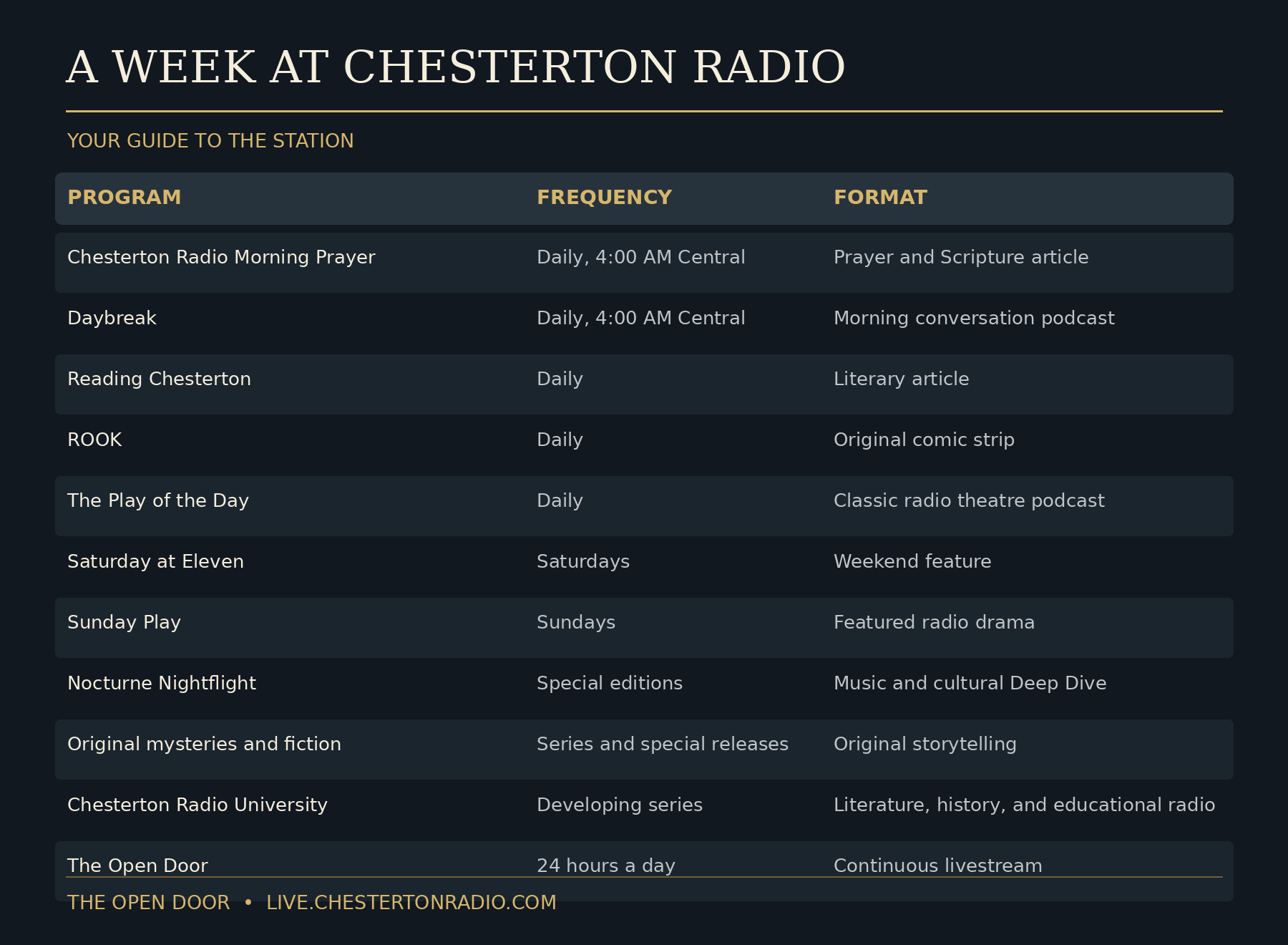
Chesterton Radio Morning Prayer and Daybreak are both published daily at 4:00 AM Central Time, giving early risers a chance to begin the day with prayer and a good morning conversation. ROOK appears daily at noon Central Time. Reading Chesterton, The Play of the Day, and our other features follow the station’s regular publication schedule.
These are features of the Chesterton Radio publication. The Open Door operates continuously, with its own broadcast rotation. It isn’t simply a replay of everything published on Substack.
Here’s what you’ll find.
Begin with Morning Prayer
Before the news, before the day’s obligations, before the first argument over something that probably doesn’t matter very much, there is an opportunity to pray.
Chesterton Radio Morning Prayer is a daily written feature drawing on traditional Catholic prayer and Scripture, including the Douay-Rheims Bible.
It is intended to provide a quiet and orderly beginning to the day, with readings and prayers that connect the reader to the Church’s devotional tradition.
The feature is published as an article, not a daily podcast. Readers can follow the prayers in their own time, return to a passage, or simply sit with the words for a few minutes.
Morning Prayer is an important part of the station’s Catholic character, but it doesn’t require every other program to become a religious discussion. Faith belongs naturally within a world that also contains literature, comedy, music, history, and ordinary human life.
Daybreak: the morning conversation
Daybreak is the daily podcast from The Little Station on Commercial Street.
Its subjects are deliberately varied. One morning might begin with a historical anniversary, another with a classic radio performance, a piece of literature, a cultural controversy, or the story of a musician whose work deserves another hearing.
There is room for education, Catholic life, history, books, music, and the occasional curious news item.
Daybreak is not intended to be a relentless news bulletin. There are plenty of places to hear about the latest crisis.
The idea is to offer a morning conversation worth having.
A good episode should leave the listener with something new to think about, something worth reading, or perhaps a radio play worth finding later in the day.
The program also reflects the station’s transatlantic character. American and British cultural traditions have influenced one another for generations, and Daybreak enjoys discovering the connections.
We like to think of it as the sort of conversation that might continue over a second cup of coffee.
Reading Chesterton: a daily encounter with Gilbert
G. K. Chesterton wrote about nearly everything.
Theology, politics, literature, art, education, marriage, economics, architecture, fairy tales, and the curious habits of modern civilization all came within his reach.
He was also exceptionally good at noticing what other people had stopped noticing.
Reading Chesterton is our daily written feature devoted to his essays, books, arguments, and imagination.
Consider On Running After One’s Hat. Chesterton takes the minor embarrassment of chasing a hat down the street and turns it into a reflection on adventure.
He imagines flooded Battersea streets as a kind of Venice. The physical circumstances are inconvenient, but imagination offers another way of seeing them.
That doesn’t mean every hardship is secretly enjoyable. Chesterton is too sensible for that. It means that our experience of ordinary life depends partly on what we bring to it.
The same instinct appears throughout his writing.
A piece of chalk becomes an occasion for wonder. A discussion of fairy tales becomes a serious argument about reality. An apparently small question opens onto something much larger.
Reading Chesterton invites readers to encounter the original writer rather than merely collect quotations attributed to him.
And because Chesterton could be funny, provocative, surprising, and occasionally exasperating, there is plenty to discuss.
ROOK: a little humor every day
Chesterton Radio also publishes an original daily comic strip.
ROOK is a black-and-white comic built around recurring characters, friendships, family life, ordinary frustrations, and the absurdities of contemporary behavior.
Its humor belongs to the tradition of newspaper comics that could make a point in a few panels without delivering a lecture.
Sometimes the joke is simply a joke.
Sometimes a character discovers that a perfectly reasonable plan has collided with the way human beings actually behave.
And sometimes the strip has something sharper to say about technology, institutions, fashion, education, or the peculiar things people have learned to accept as normal.
ROOK is an original Chesterton Radio production, not a historical strip or a direct adaptation of Chesterton.
But its presence is thoroughly appropriate.
Chesterton understood that humor is often one of the best ways to expose a false assumption. A ridiculous situation can reveal something a serious argument might miss.
Besides, a station that takes itself seriously all the time is probably taking itself too seriously.
The Play of the Day: the theatre of the imagination
Radio drama deserves more than a place in an archive.
It deserves an audience.
The Play of the Day is a daily podcast introducing and exploring a classic dramatic production.
The featured works may come from American radio theatre, BBC dramatic broadcasting, literary adaptations, suspense anthologies, or performances by actors better known for their film and stage careers.
The podcast provides context. Who wrote the play? Who performed it? What makes the story interesting? How did the production fit into the broadcasting world of its time?
A recent example is Margery Allingham’s Black Plumes, a mystery involving an art gallery, family tensions, and the dangers of appearances.
Other featured works include dramatic adaptations of Gaslight, theatrical classics, and mysteries drawn from the great British and American radio traditions.
The Play of the Day is a companion to the featured production. It isn’t necessarily the full dramatic performance itself.
That distinction matters because the purpose of the podcast is to make the listener a more interested, informed member of the audience.
A familiar play may become more rewarding when we know something about its writer or actors. An unfamiliar one may suddenly become irresistible.
The hope is that you’ll listen to the discussion and then want to hear the play.
Saturday at Eleven and Sunday Play
Weekends deserve their own listening traditions.
Saturday at Eleven gives Chesterton Radio a recognizable Saturday appointment and a place for the broader pleasures of classic broadcasting and storytelling.
Sunday Play provides an occasion to settle in with a substantial dramatic work.
There was a time when listeners organized part of their week around particular broadcasts. A radio play could be an event. The family might gather, the evening’s other activities would be arranged around the program, and the actors would arrive through the loudspeaker.
That experience doesn’t have to disappear simply because recordings are now available on demand.
A good play is still worth setting aside time to hear.
The station’s archive contains a considerable range of British dramatic works, including productions associated with BBC Saturday Night Theatre, as well as American adaptations and theatrical broadcasts.
These weekend features sit naturally beside The Play of the Day. The daily podcast helps listeners discover and understand particular productions. The weekend provides another opportunity to enjoy the drama itself.
Original mysteries: new stories in a great tradition
Chesterton Radio doesn’t exist only to preserve older performances.
It also creates new stories.
Original mysteries, literary adaptations, and serialized fiction are an increasingly important part of the station.
Father Brown is an obvious place to begin.
Chesterton’s modest priest-detective approaches crime through an understanding of human nature. He recognizes that people do things for reasons that are often moral, emotional, or spiritual before they are logical.
He is interested in the criminal as a person, not merely in the mechanics of the crime.
Chesterton Radio has developed new Father Brown adventures, including The Three Separate Sins, alongside other stories in the priest-detective tradition.
Sherlock Holmes offers a different kind of pleasure.
Holmes brings observation, deduction, theatrical personality, and the enduring companionship of Dr. Watson. His world lends itself naturally to atmospheric audio storytelling.
The station has also explored new Sherlock Holmes adventures and serialized detective fiction.
Then there are the Harker Mysteries, including The Empty House, and other original works that move beyond the familiar names of detective literature.
The appeal of these stories is not simply the final revelation.
A good mystery creates a place the listener wants to visit. It introduces people worth knowing, gives them something to conceal, and invites the audience to make sense of the evidence.
Radio is particularly effective here.
A voice in another room, an unexpected telephone call, footsteps in an empty house, or a conversation that suddenly stops can create more suspense than an elaborate visual effect.
And unlike a film, radio leaves much of the world to the listener’s imagination.
Chesterton Radio is developing a growing collection of original mysteries and literary adaptations, including new Father Brown adventures, Sherlock Holmes stories, and the Harker Mysteries. Published productions such as The Three Separate Sins and The Empty House offer a good introduction to this work. Other stories and longer literary projects are in various stages of development and will join the collection as they are completed.
The result is a developing library of new storytelling built on some very old pleasures.
Nocturne Nightflight: the stories behind the songs
A familiar recording can conceal an unfamiliar history.
We may know the singer but not the songwriter. We may recognize the chorus without knowing where the song began or how it reached its audience.
Nocturne Nightflight follows those stories.
The program explores music, performers, recording history, songwriting, and the circumstances that produced particular works.
Consider Jimmy Webb, whose songs have traveled through different voices and musical styles. A song can acquire a new emotional character depending on who performs it and when.
Or Jesse Stone, whose career connects the musical world of Kansas and Kansas City with the development of rhythm and blues and rock and roll.
These aren’t merely stories about records. They’re stories about people, places, influences, and cultural change.
The feature can also move beyond music into film and broader cultural interpretation. The station’s exploration of The Matrix, for example, raises questions about reality, technology, freedom, and the philosophical ideas behind a popular work of cinema.
Nocturne Nightflight belongs to the part of Chesterton Radio that enjoys following an interesting subject wherever it leads.
Sometimes that journey begins with a song you’ve known all your life.
Chesterton Radio University: learning through listening
Radio has always had an educational side.
Long before online courses and streaming lectures, broadcasters brought literature, history, biography, and drama into homes.
Chesterton Radio University develops that tradition.
The project is an educational and cultural initiative, not a degree-granting institution.
Its purpose is to help listeners encounter worthwhile books, ideas, historical events, and performances through accessible broadcasting.
Consider NBC University Theater, which adapted major literary works for radio.
A listener who might hesitate to begin a substantial novel could first encounter its characters and central questions through a dramatic adaptation.
You Are There approached history through imaginative broadcasting, reconstructing events as though contemporary radio reporters were present.
Biography in Sound explored notable lives through narration, recollection, and recorded voices.
Other dramatic series brought major stage works to audiences who might never attend a theatre.
These productions can become gateways to further reading.
A radio adaptation of The Grapes of Wrath, for example, invites questions about family, work, displacement, poverty, and the obligations people owe one another.
The broadcast is not a substitute for Steinbeck’s novel. It is another way into it.
Chesterton Radio University seeks to make these encounters possible through curated listening, articles, discussion, and educational features as the project develops.
The underlying idea is simple: education should remain part of ordinary life.
You don’t need to enroll in a course to discover a great book.
Other corners of the station
The Chesterton Radio archive extends well beyond the principal daily programs.
There are literary serials, holiday features, original fiction, historical explorations, and special presentations devoted to familiar and unfamiliar works.
Listeners can discover classic American mysteries such as CBS Radio Mystery Theater, British detective dramas, radio adaptations of major novels, and programs that explore the history of broadcasting itself.
There are special features devoted to writers, musicians, performers, and the circumstances surrounding particular productions.
The archive also includes original literary worlds and recurring characters, some appearing in prose and others in audio-related features.
Not every series follows a fixed weekly schedule. Some are occasional projects, while others unfold in installments.
That variety is intentional.
A small independent station can follow an interesting idea without requiring it to become a permanent franchise.
One week might bring a detective mystery. Another might introduce a forgotten play, a cultural essay, or a new chapter of a longer story.
There is always another shelf in the library worth exploring.
Why classic radio still works
There is a common assumption that radio drama belongs to an earlier technological age because audiences had no television.
That explanation misses something important.
Radio drama wasn’t simply television without pictures. It developed its own methods, conventions, and artistic possibilities.
American broadcasting produced an enormous variety of dramatic and comic programming. Mystery series, literary adaptations, family comedies, detective adventures, suspense anthologies, and theatrical productions all found audiences.
British radio developed an equally significant dramatic tradition, particularly through the BBC.
The microphone made possible a kind of intimate performance. Actors could speak directly into the listener’s imagination. Sound effects could establish location, while music could suggest mood or the passage of time.
A few footsteps and the sound of rain might place a character on a deserted street.
A telephone ringing in an otherwise silent room could create suspense before anyone answered it.
The audience supplied much of the scenery.
That imaginative participation is one reason the medium remains effective.
Radio was also unusually adaptable. A novel could become a dramatic broadcast. A stage actor could reach listeners who might never attend a theatre. A film star could appear in a radio adaptation without the elaborate requirements of a motion picture.
Radio became a meeting place for literature, theatre, music, and popular entertainment.
Today, surviving recordings allow new audiences to encounter many of those performances.
Some recordings have deteriorated. Others have disappeared. Historical catalogues are incomplete, and preservation requires careful work.
But the essential pleasure remains.
Someone begins telling a story.
Someone else listens.
The Open Door: radio without an ending
The Open Door is Chesterton Radio’s continuous livestream.
It runs around the clock, offering a listening experience that doesn’t depend on selecting an individual article, podcast, or recording.
That distinction is important.
Modern entertainment systems provide almost unlimited choice. We can search for a particular actor, composer, subject, or title and receive exactly what we requested.
This is useful, but it can also remove the pleasure of encountering something we didn’t know to request.
Traditional radio has a different character.
You might tune in halfway through a mystery and become curious enough to stay. You might hear a comedian you’ve never encountered or a piece of music that reminds you of someone you haven’t thought about in years.
The next program might be completely different.
That element of chance is part of the experience The Open Door seeks to preserve.
The stream draws on the station’s world of classic drama, mysteries, comedy, literature, music, and other recordings.
It can accompany a morning’s work, an afternoon at home, or a quiet evening.
You don’t have to give it complete attention every minute. Radio has always been particularly good at keeping company.
There is something appealing about a station that continues whether or not we’re listening.
Somewhere, a story is being told.
We can join it whenever we wish.
Listen to The Open Door at Live.ChestertonRadio.com.
A station for both sides of the Atlantic
Chesterton Radio has an especially natural connection to Britain and America.
Chesterton himself crossed the Atlantic in his travels and in the reach of his writing. His work belongs to English literary history, but his interests were never confined to England.
The station’s programming follows a similarly wide path.
British radio drama and American detective programs sit comfortably alongside one another. Literary works travel between countries. Songs cross the ocean and acquire new interpretations.
The two broadcasting traditions have different histories, but they share a belief in the possibilities of the spoken word.
For a British listener, Chesterton Radio may provide an introduction to an unfamiliar American comedy or dramatic series.
For an American listener, it may open a door to British theatre, writers, and broadcasting history.
Neither audience needs to know every reference in advance.
Discovering unfamiliar voices is part of the pleasure.
Where to begin
There is no required order for exploring Chesterton Radio.
If you’re new to the station, here are a few good places to start.
Begin the morning with Chesterton Radio Morning Prayer, then listen to Daybreak over coffee.
Spend a few minutes with Reading Chesterton. You might begin with On Running After One’s Hat, an excellent introduction to his sense of humor and imagination.
Enjoy the day’s ROOK comic, or explore earlier strips.
Try The Play of the Day. If you enjoy classic mysteries, the station has explored works such as Margery Allingham’s Black Plumes and many other dramatic productions.
Look through the original fiction and detective stories, including Father Brown, Sherlock Holmes, and the Harker Mysteries.
For music and cultural history, explore Nocturne Nightflight.
For literature and educational broadcasting, visit the Chesterton Radio University features.
And if you don’t feel like choosing anything at all, simply turn on The Open Door.
The station will take it from there.
A station supported by its listeners
Chesterton Radio is an independent, subscriber-supported project.
The daily articles, podcasts, original productions, and continuing livestream all require time and work.
Subscribers and founding supporters help make that work possible.
The purpose of the station isn’t to fill every available moment with a sales pitch. It’s to produce and share things worth hearing, reading, and returning to.
But independent work needs people willing to support it.
If you’ve enjoyed a Daybreak conversation, discovered a forgotten radio performance, laughed at ROOK, or found something worthwhile in a Chesterton essay, please consider helping keep the station going.
We’re grateful to everyone who reads, listens, shares the programs, and supports the work.
Become a paid subscriber or founding supporter at ChestertonRadio.com/subscribe.
Visit Mercantile, the Chesterton Radio Store, for Chesterton Radio merchandise and gifts—a little something to take home from The Little Station on Commercial Street.
The door is open
Chesterton understood that the world is full of things worth noticing.
Sometimes they are grand and consequential. Sometimes they are ordinary, funny, or easily overlooked.
A good radio station ought to have room for all of them.
Whether you have five minutes for Morning Prayer, half an hour for Daybreak, an evening for a mystery, or simply want to turn on the radio and see what’s playing, there’s a place for you at Chesterton Radio.
Welcome to The Little Station on Commercial Street.
The door is open.