

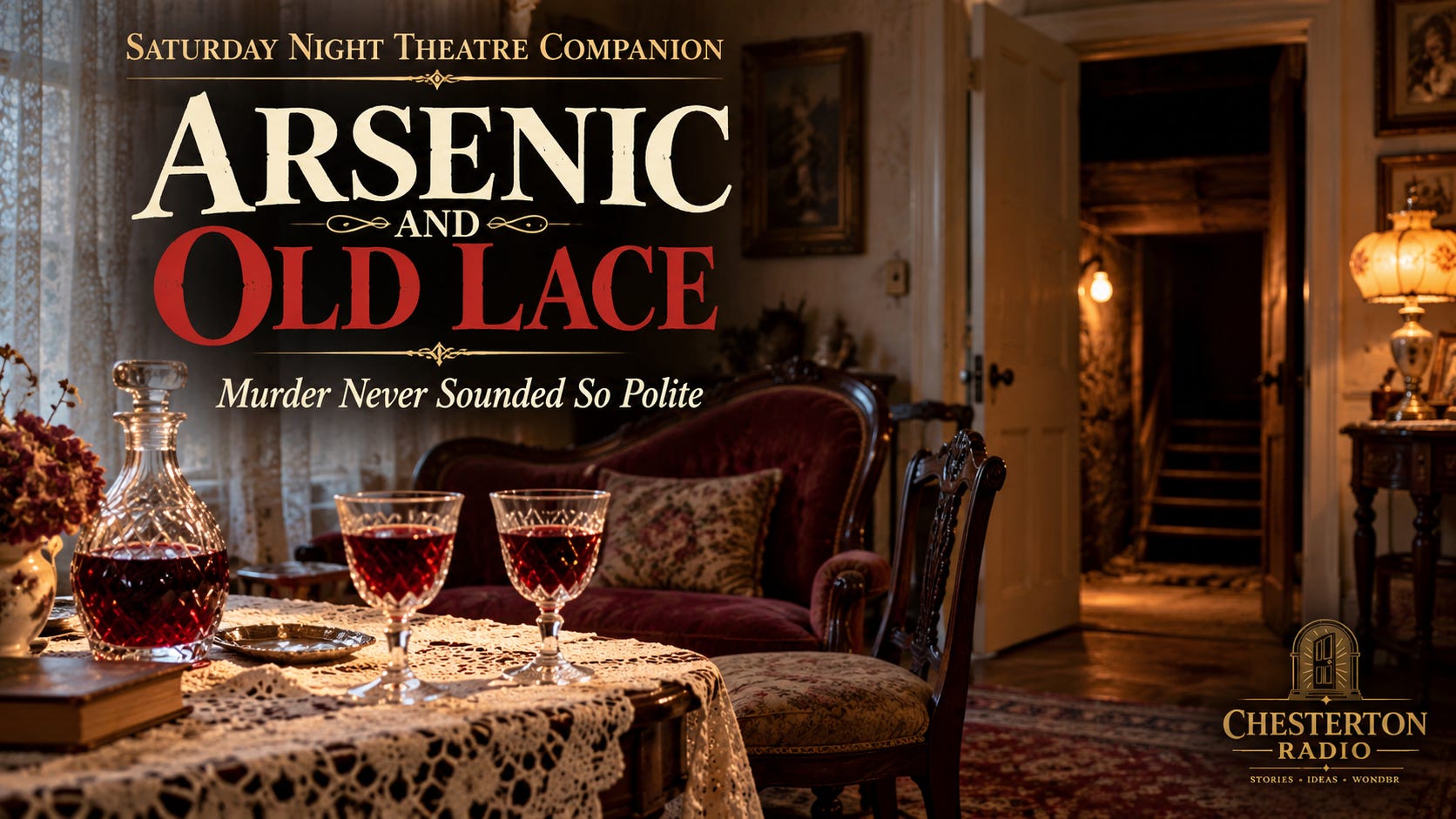
There are some plays that radio has to reinvent.
And there are others that seem almost to have been waiting for radio all along.
Arsenic and Old Lace is one of those.
A quiet house in Brooklyn.
Two charming elderly sisters.
A nephew who believes he is Theodore Roosevelt.
Another nephew who is a theatre critic.
And, somewhere in the house, a body.
Actually, quite a few bodies.
Tonight on the Saturday Night Theatre Companion, we return to Joseph Kesselring’s wonderfully improbable world of murder, manners, madness—and elderberry wine.
And this time, we have an unusual opportunity.
Because on Chesterton Radio we can hear Arsenic and Old Lace three different ways.
There is the BBC Saturday Night Theatre production.
There is the 1952 American production from Best Plays of the New York Stage, featuring Boris Karloff.
And there is an earlier, much shorter Screen Guild Theatre adaptation with Boris Karloff and Eddie Albert.
Three productions.
Three different amounts of time.
Three different approaches to exactly the same problem:
How do you put one of Broadway’s great visual farces on the radio?
And perhaps the surprising answer is—
very easily.
This Deep Dive includes Spoilers. We invite you to listen to the three original productions then return for our discussion.
Arsenic and Old Lace - Boris Karloff - Best Plays of the New York Stage
Arsenic and Old Lace - Joseph Kesselring - BBC Saturday Night Theatre
Arsenic & Old Lace - Boris Karloff & Eddie Albert - Screen Guild Theatre
A PERFECTLY RESPECTABLE HOUSE
The great joke of Arsenic and Old Lace begins before anybody says anything funny.
Everything looks respectable.
The Brewster house is the sort of place where one expects tea, lace curtains, polished furniture and good manners.
Abby and Martha Brewster are precisely the sort of women one would trust.
They are kind.
They are generous.
They are concerned about their neighbors.
They attend church.
They help people in need.
And they murder lonely old men.
Not angrily.
Not for money.
Not even, in their minds, maliciously.
They regard it almost as a charitable service.
A lonely gentleman comes to the door.
He is welcomed inside.
Conversation follows.
And eventually he is offered a glass of elderberry wine.
Unfortunately, the recipe has been improved.
Arsenic.
Strychnine.
And just a little cyanide.
The joke works because Abby and Martha never become villains.
Everyone else understands that they are murderers.
They understand themselves to be helpful ladies.
And Joseph Kesselring never allows those two realities to meet.
That is the engine that drives the play.
ENTER MORTIMER BREWSTER
Into this peaceful domestic arrangement comes Mortimer Brewster.
Mortimer is a drama critic.
That is important.
Kesselring has placed a professional observer of theatrical absurdity inside a situation considerably more absurd than anything he could possibly review.
Mortimer thinks he understands bad plays.
Then he goes home.
His brother Teddy believes himself to be Theodore Roosevelt.
He charges up the stairs as though they were San Juan Hill.
He is digging the Panama Canal in the cellar.
And when Abby and Martha need somewhere to put their latest deceased gentleman, Teddy is quite willing to bury another victim of yellow fever in the Canal Zone.
Mortimer gradually discovers all of this.
And the comedy becomes increasingly frantic because Mortimer is apparently the only sane person in the house.
Or at least he thinks he is.
That distinction becomes increasingly important.
THEN JONATHAN COMES HOME
And now the comedy changes.
Jonathan Brewster returns.
Unlike Abby and Martha, Jonathan knows perfectly well that he is a murderer.
He arrives with Dr. Einstein, the man responsible for repeatedly altering Jonathan’s face.
Unfortunately, one of those operations has left Jonathan looking like—
Boris Karloff.
That joke must have been irresistible in 1941.
Because the actor playing Jonathan Brewster in the original Broadway production actually was Boris Karloff.
The audience sees Karloff walk onto the stage.
The characters insist that he looks like Boris Karloff.
And Jonathan becomes furious whenever anybody mentions it.
It is one of those theatrical jokes that ought to be impossible to transfer to radio.
Except that radio found an extraordinarily simple solution.
Hire Boris Karloff.
BORIS KARLOFF RETURNS
That makes the Best Plays production particularly interesting.
This isn’t simply a famous film actor being recruited for a radio adaptation.
Karloff is returning to a role that belonged to him.
And you can hear it.
The temptation would be to make Jonathan into Frankenstein’s monster—to exploit Karloff’s horror reputation and make every entrance ominous.
But Jonathan is funnier than that.
He is dangerous, certainly.
But he is also vain.
Touchy.
Petulant.
He absolutely hates the Karloff comparison.
And Karloff understands the joke better than almost anybody could.
The horror icon is playing a murderer who is deeply offended because everyone thinks he looks like a horror icon.
That extra layer survives beautifully without scenery.
Perhaps it even becomes funnier.
Because radio listeners know the face they cannot see.
THE ONE-HOUR VERSION
The Best Plays broadcast has another advantage.
Time.
At roughly an hour, it can let the situation develop.
That matters enormously with Arsenic and Old Lace.
Farce isn’t simply a collection of jokes.
It is architecture.
One improbable fact must be established.
Then another.
Then another.
The audience must understand where everybody is, what everybody knows, what everybody does not know, and what disaster is about to occur if one more person walks through the door.
Cut too much of that away and you still have the story.
But you may lose the mechanism.
The longer Best Plays treatment lets that mechanism run.
We have time to understand Abby and Martha.
We have time for Teddy.
We have time for Mortimer’s growing desperation.
And when Jonathan arrives, he isn’t simply another eccentric Brewster.
He changes the temperature of the room.
NOW TRY IT IN THIRTY MINUTES
Which makes the Screen Guild Theatre version fascinating for exactly the opposite reason.
It has roughly half the time.
That changes everything.
Radio anthologies regularly faced this problem.
Take a successful stage play or motion picture that might occupy two hours or more—
and make it fit between the opening announcement and the closing commercial.
Thirty minutes.
Characters disappear.
Scenes collapse into one another.
Exposition becomes brutally efficient.
Anything that does not move the central plot has to justify every second it occupies.
And yet Arsenic and Old Lace can survive this treatment remarkably well.
Why?
Because its central idea is so strong.
Two sweet old ladies poison lonely gentlemen.
Teddy buries them.
Mortimer discovers what is happening.
Jonathan arrives.
Chaos follows.
The short adaptation becomes almost a demonstration of how strong Kesselring’s construction really is.
Strip away much of the ornament and the machine still runs.
But listen carefully to what changes.
The longer versions allow anticipation.
The shorter version depends upon acceleration.
Those are not quite the same kind of comedy.
AND THEN THERE IS THE BBC
Which brings us to Saturday Night Theatre.
The BBC tradition approaches material like this differently from the Hollywood anthology programs.
There is less pressure to remind us constantly that a star is present.
There is more room for ensemble playing.
And Arsenic and Old Lace is fundamentally an ensemble piece.
Mortimer may be our guide through the insanity, but the Brewster household itself is really the star.
Listen to the rhythm.
A door opens.
Someone arrives.
Someone else must not discover something.
Teddy charges away.
Abby and Martha calmly discuss something horrifying.
Mortimer tries to restore order.
Another person arrives.
And the entire structure shifts again.
On stage, much of this is visual.
On radio, the microphone has to establish the geography.
Footsteps matter.
Doors matter.
Distance from the microphone matters.
Voices approaching from another room matter.
Even silence matters.
The listener gradually constructs the Brewster house in the imagination.
And once that house exists, the comedy can move through it.
WHY THIS WORKS SO WELL WITHOUT PICTURES
This is one of the pleasures of listening to Arsenic and Old Lace rather than watching it.
Consider Teddy.
A stage audience can see him charge up the stairs.
A radio audience hears the charge.
And somehow the staircase becomes enormous.
We don’t merely see Teddy Brewster pretending to be Theodore Roosevelt.
We participate in Teddy’s version of reality.
The same thing happens with the cellar.
We don’t need to see the Panama Canal.
We know it is there.
We know what is being buried there.
And every time somebody heads toward the cellar, our imagination supplies everything the scenery cannot.
Radio is exceptionally good at this.
The impossible becomes completely convincing because the listener has done half the work.
THE SECRET IS TONE
There is another reason the play survives so many adaptations.
Nobody can play the central joke as though it were a joke.
Abby and Martha cannot wink at us.
If they seem sinister, the whole thing collapses.
They must be absolutely sincere.
The elderberry wine really is, in their minds, an act of mercy.
Teddy must genuinely be Teddy Roosevelt.
Jonathan must genuinely consider himself the serious criminal in a family he regards with contempt.
And Mortimer must genuinely believe that if he can just explain things clearly enough, sanity might somehow return.
It never does.
The comedy comes from the collision of those certainties.
That is why a restrained radio performance can sometimes work better than an exaggerated one.
The straighter everyone plays it, the stranger it becomes.
WHAT ABOUT THE MOVIE?
For many people, Arsenic and Old Lace means Cary Grant and Frank Capra.
And the 1944 film is certainly the version that carried the story most widely into popular culture.
But listening to the radio productions reminds us that this was a play first.
It doesn’t actually require cinematic scale.
Its world is domestic.
A room.
A staircase.
A cellar.
A window.
A front door through which exactly the wrong person will inevitably arrive.
That confinement is part of its strength.
The Brewster house is a comic pressure vessel.
Kesselring keeps adding people until the pressure becomes almost unbearable.
Then somebody rings the doorbell.
THREE VERSIONS, THREE EXPERIMENTS
So if you’re listening through the Chesterton Radio collection, don’t think of these three productions as duplicates.
Try them as an experiment.
Begin with the Screen Guild Theatre version.
Hear how ruthlessly the story can be compressed.
Then listen to Boris Karloff in the hour-long Best Plays production.
Notice what returns when the actors are given more room.
And finally settle into the BBC Saturday Night Theatre production.
Listen particularly to the ensemble.
The pacing.
The use of space.
The way an American Broadway comedy changes—slightly, but perceptibly—when interpreted through the BBC radio drama tradition.
Same house.
Same bodies.
Same elderberry wine.
Different radio.
AND LISTEN FOR BORIS
There is one final pleasure in all of this.
Boris Karloff spent much of his career trapped, lovingly perhaps, inside the public image created by horror films.
But Karloff was much more than Frankenstein’s monster.
He was a skilled stage actor.
A radio actor.
And a performer with a wonderful sense of comedy.
Arsenic and Old Lace allows him to turn his own reputation into the joke.
Jonathan Brewster is terrifying because he looks like Boris Karloff.
Boris Karloff plays Jonathan Brewster.
And Boris Karloff is furious about looking like Boris Karloff.
There are not many jokes in theatrical history that can operate on quite that many levels at once.
THE OPEN DOOR
Perhaps that is why Arsenic and Old Lace remains so enjoyable.
It never asks us to believe that its world is realistic.
It asks us to believe that everyone inside that world thinks it is realistic.
Abby and Martha remain gracious hostesses.
Teddy remains President Roosevelt.
Jonathan remains offended.
Mortimer keeps trying to make sense of everything.
And somewhere downstairs, the Panama Canal keeps getting deeper.
Three radio productions give us three opportunities to enter that house.
So pour yourself something to drink.
Although perhaps—
just this once—
not the elderberry wine.
Then turn down the lights and listen.
This has been the Saturday Night Theatre Companion from Chesterton Radio.
The old plays are still here.
The great voices are still speaking.
And the door is always open.


