

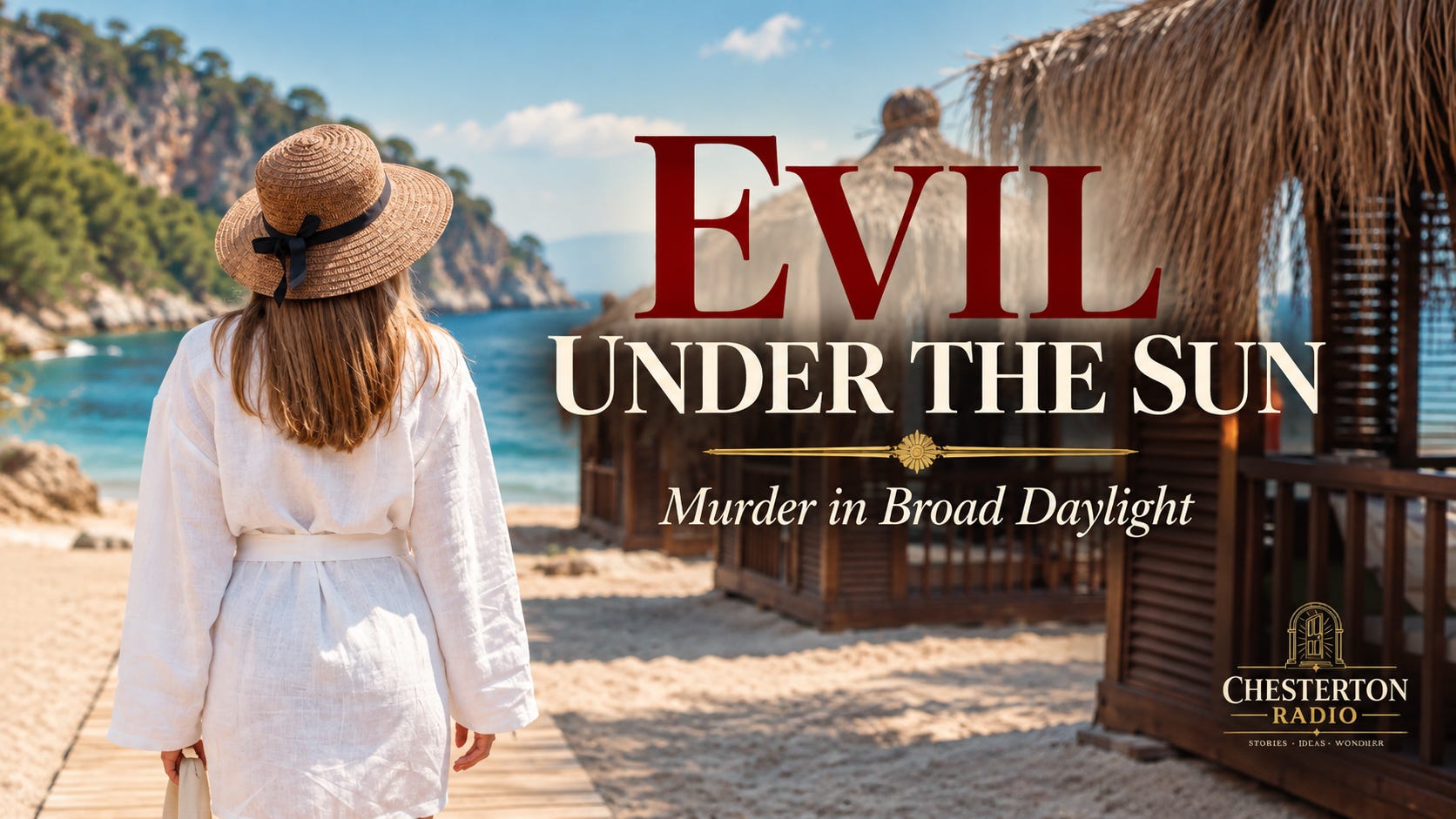
Agatha Christie usually needs very little darkness to hide a murder.
In Evil Under the Sun, Hercule Poirot goes on holiday to a beautiful seaside resort—a world of beaches, bathing, cocktails, flirtation, and brilliant summer sunshine. Then Arlena Marshall is found murdered.
This Deep Dive includes Spoilers. We invite you to listen to the play and then join us for our in-depth discussion.
Everyone seems to have a motive. Almost no one seems able to have done it.
In this Chesterton Radio Deep Dive, we look beyond the solution to explore why this Poirot mystery works so well: Christie’s fascination with appearances, jealousy and performance; the ingenious manipulation of witnesses and alibis; the earlier Triangle at Rhodes; the story’s connection to Ecclesiastes; and the remarkable decision to place evil not in a darkened mansion, but beneath an open sky.
We’ll also explore the story’s life on radio and screen—and why a mystery built around what people think they saw may be particularly effective when heard rather than seen.
The first part of our conversation is spoiler-light. We’ll give you a clear warning before revealing Christie’s solution.
Because the great question in Evil Under the Sun isn’t simply:
Who did it?
It is:
What did you think you saw—and why were you so willing to believe it?


